Rethinking Performance Management for Hybrid Teams in 2026
Hybrid working did not break performance management. It exposed the fact that, in most organisations, it never really worked. When everyone sat in the same building, managers could get by on proximity: they saw who was in early, overheard the difficult customer call, noticed the person who looked stressed. None of that was performance management. It was ambient information, and it papered over the absence of written objectives, recorded feedback and a consistent way of judging work.
Six years on from the moment offices emptied, hybrid arrangements are settled policy for most UK knowledge-based employers, and a wave of return-to-office mandates through 2025 has not reversed that so much as formalised it: three days in, two days out is the common pattern. The question for HR in 2026 is no longer whether to manage performance differently. It is how to build a process that works identically whether the person is at the next desk or two hundred miles away.

What Proximity Was Quietly Doing for You
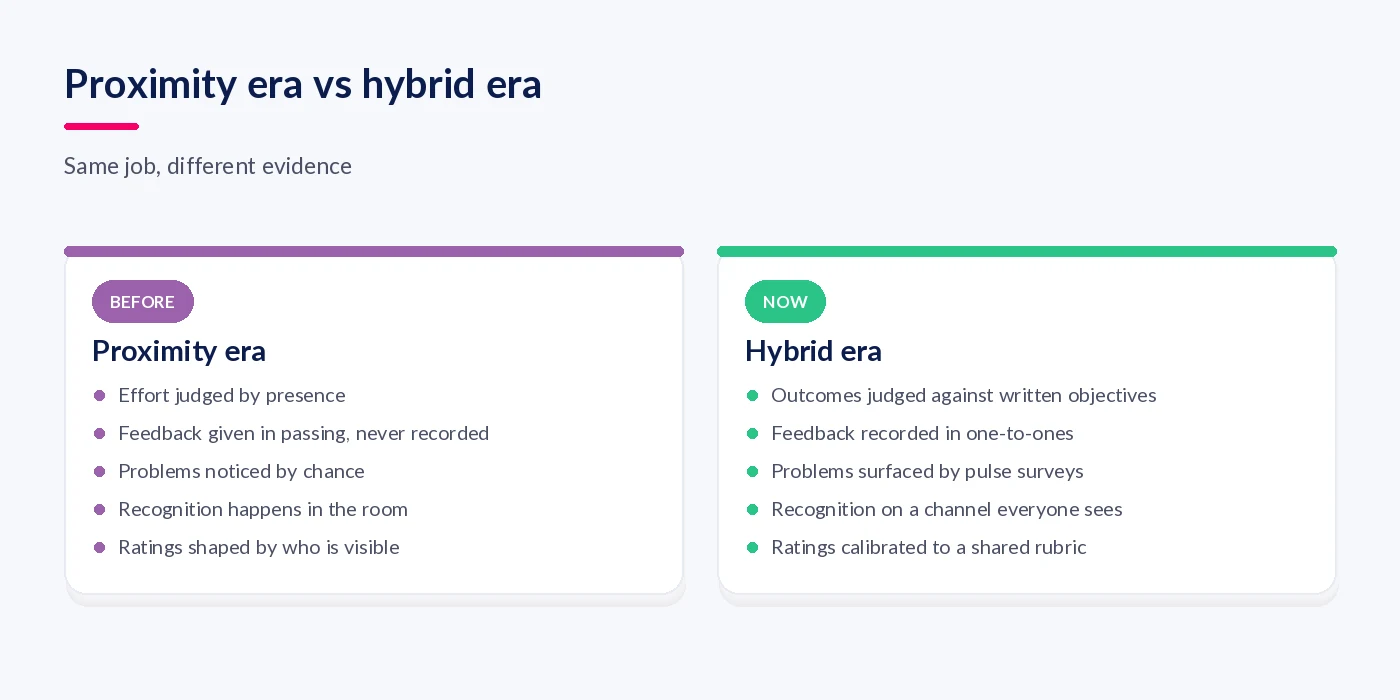
It helps to be precise about what disappeared. Proximity gave managers three things: a rough sense of effort, an early warning when someone was struggling, and cheap, frequent, informal feedback. Take those away and a manager who never set clear objectives has nothing to judge against. A manager who never wrote feedback down has no record of what was said. And a manager who relied on noticing a bad day has no way of knowing that a remote employee has been quietly disengaging for two months.
Each of those gaps has a direct replacement. Effort is replaced by outcomes against agreed objectives. Early warning is replaced by regular one-to-ones and pulse surveys. Informal feedback is replaced by recorded feedback that the employee can see. None of this is new thinking. It is simply that hybrid work removed the option of not doing it.
Objectives Are the Contract
In a hybrid team the objective is the contract between manager and employee. If it is vague, the remote employee has no way of knowing whether they are doing well and the manager falls back on the one signal still available, responsiveness, which rewards people for answering messages quickly rather than for doing good work. Three to five written objectives per quarter, each with a clear definition of done and visible to both parties, removes most of that ambiguity. Our guide to good goals for a performance review covers how to phrase them.
The One-to-One Becomes the Operating Rhythm
Where the office made the informal catch-up automatic, hybrid work makes it deliberate. A recorded one-to-one every two to four weeks is the minimum that keeps a remote or hybrid employee connected to their objectives and to their manager. The word "recorded" matters. A conversation that leaves no note is worth very little three months later, when the manager is trying to remember what was agreed or HR is trying to understand why a good performer has resigned. The signs that one-to-ones are failing show up long before a survey does, but only if someone is looking at the records.
Keep the meetings short and near-term: what moved since last time, what is blocked, one piece of feedback, one thing about how the person is doing rather than what they are doing. Managers who treat these as status updates get status updates. Managers who treat them as the main channel for feedback get engaged teams.
Sentiment Has to Be Measured, Not Sensed
The manager who could once read the room now has to ask it. Short, regular pulse surveys, four or five questions every few weeks rather than a forty-question annual exercise, give HR and managers a trend line for how each team is feeling. The value is in the trend, not the score. A team that drops from a steady seven to a five over two months has something happening that no individual one-to-one will reveal, and the drop is your cue to look. Measuring engagement this way is one of the few ways to see a hybrid team as a whole.
Recognition Needs a Channel
In an office, praise in a team meeting reached everyone in the room. In a hybrid team, half the room is not there. Recognition that only happens in person systematically favours the people who are in the building most often, and employees notice. Give recognition a channel that reaches everyone equally, a feed, a values-based award, a note on the person's record that their manager and peers can see, and make sure the people who are rarely in the office appear on it as often as the people who are.
Fairness Is the Hidden Risk
The biggest risk in hybrid performance management is not lower productivity. It is proximity bias: the tendency to rate the people you see more highly than the people you do not, without noticing you are doing it. It shows up at pay review and promotion time, it is hard to see from inside, and it can quietly undo an inclusion strategy. The defence is structural: written objectives, recorded evidence, a shared rating rubric and a calibration step where ratings are compared across managers before they are confirmed.
What HR Should Have in Place
- One system holding objectives, one-to-one notes, feedback, recognition and survey results per employee, visible to the manager, the employee and HR.
- A cadence: objectives quarterly, one-to-ones every two to four weeks, pulse surveys monthly or six-weekly, a formal review once or twice a year that summarises what is already recorded.
- A written rating scale and a calibration step, so hybrid and office-based staff are judged by the same standard.
- Reporting that shows completion and sentiment by team without asking managers to compile anything.
- A mobile experience good enough that frontline and field staff, who were never in the office in the first place, are on the same system as everyone else.
Where StaffCircle Fits
StaffCircle was built for exactly this: objectives, one-to-ones, feedback, recognition and eNPS pulse surveys in one record per person, on desktop and on a mobile app for people who are rarely at a desk. Managers run the rhythm, employees see their own progress, and HR sees completion and sentiment by team in real time. If you are comparing options, our buyer's guide to performance management software for hybrid teams sets out what to look for.
Final Thoughts
The organisations that struggled with hybrid performance management were the ones whose process had always depended on being in the same room. Replace proximity with written objectives, recorded one-to-ones, measured sentiment and a shared standard, and the location of the employee stops mattering. That was always the goal. Hybrid work just made it unavoidable.
FAQ
How do you manage performance in a hybrid team?
Agree a small number of written objectives with each person, hold a recorded one-to-one every few weeks, give feedback against the objectives rather than against hours or visibility, and review sentiment with short regular pulse surveys. The record, not the office, becomes the source of truth.
Does hybrid working hurt performance?
The evidence is mixed and depends heavily on the role and on how work is managed. What hybrid working reliably does is remove the informal signals managers used to rely on, so organisations that never wrote objectives down or recorded feedback notice the gap first.
What should performance management software do for hybrid teams?
It should hold objectives, one-to-one notes, feedback, recognition and pulse survey results in one record per employee, work equally well on a phone and a laptop, and give HR a view of completion and sentiment by team without asking managers for a report.
About the author
Mark Seemann is the CEO and Founder of StaffCircle, the AI performance management platform for mid-sized organisations. He writes about performance management, employee development and the practical use of AI in HR. Connect with Mark on LinkedIn.
See StaffCircle in action
Book a personalised demo and see how StaffCircle drives performance, engagement and development.