What's Better Than Perks? A Structured Employee Rewards Plan
Priya was a payroll specialist at a company with free breakfast, a games room and a well-stocked bar on Fridays. She left for a company that had none of those things. What it had was a manager who set three clear objectives a quarter, noticed when she hit them, and a rewards scheme that meant hitting them mattered: a recorded achievement, a values award her peers could see, and a bonus formula she could calculate herself. Priya is a composite, but the pattern is real and every HR director has watched it happen.
Perks were the fashionable answer to a tight labour market for most of the last decade. They are still useful. But the market for skilled people has stayed tight through 2025 and into 2026, and the organisations winning that market have worked out that perks and rewards do different jobs. Perks make the workplace pleasant. Rewards make performance matter.

Why Perks Stopped Doing the Job
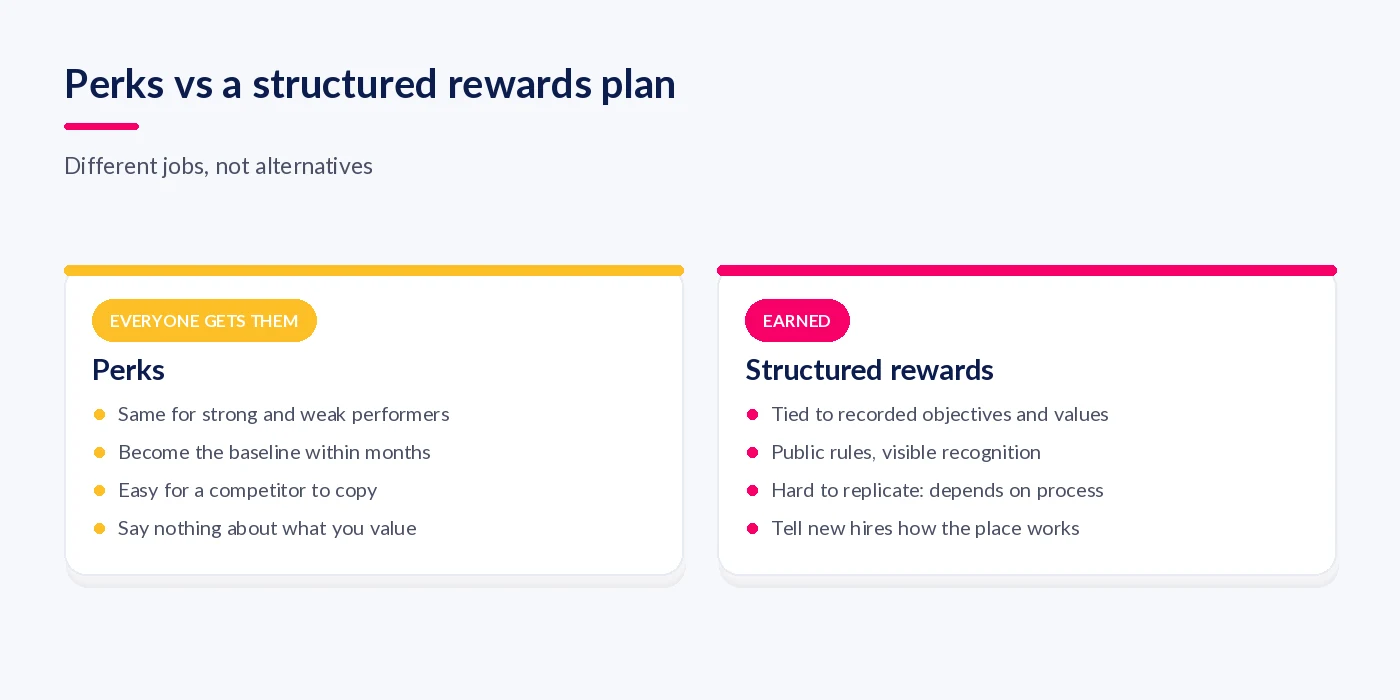
The problem with a perk is that everyone gets it. The strongest performer on the team gets the same breakfast, the same gym discount and the same Friday drinks as the person coasting. That is fine as a statement about the kind of workplace you run. It is useless as a signal about what you value, because it does not vary with anything the employee does. Over time, perks become part of the baseline, and a baseline motivates nobody.
There is a second problem. Perks are easy to copy. Any competitor with a budget can match free lunch. A culture in which good work is reliably noticed and rewarded is much harder to replicate, because it depends on managers, process and consistency rather than spend.
What a Structured Rewards Plan Looks Like
A structured plan has four parts. First, agreed objectives and stated values, so everyone knows what a reward is for. Second, a record: achievements are logged against those objectives as they happen, not reconstructed at year end. Third, a defined mechanism: what earns points or an award, who can give them, what approvals apply, how they convert into money, time or recognition. Fourth, visibility: people can see recognition happening, which is what makes it motivate the people who did not receive it this time.
Four Ways a Rewards Plan Earns Its Keep
It rewards the right behaviour
Because rewards are tied to recorded objectives and values, the people who receive them are, visibly, the people who delivered. That sends a signal a perk never can: this is what we value here, and this is what it earns you.
It gives people a reason to stretch
Employees want to be recognised and will go further to earn it, provided the scheme is consistent and they trust it. A plan that is applied unevenly, or that quietly stops after a good quarter, does more damage than no plan at all.
It builds a performance culture new hires can see
Candidates and new starters read a rewards scheme as a description of how the organisation actually works. A visible, values-based recognition feed tells them more about the culture than a careers page does.
It helps you keep the people you most want to keep
Recognition is one of the strongest levers on employee retention for high performers, precisely because they notice when it is absent. A structured plan makes sure the people you would least like to lose are the ones being noticed most.
Design Rules That Keep It Fair
- Tie every reward to something recorded: an objective met, a value demonstrated, a piece of feedback from a peer or customer.
- Make the rules public. If people cannot predict what earns a reward, it reads as favouritism.
- Mix financial and non-financial rewards. Points that convert to a bonus, values awards, public recognition and development opportunities all count, and they reach different people.
- Let peers recognise each other, with a light approval step. Managers do not see everything.
- Review who received rewards each quarter by team, gender, location and working pattern. If the distribution is skewed, the scheme is measuring proximity, not performance.
- Keep the admin close to zero. A scheme that needs a spreadsheet to run will stop being run.
Where StaffCircle Fits
StaffCircle links rewards directly to the performance record. Objectives and values sit on each person's profile, achievements are logged as they happen, and a configurable points and awards system converts them into recognition, bonus calculations or manager-assigned rewards with the approvals you set. Recognition appears on a feed everyone can see, on desktop and mobile, so the people who are rarely in the office are recognised as often as those who are. Explore the performance management module or book a demo to see the rewards workflow.
Final Thoughts
Keep the breakfast. Just stop expecting it to do a job it was never designed for. What retains strong performers is knowing that their work is seen and that seeing it leads somewhere. A structured rewards plan, tied to recorded objectives and values and visible to everyone, is how you make that true for every team rather than for the lucky few with a manager who happens to be good at it.
FAQ
What is a structured employee rewards plan?
A written scheme that ties specific rewards, financial or otherwise, to specific, recorded achievements against agreed objectives or company values. Everyone can see what earns a reward, how it is assessed and who decides, so the reward means something.
Are perks a waste of money?
No, but they are hygiene rather than motivation. Perks make a workplace pleasant and help attract candidates. They do not distinguish between a strong and a weak performer, so on their own they do not drive performance or retain your best people.
How do you reward employees without a big budget?
Recognition that is specific, timely, public and tied to something the person did costs almost nothing and is consistently rated by employees as more motivating than generic benefits. Small, configurable points or awards linked to values and objectives stretch a modest budget a long way.
About the author
Mark Seemann is the CEO and Founder of StaffCircle, the AI performance management platform for mid-sized organisations. He writes about performance management, employee development and the practical use of AI in HR. Connect with Mark on LinkedIn.
See StaffCircle in action
Book a personalised demo and see how StaffCircle drives performance, engagement and development.