Fix Your Appraisal Process: A Five-Question Audit for 2026
The appraisal form at a 90-person engineering firm I spoke to earlier this year was last redesigned in 2014. It lives in a Word template, it asks for a score out of five in six boxes, and the completed copies sit in a shared drive that two of the current managers cannot open. Nobody could tell me how many of last year's appraisals actually took place. That is not an unusual story. It is the default state of the appraisal process in most mid-sized organisations that have never deliberately fixed it.
If you suspect yours is in a similar state, you do not need a consultant or a six-month project to find out. Five questions will tell you where the process is broken, and the answers point directly at what to fix first.

Five Questions That Expose a Broken Appraisal Process
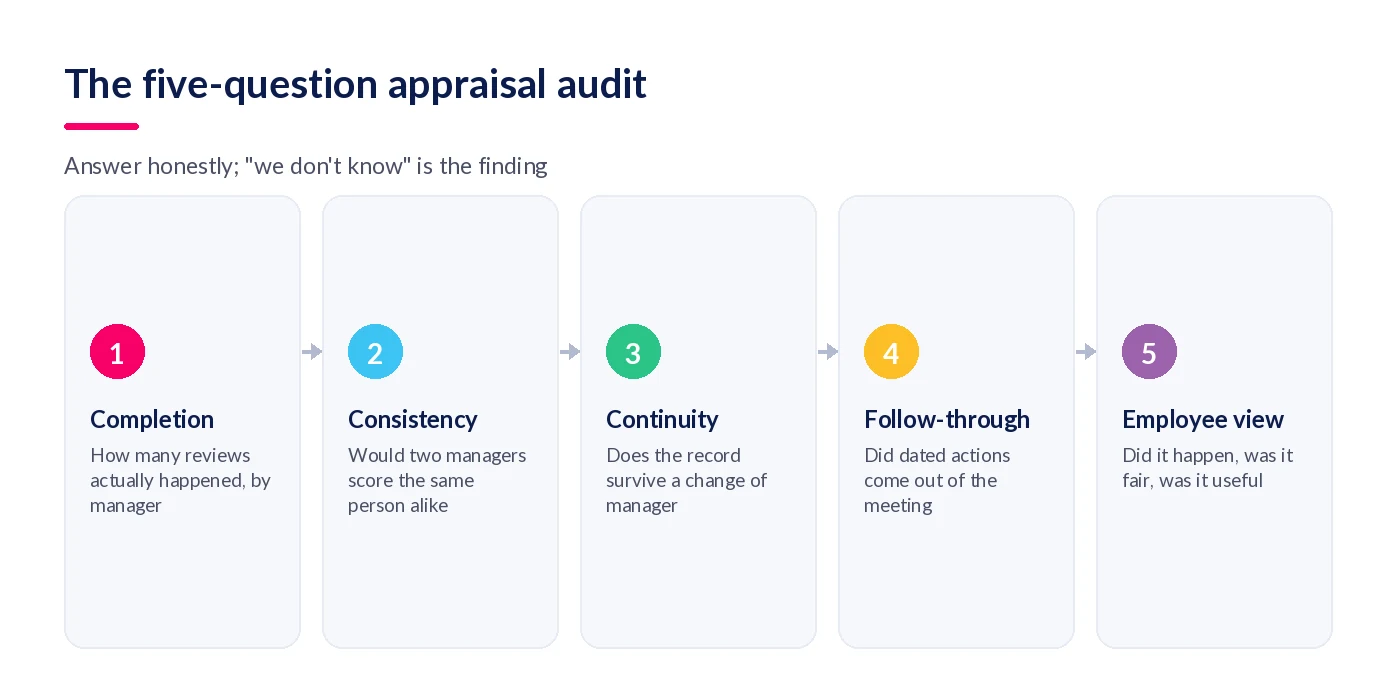
1. How many appraisals happened on time last year?
Most HR teams cannot answer this without a manual trawl. If the honest answer is "we think most of them", the process is not being managed, it is being hoped for. A completion rate is the single most useful number an appraisal process produces, because a review that never happens cannot do anything for the employee or the business. Aim to know the figure by team and by manager, not just as a company-wide percentage.
2. Would two managers give the same person the same score?
Put the same employee in front of two of your managers with the same evidence and you will often get two different ratings. One is generous by nature, one uses "meets expectations" as a default, and neither has been shown what the scale is supposed to mean. Inconsistent scoring is what makes appraisals feel unfair, and unfairness is the complaint employees raise most. The fix is a written rubric for every band and a short calibration step before ratings are confirmed.
3. Can a new line manager see what their predecessor agreed?
People change roles. When a manager leaves, the objectives they set, the feedback they gave and the promises they made about development or pay should transfer to whoever picks the team up. If that history is in a personal folder, an email thread or a notebook, it leaves with them, and the employee starts again from zero through no fault of their own.
4. Does anything change after the meeting?
An appraisal that ends with a signed form and no dated actions is a ritual. Check a sample of last year's reviews and count how many produced an objective, a development action or a decision that was then tracked to completion. If the answer is close to none, the problem is not the meeting. It is that nothing connects the meeting to what happens next.
5. What do employees say about it?
Ask, anonymously, three questions: did your appraisal happen, was it fair, and was it useful. The gap between what managers think they are delivering and what employees experience is usually the most persuasive evidence you can put in front of a leadership team.
What a Working Appraisal Process Has to Do
Strip the jargon away and an appraisal process exists to do five jobs. It should recognise good work so that it continues. It should surface poor work early enough to address it. It should document decisions well enough to survive a promotion, a pay review, a change of manager or a dispute. It should treat every employee by the same rules. And it should give people confidence that their progression depends on what they do, not on who they report to.
Notice that none of those jobs is done by the meeting itself. They are done by what is recorded before, during and after it. That is why the annual appraisal on its own has such a poor reputation, and why organisations that move to a lighter, more frequent rhythm see the formal review become easier rather than harder: the evidence is already there.
Recognising Good Work Before the Review
The most common complaint from high performers is not about pay. It is that nobody noticed. When recognition waits for a twice-yearly meeting, the work it is recognising is months old and the moment has passed. A manager who can log a two-line note against an objective the day something goes well builds a record that makes the formal review a summary rather than a surprise. It also makes the employee see that they are being noticed, which changes behaviour far more than the score at the end of the year.
Raising Poor Performance Without Waiting Six Months
The mirror image is just as important. A small problem raised in week two is a conversation. The same problem raised in month seven, as a surprise low rating, is a grievance. If your process has no way to record a concern, the conversation that followed and what was agreed, managers either avoid the issue or handle it informally with nothing written down. Neither ends well if the situation later needs a performance improvement plan.
Consistency Is the Whole Point
Some managers are simply better at this than others. That is fine for the quality of the conversation and unacceptable for the process. Every manager should use the same form, the same scale, the same definition of each band and the same place to record the outcome. Without that, HR cannot compare teams, cannot defend a promotion or redundancy decision, and cannot see which managers need support. A shared system is the only practical way to guarantee it once you have more than a handful of teams.
Where to Start
- Run the five questions above with your HR team and write the honest answers down. Half of them will be "we don't know", and that is the finding.
- Agree one form and one scale for the whole organisation, with a one-line description of what each rating means.
- Introduce a recorded one-to-one every four to six weeks so the formal review has evidence to draw on. Our guide to conducting performance reviews covers the meeting itself.
- Move the record out of personal folders into a system every manager and HR can see, with objectives, notes and actions attached to the person rather than to a document.
- Measure completion, consistency and employee sentiment quarterly, and publish the numbers internally.
Where StaffCircle Fits
StaffCircle runs the whole cycle in one place: objectives, one-to-one notes, ad hoc feedback, the formal review and the actions that follow it, all attached to the employee's record. Managers see the same form and scale, HR sees completion by team in real time, and when a manager changes the history stays with the person. See how the performance management module works, or use the ROI calculator to put a number on what missed and inconsistent appraisals currently cost you.
Final Thoughts
An appraisal process is rarely broken because the form is wrong. It is broken because nobody knows how many reviews happen, managers score differently, records do not survive, and nothing follows the meeting. Answer the five questions honestly, fix consistency first, and the rest becomes a matter of tooling rather than culture.
FAQ
How often should appraisals happen?
A formal review once or twice a year is still normal, but it should sit on top of recorded one-to-ones every four to six weeks. The formal appraisal then summarises evidence that already exists rather than trying to reconstruct a year from memory.
What is an appraisal audit?
An appraisal audit is a short, structured review of how appraisals actually run in your organisation: how many happen on time, whether every manager uses the same form and scale, whether outcomes lead to actions, and how employees rate the experience. It shows where the process is broken before you redesign it.
Should a small company use appraisal software?
Below about 30 people a well-run shared document can work. Beyond that, the problems the software solves, consistency between managers, a record that survives a change of line manager and evidence for pay and promotion decisions, start to outweigh the cost.
About the author
Mark Seemann is the CEO and Founder of StaffCircle, the AI performance management platform for mid-sized organisations. He writes about performance management, employee development and the practical use of AI in HR. Connect with Mark on LinkedIn.
See StaffCircle in action
Book a personalised demo and see how StaffCircle drives performance, engagement and development.