Board Succession Planning: What the UK Corporate Governance Code Expects
Take a composite listed company I will call Northfold. Its chair joined the board as a non-executive director in 2019 and took the chair in 2022. Its senior independent director was appointed in 2017. The audit committee chair arrived in 2018. Nobody has done anything wrong, and last year's annual report said the nomination committee "keeps succession under review".
Then the chief financial officer resigns to become a chief executive elsewhere. The nomination committee meets, and for the first time someone puts every director's dates on one page. The senior independent director passes nine years this year. The audit committee chair passes nine years next year. The chair's nine years run out the year after that. Three of the board's most important seats fall due inside three years, and the most obvious internal candidate for CFO has never presented to the board.
I will carry Northfold through this post, because it shows the gap between having a succession policy and having a succession plan.
Board succession planning is the work of making sure a board always has the directors, skills and senior executive pipeline its strategy needs, including cover for sudden departures. For UK companies that apply the UK Corporate Governance Code 2024, it means a nomination committee that leads appointments, keeps orderly succession plans for the board and senior management, oversees a diverse pipeline and describes its approach in the annual report.
What the Code actually asks of a board
The UK Corporate Governance Code 2024 puts succession in Section 3, "Composition, succession and evaluation". It applies to companies listed in the commercial companies category or the closed-ended investment funds category, for accounting periods beginning on or after 1 January 2025.
Principle J says appointments should follow "a formal, rigorous and transparent procedure" and that "an effective succession plan for the board and senior management should be maintained". Appointments and succession plans should both be based on merit and objective criteria, and "should promote diversity, inclusion and equal opportunity". Principle K adds that consideration should be given to "the length of service of the board as a whole and membership regularly refreshed".
The provisions turn those principles into machinery:
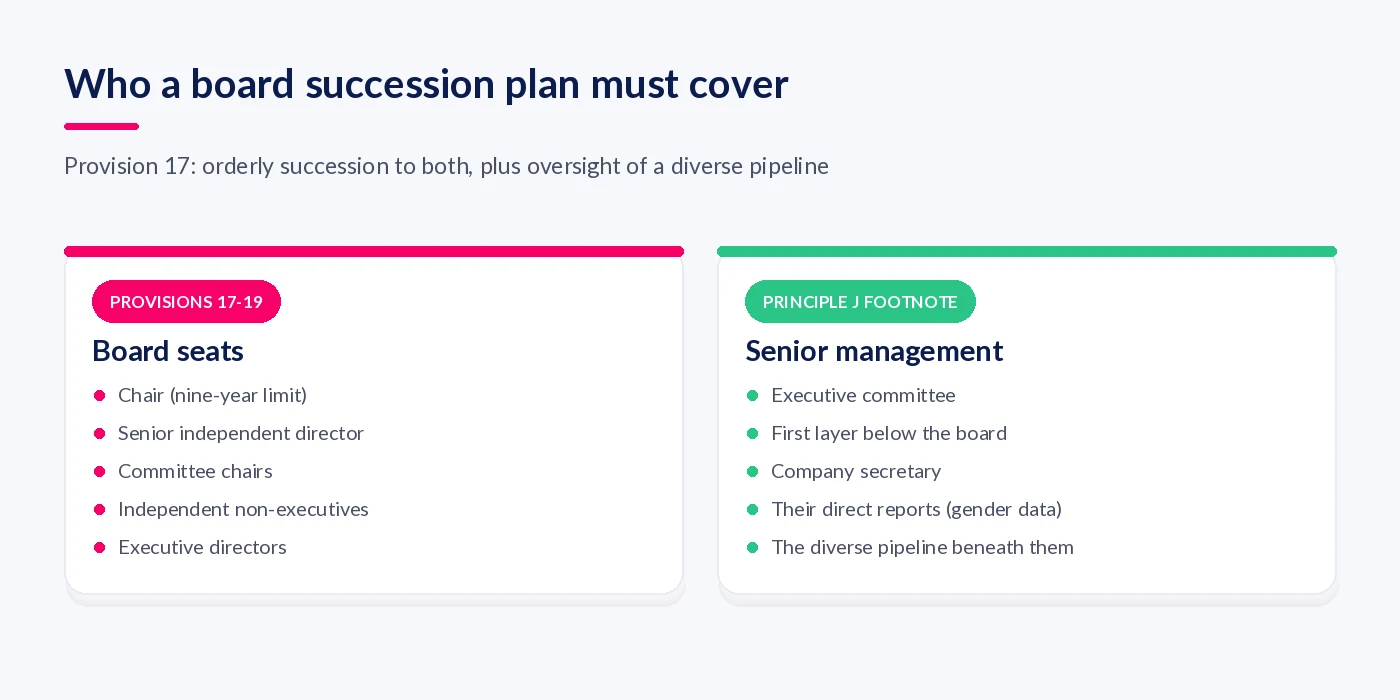
- Provision 17: a nomination committee to "lead the process for appointments, ensure plans are in place for orderly succession to both the board and senior management positions, and oversee the development of a diverse pipeline for succession". Most of its members should be independent non-executive directors, and the chair should not chair it when it is appointing their own successor.
- Provision 18: every director stands for re-election each year, with specific reasons why their contribution "is, and continues to be, important" to the company.
- Provision 19: the chair should not stay in post beyond nine years from first appointment to the board. A limited extension is possible to support succession and diversity, with a clear explanation.
- Provision 23: the annual report should describe the nomination committee's work, including "its approach to succession planning and how both support developing a diverse pipeline", and the gender balance of senior management and their direct reports.
Two details are easy to miss. First, "senior management" is defined. A footnote to Principle J defines it as "the executive committee or the first layer of management below board level, including the company secretary". A plan that covers only the directors does not cover what Provision 17 covers.
Second, the reporting has teeth. The FCA's UK Listing Rules at UKLR 6.6.6R require the annual financial report to say whether the company complied with all relevant provisions and, if not, which and why. You can depart from a provision. You cannot stay quiet about it.
So a board succession plan that stands up to Provision 23 has to answer these questions:
- Which board and senior management roles would hurt most to lose at short notice, and who covers each one tomorrow?
- When does each director's tenure, independence or chair clock run out?
- What skills will the board need for the strategy in three to five years, and where are the gaps today?
- Who below the board could step into each senior management role, how ready are they, and what is closing the gap?
- How diverse is that pipeline, and what is the committee doing about it?
- How will the next appointment be run: the brief, the search, the shortlist, and who chairs the process?
The tenure clocks nobody draws on one page
Most guides to board succession list the tenure rules. Few tell you to plot them against each other, which is exactly where Northfold got caught.
There are two different nine-year tests. For non-executive directors, Provision 10 lists having served "on the board for more than nine years from the date of their first appointment" as a circumstance likely to impair independence. The board can still judge a long-serving director independent, but it has to give "a clear explanation". For the chair, Provision 19 is a cap rather than an independence test, and the FRC's Code guidance (paragraph 169) says the nine years are calculated from when the chair was first appointed to the board. Years as a non-executive director before taking the chair count.
That is why Northfold's chair, only four years into the role, is already seven years into her nine. Provision 11 also asks that at least half the board, excluding the chair, should be independent non-executive directors, so two long-serving directors losing presumed independence in the same window can tip the balance.
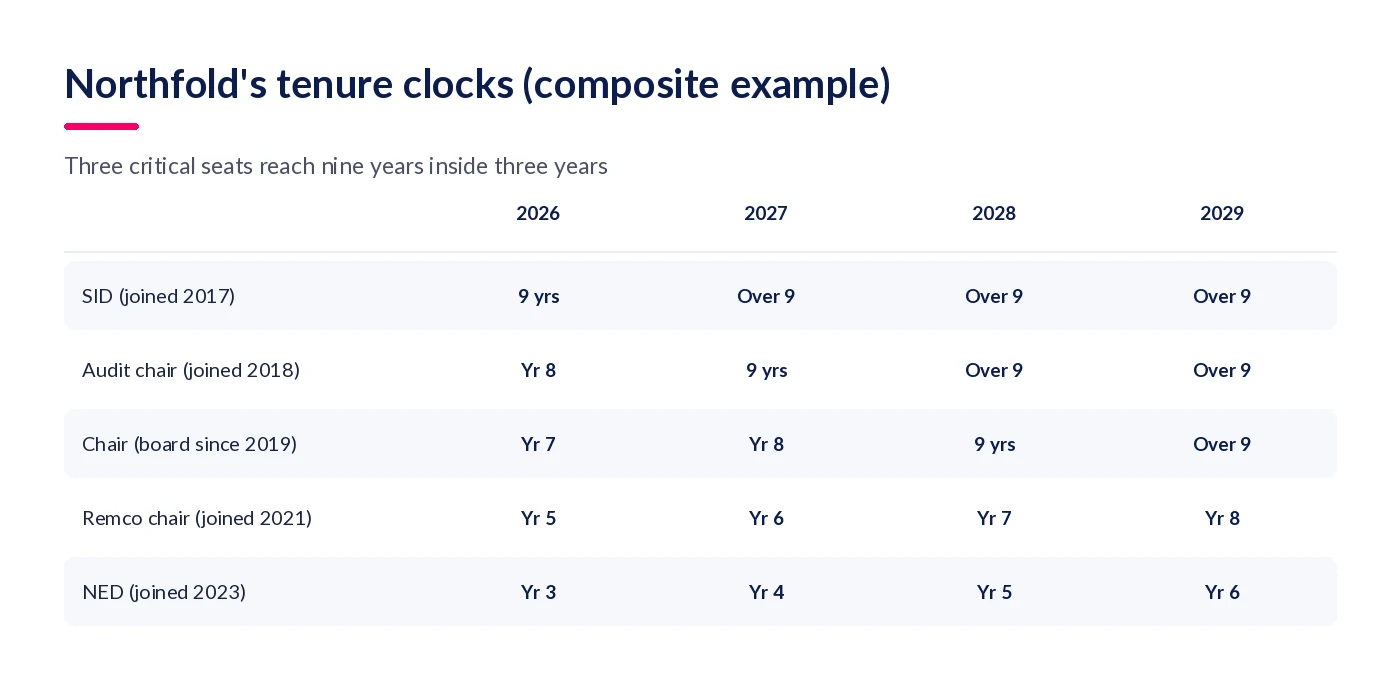
Put every director's clock on one grid and three problems become visible. First, departures that cluster. Second, committee seats that need specialist experience: Provision 24 asks that at least one audit committee member has "recent and relevant financial experience", so Northfold cannot simply promote the next non-executive director in line. Third, dependencies. The guidance (paragraph 67) suggests the senior independent director "might also take responsibility for an orderly succession process for the chair". If the senior independent director leaves first, someone else has to run the chair's succession.
Paragraph 162 of the guidance warns about "becoming too reliant on the skills of one individual" and recommends discussing tenure at appointment and discussing board succession plans with shareholders. Staggered clocks are designed when you appoint people, not fixed in year eight.
Three horizons, one written plan
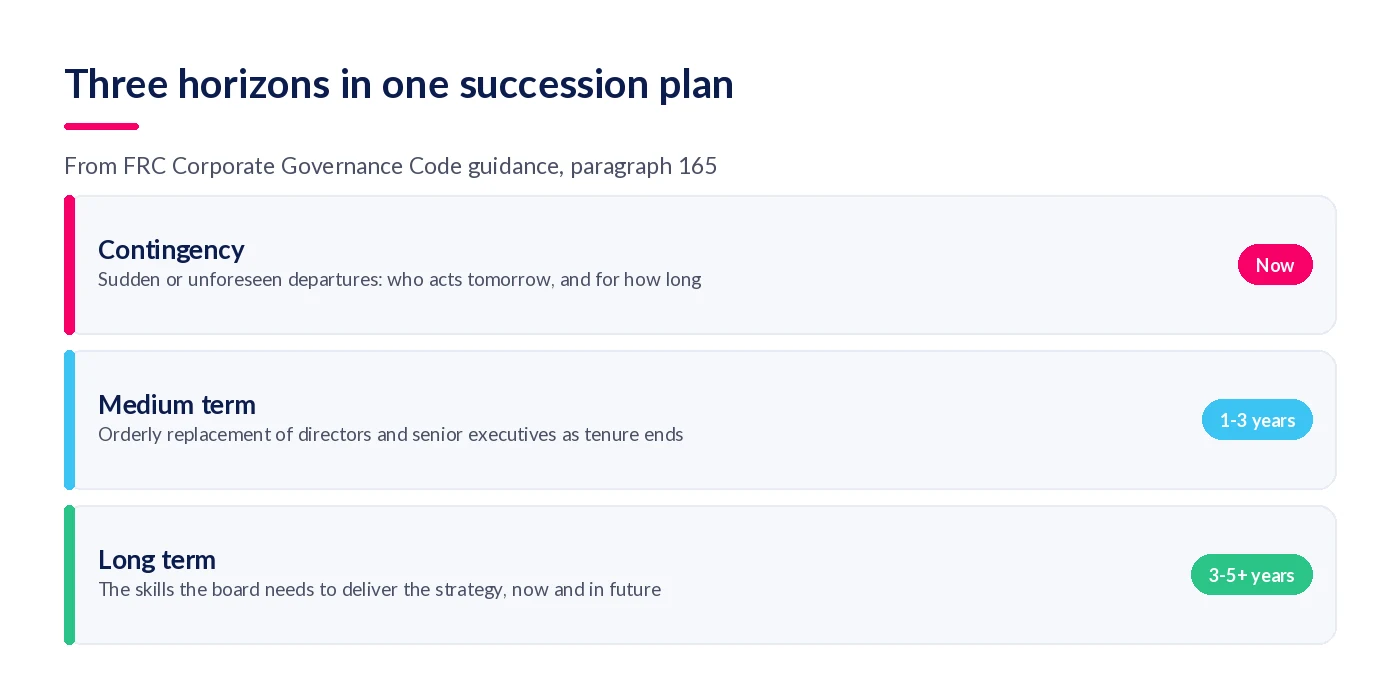
The FRC guidance (paragraph 165) suggests succession plans consider three time horizons:
- Contingency planning for sudden and unforeseen departures.
- Medium-term planning for the orderly replacement of current board members and senior executives, for example at retirement.
- Long-term planning that links the company's strategy and objectives to the skills the board needs now and in the future.
Northfold has all three at once: the CFO resignation (contingency), the cluster of nine-year dates (medium term), and a move into a regulated market that nobody on the board has run (long term). A plan built for one horizon gets surprised by the other two.
Paragraph 166 adds that "putting the succession plan in writing can help ensure it is followed through". For the contingency layer, see our guide to writing an emergency succession plan.

Building Northfold's plan in six steps
The Code sets the outcome, not the method. These steps follow the FRC guidance, in the order Northfold's committee rebuilt its plan.
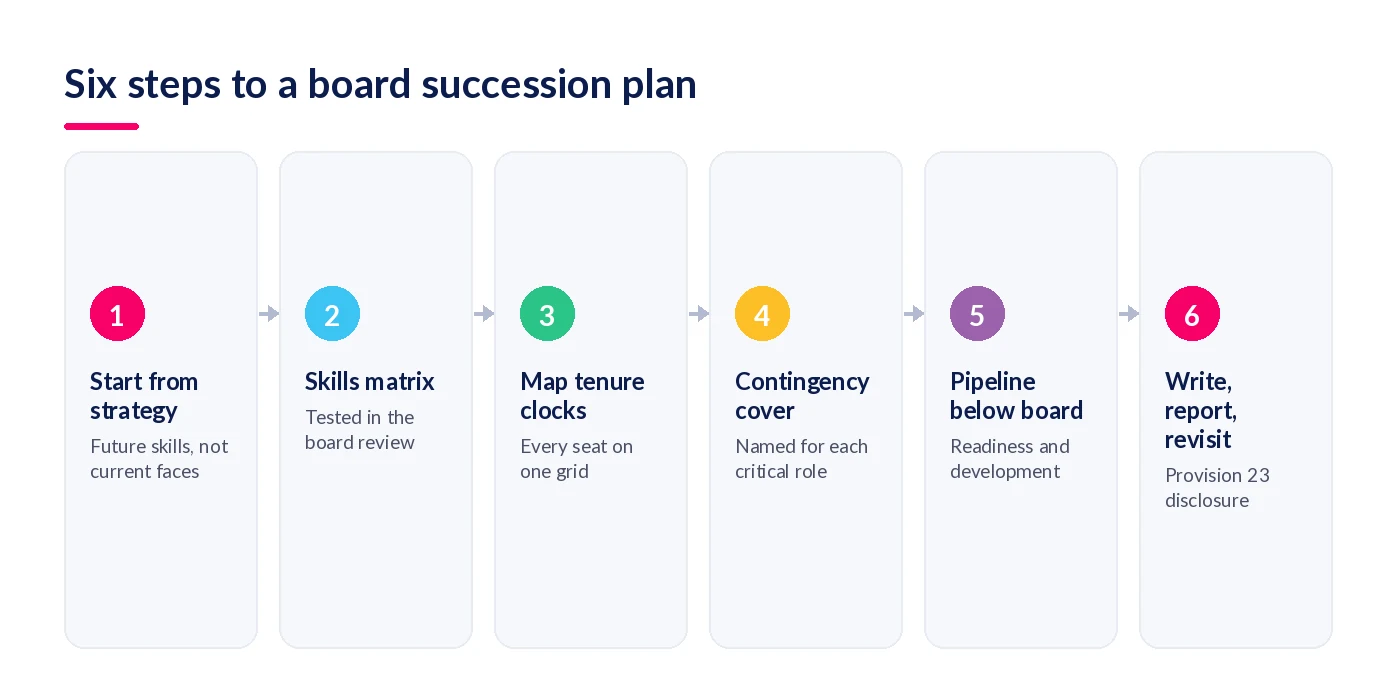
1. Start from strategy, not from the current board
Paragraph 161 of the guidance puts the chair's vision for the optimal board composition first: it helps the nomination committee "review the skills required, identify the gaps, develop transparent appointment criteria and inform succession planning". Northfold's strategy calls for regulated markets, larger acquisitions and a digital product. Those are the skills to plan for, whether or not anyone on the board holds them today.
2. Build a skills matrix from the board performance review
Paragraph 159 describes a board skills matrix as a tool to examine "the current skills, knowledge, experience and capabilities of the board, and any gaps". Paragraph 173 links it to evaluation: board performance reviews "can inform and influence succession planning". Test the matrix in the annual review under Provision 21. The guidance also lists personal attributes, such as courage, openness and the ability to listen, which belong alongside technical skills.
3. Map every tenure clock and committee seat
Record each director's first appointment date, nine-year date and committee roles on one grid. Where two or more critical seats fall due together, decide now which departure to bring forward or which term to extend, and how you would explain it.
4. Name contingency cover for every critical role
For the chair, chief executive, CFO, senior independent director and each committee chair, name who would act tomorrow and for how long. Northfold's answer for the CFO was the group financial controller as interim, with the audit committee chair agreeing to closer oversight. Writing that down before a resignation turns a crisis into a process.
5. Look below the board at the pipeline
Provision 17 asks the committee to oversee "the development of a diverse pipeline". The guidance (paragraphs 163 and 164) suggests middle management development programmes, engagement between middle managers and non-executive directors, and mentoring schemes, and says the committee "may find it worthwhile to take a more active interest" in how talent is managed throughout the organisation. Structured talent review meetings and consistent succession readiness ratings give the committee evidence rather than a list of names.

6. Write it down, report it and revisit it
Record the plan, an owner for each action and review dates. Provision 23 asks the annual report to describe the approach to succession and how the board performance review "has or will influence future board composition". Principle C asks governance reporting to focus on board decisions and their outcomes. Report what changed during the year, not that a policy exists.
Where board succession plans fall over
The plan lives in the chair's head
A chair who carries the plan personally is a single point of failure, most of all when the succession at stake is their own. That is why Provision 17 stops the chair from chairing the committee for their successor. The guidance (paragraph 69) lists "Succession planning is being ignored" among the situations where the senior independent director may need to step in.
The skills matrix is a self-assessment
When directors tick their own boxes, every board looks fully skilled. Test the matrix in the board performance review. Provision 21 asks FTSE 350 companies to have an externally facilitated review at least every three years, and the guidance (paragraph 180) says a good one challenges the board "on composition, diversity, skills gaps, refreshment and succession".
The pipeline stops at the boardroom door
Northfold's non-executive directors had never seen the internal CFO candidate present or handle a hard question. They could not judge readiness, so they defaulted to an external search. If directors never meet the people below the board, the pipeline exists only on paper. Our post on succession planning for critical roles covers how to decide which roles need this attention first.
Diversity is left to the final shortlist
UKLR 6.6.6R(9) asks listed companies to state whether they meet three board diversity targets: at least 40% of the board are women, at least one of the chair, chief executive, senior independent director or CFO is a woman, and at least one director is from a minority ethnic background. Where a target is missed, the company states which and why. The FRC guidance (paragraph 152) notes that "developing a diverse executive pipeline increases diversity at senior levels". A diverse shortlist in year nine is hard to produce if nobody worked on the pipeline in years one to eight. Our guide to equality action plans for promotion and succession goes further.
Not listed? What applies instead
The Code does not apply to private companies. The FRC notes that large private companies in scope of the Companies (Miscellaneous Reporting) Regulations 2018 must disclose their corporate governance arrangements, and that the Wates Principles provide a framework for doing so. Principle Two says "effective board composition requires an effective chair and a balance of skills, backgrounds, experience and knowledge", and its guidance says regular board evaluation "may be part of board refreshment and succession plans".
In financial services, the Senior Managers and Certification Regime adds fitness and propriety requirements on top; our post on the FCA certification regime covers that layer. For owner-managed businesses with no nomination committee at all, see succession planning for small businesses.
Where StaffCircle fits
StaffCircle does not run board searches or judge director independence. Those decisions belong to the board and its advisers. It holds the layer underneath that most board plans are thin on: the senior management pipeline Provision 17 asks the committee to oversee.
Leadership competencies the committee can read
Define what readiness for an executive committee role looks like using StaffCircle's competency framework tools, built on a leadership competency framework. The same criteria then apply to every candidate, which supports the Code's call for succession plans "based on merit and objective criteria".
Readiness and development plans for named successors
Record successors for critical roles with readiness ratings and link each one to a development plan with objectives and dated actions in skills and development. When the committee asks how close the internal CFO candidate is, the answer is evidence, not opinion.
Feedback evidence from beyond the line manager
Use 360-degree feedback and regular reviews to show the committee how each candidate handles challenge, not just how their manager rates them.
In short
The Code asks for three things: a committee that owns appointments and succession, plans covering both the board and the senior management below it, and an honest account of the approach in the annual report. Northfold's mistake was not a missing policy. It was never laying the tenure clocks side by side, and never letting the board see the people who might succeed the executives.
If your succession plan for senior management still lives in spreadsheets and the chief executive's memory, book a StaffCircle demo to see how readiness, development and 360 feedback can sit in one place. Our free succession planning guide and templates is a good place to start.
FAQ
What is board succession planning?
It is the process of making sure a board always has the directors, skills and senior executive pipeline its strategy needs, covering sudden departures, orderly replacement as tenure ends, and the skills needed in future.
Who is responsible for board succession planning in a UK listed company?
The whole board is accountable, but Provision 17 of the UK Corporate Governance Code 2024 asks the board to set up a nomination committee to lead appointments, ensure plans are in place for orderly succession to the board and senior management, and oversee the development of a diverse pipeline. A majority of its members should be independent non-executive directors.
What does the UK Corporate Governance Code say about succession planning?
Principle J says an effective succession plan for the board and senior management should be maintained, based on merit and objective criteria and promoting diversity. Provisions 17 to 23 cover the nomination committee, re-election, the chair's nine-year limit, recruitment, board reviews and disclosure.
Does the UK Corporate Governance Code apply to private companies?
No. It applies to companies listed in the commercial companies category or the closed-ended investment funds category. Large private companies in scope of the Companies (Miscellaneous Reporting) Regulations 2018 must disclose their governance arrangements, and the FRC's Wates Principles provide a framework for doing so.
How long can a chair stay in post under the UK Corporate Governance Code?
Provision 19 says the chair should not remain in post beyond nine years from the date of their first appointment to the board. The FRC guidance confirms that years served as a non-executive director before becoming chair count. A limited extension is possible to support succession and diversity, with a clear explanation.
Is a non-executive director still independent after nine years?
Provision 10 lists serving on the board for more than nine years from first appointment as a circumstance likely to impair independence. It is not an automatic disqualification: the board can still consider the director independent, but it should give a clear explanation in the annual report.
What counts as senior management in the UK Corporate Governance Code?
A footnote to Principle J defines senior management as the executive committee or the first layer of management below board level, including the company secretary.
What should a board succession plan include?
Contingency cover for each critical role, a tenure grid, a skills matrix linked to strategy, named internal candidates for senior management roles with readiness and development plans, pipeline diversity objectives, and how future appointments will be run.
What is a board skills matrix?
A board skills matrix maps the skills, knowledge, experience and capabilities of current directors against what the board needs, to show gaps that future appointments should fill. The FRC guidance describes it as a useful tool and links it to the board performance review.
What is the difference between board succession planning and executive succession planning?
Board succession covers the chair and directors and is driven by tenure, independence and skills. Executive succession covers senior management below the board and depends on developing internal talent. The Code asks the nomination committee to oversee both.
What are the FCA board diversity targets for listed companies?
UKLR 6.6.6R(9) asks listed companies to state whether at least 40% of the board are women, at least one of the chair, chief executive, senior independent director or chief financial officer is a woman, and at least one director is from a minority ethnic background. Where a target is not met, the company must say which and why.
What should the annual report say about succession planning?
Provision 23 asks it to describe the nomination committee's work: the appointments process, the approach to succession planning and the diverse pipeline, how the board review will influence future composition, the diversity and inclusion policy, and the gender balance of senior management and their direct reports.
Related articles



See StaffCircle in action
Book a personalised demo and see how StaffCircle drives performance, engagement and development.