Succession Readiness Ratings: What 'Ready Now' Should Actually Mean
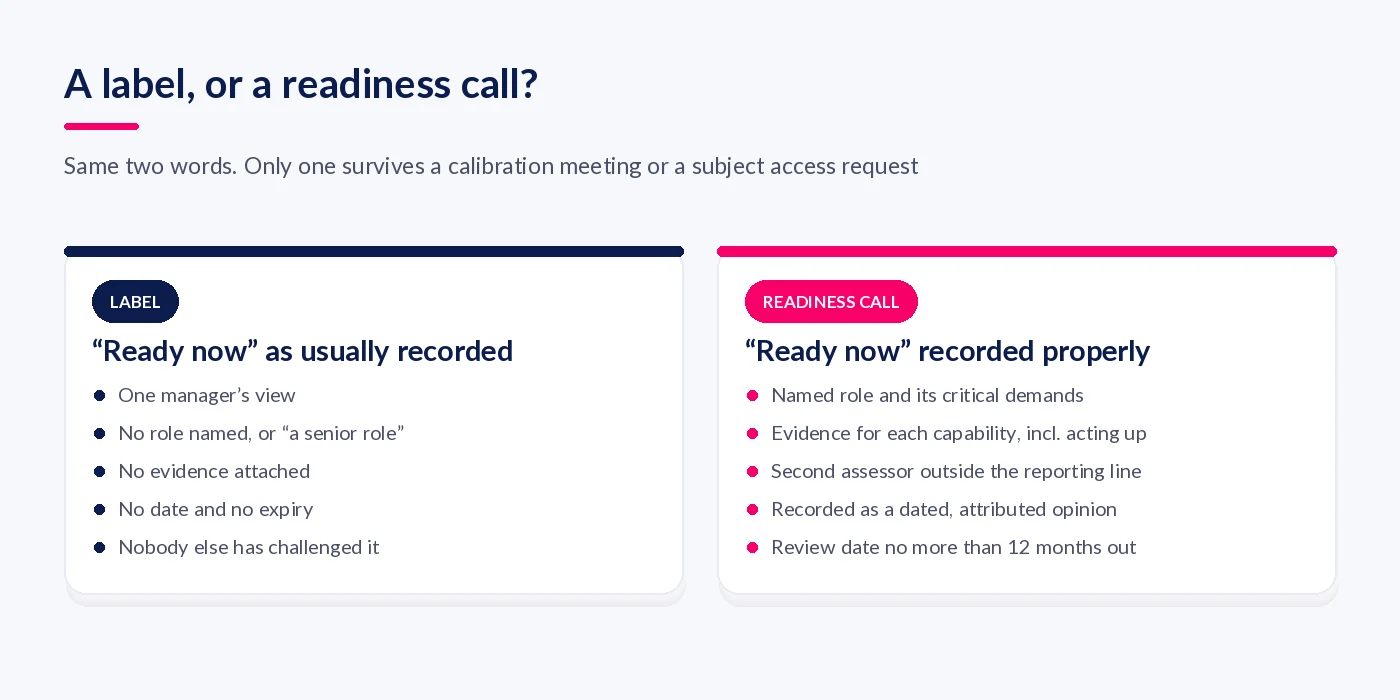
Here is an uncomfortable claim: most “ready now” ratings in succession plans are not assessments at all. They are forecasts, usually made by one manager, often about someone that manager rates highly and wants to keep, and written down in a format that makes them look like facts.
That is not a criticism of managers. It is what happens when an organisation adopts the familiar three-band scale (ready now, ready in one to two years, ready in three or more) without ever saying what has to be true for someone to sit in each band. The scale is everywhere. The definition is almost nowhere.
Succession readiness is a dated, evidence-based judgement of how soon a named person could perform a specific role to the standard it needs, with normal handover support. “Ready now” should mean the person has already shown the role’s critical capabilities, ideally by doing parts of the job, that a second assessor agrees, and that any remaining gaps are small enough to close in the first few months in post.
Why does every organisation define “ready now” differently?
Because there is no standard, and the published scales disagree. One free readiness framework defines ready now as able to assume the role “within 0-6 months” (Hyring). A glossary from another vendor says “minimal additional preparation” (Qandle). Some HR systems run their bands to three to five years and beyond; others stop at three-plus. The CIPD succession planning factsheet talks more simply about “short-term or longer-term successors”.
None of these is wrong. The trouble is that the label travels without its definition, so a board-pack coverage figure adds up ratings that different managers made against different mental standards. Every readiness call should answer the same five questions:
- Ready for which role? A named position, not “a more senior role”.
- Ready by what standard? The role’s critical capabilities, taken from your competency framework rather than the job advert.
- On what evidence? What the person has done, not what you expect them to do.
- In whose opinion? And does anyone outside the reporting line agree?
- As of when? And when does the rating lapse if nobody reviews it?
With those answered, the bands can carry real meaning. This is the set I would start from:
| Band | What it should mean | Minimum evidence | Typical next action |
|---|---|---|---|
| Emergency cover | Can hold the role safely for a few weeks while a permanent decision is made | Knows the role’s critical decisions; has covered absence before | Handover notes and delegated authorities kept current |
| Ready now | Could be appointed today and perform to standard after a normal handover | Has done the role’s critical tasks; no critical capability gap; second assessor agrees | Onboarding plan only |
| Ready in 1–2 years | One or two named gaps, each with an action that can realistically close it | Gaps scored against the framework; development plan with dates | Stretch assignment, acting up, coaching |
| Ready in 3+ years | Potential noted, but several gaps or missing experience | Development conversation held; interest in the role confirmed | Career pathway, broader experience |
| Not a current successor | Not a judgement on the person’s worth, only on fit for this role now | None needed | Development for their own path |
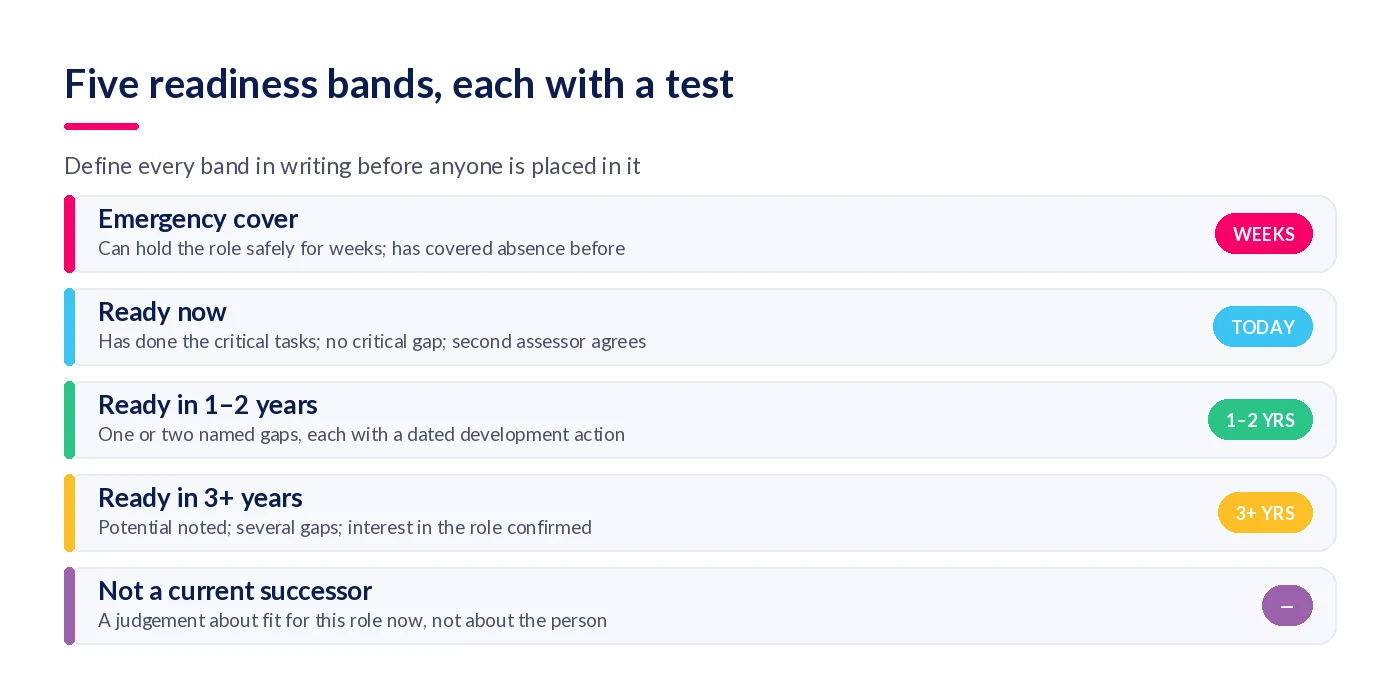
Emergency cover sits apart from ready now on purpose. They are different questions.
Readiness is an opinion, and UK law treats it as one
A readiness rating about a named employee is personal data, and it is an opinion. The ICO says an opinion about an individual can be personal data irrespective of whether it is accurate. That has three practical consequences that ranking guides on succession readiness rarely mention.
Record it as an opinion, and say whose
The ICO’s guidance on the accuracy principle says your records “must make clear that it is an opinion, and, where appropriate, whose opinion it is.” It also says that a record of an opinion “is not necessarily inaccurate personal data just because the individual disagrees with it”, and that if someone challenges it, it is good practice to add a note recording the challenge and the reasons. An unsigned, undated “Ready now” cell does none of that.
Assume the person may ask to see it
Under Article 15 of the UK GDPR employees have a right of access to their personal data. There is a management forecasting exemption in the Data Protection Act 2018, but the ICO’s guidance on exemptions is clear that it is “not a blanket exemption”. You have to show that disclosure would be likely to prejudice the business, and that the prejudice outweighs the harm to the person of not seeing their data. In one ICO example, discussions about a specific employee failed the test because they were “about the specific employee, not about the wider strategy of the organisation.” Take advice on your own plan, but the safe assumption is simple: write every readiness note as if the person will read it.
Check the label is not standing in for a protected characteristic
Time-based judgements can quietly carry assumptions. Age is a protected characteristic under the Equality Act 2010, and section 13 allows age-based treatment only where it is a proportionate means of achieving a legitimate aim. Section 18 makes it unlawful to treat a woman unfavourably because she is on, or has taken, maternity leave. The Part-time Workers Regulations 2000 protect part-timers from less favourable treatment that cannot be objectively justified. A “3+ years” label for everyone over a certain age, a downgrade while someone is on leave, or “not ready because she works four days” are patterns worth testing for. This is general information, not legal advice.
For listed companies there is a governance angle too. The UK Corporate Governance Code 2024 says “Both appointments and succession plans should be based on merit and objective criteria”, and Provision 17 asks the nomination committee to “oversee the development of a diverse pipeline for succession.” A readiness label with no written definition is hard to defend as an objective criterion.
Why do readiness ratings drift upwards?
Readiness ratings inflate because one person usually makes the call, the plan looks better with names in it, and nothing makes a rating expire. No bad faith is needed.
One rater sees one version of the person
Research on performance ratings shows how much of a rating reflects the rater. In Scullen, Mount and Goff (2000), a study of two large samples of managers each rated by bosses, peers, subordinates and themselves, idiosyncratic rater effects accounted for 62% and 53% of rating variance, more than the measured performance of the people being rated. Those were performance ratings, not readiness calls, but readiness calls are made by the same people with less structure.
Potential is where bias hides
Readiness bands lean on judgements of potential, and potential is the softest input. A study of a large retail chain by Benson, Li and Shue found that women received “substantially lower potential ratings despite receiving higher job performance ratings”, and that differences in potential ratings accounted for 30 to 50% of the gender promotion gap. So the problem is not only inflation. The same loose process can inflate one group and deflate another.
The plan wants to show cover
A blank successor box invites a hard question; a ready-now name makes it go away. In a 2010 survey by Heidrick & Struggles and Stanford’s Rock Center of more than 140 North American CEOs and directors, 69% said a CEO successor needs to be ready now, only 54% were grooming one, and 39% said they had zero viable internal candidates. Labels fill the gap development has not.
Ratings never expire
A rating made two years ago, before a restructure and a new manager, still looks current on the chart. Without a review date, every rating ages into fiction.
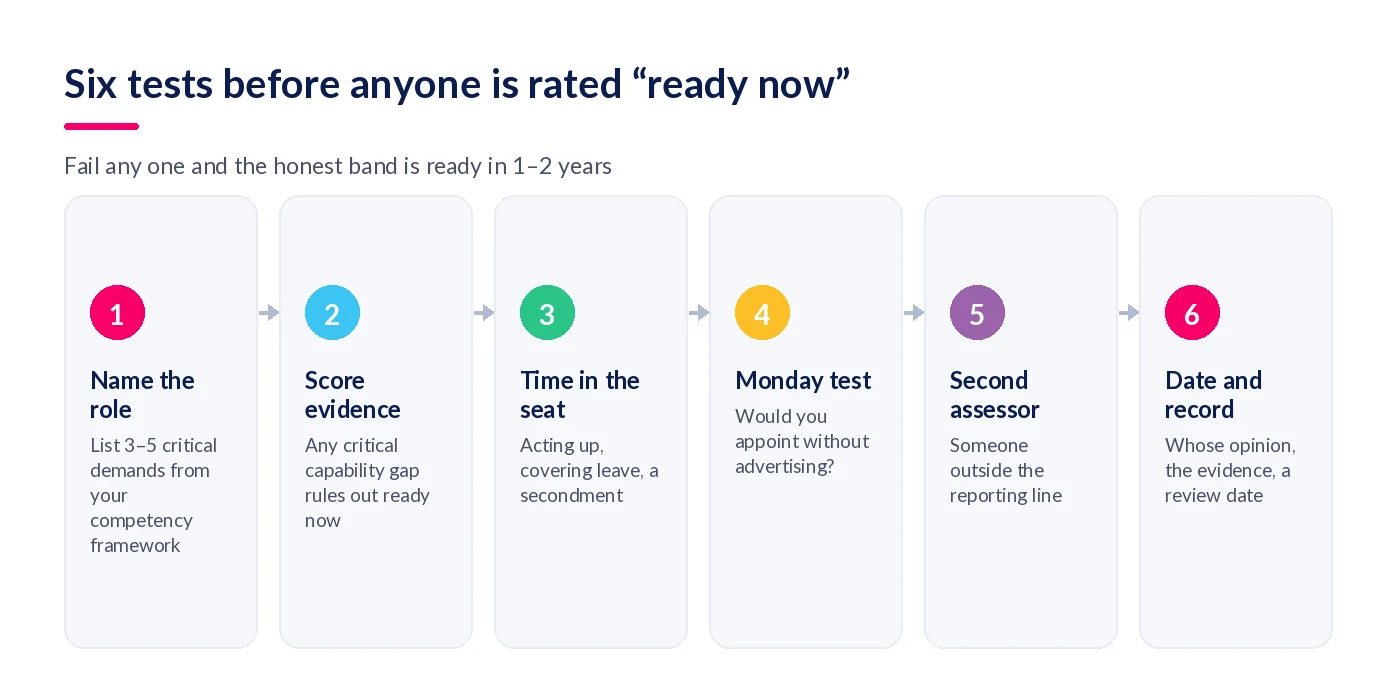
Six tests before anyone is rated “ready now”
A ready-now rating should pass all six of these tests. If it fails any one, the honest band is ready in one to two years, with the failed test becoming the development action.
1. Name the role and its critical demands
List the three to five capabilities the role cannot be done without, from your competency framework for succession planning. “Leadership” is too vague; “owns a £4m budget and signs off overtime” is testable.
2. Score each demand against evidence
For each capability, record the gap and the evidence behind it. Any gap in a critical capability means the person is not ready now, however strong they are overall. A skills gap analysis done once for the role makes this quick for every candidate.
3. Look for time in the seat
Has the person done any part of the job: acting up, covering leave, a secondment? If not, a ready-now rating is a forecast, not an observation.
4. Apply the Monday-morning test
If the incumbent resigned on Friday, would you appoint this person on Monday without advertising? If you would advertise “just to see who is out there”, you already know the answer.
5. Get a second assessor
Ask someone outside the reporting line who has seen the person’s work, such as a peer manager, a project sponsor or the role’s own boss. Disagreement shows you where the evidence is thin.
6. Record a dated, attributed opinion with a review date
Write down whose opinion it is, the evidence, the date and when it lapses: twelve months at most, or sooner if the role or the person changes. That single habit deals with most of the data protection points above.
How do you calibrate readiness without a political fight?
Calibrate readiness by reviewing the evidence for each critical role as a group, using the same challenge questions every time, and agreeing that ratings only move when evidence moves.
Run it inside your talent review meeting or on its own, with a one-page card per successor circulated beforehand (the template below works). The habits behind good performance review calibration apply. Ask the same five questions of every ready-now call:
- What has this person already done that the role requires?
- Which critical capability is weakest, and what is the evidence?
- Would we appoint them on Monday without advertising?
- Is this rating about the role, or about keeping the person?
- Would the rating be the same if they worked full time, were not on leave, or were ten years younger or older?
Agree two ground rules: a downgrade is not a criticism, and any challenge is noted on the record with its reason, as the ICO suggests.

If you want a ready-made structure for the wider plan, our succession planning guide with free customisable templates covers role criticality and successor mapping.
A readiness card you can copy
A composite worked example: a 600-person logistics business reviewing successors for its Site Operations Manager. The outgoing manager rated Shift Lead Sam as ready now.
| Field | Entry |
|---|---|
| Role | Site Operations Manager, Northern hub |
| Critical demands | Site budget ownership; shift planning across 140 staff; health and safety accountability; customer escalations |
| Evidence | Ran shift planning for 18 months; covered the manager for two weeks of leave; has never owned the budget; deputises on safety walks but has not signed off a risk assessment |
| Critical gaps | Budget ownership (critical); safety sign-off (critical) |
| Monday-morning test | Panel would advertise alongside |
| Second assessor | Regional director: agrees on gaps, rates operations strongly |
| Rating | Ready in 1–2 years. Emergency cover: yes |
| Recorded by | Opinion of outgoing manager and regional director, 8 October 2026. Sam’s view noted: considers budget experience gained in previous employer |
| Development actions | Co-own next quarter’s budget; complete and sign two risk assessments under supervision |
| Review date | April 2027, or earlier if the role changes |
Sam moved from ready now to ready in one to two years, but was confirmed as emergency cover, which is what the business actually needed to know. The gaps became two dated actions the next calibration can check.

Where readiness ratings go wrong
The same name on five plans
One strong person listed as successor for several roles makes coverage look healthy while the real bench is thin. Count each person once against the role they are most likely to fill. The succession planning guide explains how to size the bench for critical roles.
Confusing emergency cover with ready now
Someone who can keep the lights on for six weeks is not necessarily someone you would appoint. Rate both separately. Our post on the emergency succession plan covers the cover side in detail.
Keeping ratings secret
The CIPD factsheet puts it plainly: “Transparency is key in the methods used to judge potential successors.” People should at least know how readiness is judged and what they would need to show. Given the right of access, a process that only works if nobody sees it does not work.
Treating the 9-box as the readiness call
A 9-box grid placement is about performance and potential in general; readiness is about one person and one role. A top-right box is a reason to look closely, not a rating.
Where StaffCircle fits
StaffCircle is employee development software that keeps the evidence behind readiness in one place.
Role standards from your competency framework
StaffCircle’s AI competency framework tools build role expectations with the skills and levels each role needs, which you review and edit. Customers report around 40 minutes to build a competency framework, giving every readiness call one standard.
Evidence from everyday performance
Skills and competency ratings sit alongside objectives, one-to-ones and reviews, and gaps feed into personalised development plans. When the calibration asks “what is the evidence?”, it is already there, dated and attributed.
Success Circles instead of a static grid
Success Circles is StaffCircle’s live, evidence-based alternative to the 9-box grid, bringing skills, performance and development signals together so succession views update as people grow rather than once a year.
Final thoughts
“Ready now” is two words doing a great deal of work. Define the label, attach evidence and a second opinion, date it, and let it lapse when nobody reviews it. You will have fewer ready-now names, and they will hold up in the boardroom and in a subject access request.
If you would like to see how StaffCircle connects competency gaps, development plans and succession views, book a demo.
FAQ
What does “ready now” mean in succession planning?
Ready now means a named person could be appointed to a specific role today and perform to standard after a normal handover. They should have no gap in the role’s critical capabilities, have already done parts of the job, and have a second assessor who agrees.
What is the difference between potential and readiness?
Potential is a general view of how far someone could grow. Readiness is specific: could this person do this role, and when? A high-potential employee may be years from ready for one role, while a specialist may be ready now for the role next to theirs.
What are the standard succession readiness levels?
Most organisations use ready now, ready in one to two years and ready in three or more years, sometimes adding not ready. There is no official standard and time windows vary, so define each band in writing and rate emergency cover separately.
How do you assess succession readiness?
Score each candidate against the role’s critical capabilities using evidence such as acting-up periods, projects and reviews. Ask whether you would appoint them without advertising, get a second assessor’s view, and record the rating as a dated, attributed opinion.
How many successors should a critical role have?
There is no fixed rule. Aim for at least one person who can provide emergency cover and at least one named successor in development, and count each person once, so one strong employee on several plans does not make your bench look deeper than it is.
How often should succession readiness be reviewed?
At least once a year, and sooner when the role changes, the person changes role or manager, or a development action is completed. Give every rating a review date when it is made, so stale ratings lapse visibly instead of staying on the plan.
What is bench strength?
Bench strength describes how well your critical roles are covered by people who could step into them. Count how many critical roles have a genuinely ready successor and how many have emergency cover, counting each person only once.
What is the difference between an emergency successor and a ready-now successor?
An emergency successor can hold a role safely for a short period while a permanent decision is made. A ready-now successor is someone you would appoint permanently today. They are often different people, so rate them separately.
Should employees be told they are a successor?
Be open about how readiness is judged and discuss development with the people involved, but avoid promises. A conversation about the gaps someone needs to close is motivating. Implying an appointment is guaranteed is not, especially when a recruitment process may still follow.
Can employees see their succession readiness rating?
Often, yes. A rating about a named person is personal data and can fall within a subject access request under UK GDPR. A management forecasting exemption exists, but the ICO says it is not a blanket exemption, so record ratings as if the person will read them.
How do you stop readiness rating inflation?
Define each band in writing, require evidence for every ready-now call, add a second assessor from outside the reporting line and calibrate in a group with the same challenge questions. Give each rating a review date, and move ratings only when evidence moves.
See StaffCircle in action
Book a personalised demo and see how StaffCircle drives performance, engagement and development.