Manual Handling Training: What the Regulations Require and the Records to Keep
It is a Tuesday in November and Dana, the operations manager at a two-site wholesale business, has a claim letter on her desk. A picker hurt his back lifting cases of bottled water from the bottom of a pallet. The letter asks a simple question: what manual handling training did he have, and when?
Dana knows the answer is "some". He did an online module in his first month, three years ago. There is a certificate somewhere. Nobody showed him the pallet, nobody watched him lift, and the water came in on a new supplier's heavier pack last spring. The certificate is real. Whether it is evidence of adequate training is a different question, and it is the one that matters.
Manual handling training requirements come from three places: section 2(2)(c) of the Health and Safety at Work etc. Act 1974, regulation 13 of the Management of Health and Safety at Work Regulations 1999, and the Manual Handling Operations Regulations 1992. Together they require adequate, task-specific training at recruitment and whenever risks change, repeated periodically where appropriate, as one control after you have tried to avoid and reduce the risk. No law sets a fixed refresher interval or weight limit.
What the law actually says about manual handling training
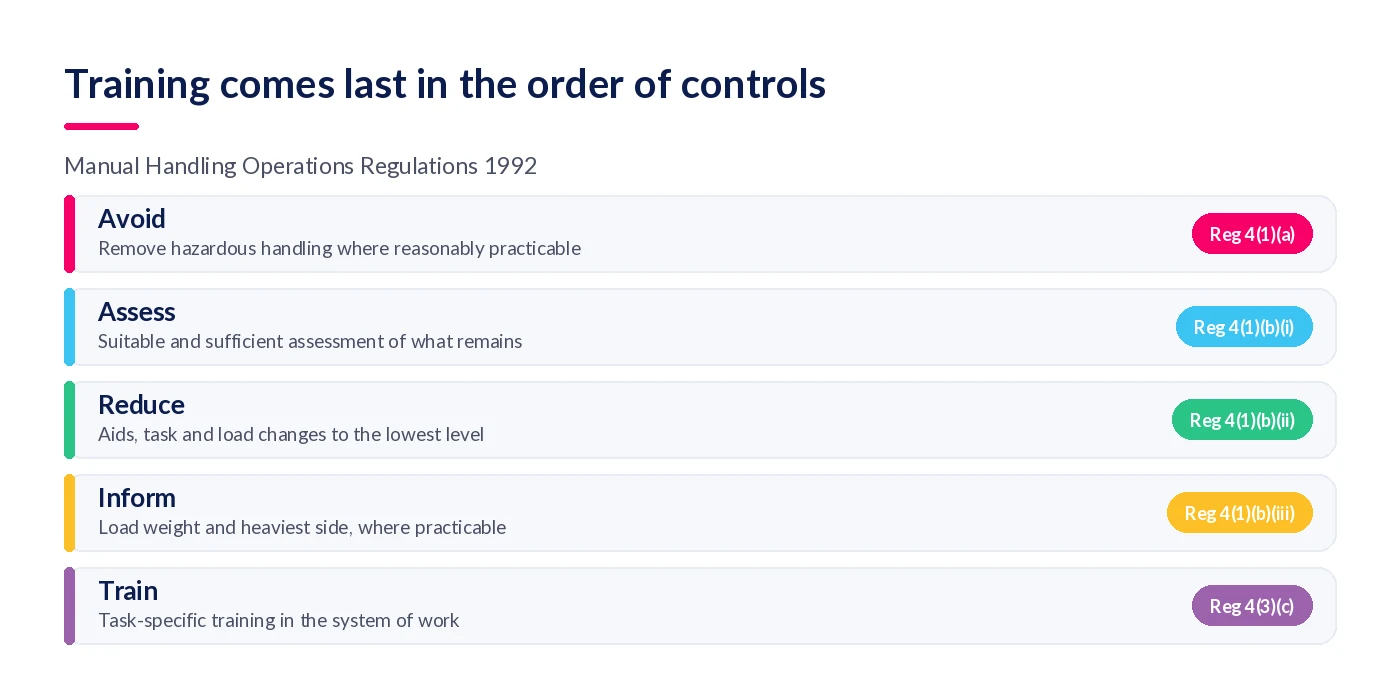
Start with the regulations people quote most and read least. Regulation 4 of the Manual Handling Operations Regulations 1992 sets the employer's duty in a strict order. So far as is reasonably practicable, you must "avoid the need for his employees to undertake any manual handling operations at work" that involve a risk of injury. Where that is not reasonably practicable, you must make "a suitable and sufficient assessment", reduce the risk "to the lowest level reasonably practicable", and give information on the weight of each load and its heaviest side.
Training appears in regulation 4(3), which lists what you must have regard to when deciding whether there is a risk and how to reduce it. Item (c) is the employee's "knowledge and training". Item (a) is "the physical suitability of the employee to carry out the operations". In other words, the Regulations treat training as part of reducing risk, not as a standalone duty.
The general training duties sit elsewhere. Section 2(2)(c) of the 1974 Act requires "such information, instruction, training and supervision as is necessary to ensure, so far as is reasonably practicable, the health and safety at work of his employees". Regulation 13 of the Management Regulations makes it specific: "adequate health and safety training" on recruitment and when people are exposed to new or increased risks, "repeated periodically where appropriate", adapted to new or changed risks, and given during working hours.
HSE's guidance on the Regulations, L23 (fourth edition), ties these together in paragraph 65: you should supplement general health and safety training with "more specific information and training on manual handling injury risks and prevention" as part of reducing risk.
Employees have a duty too. Regulation 5 says each employee "shall make full and proper use of any system of work provided for his use by his employer". That only bites if the system of work was explained to them, which brings you back to training.
So a training system that would satisfy an inspector, or a defendant's solicitor, has to answer these questions for every person who handles loads:
- Which handling tasks does this person do, and has each one been assessed?
- What training did they receive, and was it specific to those tasks and loads?
- When did they receive it: before or close to starting, and after each change?
- Did someone watch them handle the real load and correct their technique?
- Who trained them, and how do you know the trainer was competent?
- When is the next refresher due, and what decided that interval?
Training is the last control, not the first
This is the point most manual handling training pages skip, usually because they are selling the course. HSE's own training guidance says training "won't ensure safe manual handling on its own" and that "You should first design the manual handling operations to be as safe as reasonably practicable." L23 paragraph 68 says the same thing more firmly: the first objective "should always be to design the manual handling operations to be as safe as reasonably practicable".
That has a practical consequence. If a task fails its risk assessment, a training course does not make it pass. Dana's water pallets are a good example. Lifting full cases from mid-lower-leg height is exactly where the risk sits. Raising the pallet on a stand, splitting the packs or using a vacuum lifter changes the task. A course on bending the knees does not.
The weight figures are filters, not limits
HSE's manual handling overview states that "the law does not set specific weight limits". The figures you often see on posters, such as 25 kg for men and 16 kg for women, come from the lifting and lowering risk filter in Appendix 3 of L23. They apply to the zone between knuckle and elbow height with the load close to the body, and they drop sharply further from the body or at floor and shoulder height.
L23 is explicit that "you must not regard them as safe weight limits for lifting". The filters are designed to protect around 95% of working men and women, and they exist to sort out low-risk tasks that do not need a detailed assessment. If your training teaches the 25 kg figure as a rule, it is teaching something the guidance says is wrong.
The stakes are not small. In HSE's 2025/26 injury statistics, handling, lifting or carrying accounted for 18% of employee non-fatal injuries reported by employers under RIDDOR. Musculoskeletal disorders made up 26% of the cases of work-related ill health in HSE's 2025/26 ill health figures.
When manual handling training is due
Training is due on events as well as dates. Regulation 13(2) of the Management Regulations names the events: when someone is recruited, and when they are exposed to new or increased risks because they are transferred or given new responsibilities, because new work equipment arrives or existing equipment changes, because new technology is introduced, or because a system of work is new or changed.
Dana's picker hit the fourth of those without anyone noticing. A heavier pack from a new supplier changed the load, and nobody connected a purchasing decision to a training trigger.
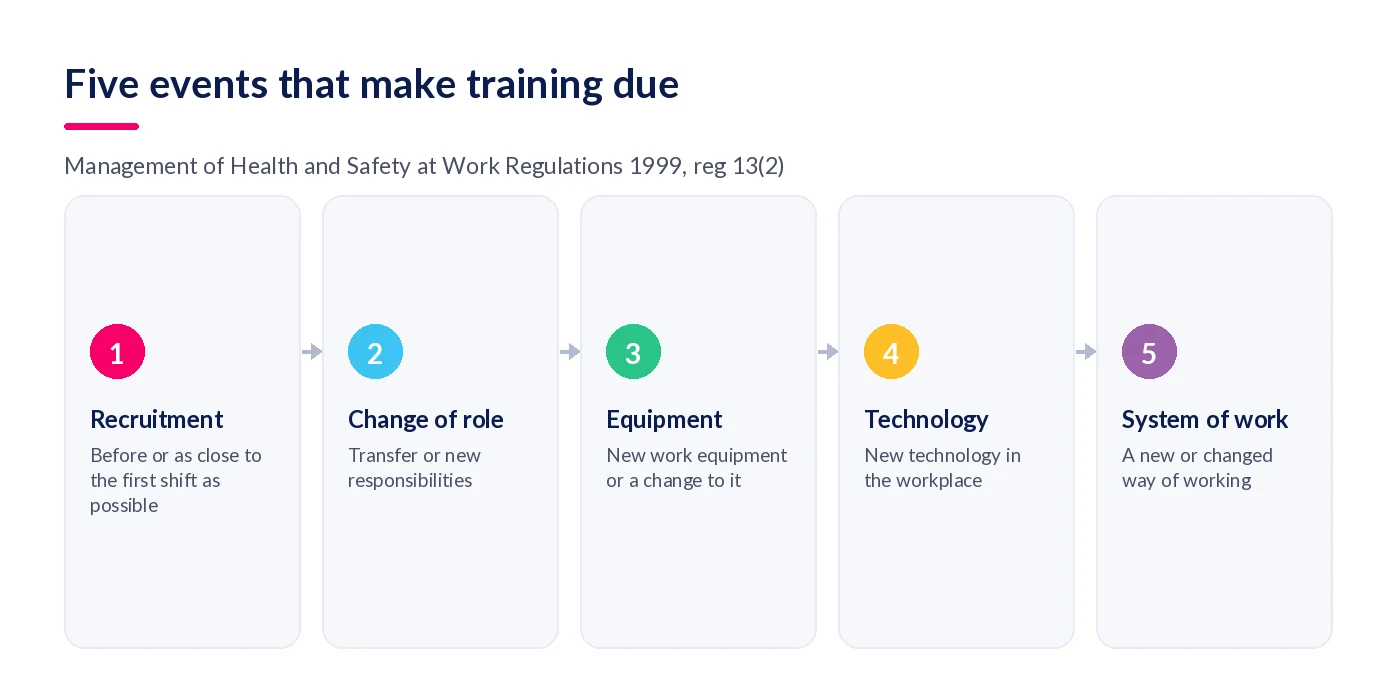
There is no statutory refresher interval. The law says "repeated periodically where appropriate", and HSE's training page gives no number. L23 paragraph 70 asks for "a planned training programme" with basic training for everyone identified as needing it, "updates when necessary", and new starters trained "either before or as close to starting a new job as possible".
Many organisations settle on a one-year or three-year cycle. Either can be defensible, as long as the number came from your risk assessment and your incident data rather than a course provider's renewal email. High-risk work, such as people handling in care, usually justifies a shorter interval than occasional lifting in an office.
Six steps to a manual handling training programme that holds up
L23 paragraph 69 notes that HSE "does not publish prescriptive guidance" on what a good course should include or how long it should last. That leaves the design to you. These six steps follow the guidance it does give.
1. Start from the risk assessment, not the course catalogue
List the handling tasks that could not be avoided and the findings of each assessment. HSE's MAC tool covers lifting, lowering, carrying and team handling. L23 paragraph 111 notes that if you have five or more employees you are required by law to record the results of your assessment. Those findings are your syllabus.
2. Group people by task, not job title
Two "warehouse operatives" may do completely different handling. Map who does which assessed task, on which site and shift, to see who needs basic awareness and who needs practical, task-specific training on a particular load or aid.
3. Tailor the content to the real tasks
L23 lists what courses usually need to cover: risk factors and how injuries happen, safe handling including good technique, the systems of work for the person's task and environment, safe use of lifting and handling aids, and "practical work to allow the trainer to identify and put right anything the trainee is not doing safely". HSE's guidance says content should be "tailored to the tasks the workers carry out".
4. Include practical work and check competence
Online modules can carry the theory. They cannot watch someone lift. L23 paragraph 194 says good handling technique "needs both training and practice" in conditions "as realistic as possible". Have a competent person observe each person on their actual tasks and sign off against a written standard. Check your trainers too: paragraph 67 asks you to confirm in-house trainers have "reached an adequate level of competence" and to check external ones.

5. Set refresher triggers and intervals from risk
Write down the events that trigger retraining, using the regulation 13 list, and a default interval for each task group based on its risk. Add your own triggers: a near miss, an injury, a return from long absence, or a supervisor seeing poor technique.
6. Keep records and test whether the training worked
L23 paragraph 70 suggests keeping records of "who has been trained, when the training was carried out and what the content of the course was" to manage the programme and see when refreshers are due. The same paragraph suggests monitoring sickness absence and near-miss reports to judge whether the training is working. HSE also asks you to monitor procedures "to make sure workers understand and apply them".
Where manual handling training quietly fails
The e-learning certificate is the whole programme
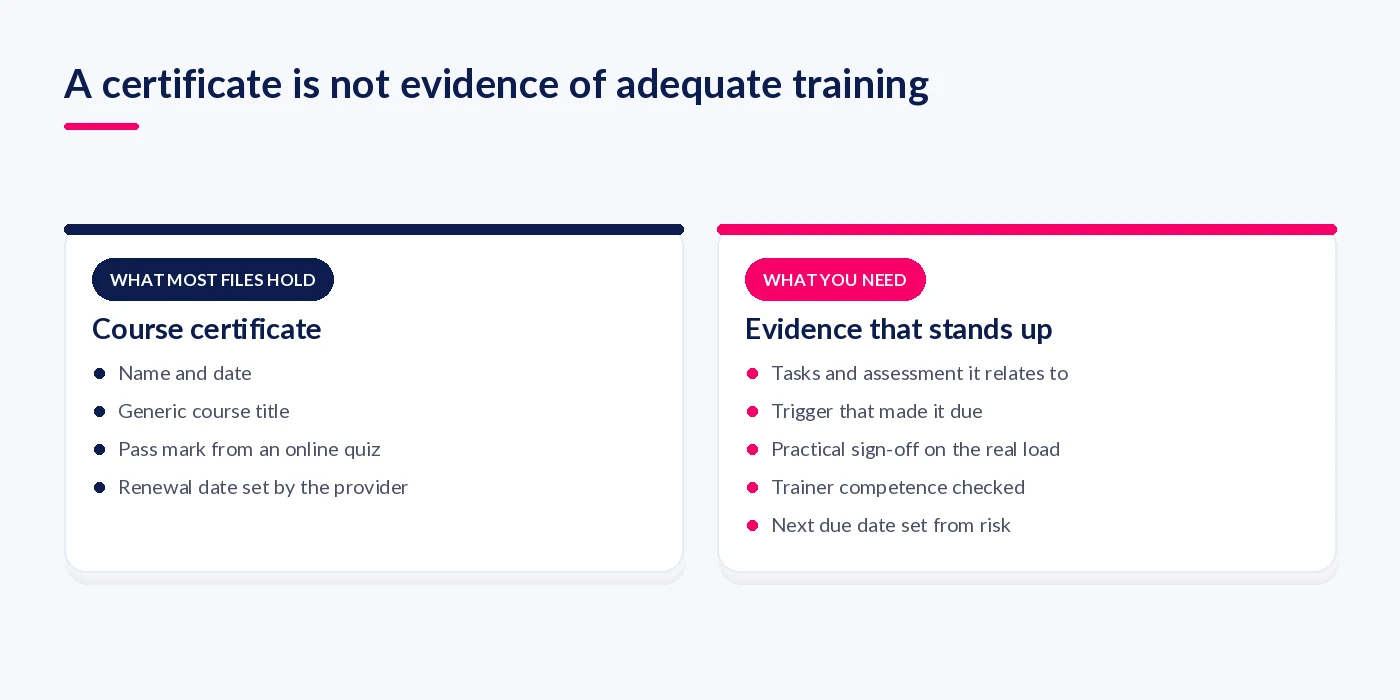
A module completion proves someone clicked through a module. Without practical, observed work on real tasks, the record answers "did they attend?" and not "were they trained adequately for this task?"
Supervisors were never told what was taught
L23 paragraph 71 asks you to make sure supervisors "are also aware of the practices that have been taught" so they can encourage them and check they continue. When a team leader was not on the course, the technique fades within weeks and nobody notices.
Individual risk is ignored
Regulation 4(3) requires regard to physical suitability. L23 calls out people who are or have recently been pregnant, young workers, people new to the job and people with a health problem or recent injury. Regulation 19 of the Management Regulations adds that young people must not be given work "beyond his physical or psychological capacity". A single course for everyone misses all of them.
People handling gets treated as box handling
Under regulation 2, a "load" includes any person and any animal. Moving a resident or patient is a manual handling operation, and it needs its own assessment, its own equipment training and much more practice than lifting a carton.
The record Dana wishes she had
Go back to the claim letter. The question was not "did he do a course?" It was whether the business did what was reasonably practicable. A record that answers that holds more than a certificate. Here is what each line should contain.
| Field | Example for one picker | Why it matters |
|---|---|---|
| Tasks covered | Case picking from pallets, roll cage loading | Links training to assessed tasks |
| Assessment reference | Picking assessment, reviewed after new supplier pack | Shows training followed the assessment |
| Content | Risk factors, pallet stand use, technique, practical | L23 para 70 suggests recording content |
| Trigger | Change of load (new supplier pack) | Reg 13(2) training on new or increased risk |
| Practical sign-off | Observed on live pallets by team leader | Proves technique on the real task |
| Trainer | Team leader, trainer competence checked | L23 para 67 on trainer competence |
| Date and next due | Training date and refresher due date | Planned programme and refresher timing |
Kept like this, the record shows your gaps before a claim letter does: who has never had a practical sign-off, and which load changes produced no retraining.
Where StaffCircle fits
StaffCircle does not assess your loads or redesign your tasks. It holds the people side of the steps above: who needs what, what they have had, and when it is due again.
Handling tasks defined as competencies
With the competency framework tools you can describe what competent handling looks like for a role or task, so a practical sign-off is made against a written standard rather than a feeling.
Training records with refresher dates
Training compliance tracking keeps each person's manual handling training, sign-offs and certificates with dates, so the intervals you set from your risk assessment are tracked rather than remembered.
Gaps you can see by site and shift
A matrix of people against requirements shows who is overdue or has never had a practical sign-off. Our mandatory training matrix guide explains the structure, and preparing for a skills compliance audit covers how to present it.
In short
Manual handling training is a legal requirement, but it is the last control, not the first. Avoid the task where you can, assess and reduce what is left, then train people on the real tasks, watch them do it, and retrain when anything changes. Keep a record that shows all of that. For related duties, see our guides to PUWER training requirements, fire safety training requirements and skills compliance. If you would like to see how StaffCircle keeps that evidence in one place, book a demo.
FAQ
What are the manual handling training requirements for employers?
Employers must give adequate health and safety training on recruitment and when people face new or increased risks, under regulation 13 of the Management of Health and Safety at Work Regulations 1999 and section 2 of the 1974 Act. For manual handling, HSE guidance says this should include task-specific training on handling risks and prevention, after you have tried to avoid and reduce the risk.
Is manual handling training a legal requirement in the UK?
Yes, where employees carry out manual handling that involves a risk of injury. The general duty to provide necessary training comes from section 2(2)(c) of the Health and Safety at Work etc. Act 1974 and regulation 13 of the Management Regulations. The Manual Handling Operations Regulations 1992 list knowledge and training among the factors to consider when reducing risk.
How often should manual handling training be refreshed?
No law sets a fixed interval. Regulation 13 says training must be repeated periodically where appropriate and adapted when risks change. HSE's L23 guidance asks for a planned programme with updates when necessary. Many employers choose one or three years, but the interval should come from your risk assessment, with earlier retraining after changes or incidents.
Does manual handling training expire?
Not in law. A certificate's expiry date is usually set by the training provider, not by statute. What matters legally is whether the training is still adequate for the tasks the person does now. A change of load, equipment, role or system of work can make recent training out of date.
What should manual handling training include?
HSE's L23 guidance says courses usually cover manual handling risk factors and how injuries happen, safe handling including good technique, the systems of work for the person's task and environment, safe use of lifting and handling aids, and practical work so the trainer can spot and correct anything the trainee is not doing safely.
Is online manual handling training enough?
Rarely on its own. Online modules can cover theory and risk factors, but HSE's guidance calls for practical work so a trainer can correct unsafe handling, and says good technique needs training and practice in realistic conditions. For most handling tasks, add an observed practical sign-off on the real loads and equipment.
What is the maximum weight a person can lift at work in the UK?
There is no legal maximum. HSE states that the law does not set specific weight limits. The 25 kg and 16 kg figures often quoted come from a risk filter in HSE's L23 guidance, which says they must not be regarded as safe weight limits. Risk depends on posture, distance, frequency, the load and the person.
What records should I keep for manual handling training?
HSE's L23 guidance suggests recording who was trained, when, and what the course covered, to manage the programme and see when refreshers are due. A stronger record also links the training to the assessed tasks, notes what triggered it, records a practical sign-off and who gave it, and sets the next due date.
Who needs manual handling training?
Anyone whose work involves manual handling that carries a risk of injury and cannot be avoided, including new starters before or close to their first shift. Training should match the tasks people actually do, so a care worker moving residents needs far more than someone who occasionally carries a box of paper.
Do employees have legal duties around manual handling?
Yes. Regulation 5 of the Manual Handling Operations Regulations 1992 requires employees to make full and proper use of any system of work their employer provides to reduce the risk of injury. HSE guidance adds that employees should use equipment provided for them in line with their training and instructions.
Does moving people count as manual handling?
Yes. Under regulation 2 of the Manual Handling Operations Regulations 1992, a load includes any person and any animal. Moving a patient or resident is a manual handling operation and needs its own risk assessment, suitable equipment and specific practical training in using that equipment safely.
Who can deliver manual handling training?
Anyone competent to do so, in-house or external. HSE's L23 guidance says you should check in-house trainers have understood the information and reached an adequate level of competence, and that you should also check the competence of any external trainers. Trainers should know your tasks, loads and equipment.
Related articles



See StaffCircle in action
Book a personalised demo and see how StaffCircle drives performance, engagement and development.