Succession Planning for Small Businesses, Kept Proportionate
Ask the owner of a 30-person business about succession planning and you usually get one of three replies. "That's for when I retire." "We're too small for a talent pipeline." Or, more honestly: "If Dave left, we'd be in trouble, but Dave isn't going anywhere." This post takes the questions small firms actually ask about succession and answers them one at a time, at a scale that fits a business without an HR department.
I will use one example throughout: Harrow & Finch, a 38-person joinery and shopfitting firm. It is a composite of several owner-managed businesses I have spoken to, and the details are illustrative.
Succession planning for small businesses means identifying the handful of roles where one person leaving would stop work, then making sure someone else could hold each of those roles and is being developed to do it well. It is a short, practical plan for workforce continuity, kept separate from the owner's exit plan and reviewed twice a year.
Key facts
- SMEs accounted for 60% of UK private-sector employment at the start of 2025.
- An employee with one month's service need only give one week's statutory notice.
- Ownership succession and workforce succession are separate plans with different owners and advisers.
- A proportionate plan covers the few roles where one departure stops work, not every job.

What is succession planning in a small business?
In a small business, succession planning is a short list of critical roles, the person who would cover each one, and what is being done to get that person ready. It answers a practical question: if someone important left, fell ill or went on long leave next month, would the work still get done?
Enterprise succession planning involves talent reviews, nine-box grids and leadership pipelines. You do not need most of that. A proportionate plan has to answer five questions and no more:
- Which roles would stop the business, or a legal duty, if the person went?
- Who could hold each of those roles for the first few weeks?
- Does that person know, and could they actually do it?
- What knowledge sits only in one person's head?
- What is each cover person doing this quarter to get closer to ready?
If you want the full enterprise picture, our guide to succession planning covers it. This post is the cut-down version.
Is succession planning the same as planning the owner's exit?
No. Planning who will own or run the company when the founder steps back is business succession, and it involves valuation, tax, shareholder agreements and often a sale. Workforce succession is about keeping critical roles covered. Most small business guides blend the two, which is why so many owners file the whole subject under "retirement" and leave it for later.
The two plans differ in almost every respect:
| Ownership (exit) succession | Workforce succession | |
|---|---|---|
| Question it answers | Who will own or lead the business? | Who keeps critical roles running? |
| Typical trigger | Retirement, sale, ill health of the owner | Resignation, long-term sickness, parental leave, promotion |
| Time horizon | Years | Weeks to months |
| Who leads it | Owner, with accountant, solicitor and financial adviser | Owner or operations lead, with line managers |
| Output | Exit plan, valuation, legal documents | One-page cover and development plan |
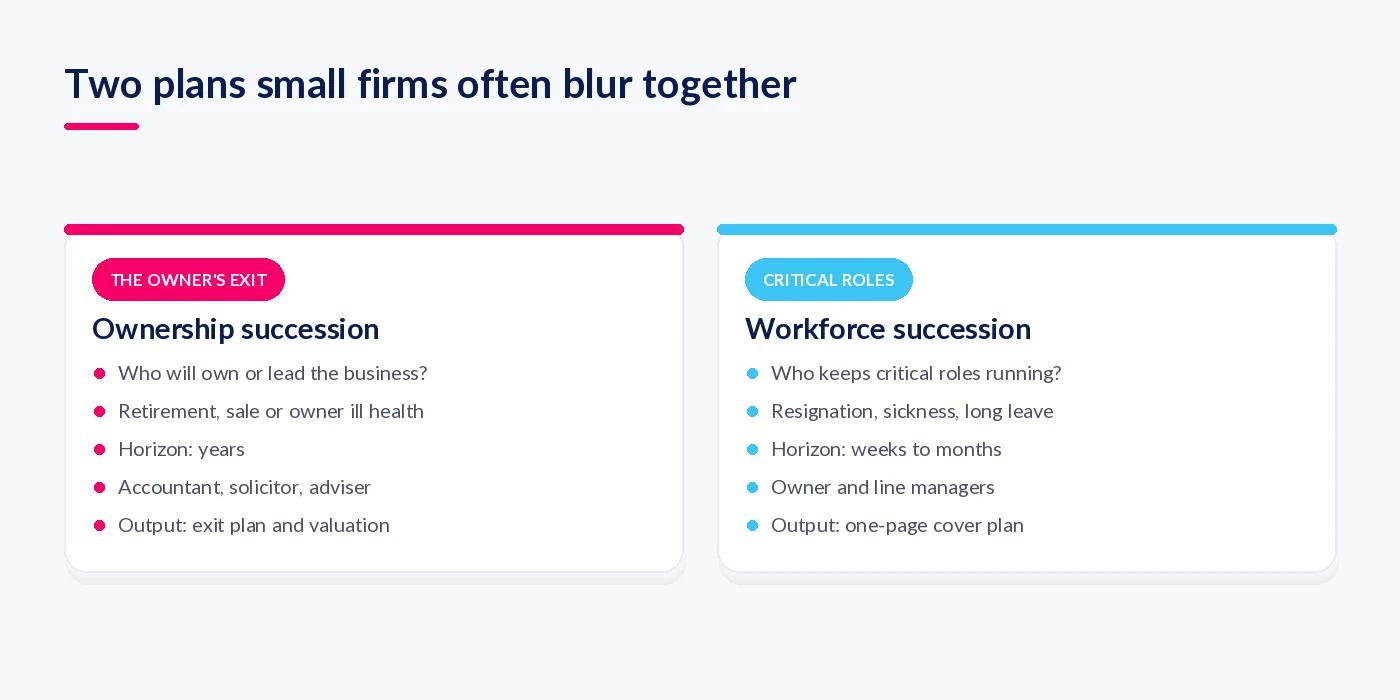
Keep them apart. The owner's exit plan can take years and needs professional advice. The workforce plan can be drafted in an afternoon, and it protects the business, and its value, long before any sale.
Why does losing one person hurt a small business more?
Because there is no bench. In a large organisation a departing manager is usually one of several people doing similar work. In a small firm, the estimator, the bookkeeper and the only person who can programme the CNC machine are often each a team of one, and the business may have built its processes around them without noticing.
Small firms are not a niche case. The Department for Business and Trade's business population estimates for 2025 found that SMEs accounted for 60% of private-sector employment, and that businesses with fewer than 50 employees employed 13.1 million people, 47% of the total.
The notice you get can be short. Under section 86 of the Employment Rights Act 1996, an employee who has been continuously employed for a month or more must give "not less than one week" of notice. Many contracts ask for more, but a statutory floor of one week means your cover plan has to work in days, not quarters.
Planned absences give you longer. Eligible employees can take up to 52 weeks' maternity leave, and GOV.UK guidance says they must tell you at least 15 weeks before the baby is due. That is enough time to cross-train properly, if the plan already exists.
How do you create a succession plan for a small business?
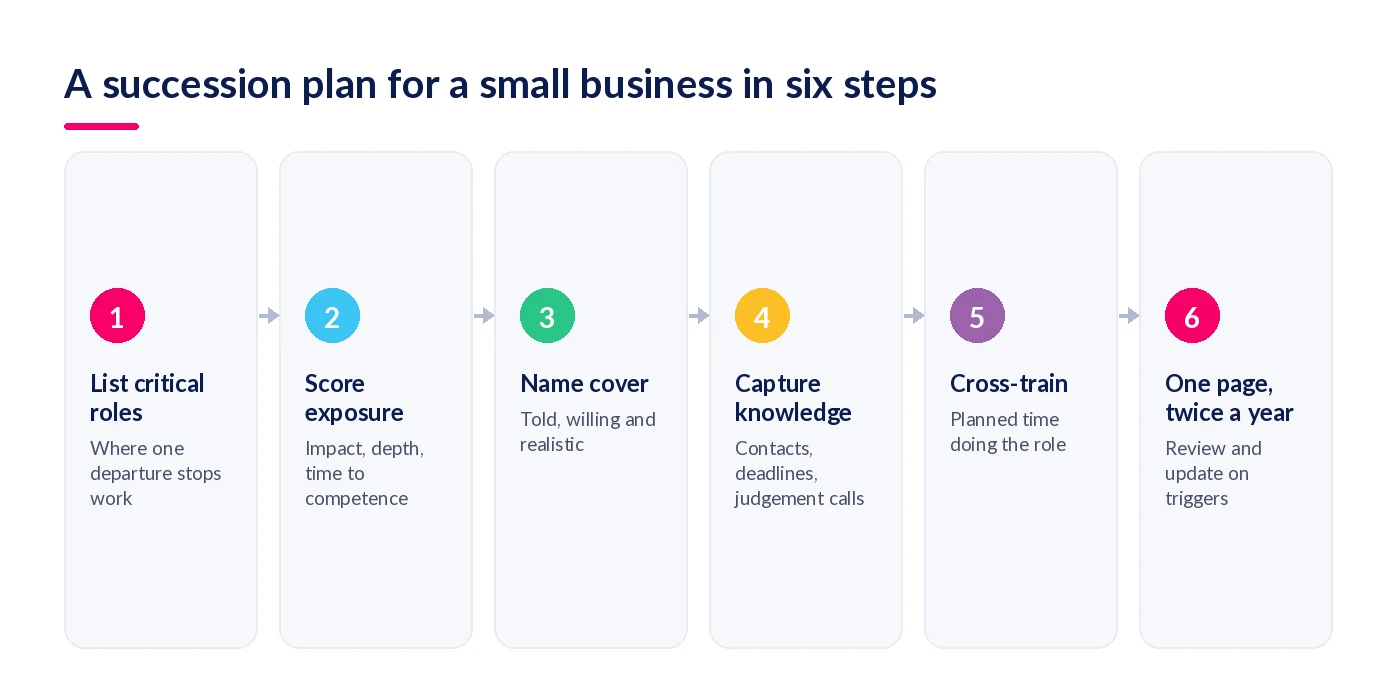
You create one in six steps: find the roles where one departure stops work, score how exposed each one is, name cover, capture the knowledge only one person holds, cross-train on a schedule, and keep it all on one page that you review twice a year. Here is each step in a little more detail.
- List the roles where one departure would stop work. Ask which jobs would halt production, sales, payroll or a legal duty if the person went tomorrow. In most small firms the answer is a short list, often including roles that are not senior.
- Score each role for exposure. Rate each role on three things: how much stops if the person goes, how many other people can do the work today, and how long a new person would take to get up to speed.
- Name cover for the highest-scoring roles. For each exposed role, agree who would hold it for the first few weeks, tell that person, and check they could realistically do it alongside their own job.
- Capture what lives in people's heads. Write down the passwords, supplier contacts, recurring deadlines, customer quirks and judgement calls that only one person knows, and keep them somewhere the cover person can reach.
- Cross-train on a schedule. Give each named cover person regular, planned time doing the role: running the month-end, quoting a job, opening up on a Monday. Watching once is not cover.
- Write it on one page and review it twice a year. Keep the roles, scores, cover names, development actions and review date on a single page, and revisit it every six months or whenever someone resigns, is promoted or goes on long leave.
Step 1 is where small firms most often go wrong. Critical is not the same as senior. When Harrow & Finch ran this exercise, the owner expected the list to be the directors. It turned out to include the stores and purchasing coordinator, who was the only person who knew which suppliers would deliver to site at short notice, and the payroll and accounts administrator. Our post on identifying critical roles goes deeper on scoring if you need it.
If you want ready-made templates for the steps, the free Succession Planning Guide includes customisable versions you can adapt.
What goes on a one-page succession plan?
A one-page plan lists each critical role, its exposure score, the named cover person, the knowledge that still needs capturing, the cover person's development action, and the next review date. Anything that does not fit on one page is probably too elaborate for a business of this size.
This is what Harrow & Finch's first version looked like. Exposure is scored 1 to 3 on impact, depth (3 means nobody else can do it) and time to competence, so the maximum is 9.
| Role | Exposure (of 9) | Cover for first weeks | Knowledge still to capture | Development action |
|---|---|---|---|---|
| Estimator | 9 | Senior site supervisor | Pricing rules of thumb, supplier rates | Prices two small jobs a month, checked by estimator |
| Payroll and accounts administrator | 8 | External bookkeeper (agreed in writing) | Payroll run checklist, HMRC deadlines | Office manager shadows two payroll runs |
| CNC programmer | 8 | None yet | Machine set-up notes, file library | Apprentice starts structured CNC training |
| Stores and purchasing coordinator | 7 | Workshop manager | Supplier contacts and delivery terms | Workshop manager places orders one week a month |
| Contracts manager | 6 | Owner | Live client commitments | Site supervisor attends client progress meetings |
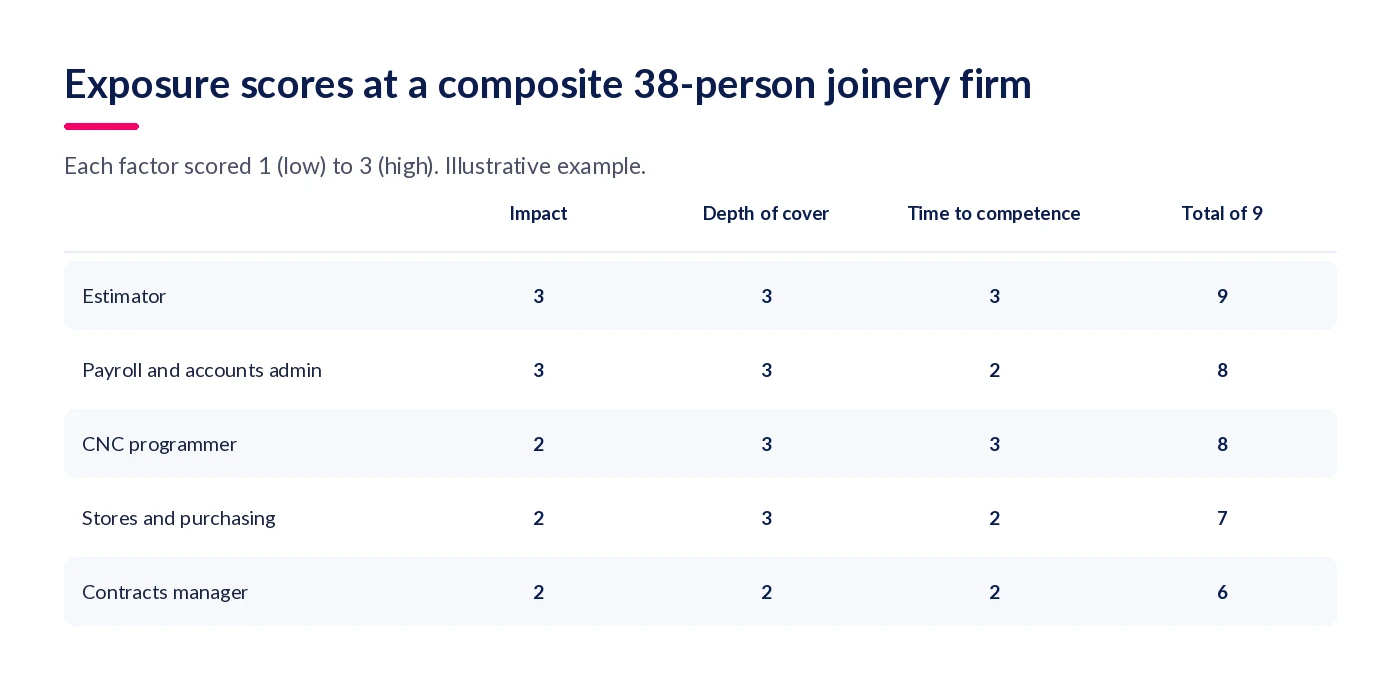
Two things stand out. The roles at the top are not the directors. And one row says "None yet", which is the honest answer and the most useful line on the page, because it tells the owner where to spend the next six months. A skills matrix is a good way to see who already has part of the capability a critical role needs.
How do you capture knowledge before someone leaves?
Capture it while nobody is leaving. Ask each person in a critical role to keep a short, living handover document: the recurring tasks and their deadlines, the contacts and logins, and the judgement calls they make without thinking. Then have the cover person use it to do the task while the expert watches. Gaps show up immediately.

One week's notice is not enough time to do this from scratch. Even a month is tight when the person leaving is also finishing their own work. Treat the handover document as part of the job, check it at one-to-ones, and it will be ready when you need it.
Where does small business succession planning go wrong?
It usually goes wrong in five ways: the plan is really the owner's retirement plan, one person is cover for everything, cover has never done the job, nobody told the cover person, or the plan goes stale. Almost none of these are design flaws. They come from treating the plan as a one-off document rather than a habit.
The plan is really the owner's retirement plan
If the only succession conversation in the business is about the owner, every other critical role is unplanned. Run the workforce plan first. It is faster, and it protects the business while the exit plan is still years away.
Everyone is cover for everything
Small teams tend to name the same capable person as cover for four roles. That person cannot hold four jobs at once. Limit anyone to cover for one or two roles, and check they could do it alongside their own work.
Cover has never actually done the job
Sitting in on a payroll run once is not cover. Unless the named person has done the task, under supervision, recently, you have a name rather than a plan. The cross-training in step 5 is what turns one into the other.
Nobody told the cover person
A plan the cover person has never heard of fails on the first morning. Tell them, explain what it does and does not mean (it is not a promise of promotion), and agree their development action with them.
The plan goes stale
Small businesses change quickly. A plan written before a key hire, a new contract or a resignation is wrong within months. Our post on emergency succession plans covers what to do in the first 72 hours when an unplanned exit happens anyway.
How often should a small business review its succession plan?
Review it twice a year as a matter of routine, and again whenever someone in or covering a critical role resigns, is promoted, starts long-term leave or takes on new responsibilities. A scheduled review takes under an hour if the plan is genuinely one page.
At each review, ask three questions of every row: is the score still right, is the cover person still the right person, and has their development action actually happened? The third question is the one that matters. A plan where every action is still "planned" six months later is not moving.
The simplest way to keep it alive is to tie development actions to normal management. If each cover person's action is discussed at their regular one-to-one, progress is visible without a separate process. Our employee development plan template is a good home for those actions.
Where StaffCircle fits
A spreadsheet is a perfectly good place to start. Where it struggles is keeping the plan connected to people's day-to-day development once the business has grown past a few dozen people.
See capability, not just names
StaffCircle's Success Circles visualise competencies so you can spot strengths, gaps and likely cover for a role from current skills and performance data. More on the employee development software page.
Keep development actions in front of people
Personalised development plans let a manager and their cover person agree the action that closes the gap, such as pricing two jobs a month, and keep it visible to both of them.
Review in the normal rhythm of management
Regular check-ins give managers a natural moment to ask whether cross-training happened this month, so the succession plan updates as part of everyday management rather than twice a year in a rush.
Start with one role
You do not need a full plan by Friday. Pick the one role that would hurt most if its holder handed in a week's notice tomorrow, name the cover, and book the first cross-training session. Then do the next role. If you would like to see how StaffCircle connects skills, development plans and check-ins, book a demo.
FAQ
What is succession planning for small businesses?
Succession planning for small businesses is a short plan that identifies the few roles where one person leaving would stop work, names who would cover each one, and sets development actions to get that person ready. It focuses on workforce continuity and is kept separate from the owner's own exit or retirement plan.
Do small businesses need a succession plan?
Yes. Small firms often rely on one person for estimating, payroll or a specialist skill, so a single resignation can halt work. An employee with a month's service need only give one week's statutory notice, so a simple plan naming cover for critical roles protects the business at very little cost.
How do you create a succession plan for a small business?
List the roles where one departure would stop work, score each for exposure, and name cover for the highest-scoring roles. Capture the knowledge only one person holds, cross-train the cover person on a schedule, and keep everything on a one-page plan that you review twice a year.
Which roles need a succession plan in a small business?
Prioritise roles where the business would stop, or a legal duty would be missed, if the person left. These are often not senior: estimators, payroll administrators, specialist machine operators and purchasing coordinators frequently score higher than directors because nobody else can do their work.
What is the difference between business succession planning and workforce succession planning?
Business succession planning decides who will own or lead the company when the owner steps back, and involves valuation, tax and legal advice over years. Workforce succession planning keeps critical roles covered when employees leave, fall ill or take long leave, and works over weeks or months.
How many successors should each role have in a small business?
One named cover person for each critical role is a realistic start, with a second where the role is very exposed. More important is limiting each person to covering one or two roles, so the same capable employee is not expected to hold several jobs at once.
What should a small business succession plan include?
Include each critical role, its exposure score, the named cover person, the knowledge that still needs capturing, the cover person's development action and the next review date. If it fits on one page and every row has an owner and an action, it is detailed enough for most small firms.
How often should a small business review its succession plan?
Review it every six months, and also whenever someone in or covering a critical role resigns, is promoted, starts long-term leave or changes responsibilities. At each review, check the score, the choice of cover person and whether the agreed development action has actually happened.
How do you capture knowledge before an employee leaves?
Ask each person in a critical role to keep a living handover document covering recurring tasks, deadlines, contacts, logins and judgement calls. Then have the cover person complete the task using it while the expert watches. Do this routinely, because one week's notice is rarely enough time to start.
Should you tell employees they are a successor?
Yes. A cover person who has not been told cannot prepare and may not accept the role when it matters. Explain what being named means, make clear it is not a promise of promotion, and agree a specific development action with them so the arrangement is real.
Do you need software for succession planning in a small business?
Not to start. A spreadsheet or a single page works for a handful of critical roles. Software becomes useful as headcount grows, when you want skills data, development plans and regular check-ins connected so the succession plan updates as part of normal management.
Related articles



See StaffCircle in action
Book a personalised demo and see how StaffCircle drives performance, engagement and development.