How to Identify Critical Roles for Succession Planning
Last spring the leadership team at a 380-person food manufacturer I will call Hadley sat down to start a succession plan. Two sites, three production lines, a retail customer base that cannot be let down. The first slide listed eight roles that needed successors. All eight were on the leadership team.
Nine weeks later a different list was on the wall. The managing director was still there. So was the finance director. But two of the three highest-scoring roles were not leadership roles at all: a maintenance engineer who was the only person able to fault-find the main line’s control system, and a production planner whose spreadsheet was, in practice, the factory’s schedule.
To identify critical roles for succession planning, list every role rather than every person, treat roles that a law or regulator requires to be filled as critical by default, then score the rest on five factors: impact of a vacancy, time to replace, scarcity of skills, concentration of knowledge in one person, and strategic weight. Roles above your threshold are critical. Seniority is not one of the factors, and it should not be.
Hadley is a composite, but every step below is one you can run next month.

Criticality is about the gap, not the job title
The CIPD defines succession planning as identifying and growing talent to fill business-critical positions, and notes that inclusive approaches find those roles at all levels. That is the starting point: a critical role is one whose sudden absence would hurt, whoever happens to hold it.
For each role, your assessment needs to answer five questions:
- If this role were empty tomorrow, what would stop, slow down or break?
- How long would it take to get someone competent into it, from inside or outside?
- How rare are the skills, licences or approvals it needs?
- How much of what the role does lives only in one person’s head?
- Does next year’s plan depend on this role more than this year’s did?
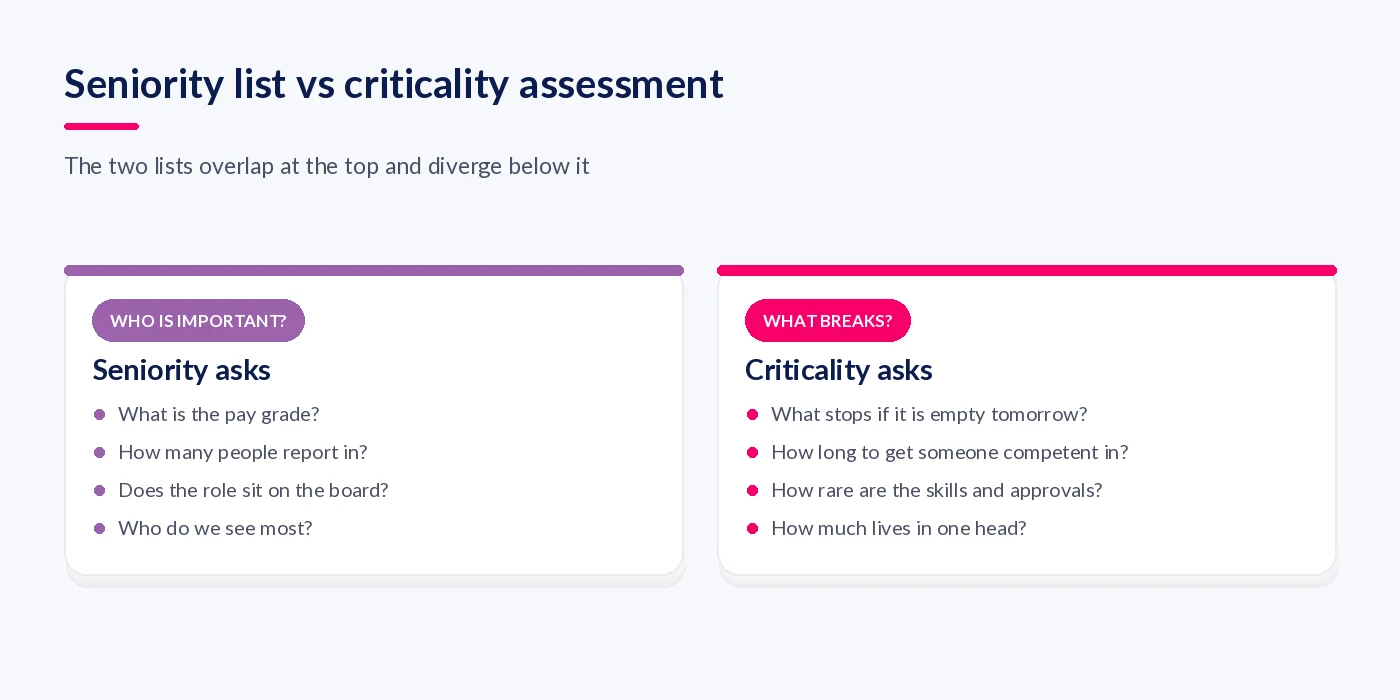
Notice what is missing: pay grade, headcount and how often the role holder appears in board papers. Those are proxies for seniority. They overlap with criticality at the top, which is why leadership-only lists look plausible. Below that they diverge fast. The RBL Group makes a similar argument in The Critical Role Trap, warning that organisations often confuse the roles that cause most anxiety with the roles that matter most.
The roles the law has already decided for you
Most guides to critical roles stop at strategy and skills. In regulated UK sectors there is a shorter route for some roles: legislation or a regulator has already said the job must always be done by an approved, registered or competent person. You do not need to score those roles. They are critical by default, because a gap is a compliance breach as well as an operational problem.
| Role | Source | What it says | Why it matters for succession |
|---|---|---|---|
| FCA Senior Management Function holders | FCA Handbook SUP 10C.3A (the 12-week rule) | Temporary cover without approval is allowed only where “the appointment is for less than 12 weeks in a consecutive 12-month period”. The guidance also refers to “effective and up-to-date succession plans for each of its SMF managers”. | An internal successor may still need FCA approval before stepping in permanently, so readiness has to include the approval timeline. |
| CQC registered manager | CQC (Registration) Regulations 2009, reg 14; 2014 Regulations, reg 7 | Notice is required for an absence of “28 days or more”, normally “no later than 28 days before”, or “within 5 working days” in an emergency. Reg 7 requires the manager to be fit, with the necessary skills and experience. | A sudden absence starts a five-working-day clock. You need to know who will be responsible before it happens. |
| Designated Safeguarding Lead (schools and colleges) | Keeping Children Safe in Education 2026 | The DSL should come from the leadership team, schools “should implement robust cover arrangements”, and deputies “should be trained to the same standard”. | Deputies are named successors with a training standard, not an informal backstop. |
| Health and safety competent person | Management of Health and Safety at Work Regulations 1999, reg 7 | Every employer must appoint one or more competent persons, with “sufficient training and experience or knowledge and other qualities”. | If the role is held in-house by one person, their departure leaves a statutory gap. |
| Gas engineers | Gas Safety (Installation and Use) Regulations 1998, reg 3 | Work must be done by someone competent and a member of a class of persons approved by the HSE. | Registration is personal, so a successor without it cannot cover the work. |
If you are FCA-regulated, there is a second, broader prompt. SYSC 15A.4.1R says a firm must identify and document “the people, processes, technology, facilities and information necessary to deliver each of its important business services”. People are named explicitly. Your critical-role work and your operational resilience mapping should be the same list, not two lists maintained by two teams.
Hadley is not in any of these sectors, but the gate still caught one role: the in-house health and safety adviser, appointed as the company’s competent person. Nobody had put it on the leadership list because it reports to the operations director. It went straight onto the critical list without being scored.
Scoring every other role: the six steps Hadley followed
Everything that did not pass through the statutory gate was scored. The method below is the one Hadley used, lightly tidied. It took two half-day sessions plus some homework for the operational managers.
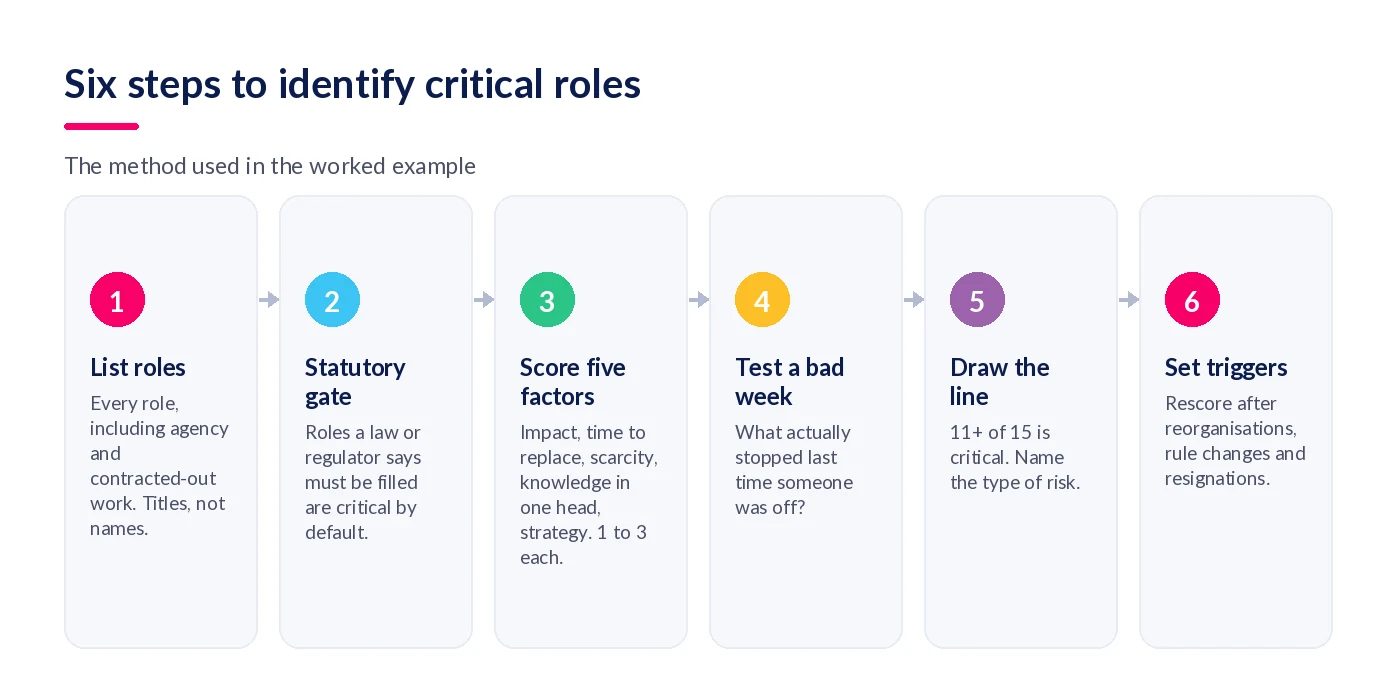
- List roles, not people. Pull every distinct role from the org chart and payroll, including part-time, night-shift, agency-filled and contracted-out roles. Write the role title, not the name of whoever holds it today.
- Run the statutory gate. Mark any role that a law, regulator or licence says must be filled by an approved, registered or competent person. Those roles are critical by default and skip the scoring.
- Score the rest on five factors. Give each remaining role 1 to 3 for impact of a vacancy, time to replace, scarcity of the skills, concentration of knowledge in one person, and weight in next year’s strategy.
- Test the scores against a bad week. Ask the operational managers what actually stopped last time someone was off unexpectedly. Raise any role that caused real disruption but scored low, and write down why.
- Draw the line and name the type of risk. Treat roles scoring 11 or more out of 15 as critical. For each one, record whether the risk is a vacancy, a hidden knowledge store, a statutory gap or a future capability gap.
- Set a review trigger. Rescore after any reorganisation, regulatory change, acquisition or resignation in a critical role, and at least once a year alongside workforce planning.
Two choices in that method are deliberate. First, the scale is 1 to 3, not 1 to 10. A wide scale invites false precision and long arguments about whether something is a 6 or a 7. Three points forces the question that matters: low, medium or high?
Second, step 4 exists because scoring sessions are polite. People underrate roles held by quiet colleagues and overrate roles held by people in the room. Asking “what actually stopped last time?” pulls the conversation back to evidence. At Hadley it moved the planner up two points, after the operations manager described the week the planner was off sick and two lines ran the wrong product sequence.
What Hadley’s list looked like
Here are eight of the roles Hadley scored, out of roughly sixty distinct roles across both sites. Each factor is scored 1 (low) to 3 (high), for a maximum of 15.
| Role | Vacancy impact | Time to replace | Skill scarcity | Knowledge in one person | Strategic weight | Total |
|---|---|---|---|---|---|---|
| Maintenance engineer (main line controls) | 3 | 3 | 3 | 3 | 2 | 14 |
| Production planner | 3 | 2 | 2 | 3 | 3 | 13 |
| Managing director | 3 | 3 | 2 | 1 | 3 | 12 |
| Key account manager (largest retailer) | 3 | 2 | 2 | 2 | 2 | 11 |
| Finance director | 2 | 2 | 2 | 1 | 3 | 10 |
| Payroll officer | 2 | 1 | 1 | 3 | 1 | 8 |
| Night shift production manager | 2 | 2 | 1 | 1 | 1 | 7 |
| HR business partner | 1 | 2 | 1 | 1 | 2 | 7 |
With the line drawn at 11, five roles were critical on score, plus the health and safety adviser through the statutory gate. The finance director, at 10, sat just below the line. The team kept the line where it was: the FD has a capable financial controller and a documented year-end timetable. Moving the line to fit a job title would have undone the exercise.
The payroll officer is the useful near miss. A score of 8 says the role is not critical, but a 3 for knowledge concentration says the person is a dependency. Hadley did not add payroll to the succession plan. It asked the payroll officer to document the month-end routine and cross-trained someone in finance. That is key person risk handled as key person risk, not dressed up as succession.
Five ways a critical-role list goes wrong
It is really a list of senior people
If every name on your list sits in the leadership team, you have probably measured seniority. Check it against the frontline: shift leads, technicians, planners, schedulers. Our post on succession planning for frontline teams goes deeper on roles that never appear in board papers.
It scores people instead of roles
When the conversation turns to “but Sarah is brilliant”, you have stopped assessing the role. Performance and potential belong in the next stage, when you assess candidates. Mixing them in here inflates roles held by strong performers and hides roles held by people who are quietly irreplaceable.
Everything is critical
A list with forty critical roles gets no attention at all. If more than about a quarter of your roles clear the line, raise the threshold or tighten the scoring guidance. The aim is to know where to spend limited development time, not to reassure everyone that their role matters.
It ignores roles you do not employ
Contractors, agency staff and outsourced specialists can be single points of failure too. Hadley’s line control software was originally installed by a contractor whose knowledge the maintenance engineer had absorbed over ten years. If neither of them were available, the gap would have been total.
It is never reopened
Criticality changes when the organisation changes and when the rules change. The FCA’s 12-week rule section was updated in April 2026, and Keeping Children Safe in Education was reissued for September 2026. A list built before either change may now be wrong. Set the review triggers in step 6 and stick to them.

Different kinds of critical need different answers
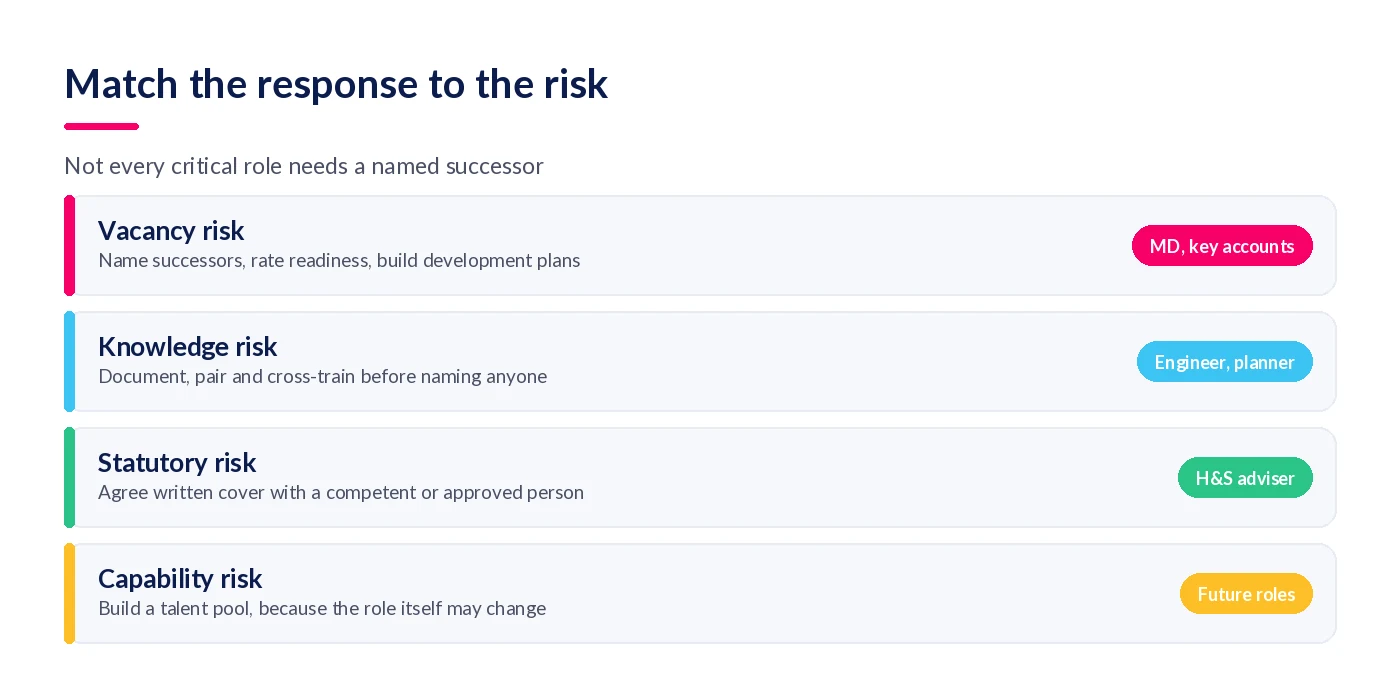
Once the list exists, resist the urge to give every role the same treatment. A named successor is the right answer for some roles and the wrong one for others. Hadley sorted its critical roles by the type of risk each one carried:
- Vacancy risk (managing director, key account manager): name one or two successors, assess readiness honestly and build a development plan for each. Our guide to succession readiness ratings covers how to grade them.
- Knowledge risk (maintenance engineer, production planner): document, pair and cross-train first. A successor who has never shadowed the work is not a successor.
- Statutory risk (health and safety competent person): agree the cover arrangement in writing now, including who is competent to step in and whether external support is needed for the gap.
- Capability risk (roles next year’s strategy depends on): build a talent pool rather than a one-to-one successor, because the role itself may change.
For the first few weeks of an unexpected gap, you also need an emergency plan that names who holds the work on day one. That is a different document from the long-term plan, and we cover it in how to write an emergency succession plan.
Where StaffCircle fits
You can run everything above with a spreadsheet and two workshops. The hard part is keeping the list current and connected to evidence of whether successors are ready.
Role requirements in one place
StaffCircle’s competency frameworks describe what each role needs, including the licences and approvals that put a role through the statutory gate. When a critical role is defined by its competencies rather than its title, you can see which successors are missing what. Our post on competency frameworks for succession planning explains why that matters.
Readiness you can see, not guess
Through Skills & Development, each successor’s skills gaps and personalised development plan show how close they are to being role-ready. That turns “who could step in?” into a question you can answer with evidence.
Successors spotted from everyday work
Success Circles™ build a picture of performance, potential and development from everyday activity on the platform, as an alternative to the 9-box grid. That helps you find candidates for critical roles who would not have come up in a leadership meeting, including on the frontline.
A list that gets reopened
Because objectives, one-to-ones and reviews sit in the same platform, changes to a critical role’s holder or successors show up in the work you already do, rather than in a document nobody opens until someone resigns.
Final thoughts
The most useful thing Hadley’s team did was let the scoring overrule the org chart. Two of their highest risks were in overalls and in a spreadsheet, not in the boardroom, and they would never have found them by starting with a list of directors.
Start with roles, run the statutory gate, score the rest honestly and test the results against the last bad week. Then match each critical role to the type of answer it needs. If you want to see how StaffCircle keeps that picture live, book a demo and bring your current list of critical roles.
FAQ
What is a critical role in succession planning?
A critical role is one where an unplanned vacancy would stop or seriously damage something the organisation must keep doing, and which cannot be filled quickly from inside or outside. Criticality is about the consequence of the gap, not the seniority or salary of the job.
How do you identify critical roles in an organisation?
List every role rather than every person, mark the roles that a law or regulator says must always be filled by an approved or competent person, then score the rest on impact of a vacancy, time to replace, skill scarcity, knowledge concentration and strategic weight. Check the results against what actually broke the last time someone was absent.
Are critical roles always senior leadership positions?
No. The CIPD notes that inclusive approaches identify business-critical roles at all levels. A maintenance engineer who is the only person able to fault-find a production line, a production planner who owns the schedule, or a registered care manager can all be more critical than a director with a capable deputy.
How many critical roles should an organisation have?
There is no reliable benchmark, and published percentages tend to be untraceable. Use a threshold on your own scoring instead. If more than a quarter of roles come out as critical, your scoring is probably too generous; if only the board appears, it is probably measuring seniority rather than risk.
What is the difference between a critical role and a key person?
A critical role is a position whose vacancy would hurt the organisation whoever holds it. A key person dependency is risk attached to one individual because they hold knowledge, relationships or approvals that nobody else does. A role can become critical only because one person has made it so, and the fix there is spreading the knowledge as much as naming a successor.
Which roles are critical because of UK law or regulation?
Common examples are FCA Senior Management Functions, CQC registered managers, the Designated Safeguarding Lead in schools and colleges, the competent person appointed under the Management of Health and Safety at Work Regulations 1999, and roles that need Gas Safe registration. Each has rules about who may do the job and, in some cases, how long cover can last.
Is identifying critical roles the same as succession planning?
No. Identifying critical roles is the first step that tells you where to focus succession planning. The planning itself covers naming successors or talent pools, assessing readiness, closing development gaps and arranging emergency cover.
How often should critical roles be reviewed?
At least once a year, and whenever something changes the answer: a reorganisation, a new regulation, an acquisition, a new strategic priority or a resignation in a role already on the list.
What scoring criteria should I use for role criticality?
Five factors cover most organisations: impact of a vacancy on operations, customers or revenue; time to replace; scarcity of the skills; how much knowledge sits with one person; and how important the role is to next year’s strategy. Treat statutory roles as critical automatically rather than scoring them.
Should every critical role have a named successor?
Not necessarily. Some critical roles are best covered by a talent pool, some by documenting and cross-training knowledge, and some by a formal temporary cover arrangement. Match the response to the type of risk the role carries.
Who should be involved in identifying critical roles?
HR should run the process, but operational managers, finance and whoever owns compliance must score the roles. Senior leaders alone tend to rate roles by visibility, and the people who run the shifts know which absence actually stops work.
Do contractors and agency workers count when identifying critical roles?
Yes. If a contracted-out or agency-filled role would stop operations when that person leaves, it belongs on the list. FCA operational resilience rules, for example, ask firms to identify the people needed to deliver important business services, not only their own employees.
Related articles


See StaffCircle in action
Book a personalised demo and see how StaffCircle drives performance, engagement and development.