Equality Action Plans: Will Your Promotion Decisions Stand Up to Being Published?
How confident are you that your succession decisions would stand up to being published?
Not the promotion itself. Most organisations are comfortable announcing who got the job. I mean the process behind it: who was considered, who was never put forward, what evidence separated the person who got the role from the people who didn't, and whether any of that looks different for women and men.
From spring 2027, large UK employers are expected to have to answer a version of that question in public. Under the Employment Rights Act 2025, employers with 250 or more staff will publish an equality action plan alongside their gender pay gap figures, setting out what they are doing to close the gap and to support employees experiencing menopause. A named senior person takes responsibility for it. Several of the actions on the government's list are about how people get promoted, and those are the ones an annual 9-box grid and a manager's view of "potential" will struggle to evidence. The plans are voluntary for 2026/27, which makes this year the cheapest time to find out.

What an equality action plan actually asks of you
The legal hook is section 33 of the Employment Rights Act 2025, which inserts a new section 78A into the Equality Act 2010. It is an enabling power: it lets ministers make regulations requiring employers to develop and publish a plan "showing the steps that the employers are taking" on gender equality matters. The Act names two of those matters, addressing the gender pay gap and supporting employees going through the menopause, and excludes employers with fewer than 250 employees. Section 33 came into force on 6 April 2026. The regulations that make publication compulsory are still to come.
The detail sits in the government's guidance for employers on creating an action plan. The parts that matter for HR are these:
- Who: employers with 250 or more employees, the same population that already reports a gender pay gap. A group with several legal entities over 250 needs a plan for each one.
- Minimum content: at least two actions from the government list, one addressing the gender pay gap and one supporting employees experiencing menopause. At least two must be "new or in progress", so things you already do well ("embedded" actions) can be listed but do not satisfy the minimum on their own.
- Sign-off: for private and voluntary sector employers, a responsible person who "should usually be a director, partner or senior officer".
- Where: the plan is created, submitted and published on the gender pay gap service, next to your pay gap figures.
- When: voluntary plans for the 2026/27 reporting year are due by 4 April 2027 for private, voluntary and most public employers (30 March 2027 for most public authorities). Gov.uk says plans become mandatory from spring 2027, subject to secondary legislation.
- Afterwards: the review guidance describes, subject to legislation, an interim progress review one and two years after a mandatory plan and a detailed review after three, covering progress on each action.
That last point is the one most commentary skips. An action plan is not a one-off statement. It is a promise you will be asked to report against, by sex, for three years.
The four actions that land on your promotion process
The government list has eighteen actions: twelve aimed at the gender pay gap and six at menopause. Grouped under "developing and promoting staff" and "increasing transparency" are four that go straight to how succession works:
- Automatically consider eligible employees for promotion. Everyone who meets the criteria is in the pool by default and can opt out, rather than having to put themselves forward.
- Encourage employee development through actionable steps. Managers give specific, usable feedback and employees know the behaviours and results expected at each grade.
- Offer mentoring, sponsorship and other development programmes. Matched on career goals and development needs, not "chance or existing friendships", with a set duration.
- Increase transparency for pay, promotion and rewards. Publish the criteria and process for promotions, make internal opportunities visible to everyone, and give people a way to raise concerns if the process wasn't followed.
Each action page has a "tracking progress" section, and that is where the real workload lives. The automatic-consideration page suggests tracking the rate at which employees progress from middle to senior management, "with a specific focus on sex", and the breakdown of applicants and successful candidates. The development page adds employees' understanding of their development goals and "changes in employee's knowledge and skills over time, for example through a skills inventory". The transparency page asks whether men and women doing similar work get similar rewards.
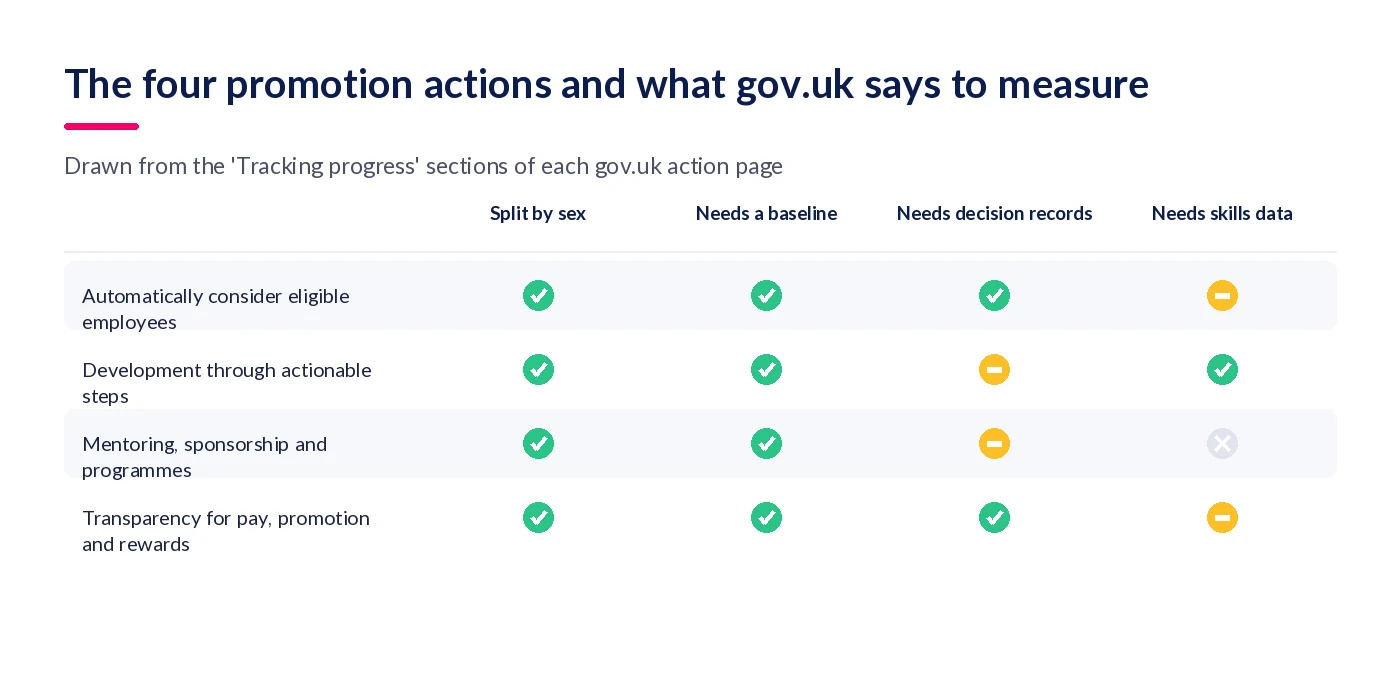
Step 5 of the guidance is blunt about timing: "Record these metrics before you put each action in place." If you start an action in January and only think about measurement in March, you have lost your baseline.
Why the 9-box makes these actions hard to evidence
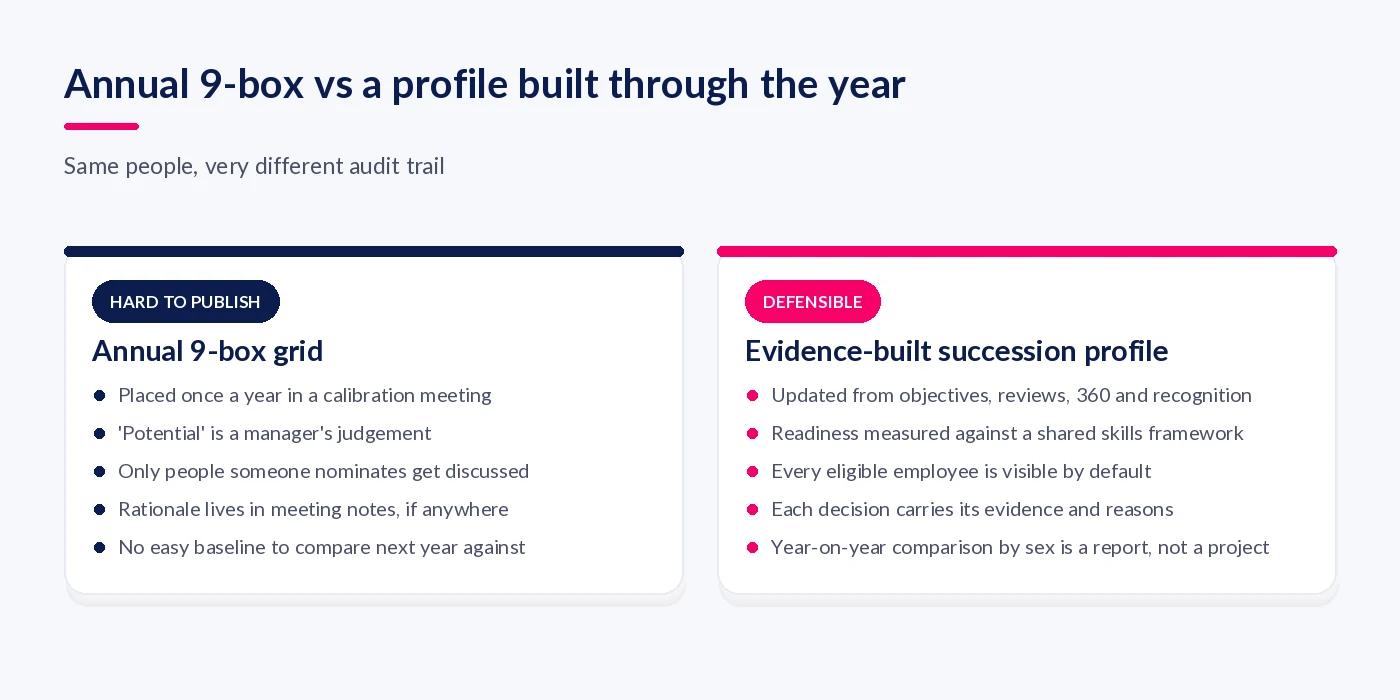
Here is the uncomfortable part. Most mid-sized organisations still make succession decisions the same way: once a year, managers place their people on a 9-box grid in a calibration meeting, a few names get discussed as high potential, and the outcome lives in a spreadsheet and somebody's memory.
Put that process next to the four actions and the gaps are obvious.
- Automatic consideration needs a full population. A 9-box only discusses the people a manager chose to plot. The employee who was never nominated, often because she was on leave, part-time or quieter in meetings, is invisible by design. You cannot show you considered everyone eligible if your process starts with nominations.
- Development needs a shared definition of ready. "Potential" on the vertical axis is a judgement. Without a skills or competency framework, two managers can mean different things by it, and nobody can tell an employee what to do next to move up a box.
- Transparency needs reasons. If the criteria are "the panel's view", publishing them does not help anyone. If the reasons for a decision were never written down, a concern raised six months later cannot be checked.
- Tracking needs comparable data. A grid redrawn each year from scratch is hard to compare with last year's, and harder still to split by sex without a manual exercise.
None of this means the people making 9-box decisions are biased. It means the method leaves no evidence either way. We have written before about alternatives to the 9-box grid and about how unconscious bias works in the workplace; the action plan simply turns those from good-practice arguments into something a director signs off in public.
What a defensible promotion process needs: three things
Strip the guidance back and an HR leader needs three things to put promotion actions in a public plan and still sleep at night.
1. A view of everyone who is ready for the next role, including those who haven't been put forward
This is automatic consideration in practice. You need a way to see readiness across the whole eligible population, built from what people actually did during the year rather than from who was nominated. Then nominations become a check on the data, not the start of the process.
2. Clear development steps for people who are close
For everyone near the line, the question "what would it take?" needs a specific answer: which skills are below the level the next role requires, and what objective, course or stretch assignment closes the gap. That is what "actionable steps" means, and it is what makes mentoring and sponsorship more than a pairing exercise.
3. A record of why each succession decision was made
Who was considered, what the evidence showed, who decided and why. Including the people who were not promoted. That record is what lets you answer the transparency action, handle a concern fairly, and report progress at year one, two and three without rebuilding the story from emails.

Where promotion actions usually come unstuck
Eligibility nobody wrote down
Automatic consideration starts with "organisation-wide criteria to decide who is eligible", in gov.uk's words. Many firms discover they have none, or a different unwritten rule in every department.
A skills language that changes by manager
If the sales team and the operations team describe the same leadership behaviour in different words, readiness cannot be compared across them. A single framework is the fix; our guide to skills frameworks versus competency frameworks covers which one you need.
Evidence split across five systems
Objectives in one tool, reviews in another, training in an LMS, recognition in Teams, and 360 feedback in a survey platform. Pulling a single promotion profile together becomes a project, so it only happens for the people already shortlisted.
No baseline
The plan asks you to show change. If nobody captured applicants, promotions and senior representation by sex before the action began, the first review has nothing to compare against.
Treating the plan as a comms exercise
Picking actions that sound good but cannot be measured is the fastest way to an awkward year-one review. Choose actions you can evidence, then add ambition.
Succession planning, done properly, is the foundation
Promotion actions sit on top of a succession process. If that process is a list of names kept by the leadership team, no action plan will make it look fair. So before getting to tools, it is worth setting out what good succession planning involves, because each step also produces evidence for the plan.
1. Decide which roles matter most
Start with the roles where a vacancy would hurt most: specialist roles, people managers with large teams, and positions with no obvious internal cover. Our guide to identifying critical roles walks through a simple way to score them. For the action plan, this list tells you where to start measuring progression.
2. Define what success looks like in each role
Every critical role needs a profile covering the skills, behaviours and experience the next person will need. Without one, readiness turns into a judgement about whether someone "feels" ready, and that is exactly where bias gets in. A competency framework keeps the bar the same whoever is doing the assessing.
3. Assess readiness against evidence, not impressions
Most organisations group successors as ready now, ready in one to two years, or ready in three years or more. Those groupings only mean something if they come from performance data, review outcomes and development progress rather than one conversation in a calibration meeting. Our article on succession readiness ratings covers how to make the ratings consistent.
4. Close the gaps with development
A successor who is "ready in two years" needs a plan to get there: stretch objectives, mentoring, training or a secondment. If there is no plan, the rating is just a prediction. This is also where the gov.uk development and mentoring actions come in.
5. Review it often, and measure it
Succession plans go out of date quickly. People leave, roles change and new talent emerges. A plan reviewed once a year will always be behind. Track a few succession planning metrics, such as bench strength per critical role, internal fill rate and the share of successors with an active development plan. Split each one by sex, and the same numbers become your action plan baselines.
None of this is new. What the action plan changes is that the outcome is now published, so a process that relies on memory and spreadsheets is much harder to defend.
The clear path: development, succession, skills and AI as one chain
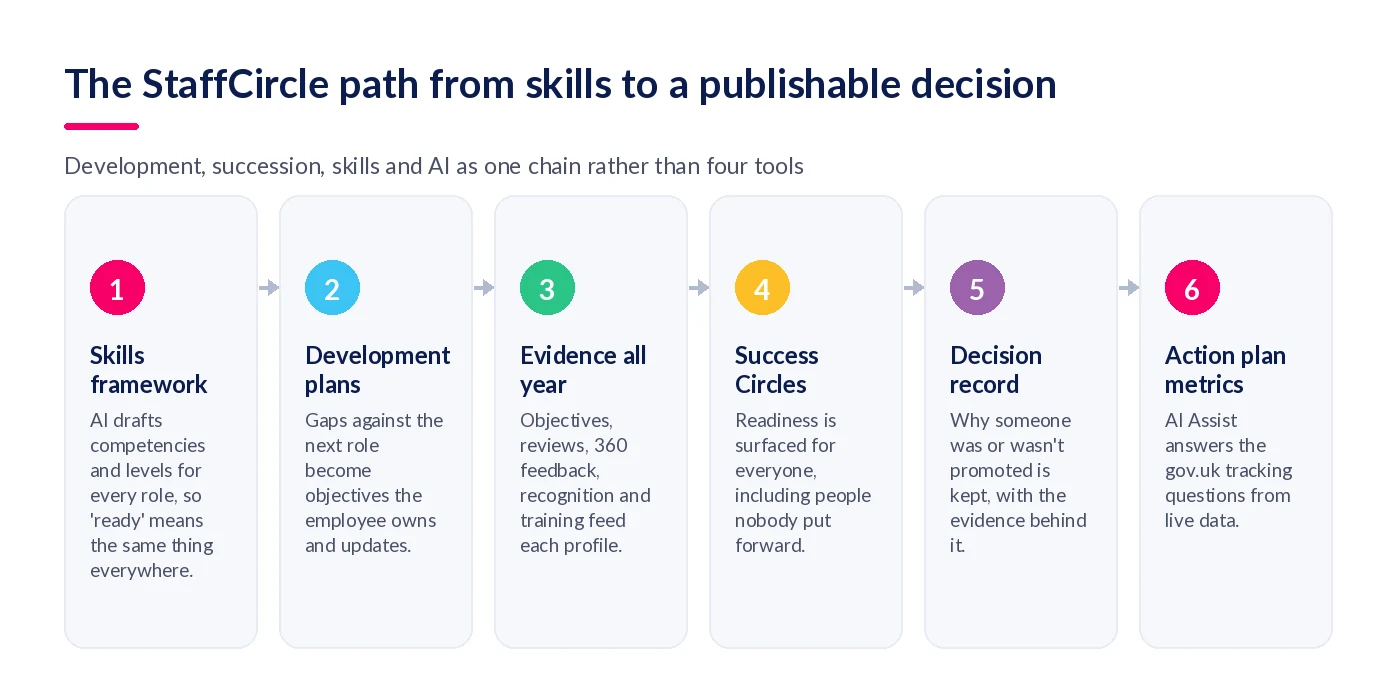
This is the problem we built StaffCircle's development and succession tools to solve, and it is worth being specific about why they work better together than as separate purchases. A promotion decision is only as defensible as the weakest link between "what does this role need?" and "why did we choose this person?" Most organisations hold those links in different systems, or not at all. StaffCircle keeps them in one chain.
It starts with a shared skills language
StaffCircle's AI competency framework drafts the competencies, proficiency levels and behaviours for each role in minutes rather than months, then connects them to reviews, objectives and development plans. That gives every manager the same definition of what "ready for team lead" means, which is the precondition for comparing candidates fairly and for publishing promotion criteria that mean something.
Development plans turn gaps into actionable steps
Once a role has a framework, the gap between someone's current level and the next role's requirement is visible. In StaffCircle development, that gap becomes a personal development plan with objectives the employee owns and updates. That is the "actionable steps" action in a form you can count: who has a plan, what it targets, and how skills change over time.
Success Circles build succession from the year's evidence
Success Circles™ are StaffCircle's alternative to the 9-box grid. Instead of a manager placing someone in a box once a year, Success Circles gather what happens on the platform all year: objectives and check-ins, reviews and 360 feedback, recognition and awards, and development and training. They combine it into a live picture of each person's performance, potential and development, measured against your organisation's values.
In practice, that means:
- Everyone is placed, not just the nominated. Every employee is shown in a circle, from emerging and established talent to future leaders. Someone a manager never mentioned can still show up as ready.
- No manual scoring. The placement comes from everyday activity, so there is no calibration spreadsheet to keep up and no annual re-scoring.
- Always current. When someone finishes a development goal, gets strong 360 feedback or is recognised for living a value, their profile updates. The view in March reflects March, not last October's talent review.
- Risks as well as successors. The succession dashboard shows future leaders, ready successors and bench strength by team, and flags people who may be a flight risk. That way, you can protect the pipeline as well as fill it.
- A clear link to development. Where someone is close but not ready, the gap points to a targeted development plan rather than a vague "next year".
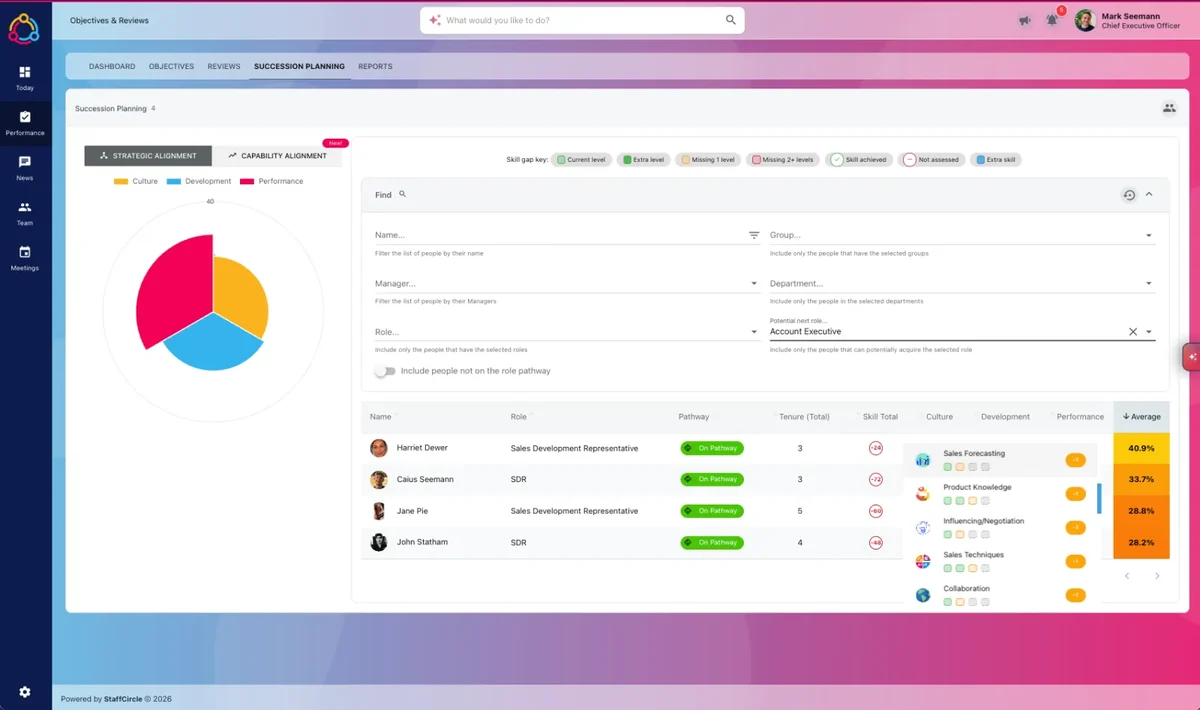
For an equality action plan, this changes the starting point. Automatic consideration happens because every employee has a profile built from the same types of evidence. And because placement rests on recorded activity rather than an impression, it is far easier to explain why one person was ready and another was not. If you're moving away from the grid, our guide to succession planning without the 9-box covers the switch in more detail.
AI Assist answers the tracking questions, and builds the dashboards
AI Assist is built into StaffCircle and already has access to your people data. You ask questions in plain English, such as "who is ready to step up if we lose a team lead?" or "where are our biggest skills gaps before next quarter?" The answers link straight to the right person, objective or department. Before anything is changed on an employee's record, a person has to confirm it.
The reporting is where it saves most time for an action plan. Through StaffCircle's Custom Insights layer, AI Assist turns a question into a governed report or dashboard, with KPIs, charts and a written summary, without anyone building charts or chasing exports. Because dashboards are built from a question rather than from a fixed template, you can create one on the fly for the exact view you need and change it by asking again. For example:
- "Show progression from middle to senior roles over the last 12 months, split by sex, by department."
- "Build a dashboard of leadership readiness by team, with bench strength for each critical role."
- "Which employees with an active development plan have moved up a proficiency level since April?"
- "Compare who was considered for promotion this year with who was promoted."
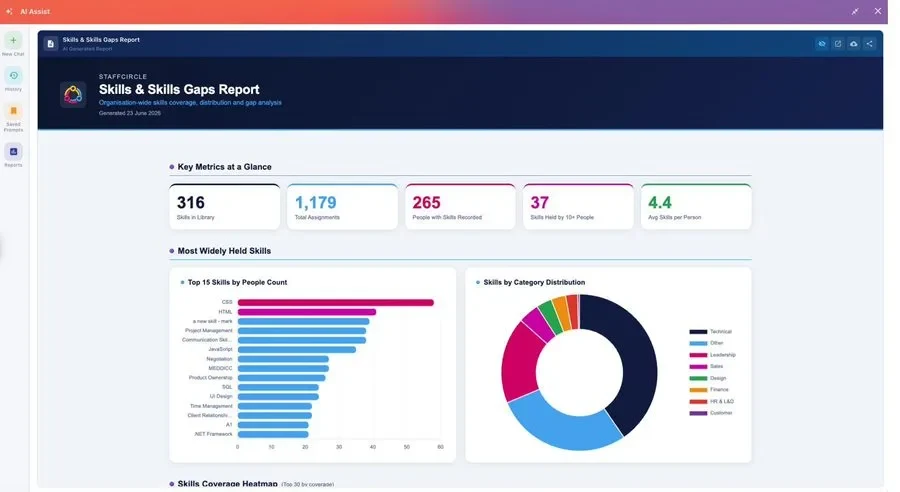
Larger analyses run in the background and tell you when they're ready. You can save, search and share finished reports with colleagues, and AI Assist can also produce board packs, talent maps, skills-gap analyses, nine-box views and org charts. If your leadership team works in Power BI, the Office 365 Power BI app and connector puts the same data there, and scheduled reports can go to the C-suite in the format they prefer.
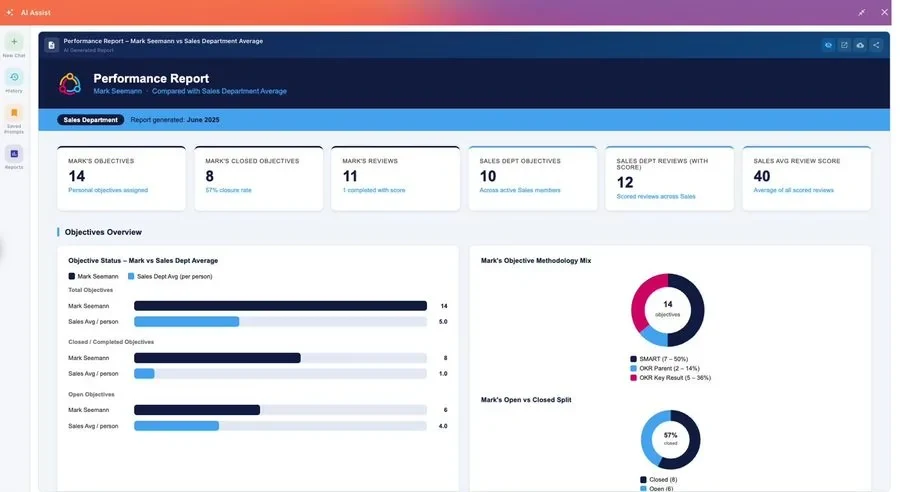
For an equality action plan, that means you can take a baseline before an action starts, re-run the same dashboard at each review point, and give the senior person signing the plan a current view instead of a spreadsheet put together the week before the deadline.
What that gives HR leaders for the action plan
- A view of everyone ready for the next role, including those nobody put forward
- Specific development steps for people who are close, tied to a common framework
- A record of the evidence and reasons behind each succession decision
- One place to pull baselines and year-on-year progress for the review cycle
Use the voluntary year as a dry run
If you have 250 or more employees, the plan you could publish by April 2027 is voluntary. Treat it as a rehearsal for the mandatory version rather than a statement of intent.
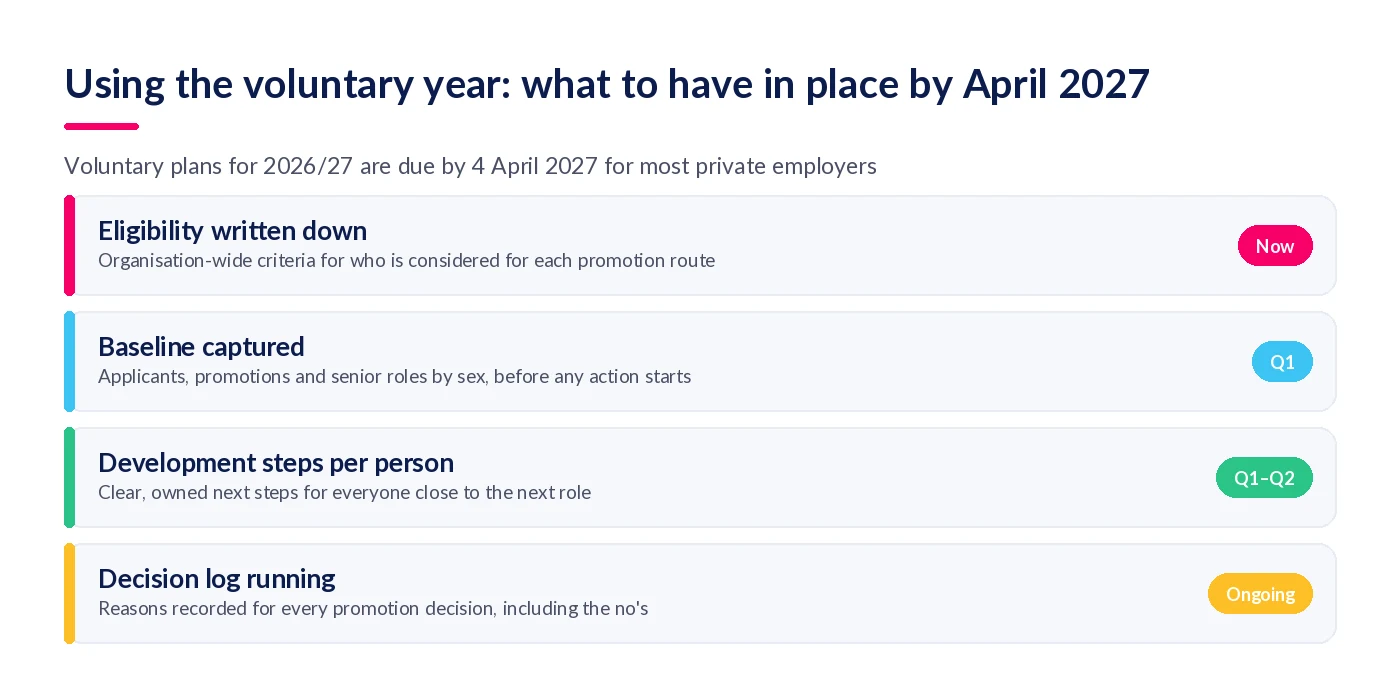
- Pick one promotion route and test it. Take the move from first-line manager to middle manager, for example. Write down who is eligible and check whether your current process considers all of them.
- Capture the baseline now. Applicants, promotions and people in senior roles, split by sex, for the last two years if you can get it.
- Check your skills language. Could two managers in different departments agree on what "ready" means for that route? If not, build the framework before you build the plan.
- Give everyone close to the line a written next step. If you choose the mentoring or sponsorship action, match on development need and set a duration.
- Start a decision log. For every promotion in the route, record who was considered, the evidence, the decision and the reason. Include the no's.
- Ask the hard question at the end. If this route's process were published next to your pay gap, would your responsible director be comfortable signing it?
For the wider legal picture, our overview of the Employment Rights Act and its impact covers the other changes landing on HR teams.
Final thoughts
The equality action plan is short on paper: two actions, a named senior person, a page on the gender pay gap service. The work is in the evidence underneath it. Promotion actions are among the most valuable you can choose, because promotion is where pay gaps are built, but they are also the ones an annual grid and an informal shortlist cannot support.
If you would like to see how StaffCircle connects a skills framework, development plans and Success Circles into one evidence trail, book a demo and bring your hardest promotion route with you.
FAQ
What is an equality action plan?
An equality action plan is a published plan in which an employer with 250 or more employees sets out the actions it is taking to address its gender pay gap and support employees experiencing menopause. It is created and published on the gender pay gap service alongside the employer's pay gap figures.
When do equality action plans become mandatory?
Employers have been able to publish voluntary plans since April 2026. Government guidance says plans will become mandatory from spring 2027, subject to secondary legislation, so the exact first deadline depends on regulations that have not yet been made.
Which employers need an equality action plan?
Employers with 250 or more employees, the same group that must report its gender pay gap. Where a group has several legal entities with 250 or more employees, each entity needs its own plan. Different rules apply to some public authorities in Scotland and Wales.
How many actions must an equality action plan include?
At least two: one that addresses the gender pay gap and one that supports employees experiencing menopause. At least two actions must be new or in progress. The government encourages employers to choose more where possible.
Who signs off an equality action plan?
Private and voluntary sector employers name a responsible person, who should usually be a director, partner or senior officer. Most public authority employers do not need to name one.
Which equality actions relate to promotion?
Four of the government's actions bear directly on promotion: automatically consider eligible employees for promotion; encourage employee development through actionable steps; offer mentoring, sponsorship and other development programmes; and increase transparency for pay, promotion and rewards.
What does automatically considering employees for promotion mean?
It means everyone who meets clear, organisation-wide eligibility criteria is included in the promotion pool by default and can opt out, instead of having to put themselves forward. Gov.uk also advises that selectors should not know who opted in.
What metrics should I track for promotion actions?
Gov.uk suggests tracking progression from middle to senior management by sex, the breakdown of applicants and successful candidates by sex, retention, and changes in skills over time. Record a baseline before each action starts.
Is the 9-box grid compatible with an equality action plan?
It can be used, but it makes promotion actions hard to evidence. A 9-box usually only covers nominated employees, rates potential by judgement and leaves little record of reasons, which works against automatic consideration and transparency.
Do I have to report progress on my equality action plan?
Subject to legislation, gov.uk describes an interim progress review one and two years after a mandatory plan is submitted and a detailed review after three years, covering progress on each action.
Does an equality action plan create paid menopause leave?
No. The plan requires employers to set out actions that support employees experiencing menopause, such as manager training or workplace adjustments. It does not create a statutory right to paid menopause leave.
What is the difference between succession planning and an equality action plan?
Succession planning identifies and develops people for critical roles. An equality action plan is a published commitment to actions that close the gender pay gap and support employees through the menopause. The two overlap on promotion: the plan's promotion actions are only credible if your succession process is evidence-based, consistent and open to everyone eligible.
Can I build custom dashboards for equality action plan metrics in StaffCircle?
Yes. AI Assist turns plain-English questions into governed reports and dashboards, so you can build a view on the fly, such as progression by sex or readiness by team, then re-run it at each review point. Reports can be saved and shared, and the data can also be surfaced in Power BI.
How can software help with an equality action plan?
Software helps by keeping the evidence behind promotion decisions in one place: a shared skills framework, development plans, year-round performance data and a record of decisions. StaffCircle combines these with Success Circles for live succession views and AI Assist for on-demand reports and dashboards, so progress metrics come from live data.
Related articles


See StaffCircle in action
Book a personalised demo and see how StaffCircle drives performance, engagement and development.