Emergency Succession Plan: Covering a Role at Short Notice
At 07:40 on a Monday, Priya, Head of People at a 420-person home care provider, took a call from her chief executive. Mark, the operations director, had been admitted to hospital overnight and would be off for at least six weeks. Mark was also the registered manager for the largest branch, one of two signatories on the main bank account, and the only person who knew how to approve Wednesday's payroll in the finance system. The company had a succession plan. It named Mark's successor for 2028. It said nothing about Tuesday.
(Priya and her employer are a composite, built from situations HR teams describe. The gaps are real.)
An emergency succession plan sets out who covers each critical role at short notice when its holder suddenly leaves or is absent, what that person is authorised to do, and how the handover happens. It differs from long-term succession planning: it names an interim for days or months, not a successor for years, and it is built around access, authority and know-how so the role keeps working from the first morning.
Key facts
- An employee with a month's service can legally resign on one week's notice.
- FCA firms can cover an absent senior manager for under 12 weeks in any 12 months without approval.
- CQC must be told within 5 working days of an emergency absence of a registered manager lasting 28 days or more.
- A UK private company must have at least one director at all times.
Most guides to emergency succession are written for boards replacing a chief executive. This one is for the HR lead who has to make a role work on Tuesday, whether it belongs to a director, a branch manager or the one person who runs payroll.

Why your succession plan does not help on a Monday morning
A normal succession plan answers a long-term question: who could step into this role when it falls vacant, and what development do they need first? The CIPD's succession planning factsheet describes the aim as being able to fill key roles effectively if an employee leaves or changes role. That work runs on a horizon of years.
An emergency plan answers a different question: who runs this role from tomorrow, and can they actually do it? The best long-term successor may be the wrong interim. They may be on leave, mid-project, or not yet trusted with the bank. The interim needs things a development plan never covers: logins, approval limits, the supplier who only answers one person's calls.
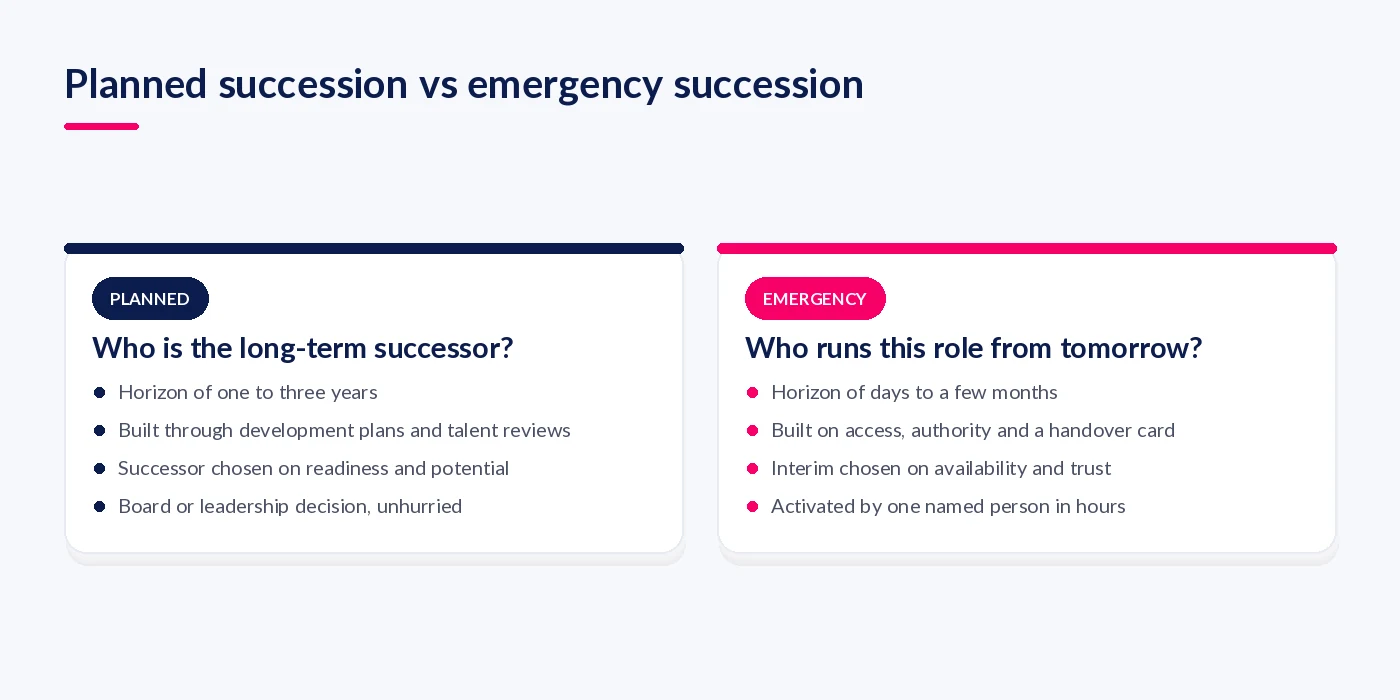
You need both, and they should share data. The interim you name today is often your best evidence about who is ready for the permanent role later.
Which roles need emergency cover first?
Start with roles where a sudden gap would stop money moving, break a legal duty or halt a service within a week. Seniority is a poor guide. A payroll administrator can be more critical in an emergency than a director with a capable deputy.
For each role on your list, the emergency plan must answer:
- Who covers it from tomorrow, and who covers if they are also unavailable?
- What can the interim approve, sign or spend, and what must they escalate?
- Which systems, accounts and buildings do they need access to, and who grants it?
- Which regulator, client or bank must be told, and by when?
- Where is the know-how written down: recurring tasks, key contacts, decisions in flight?
- How long can the arrangement run before you appoint permanently?
A quick way to build the list: ask each director, "If this person did not come in tomorrow, what would fail first and when?" Any answer under a week goes on the list. If you already keep a skills matrix, look for rows where only one name has the skill at a usable level.
The deadlines that start the moment someone goes
This is the part most emergency succession guides skip. In the UK, several sudden departures start a statutory or regulatory clock, and your plan should name who watches each one.
| Situation | What the rule says | What your plan needs |
|---|---|---|
| Resignation | An employee with one month's continuous service must give "not less than one week" of notice (Employment Rights Act 1996, s.86). Contracts often require more. | Assume the worst case is one week of handover, or none if you choose garden leave. |
| Garden leave | An employer may ask someone not to come in during notice; they get "the same pay and contractual benefits" (gov.uk). | Agree in advance which knowledge must be captured before access is removed. |
| Long-term sickness | Statutory Sick Pay can be paid for up to 28 weeks (gov.uk). | Plan interim cover in blocks and review it, because the return date is often unknown. |
| FCA senior manager absent | Cover for an absent SMF manager is allowed without approval if the absence is temporary or reasonably unforeseen and the cover lasts "less than 12 weeks in a consecutive 12-month period" (FCA Handbook SUP 10C.3A.6R). | Name the interim from your conduct rules staff and diarise week 12. SUP 10C.3A.8R extends cover for unforeseen absences only if a valid approval application is made before then. |
| CQC registered manager absent | For absences of 28 days or more, an emergency absence must be notified "within 5 working days of its occurrence", including the management arrangements and plans to appoint (CQC (Registration) Regulations 2009, reg 14). | Keep a pre-drafted notification with the interim manager's details. |
| Company director | "A private company must have at least one director"; a public company needs at least two (Companies Act 2006, s.154). | Sole-director companies need a documented plan for appointing another director quickly. |
There are quieter duties too. Under the Management of Health and Safety at Work Regulations 1999, reg 7, employers must appoint "one or more competent persons" to help them meet health and safety duties. If that is one person, their absence is an emergency succession question as well.
This is not legal advice, but a plan without these dates is a list of names, not a plan.
What goes on a one-page cover card
The working unit of an emergency succession plan is a cover card: one page per critical role, kept current and stored where the interim and HR can both reach it. A forty-page continuity manual tends to go out of date first. A card is short enough to review at every one-to-one.
| Field | What to record |
|---|---|
| Interim and backup | Two named people, and confirmation they have agreed |
| Authority | Spend, approval and signing limits the interim holds, and what goes to whom |
| Access | Systems, admin rights, bank mandates and buildings, plus who grants each |
| Recurring tasks | Anything weekly, monthly or annual that only this person does now |
| Key relationships | Clients, suppliers, regulators and internal contacts who need a call |
| Deadlines | Statutory, regulatory and contractual clocks linked to the role |
| Where the know-how lives | Links to procedures, recordings and the shared folder |
| Last reviewed | Date and reviewer, so stale cards are easy to spot |

Bank mandates and admin rights deserve special attention. Changing them usually takes longer than anyone expects, so the best time to add a second signatory or a second system administrator is before you need one.
The first 72 hours, step by step
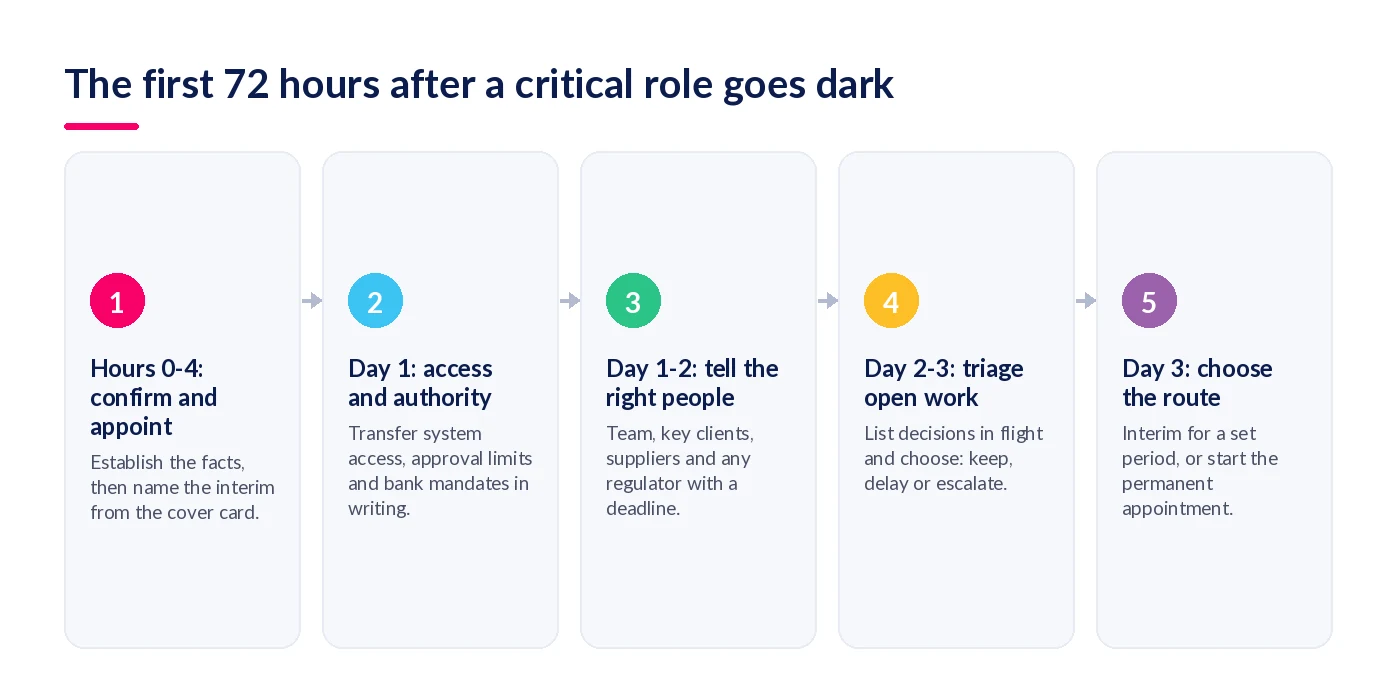
When the call comes, the plan should turn panic into a sequence. This is the order that works for most roles.
- Confirm and appoint (hours 0 to 4). Establish what has happened and the likely duration, without pressing an unwell employee or their family for detail. Then activate the cover card and tell the interim, in writing, that they are acting.
- Transfer access and authority (day 1). Grant the system access, approval limits and mandates on the card, and record the date. Interim authority that exists only verbally gets challenged the first time it is used.
- Tell the people who need to know (days 1 to 2). The team first, then key clients and suppliers, then any regulator with a deadline. Share only what the absent person would reasonably expect to be shared.
- Triage open work (days 2 to 3). List every decision, approval and contract in flight. For each, choose: the interim takes it, it waits, or it goes up a level.
- Choose the route (day 3). Decide whether this is interim cover for a set period, with a review date, or the start of a permanent appointment. Put the decision and the review date in writing.
Interim cover or a permanent successor?
Do not let an emergency make a permanent decision by accident. An interim who stays six months has, in practice, been appointed without a selection process, and others who wanted the role will notice.
Use interim cover when the absence has a likely end, when the long-term successor is not ready yet, or when the role itself may change. Move to a permanent appointment when the holder is not coming back and you have a ready candidate, or when a regulator requires a named permanent holder by a date.
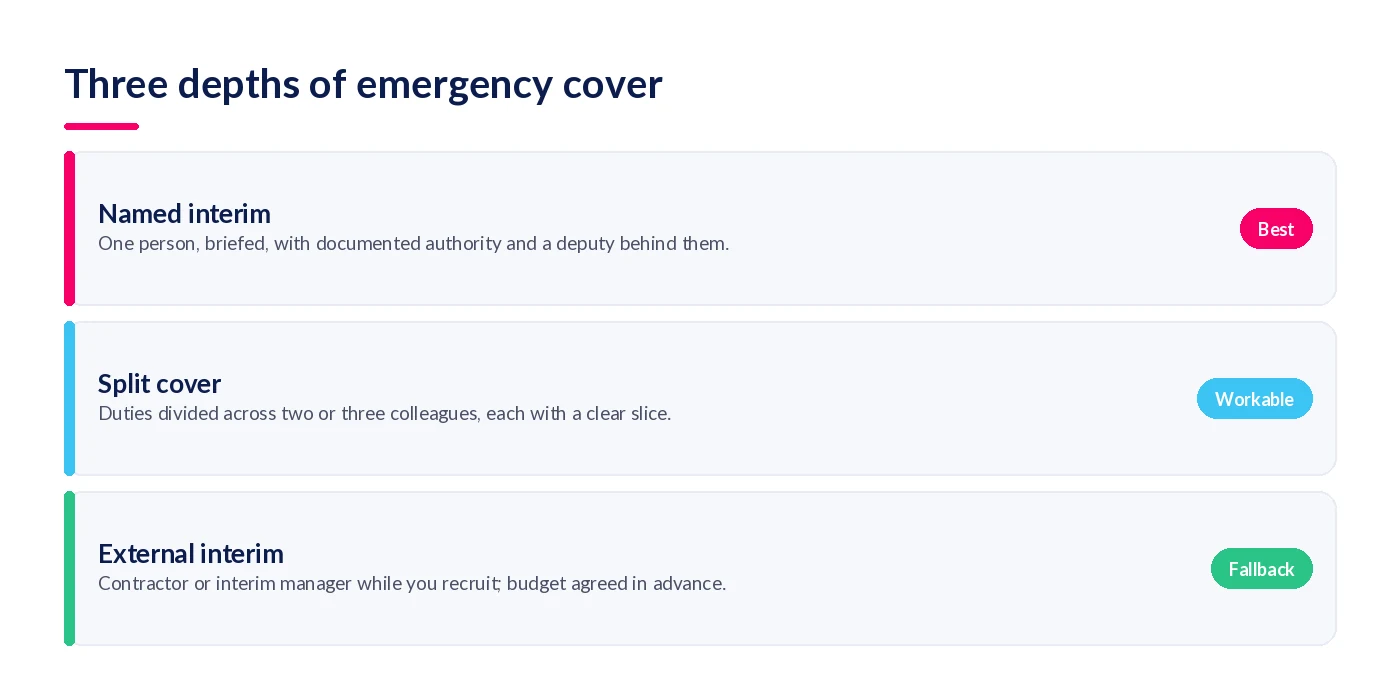
Whichever you choose, deal with pay and terms early. Many employers have an acting-up or higher-duties policy that sets when extra pay applies and for how long. If yours does not, agree the temporary change in writing, including how long it is expected to last. Unclear acting-up arrangements are a common source of later grievances.
Where emergency succession plans fall over
One person holds three roles
Priya's operations director was a director, a registered manager and a bank signatory. Map role holders, not just roles, and look for anyone whose absence triggers more than one card.
The same deputy covers everything
If one capable deputy is the named interim for four roles, you have a plan for one absence, not two. Check that no backup appears on more than two cards.
The card is out of date
Passwords change, suppliers change, interims leave. A card reviewed once a year will be wrong when you need it. Tie the review to a routine that already happens, such as a quarterly one-to-one or a talent review meeting.
Frontline roles are left off
Shift leaders, site supervisors and the only trained first-aider on a night shift rarely appear in succession plans, yet their absence stops work fastest. Our guide to succession planning for frontline teams covers how to build depth there.
Nobody practises
The quickest test is a planned absence. When a critical role holder takes two weeks of annual leave, run the cover card for real and note what was missing.
Back to Priya: what she would do differently
Priya got through the week. The chief executive approved payroll after an anxious call to the bank, a branch deputy acted as manager, and the CQC notification went in on day four. Here is the 30-day plan she used afterwards, which works for most mid-sized organisations:
- Week 1: list critical roles with directors, using the "what fails first" question. Keep the list short enough to maintain.
- Week 2: draft a cover card for each, starting with roles that have a statutory or regulatory clock.
- Week 3: fix the gaps the cards expose: add second signatories and administrators, write down the single-person tasks.
- Week 4: brief every named interim, confirm they agree, and schedule the first review. Use the next planned annual leave as a test.
The useful output is the list of gaps, not the cards themselves.
How StaffCircle helps you plan for the unplanned
An emergency plan is only as good as what you know about your people. StaffCircle keeps that knowledge in one place, so naming an interim is a decision based on evidence rather than memory.
See who could step in, on live data
StaffCircle's employee development software uses Success Circles to visualise competencies, and brings live skills and performance data into succession planning. When you need an interim, you can see who has the relevant competencies now, not who was rated well two years ago.
Build depth before you need it
Development plans link each named interim to the gaps that would hold them back, so cover cards become development goals rather than paperwork. Our guide to competency frameworks for succession planning shows how to define those gaps.
Keep reviews in the rhythm of work
Regular check-ins in StaffCircle's performance management software give you a natural point to review cover arrangements with each critical role holder. For the wider picture, see our guide to succession planning software.
Final thoughts
An emergency succession plan is not a smaller version of your succession plan. It is a different tool for a different morning. Name the roles where a gap would hurt within a week, write one cover card for each, find the deadlines that start when someone goes, and test the cards whenever someone takes planned leave. Then a call at 07:40 on a Monday is a bad morning, not a crisis.
If you want to see how StaffCircle connects skills, performance and succession data so your interims are ready before you need them, book a demo.
FAQ
What is an emergency succession plan?
An emergency succession plan names who covers each critical role at short notice if its holder suddenly leaves, falls ill or dies. It sets out the interim's authority, the access they need, who must be told and how the handover works, so the role keeps operating from the first day while a longer-term decision is made.
How is an emergency succession plan different from regular succession planning?
Regular succession planning develops future successors over years for when a role becomes vacant. An emergency plan covers the next days or months: it names an interim chosen for availability and trust, and focuses on access, authority and know-how. The two should share data, because good interims often become strong long-term candidates.
Which roles need an emergency succession plan?
Any role where a sudden gap would stop money moving, break a legal or regulatory duty, or halt a service within about a week. That includes directors, but often also payroll, finance approvers, registered managers, health and safety competent persons and frontline supervisors. Seniority alone is a poor guide to criticality.
Who should be named as an emergency interim successor?
Choose someone who is available, trusted with the role's authority and familiar with its work, plus a backup. The best long-term successor is not always the best interim. Avoid naming the same person as interim for more than two roles, or one absence can leave several roles uncovered at once.
What should an emergency succession plan include?
For each critical role: a named interim and backup, the authority they hold, the systems and accounts they need, recurring single-person tasks, key relationships, any statutory or regulatory deadlines, where documented know-how is kept, and the date the plan was last reviewed. One page per role is usually enough.
How often should an emergency succession plan be updated?
Review each cover card at least quarterly and whenever the role holder, interim, systems or key suppliers change. Linking the review to an existing routine, such as one-to-ones or talent reviews, keeps it current. A plan reviewed once a year is likely to be out of date when it is needed.
Should every company have an emergency succession plan?
Yes, scaled to its size. A small business may need only a few cover cards, but small firms are often the most exposed, because one person holds the bank mandate, key clients and core systems. A private company must also always have at least one director under the Companies Act 2006.
How much notice does an employee have to give in the UK?
Under section 86 of the Employment Rights Act 1996, an employee with at least one month's continuous service must give at least one week's notice. Contracts often require longer, but you should plan on the basis that a critical role holder could leave with one week's handover, or none on garden leave.
How long can an FCA-regulated firm cover an absent senior manager?
Under FCA Handbook SUP 10C.3A.6R, a firm can appoint someone to cover an absent SMF manager without FCA approval for less than 12 weeks in a consecutive 12-month period, if the absence is temporary or reasonably unforeseen. SUP 10C.3A.8R can extend this when a valid approval application is made in time.
When must CQC be told a registered manager is absent?
Under regulation 14 of the CQC (Registration) Regulations 2009, absences of 28 days or more must be notified. Planned absences need notice no later than 28 days before they start; emergency absences must be notified within 5 working days, including the management arrangements and plans for appointing a replacement.
What should happen in the first 72 hours after a key person leaves suddenly?
Confirm the facts and appoint the interim in writing within hours. On day one, transfer access, approval limits and mandates. Over days one and two, tell the team, key clients, suppliers and any regulator with a deadline. By day three, triage open work and decide between interim cover and a permanent appointment.
How do you pay someone who covers a more senior role temporarily?
Follow your acting-up or higher-duties policy if you have one; it usually sets when extra pay starts and how long the arrangement can last. Without a policy, agree the temporary change in writing, including expected duration and any pay adjustment. Setting terms early avoids disputes when the arrangement ends.
Related articles


See StaffCircle in action
Book a personalised demo and see how StaffCircle drives performance, engagement and development.