Leadership Competency Framework: Building One That Managers Recognise
Claire is HR director at a 480-person facilities management company. The board has asked her for a leadership competency framework by the end of the quarter, so she does what most people do: she finds a good public one, the NHS Healthcare Leadership Model, and adapts it. Nine dimensions, a four-point scale, a tidy PDF.
Three weeks later she runs it past her site team leaders. One of them reads “Connecting our service” twice, puts the page down and says, “I run a cleaning crew across two hospitals and a school. Where am I in this?”
That is the problem with most leadership frameworks: sound, well researched, and written for someone else. This post follows Claire as she rebuilds hers into something her managers recognise as their job.
A leadership competency framework is a short set of leadership behaviours, written separately for each level of manager, that describes what good leadership looks like in your organisation. A useful one has about six competencies, shows how each changes from team leader to senior leader, and uses observable indicators that two managers would rate the same way. That makes it usable in reviews, promotion and succession.
What is a leadership competency framework for?
A leadership competency framework exists to make leadership decisions consistent. Without one, “good manager” means whatever the person hiring, rating or promoting thinks it means.
Before writing a word, Claire listed the questions the framework had to answer. Yours will probably look similar:
- What do we expect of a first-time team leader in their first year, and how will they know?
- What changes when someone moves from leading a team to leading team leaders?
- What evidence should a reviewer look for when rating a manager’s leadership?
- Who is ready for the next level, and on what basis?
- Where should development money go, given the gaps the framework shows?
None of these is “what are the twelve qualities of a great leader?” For the basics of structure, see our guide to what a competency framework is.
First-line managers are where this matters most. In CMI’s 2023 research with YouGov, 82% of managers who enter management positions had not had any formal management and leadership training. CMI calls them “accidental managers”. If most of your team leaders arrive untrained, the framework may be the only written description of the job they ever see.
Why borrowing a public framework rarely works
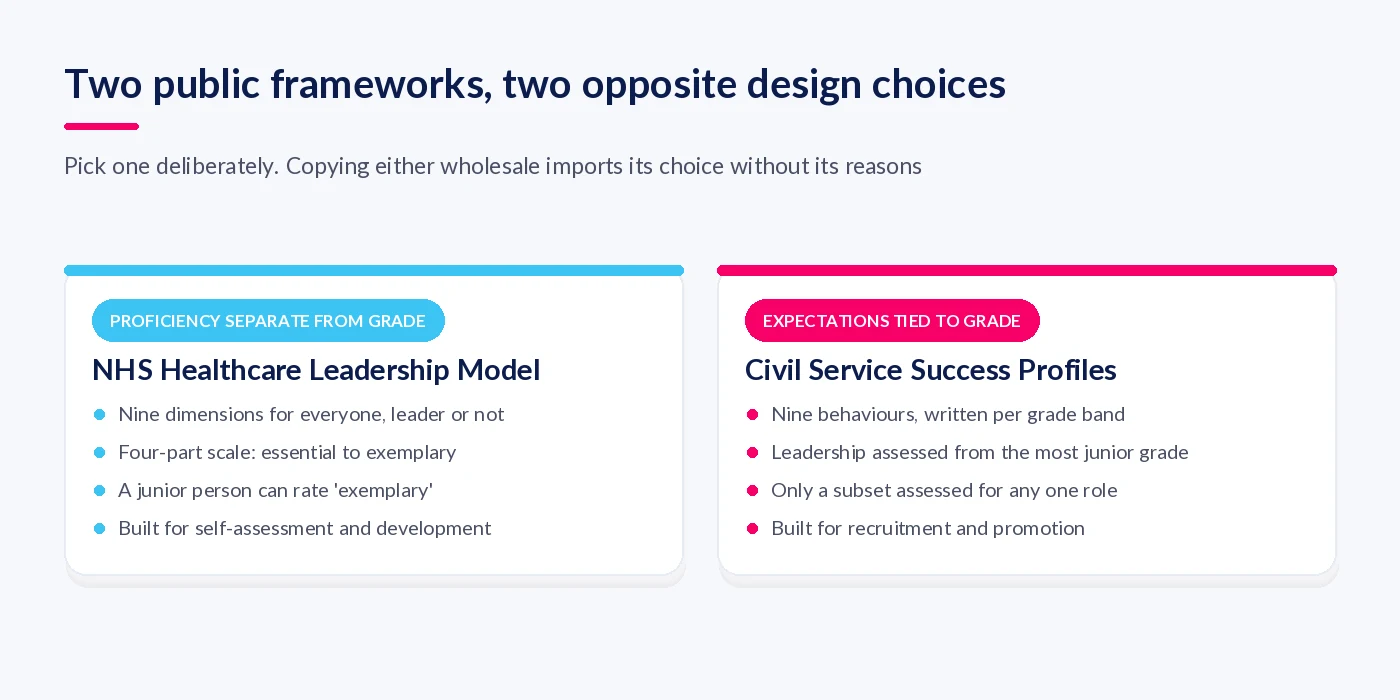
Public frameworks are worth studying, but copying one wholesale usually fails because each was built around design choices you may not share. The most important of those choices is whether expectations are tied to grade. The two best-known UK public frameworks answer that question in opposite ways.
The NHS Healthcare Leadership Model has nine dimensions and uses “a four-part scale which ranges from ‘essential’ through ‘proficient’ and ‘strong’ to ‘exemplary’”. It says plainly that the scale is not tied to particular job roles or levels, so a junior person can be “exemplary” and a senior one “essential”. It is designed for everyone, whether they lead a team of five or 5,000, and it works best as a development and self-assessment tool.
The Civil Service Success Profiles do the reverse. They also list nine behaviours, but state that “Civil Service Behaviours are specific to the grade level of the job role”, with each behaviour described separately for each grade band. And they add an important rule: “You will not be asked to demonstrate all Civil Service Behaviours for one role.” That makes them well suited to recruitment and promotion.
Two more UK reference points are useful. The CMI Professional Standard groups nine areas of competency into three sections and describes four stages of manager, from aspiring manager to executive. The government’s management apprenticeship standards describe each level of leadership in plain language; more on those below.
| Framework | Built for | Tied to level? | What to borrow |
|---|---|---|---|
| NHS Healthcare Leadership Model | Development and self-assessment across the NHS | No: one scale for everyone | Clear, behavioural dimension descriptions |
| Civil Service Success Profiles | Recruitment and promotion | Yes: written per grade band | Assessing only a subset of behaviours per role |
| CMI Professional Standard | Professional recognition of managers | Yes: four stages | A balanced spread across self, people and results |
| Management apprenticeship standards | Training and assessment of managers | Yes: Levels 3, 5 and 7 | Plain-language descriptions of how scope widens |
There is also an older warning from the research. Bolden and Gosling, writing in the journal Leadership, described the competency approach as a repeating refrain that promises to simplify selecting and developing leaders, yet reflects only a fragment of leadership’s complexity. Their comparison found a substantial difference in the weight given to the moral, emotional and relational side of leading. The lesson is not to abandon frameworks but to write them in the words your managers use about their real work, which a copied framework cannot do.
How do leadership expectations change from team leader to senior leader?
Leadership expectations widen in three ways as people move up: the scope of strategy they own, the time horizon they work to, and how far their influence has to reach beyond their own authority. The clearest public evidence for this is the UK’s management apprenticeship standards, because they describe each level in the employer’s own terms.
- Team leader (Level 3). The Team Leader or Supervisor standard describes “a first line management role” that must communicate organisational strategy and deliver against operational plans, “translating goals into deliverable actions for the team, and monitoring outcomes.” Decisions are about delivery, and the team leader should escalate issues when required.
- Manager of managers (Level 5). The Operations or Departmental Manager standard adds knowing how to “lead multiple and remote teams and manage team leaders”, and being able to “input into strategic planning and create plans in line with organisational objectives.”
- Senior leader (Level 7). The Senior Leader standard expects people to take account of “global/macro level market trends and environmental influences, identifying longer-term opportunities and risks”, and to lead “beyond area of control/authority”.
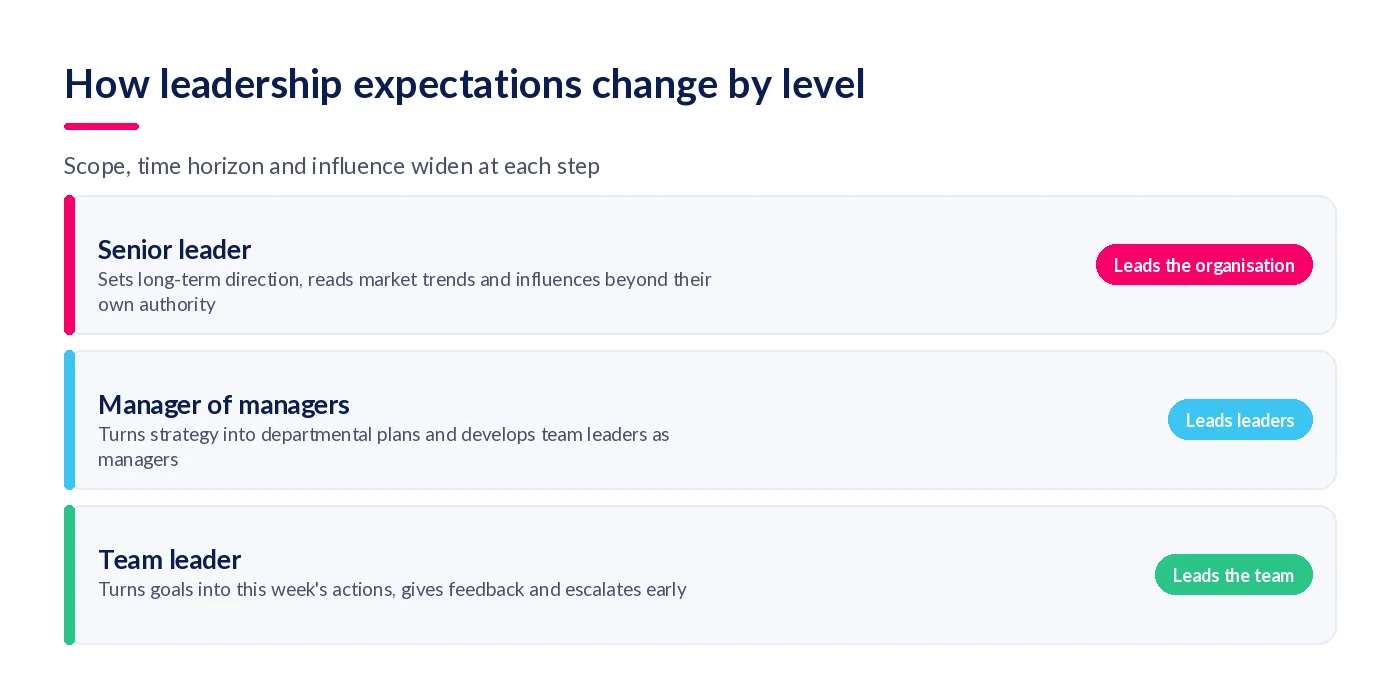
So strategy goes from being communicated, to being contributed to, to being set. The Civil Service shows the same shift in its own wording: at EO grade, making effective decisions means to “take responsibility for making effective and fair decisions, in a timely manner”; at Deputy Director, it means to “act decisively and make bold, unbiased decisions at a strategic level”.
For Claire, this settled the first design question. Her organisation runs on three layers (site team leaders, contract managers and the executive team), so her framework would have three levels tied to role. She needed it for promotion decisions, so the NHS model’s grade-free scale was out.

Six steps to a framework managers recognise
Building a leadership competency framework that managers use takes six steps: fix the levels, choose a small set of competencies, write each at every level, test the indicators, check them with managers, and connect the framework to the processes that already run your year.
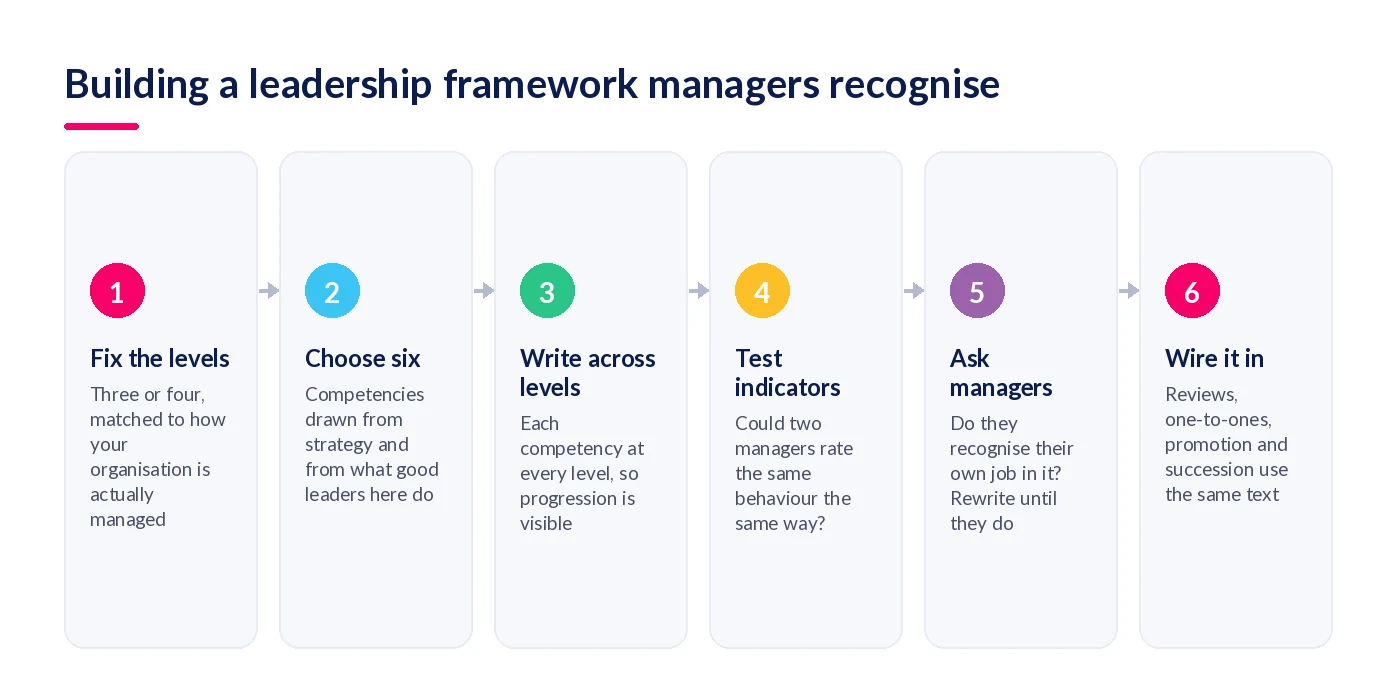
1. Fix the levels
Match the levels to how your organisation is actually managed, not to your pay grades. Three or four is typical. If team leaders and supervisors do the same job under different titles, they are one level.
2. Choose about six competencies
Start from your strategy and from what your best managers already do, then cut hard. Published guides recommend anything from four to twenty competencies, without evidence either way. Claire settled on six: setting direction, making decisions, developing people, managing performance, leading change and building relationships. Her values (how people are treated) sat across all six rather than as a seventh competency.
3. Write each competency at every level
This is the step most frameworks skip. Write the same competency once per level, so a manager can see what “better” looks like before promotion. The full grid is below.
4. Test every indicator
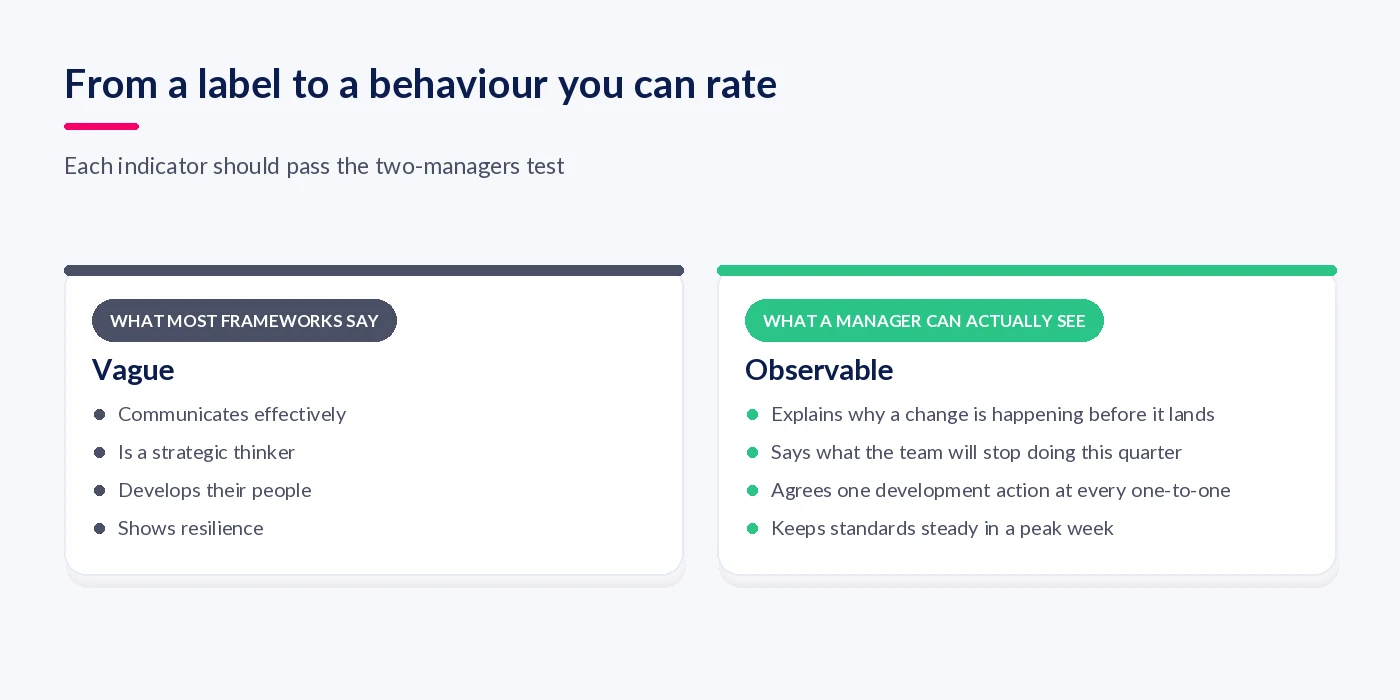
Apply one test to every behavioural indicator: could two managers watching the same person for a week give the same rating? “Communicates effectively” fails, because everyone defines it differently. “Explains why a change is happening before it lands” passes, because you can see whether it happened.
If your scale is the harder part, our guide to defining proficiency levels so managers score consistently goes deeper on rating scales.
5. Ask managers whether they recognise their job
Claire took the draft back to the same team leader who had put the NHS version down. This time the question was simple: is this your job? Anything that drew a blank look was rewritten in the words they used, or removed. Two rounds were enough.
6. Connect it to reviews, promotion and succession
A framework that only appears in a launch email is dead within a year. Use the same text in one-to-ones, reviews, promotion criteria and successor discussions, so managers meet it all year.
A leadership framework you can adapt
This is a condensed version of Claire’s framework: six competencies across three levels, one headline indicator each. It is a starting point to rewrite in your own language, not a finished standard.
| Competency | Team leader | Manager of managers | Senior leader |
|---|---|---|---|
| Setting direction | Turns team goals into this week’s priorities and explains why they matter | Translates strategy into departmental plans and balances competing priorities across teams | Sets a three-to-five-year direction and decides what the organisation will stop doing |
| Making decisions | Makes day-to-day calls and escalates with options, not just problems | Makes trade-offs across teams using evidence and explains the reasoning to those affected | Decides with incomplete information, owns the risk and revisits decisions when evidence changes |
| Developing people | Holds regular one-to-ones and gives specific feedback within days | Develops team leaders as managers and delegates real decisions to them | Names successors for critical roles and moves talent across functions |
| Managing performance | Sets clear expectations and deals with slipping standards early and fairly | Makes sure team leaders set objectives and handle underperformance consistently | Sets the standard for performance conversations and holds the leadership team to it |
| Leading change | Explains changes to the team, listens to concerns and feeds them back | Plans how change rolls out across teams and removes blockers | Decides which changes the organisation takes on, and in what order |
| Building relationships | Works with other shifts and teams to fix shared problems | Influences peers and functions they do not manage | Influences clients, partners and boards beyond their own authority |
Eighteen indicators fit on one page, which is about as much as a manager will carry into a one-to-one. For more patterns, see our competency framework examples.
Using the framework in reviews and succession
A leadership competency framework earns its keep when it changes decisions about people. That means using it in three places: performance reviews, promotion and succession planning.
In reviews, rate two or three competencies a cycle rather than all six, alongside objectives. Ask for evidence: a real situation, dated, rather than an impression. Behaviours line managers rarely see are better informed by upward or 360-degree feedback.
In promotion, the next level’s indicators become the criteria. A team leader who develops a deputy and influences other sites is showing manager-of-managers behaviour; one who simply hits targets is a good team leader, which is valuable but different.
In succession, the same indicators define readiness. Our post on what “ready now” should actually mean covers the evidence standard in detail, and competency frameworks for succession planning covers the wider link. If you need a structure for the whole plan, our succession planning guide with free customisable templates includes successor mapping.

One caution: Hollenbeck and McCall argued that executive performance must focus on “what gets done” rather than on one way of doing it. Use the framework to structure the conversation about evidence, not to penalise a leader whose style differs from an indicator’s wording.
Where leadership frameworks lose their managers
Most leadership frameworks fail quietly: nobody objects, and nobody uses them.
Too many competencies
Twelve competencies at four levels is 48 descriptions. Nobody holds that in their head, so ratings default to one general impression.
Adjectives instead of behaviours
“Resilient”, “strategic” and “inspiring” describe a person, not something they did. They invite bias, because the rater fills the gap with their own picture of a leader.
The same words at every level
If a team leader and a director are both rated on “thinks strategically”, the framework cannot tell you who is ready to step up. Progression has to be visible in the wording.
The senior team exempts itself
When executives are not reviewed against the senior level, everyone below notices. The framework becomes something done to managers rather than a standard leaders hold themselves to.
How StaffCircle keeps the framework in daily use
StaffCircle is performance management software that puts a leadership competency framework into the conversations where managers actually lead.
Build the framework once, by level
StaffCircle’s AI competency framework tools draft role expectations with the skills and levels each role needs, which you review and edit before anyone sees them. Customers report around 40 minutes to build a competency framework, which leaves more time for the manager testing that makes it work.
Ratings with evidence, not memory
Competency ratings sit alongside objectives, one-to-ones and reviews, so the evidence for a leadership rating builds up through the year. Gaps can feed directly into personalised development plans.
Succession that follows the evidence
Success Circles, StaffCircle’s evidence-based alternative to the 9-box grid, brings skills, performance and development signals together, so successor views reflect what leaders are actually showing rather than last year’s impression.
Final thoughts
Claire’s second framework was shorter, less polished and much more used: six competencies instead of nine dimensions, three levels instead of one scale, and indicators her team leaders had argued about. The test of a leadership competency framework is not whether it would impress a consultant. It is whether a new team leader can read it and say, “Yes, that is my job.”
If you would like to see how StaffCircle connects your leadership framework to reviews, development and succession, book a demo.
FAQ
What is a leadership competency framework?
A leadership competency framework is a short set of leadership behaviours, written separately for each level of manager, that sets out what good leadership looks like in your organisation. It gives one shared standard for hiring, developing, reviewing and promoting managers.
What is the difference between leadership and management competencies?
Management competencies cover running the work: planning, resourcing, monitoring results and fixing problems. Leadership competencies cover direction and people: setting purpose, developing others, leading change and influencing. Most UK frameworks, including the CMI Professional Standard, combine them, because every manager needs both.
How many competencies should a leadership framework have?
Keep it to about six competencies, each written for every level. Published advice ranges from four to twenty, and none of it is backed by firm evidence. The Civil Service also assesses only a subset of its behaviours for any one role.
What are behavioural indicators?
Behavioural indicators are the observable actions that show a competency is being demonstrated, such as explaining why a change is happening before it lands. A good indicator describes something a manager could see or hear in a normal week, so two people watching the same behaviour would rate it the same way.
What leadership competencies do first-line managers need?
First-line managers need to turn goals into the team's daily priorities, hold regular one-to-ones, give specific feedback quickly, deal with dropping standards early and fairly, and escalate problems with options. The Team Leader apprenticeship standard describes the role as translating goals into deliverable actions for the team and monitoring outcomes.
How do leadership competencies differ for senior leaders?
Senior leaders work over a longer time horizon and well beyond their own authority. The Senior Leader apprenticeship standard expects them to read macro-level market trends, use horizon scanning to shape strategy, and lead beyond their area of control.
Should we adopt the NHS or Civil Service leadership framework?
Use them as reference points, not as your framework. They were built for different organisations, and they make opposite design choices: the NHS model separates proficiency from grade, while the Civil Service ties behaviours to grade. Borrow structure and ideas, then write the indicators in your own managers' language and test them.
How do you assess leaders against a competency framework?
Rate two or three competencies at each review, using dated evidence from one-to-ones, feedback and real situations rather than memory. Add upward or 360-degree feedback for behaviours that a line manager rarely sees. Then calibrate ratings across managers.
How do you use a leadership competency framework in succession planning?
Use the next level's indicators as the readiness standard. A team leader is ready to manage managers when they already show most of that level's behaviours, backed by evidence and a second assessor's agreement.
How long does it take to build a leadership competency framework?
It depends on size and how much testing you do. Published estimates range from eight weeks to more than sixteen months, and none cites evidence. A short framework with six competencies and three levels, drafted by a small group and tested with real managers, is achievable within a single quarter.
How often should a leadership competency framework be reviewed?
Review it once a year and whenever your strategy or structure changes significantly. Check which indicators managers find hard to rate or never use. Small annual edits are better than a full rewrite every five years.
See StaffCircle in action
Book a personalised demo and see how StaffCircle drives performance, engagement and development.