How to Run a Talent Review Meeting That Produces Decisions
Quick answer: A talent review meeting is where managers and HR bring performance and potential evidence for a group of employees into one room, calibrate the ratings against a shared rubric, and leave with dated decisions — who moves into a talent pool, who gets a named development action, who is ready for a role change — rather than an updated 9-box grid and nothing else. It only produces decisions if pre-work happens before the room fills, ratings are calibrated against a rubric rather than the peer sitting next to someone, and every placement carries a written rationale an auditor or an employee could later ask to see.
The meeting itself is rarely the problem. Ten managers turn up with a laptop each, someone projects a 9-box grid, ratings get argued over for ninety minutes, and everyone leaves feeling like useful work happened. Three months later nobody can say who was supposed to get a stretch assignment, why one manager’s whole team clustered in the top-right box, or what evidence backed the one placement that got queried afterwards. The meeting produced a grid. It did not produce decisions.
That gap is a design problem, not a facilitation problem. Fix what happens before the room fills, what the room is asked to do once it does, and what happens to the output afterwards, and the same ninety minutes starts producing outcomes instead of an updated spreadsheet.
What Is a Talent Review Meeting?
A talent review meeting is a structured session, usually run once or twice a year with an interim check midway, where a leadership group looks at performance and potential evidence for a defined population — a function, a level, or the whole management team — and makes calibrated decisions about development, mobility and succession. It sits downstream of individual performance reviews and upstream of a formal succession plan: performance reviews generate the evidence, the talent review interprets it as a group, and succession planning acts on what the review decided.
A talent review meeting that works answers four questions for every person discussed:
- What is the evidence for this person’s current performance and future potential, and has someone outside their own manager seen it?
- Where do they sit once that evidence is calibrated against people in comparable roles, not just against their own team?
- What is the one development action, mobility move or succession placement that follows from that placement?
- Who owns that action, and by when does it need to have happened?
Most organisations run the first two reasonably well. The room is good at producing a grid. It is the third and fourth questions — the ones that turn a grid into a decision — that get skipped when the meeting runs out of time.
Talent Review vs Performance Review vs Calibration Meeting
These three terms get used interchangeably and it causes real confusion in planning an HR calendar, so it is worth separating them. A performance review is a conversation between one manager and one employee about how that person performed against their own goals, typically feeding pay or a rating. A calibration meeting is the mechanism inside a talent review — the specific agenda item where ratings from different managers are compared and adjusted so that “strong performer” means the same thing across the room. A talent review meeting is the wider session that calibration sits inside: it takes the calibrated ratings and turns them into pool membership, development actions and succession placements. You can run calibration without a full talent review. You cannot run a useful talent review without calibration somewhere in it.
Where the Legal Risk Actually Sits
Most guidance on talent reviews treats the legal exposure as an afterthought, if it mentions it at all. It shouldn’t be. A talent review meeting is a selection decision — it decides who gets development spend, who gets fast-tracked, and who gets nothing — and selection decisions are exactly what UK discrimination law scrutinises.
Section 19(2) of the Equality Act 2010 sets out indirect discrimination as a practice that is applied equally to everyone but puts people who share a protected characteristic at a particular disadvantage, and that the employer cannot show to be “a proportionate means of achieving a legitimate aim”. A 9-box placement decided on gut feel, with no written rationale, is precisely the kind of practice that is hard to defend once challenged — not because the outcome was necessarily wrong, but because there is nothing to point to that shows how it was reached.
This is also where the CIPD’s succession planning factsheet is useful. It contrasts the traditional model of succession planning — “highly structured, confidential and top-down” — with a modern approach built on “greater openness and diversity”. The practical translation is that the room needs a documented rubric before it starts calibrating, and the output needs to record the evidence a placement was based on, not just the placement itself.
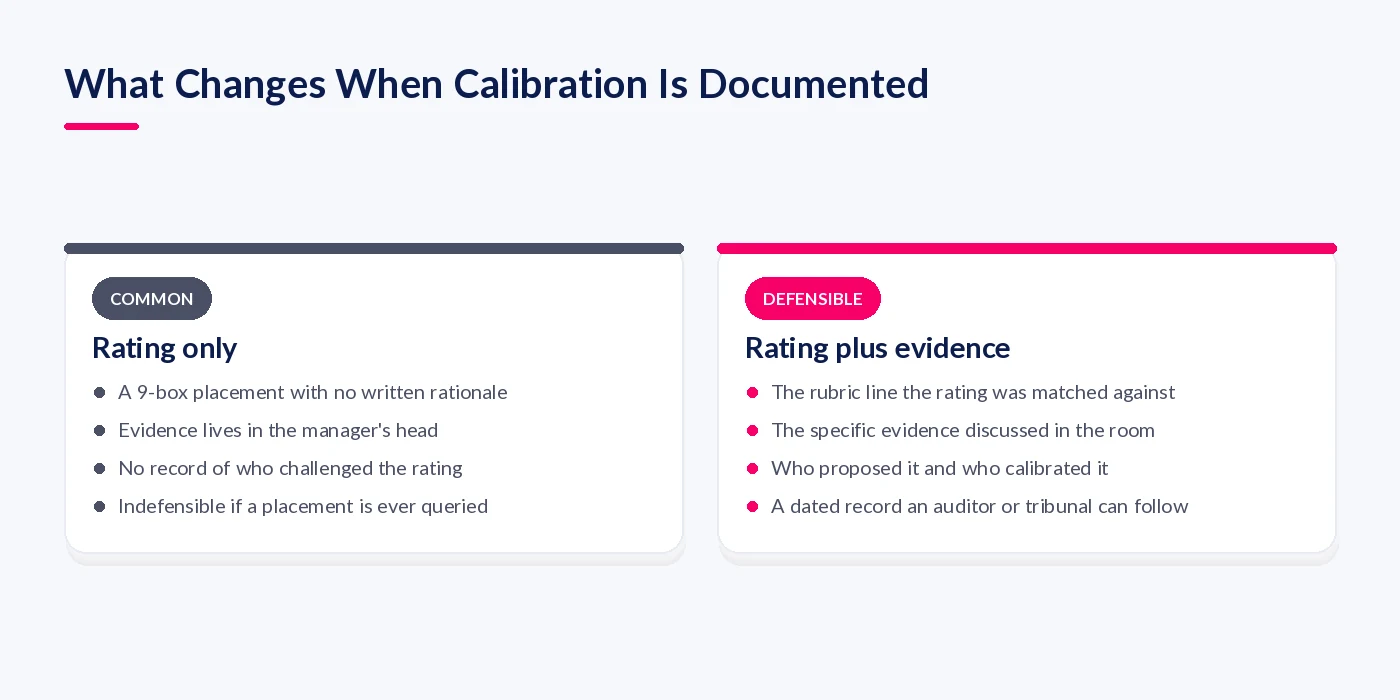
None of this means a talent review needs a lawyer in the room. It means the same discipline that makes calibration fair — a rubric, a challenge process, a written rationale — is also what makes it defensible. Get the fairness right and the legal exposure mostly takes care of itself.
How to Run a Talent Review Meeting
The process below assumes a group of 8–15 managers reviewing a population of 40–80 people, which comfortably fits a 90–120 minute session. Scale the timings, not the stages, for a bigger or smaller group.
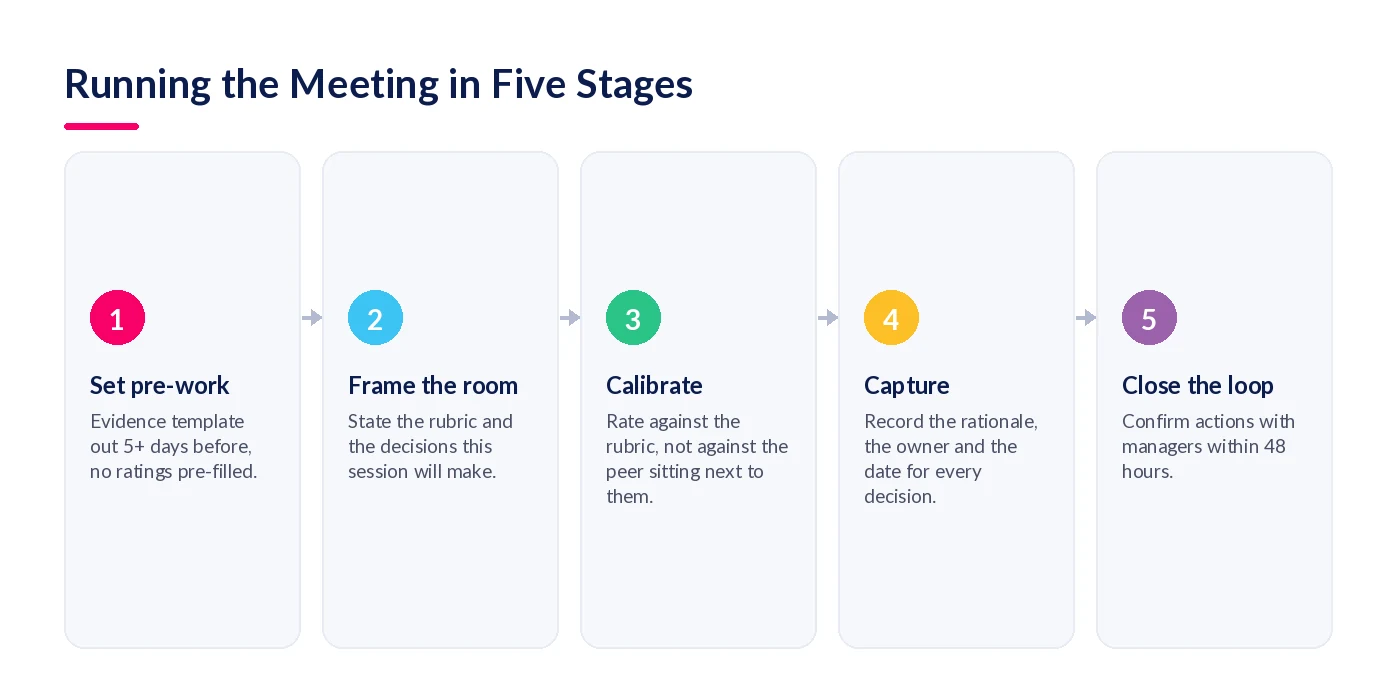
- Set the pre-work, and send it out at least five working days before. Every manager fills in a short evidence template per person: current performance rating and the evidence behind it, a proposed potential rating, one flight-risk flag if relevant, and one proposed development action. Ratings should be proposed, not final — the room exists to challenge them.
- Open by stating the rubric, not the agenda. Before any names come up, put the definition of each performance and potential band on screen and agree it applies to everyone in the room the same way. This single step is what stops the meeting drifting into “my team is stronger than yours”.
- Calibrate in tiers, most senior or most business-critical roles first. For each person, the proposing manager states the rating and the evidence in under a minute, the room is invited to challenge it against the rubric, and a facilitator who is not that person’s manager records the final placement. Watch for a rating that shifts once challenged — that is calibration working, not a manager being wrong.
- Capture the decision, not just the position on the grid. For every person discussed, record the final rating, the one piece of evidence it turned on, who proposed and who challenged it, and the single next action with a named owner and a date. A grid position with no action attached is not a decision.
- Close the loop within 48 hours. Send each manager their team’s outcomes and the actions they now own, and put a date in the diary — typically a quarter out — to check whether those actions actually happened. Talent reviews fail on follow-through more often than they fail on the meeting itself.
Step 3 is where most rooms get vague about what “potential” actually means. A useful shortcut is to force every potential rating into one of three readiness tiers rather than a single abstract score:
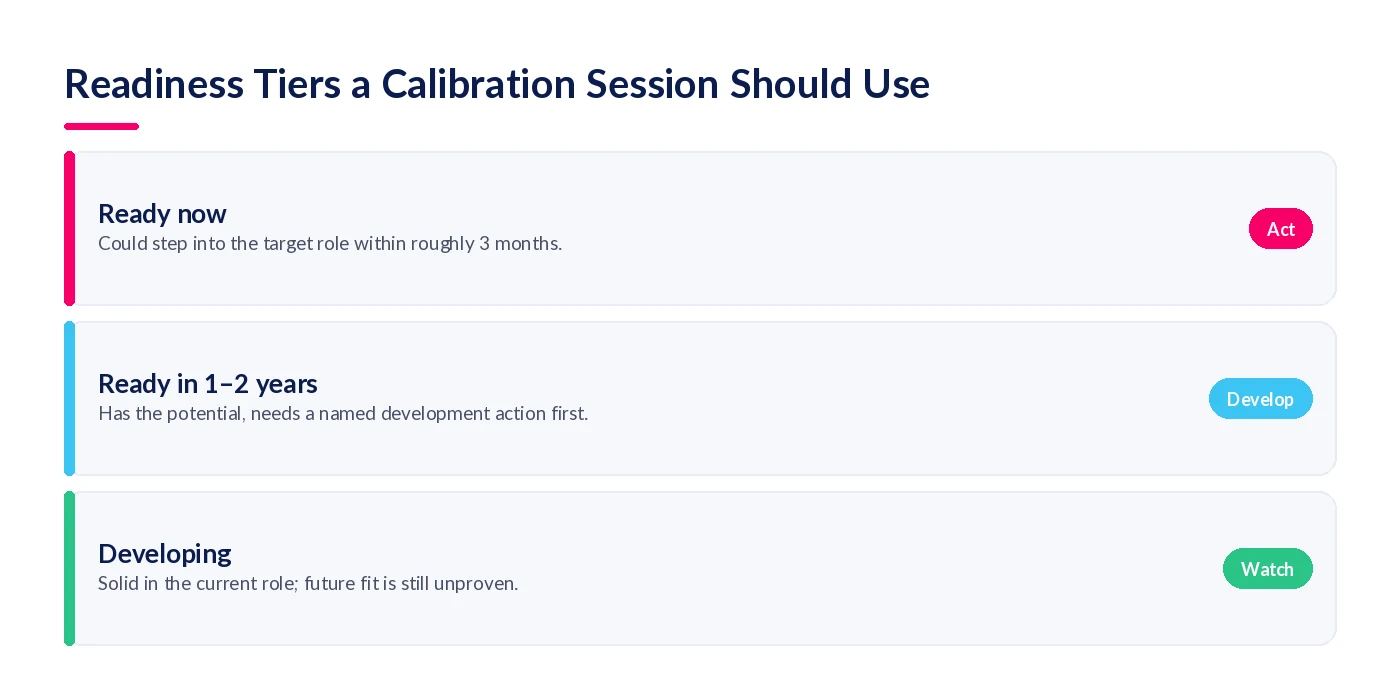
Forcing a tier rather than a number does two things. It makes the room argue about something concrete — could this person actually do the target role in three months, yes or no — instead of debating whether someone is a 7 or an 8. And it gives the “ready in 1–2 years” tier, which is usually the largest and most neglected group, a mandatory development action instead of a label that sits untouched until next year’s review.
Where Talent Review Meetings Break Down
The same handful of bias patterns recur across talent review meetings, and naming them out loud at the start of the session — before anyone’s name comes up — measurably reduces how often they happen. A facilitator whose only job is to watch for these, rather than also managing their own team’s ratings, catches most of them.
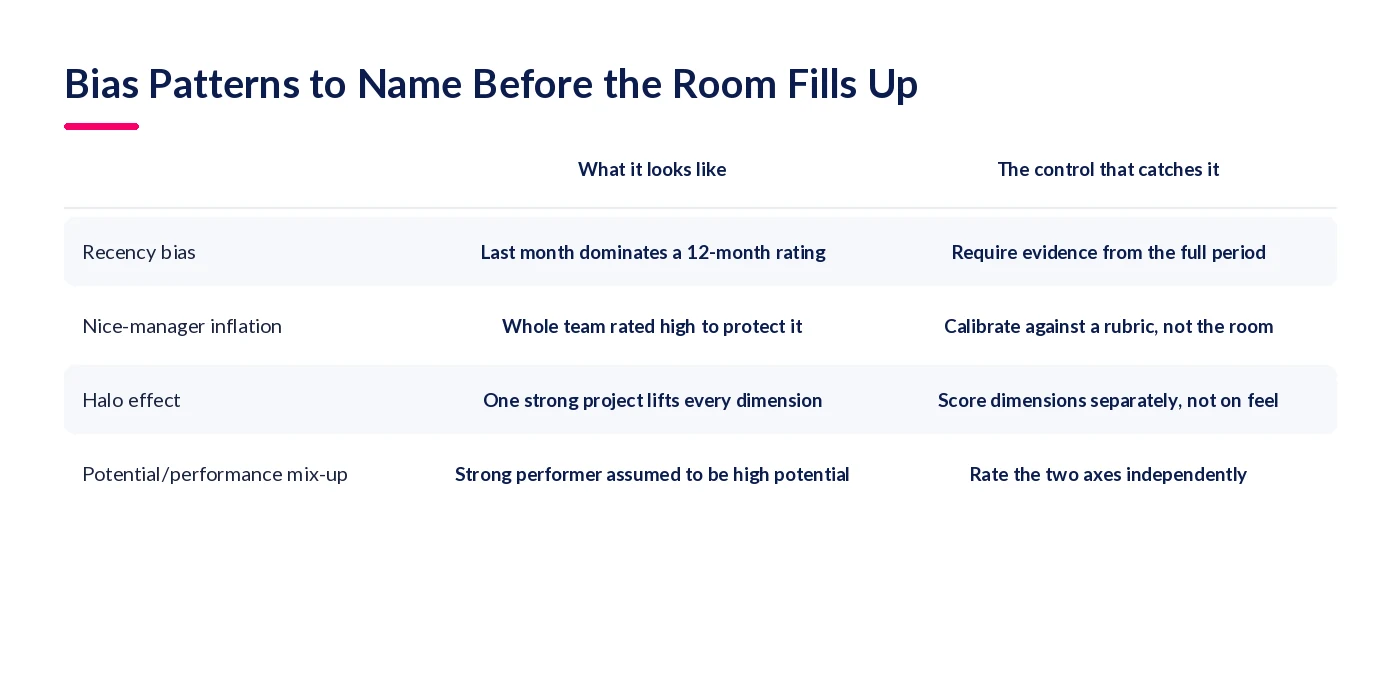
Two other failure modes sit outside that table because they are structural rather than behavioural. The first is no follow-through: the meeting produces a grid, the grid gets filed, and nobody checks in a quarter later whether the development actions actually happened. The second is treating the grid as the record: a 9-box position tells you where someone landed, not why, and “why” is the part that matters if a placement is ever challenged by the employee it was about.
A Practical 90-Minute Talent Review Agenda
This is a worked example for a single-function review — one department, roughly 40 people, 8–10 managers in the room. Split the calibration block across two sessions for a larger population rather than compressing the other stages.
| Time | Agenda item | Purpose |
|---|---|---|
| 0–10 min | State the rubric and the decisions this session will make | Aligns the room on what “strong” and “ready” mean before any names come up |
| 10–20 min | Flag retention risks and any role changes since the last review | Surfaces context that changes how evidence should be read |
| 20–70 min | Calibrate, most senior or business-critical roles first | The core discussion — propose, challenge, place, capture |
| 70–85 min | Agree the one development action for every “ready in 1–2 years” placement | Stops the largest tier leaving the room with no next step |
| 85–90 min | Confirm who owns write-up and the 48-hour send-out | Sets the follow-through mechanism before anyone leaves the room |
The single biggest predictor of whether a talent review produces decisions is whether that last row actually happens. A meeting that ends without a named owner for the write-up defaults to whoever remembers to do it days later, which in practice means it often does not get done at all.
How StaffCircle Supports Talent Review Meetings
StaffCircle does not replace the conversation — the judgement calls in a talent review still belong to the people in the room. What it removes is the manual work of assembling evidence beforehand and the manual work of chasing actions afterwards, which is where most reviews lose momentum.
Evidence assembled before the room fills
Performance ratings, goal progress and competency framework assessments already sit in one record per employee, so the pre-work template pulls real evidence instead of a manager reconstructing a year from memory the night before.
A calibration view the room can actually use
A live 9-box view that the facilitator can filter by function or level means the room is calibrating against the same rubric and the same visible evidence, not a slide someone built from a spreadsheet the week before.
Decisions that turn into tracked actions
Every placement made in the room can be written back as a rationale, an owner and a date attached to that person’s record, and the development action links directly into that person’s existing development plan rather than living in a separate document nobody opens again.
Final Thoughts
A talent review meeting is not hard to run well. It is hard to run well consistently, because the parts that make it work — pre-work discipline, a stated rubric, a facilitator watching for bias, a 48-hour write-up — are the parts that get cut first when the calendar is tight. Protect those over protecting meeting length, and the same ninety minutes starts producing named actions instead of an updated grid. Book a demo to see how StaffCircle turns talent review evidence and decisions into one connected record.
FAQ
What is a talent review meeting?
A talent review meeting is a structured session where managers and HR bring performance and potential evidence for a group of employees, calibrate ratings against a shared rubric, and leave with dated decisions about development, mobility and succession for the people discussed.
What is the difference between a talent review and a performance review?
A performance review is a conversation between one manager and one employee about how that person performed against their own goals. A talent review looks across many employees at once, compares them against each other and against a shared rubric, and produces decisions about future potential rather than a rating on past performance alone.
What is the difference between a talent review meeting and a calibration meeting?
Calibration is the specific agenda item inside a talent review where ratings proposed by different managers are compared and adjusted so ratings mean the same thing across the room. The talent review is the wider session that takes those calibrated ratings and turns them into pool membership, development actions and succession placements.
How long should a talent review meeting last?
Ninety to 120 minutes comfortably covers a group of 8–15 managers reviewing 40–80 people. Larger populations should be split across two or more sessions by function or level rather than compressed into one long meeting, since calibration quality drops once attention fatigue sets in.
How often should you run talent review meetings?
Most organisations run a full talent review annually, with a shorter interim check around six months later to catch role changes and flight risks. Fast-moving teams sometimes move to quarterly reviews, but the pre-work burden on managers needs to scale down to match the shorter interval.
Who should attend a talent review meeting?
The direct managers of the population being reviewed, a facilitator from HR who is not managing anyone in the room, and typically one level of senior leadership above the managers to sponsor the decisions and unlock cross-team moves. Keeping the group to 8–15 people keeps calibration workable.
What is talent calibration?
Talent calibration is the process of comparing performance or potential ratings that different managers have proposed for their own people, and adjusting them against a shared rubric so that a rating means the same thing regardless of which manager gave it.
How do you stop a talent review meeting from being subjective?
State the rubric before any names come up, require written evidence for every proposed rating rather than an opinion stated in the room, have a facilitator who is not managing anyone present watch specifically for bias patterns, and record the rationale behind every final placement, not just the placement itself.
What is the difference between high performance and high potential?
High performance describes how well someone is doing their current role. High potential describes their capacity to succeed in a materially different, usually more senior, role. The two are frequently conflated in talent review meetings, which is why they should be rated on separate axes rather than blended into one score.
Can a talent review meeting create legal risk?
Yes. A talent review is a selection decision, and under section 19 of the Equality Act 2010 a practice that is applied equally to everyone but disadvantages people sharing a protected characteristic can amount to indirect discrimination unless the employer can show it was a proportionate means of achieving a legitimate aim. A documented rubric and a written rationale for each placement are what make a decision defensible if it is ever challenged.
What documents do you need before a talent review meeting?
A written rubric defining each performance and potential band, a pre-work evidence template completed by every manager for their own people, and the prior review’s outcomes so the room can see whether previous development actions actually happened.
What happens after a talent review meeting?
Every manager should receive their team’s outcomes and the actions they now own within 48 hours, and a follow-up date — typically a quarter out — should be set to check whether those actions happened. A review with no scheduled follow-up rarely gets acted on.
Do small businesses need talent review meetings?
The formal version scales down well below a few hundred people; below that, a lighter version covering the senior team and any business-critical individual roles usually delivers most of the value without the full calibration machinery, which the CIPD-style approach to succession planning was designed to scale up or down.
Should talent review meetings use a 9-box grid?
A 9-box grid is a useful shorthand for where someone lands on performance and potential, but the grid position is not the decision — the evidence, the rationale and the named action attached to it are. Some organisations are moving away from the 9-box format itself while keeping the underlying calibration discipline; see our guide to succession planning without the 9-box grid for that approach.
Related articles
See StaffCircle in action
Book a personalised demo and see how StaffCircle drives performance, engagement and development.