Skills Framework vs Competency Framework: What's the Difference?
Two people can sit in the same steering meeting, use the word “framework” a dozen times each, and be describing two completely different systems. One means a spreadsheet of technical abilities scored one to five. The other means a set of behavioural statements tied to promotion criteria. Nobody notices the gap until the project stalls: the L&D lead has built role-by-role skill lists, the HR director expected a leadership competency model for succession decisions, and six months of work does not answer either brief.
This happens constantly, and it is not a training problem — it is a naming problem. “Skills framework” and “competency framework” get used interchangeably in vendor marketing, job specs and RFPs, but they are not the same tool, they are not built the same way, and they do not answer the same question.
Quick answer: A skills framework catalogues specific, teachable abilities — what someone can technically do — and is usually scored on a simple proficiency scale for training, staffing and gap analysis. A competency framework describes the broader behaviours, knowledge and attitudes that predict good performance in a role, and is usually assessed qualitatively for hiring, reviews and succession. Skills frameworks answer “can they do this task?”; competency frameworks answer “will they do it well, consistently, in this role?” Most organisations that get value from either eventually need both, because they solve different problems rather than compete to solve the same one.
Two Different Questions, Not Two Names for the Same Thing
Start with what each tool is actually measuring, because the confusion collapses once you separate the two questions.
A skill is a specific, learnable, demonstrable ability — can this person configure a CNC lathe, run a statutory VAT return, or write a working SQL query. A competency is broader: the combination of skills, knowledge, behaviours and attitudes that predicts whether someone performs well in a role, over time, under pressure, working with other people — things like “influences without authority” or “manages ambiguity”. A skill is something you either have, to a measurable degree, or do not. A competency is something you demonstrate, inconsistently, in how you actually behave.
That difference in what is being measured drives everything else:
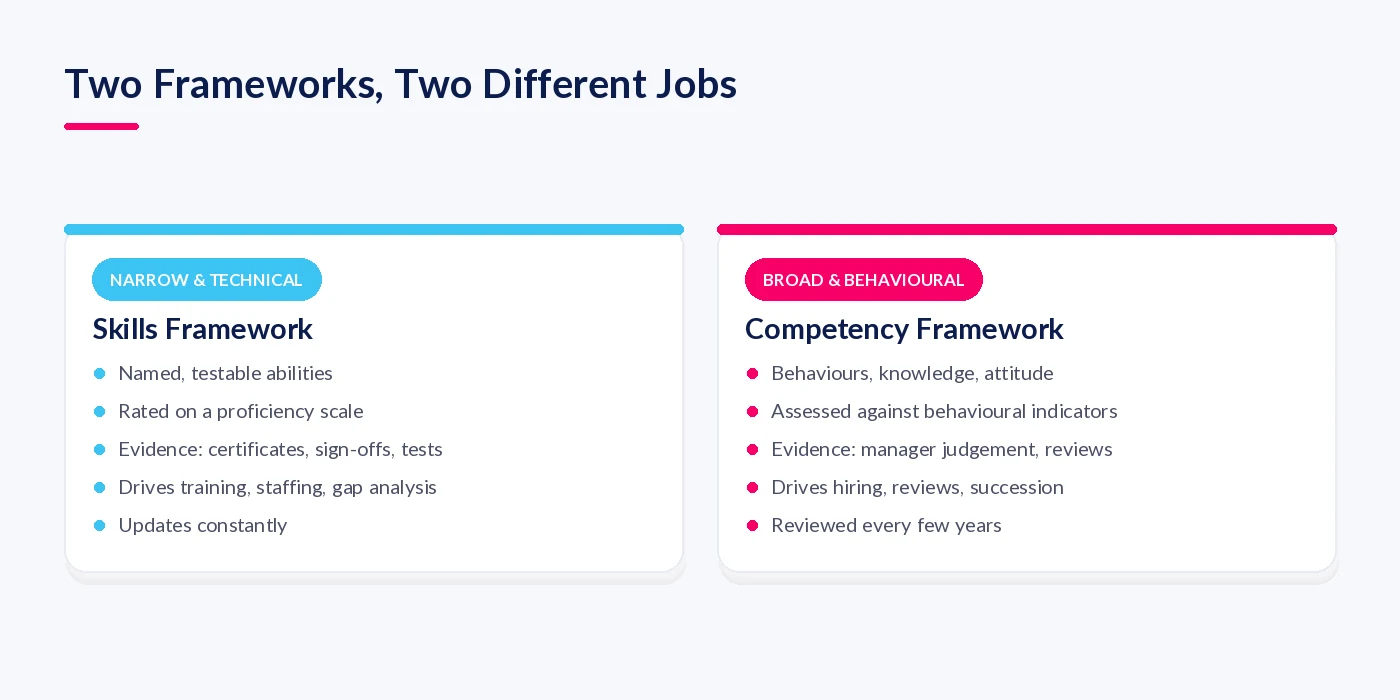
- Scope. A skills framework is narrow and technical — a list of specific abilities tied to a role or discipline. A competency framework is broader — it folds in soft skills, leadership behaviours and cultural fit alongside anything technical.
- Assessment style. Skills are usually rated on a simple proficiency scale, novice to expert or a numbered level — largely quantitative. Competencies are usually assessed against behavioural indicators and manager judgement — largely qualitative.
- Who owns the data. Skills data tends to be captured bottom-up, from what people actually do and can prove. Competency frameworks tend to be defined top-down, by HR and leadership, then applied across the workforce.
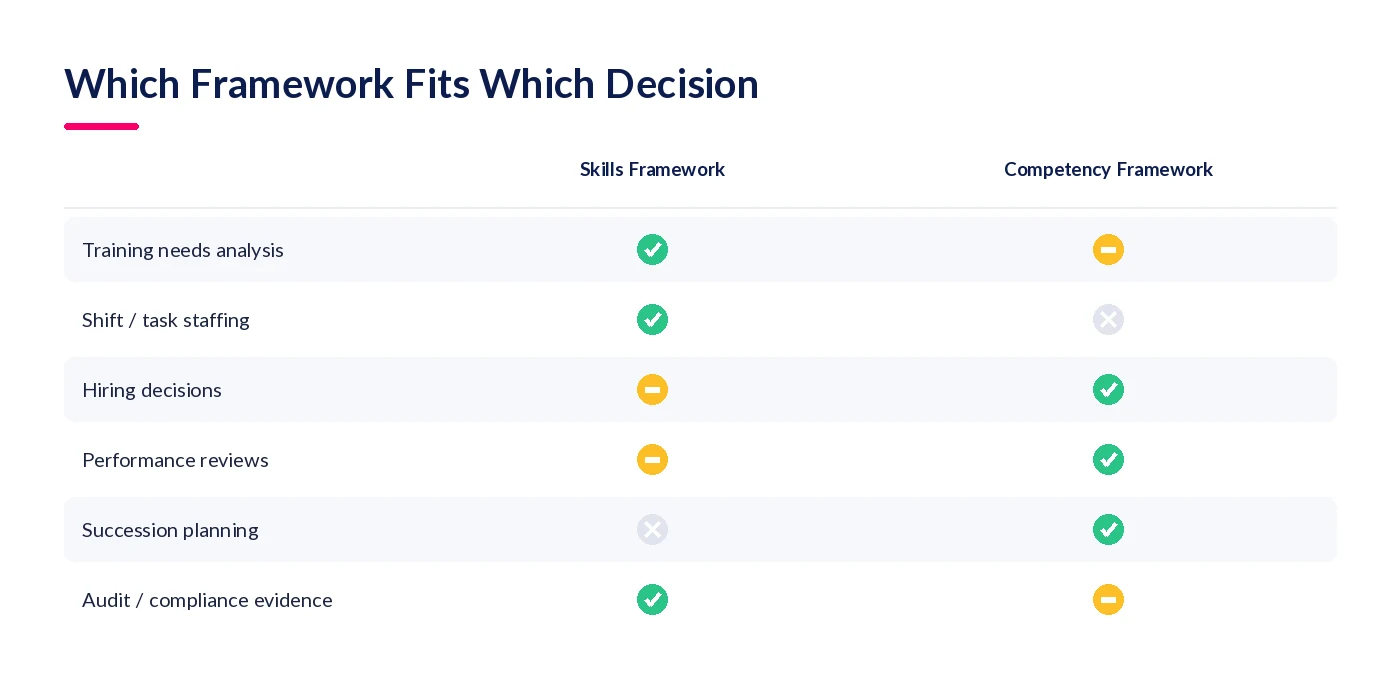
- What it is used for. Skills frameworks drive training needs analysis, staffing decisions and gap analysis. Competency frameworks drive performance reviews, promotion decisions and succession planning.
Neither list is wrong to call a “framework”. The mistake is assuming they are interchangeable, then building one and briefing stakeholders as though you built the other.
What a Real Skills Framework Standard Actually Looks Like
Most comparisons stop at “skills are narrow, competencies are broad” and leave it there. That is true but not especially useful on its own — it does not tell you how to structure either one. The clearest worked example is SFIA, the Skills Framework for the Information Age, because it is a published, widely adopted standard rather than a marketing category.
SFIA is structured around seven levels of responsibility, ranging from Level 1 (the lowest) to Level 7 (the highest), covering more than 120 defined professional skills. Crucially, a level is not just a skill rating — it is defined by three separate dimensions: autonomy (the independence, discretion and accountability for results in the role), influence (the reach and impact of decisions and actions) and complexity (the range and intricacy of tasks and responsibilities). A skill and a level only mean something together: “Level 4 software development” and “Level 6 software development” describe very different jobs, even though the underlying skill name is identical. Not every skill is defined at all seven levels either — the framework only goes as deep as the workplace actually needs it to.
This is the part most home-grown skills frameworks skip. They list skill names with a 1-5 rating and stop, which is why a “skills framework” audit so often turns up a spreadsheet that cannot actually distinguish a competent junior from a competent senior doing the same task at a different scale. SFIA’s discipline — pairing every skill with a level defined by autonomy, influence and complexity, not just a number — is what turns a skill list into something an assessor, a manager and a pay-review panel can all read the same way.
A competency framework, by contrast, rarely bothers with that level of structural precision, because it is not trying to. Its job is behavioural: what does “strategic thinking” or “customer focus” look like at manager level versus director level, expressed as observable behaviour rather than a numbered skill. Both disciplines are rigorous. They are just rigorous about different things.
How to Tell Which One You’re Actually Looking At
If you have inherited a spreadsheet, sat through a vendor demo, or picked up a half-built HR project and need to work out which one you are holding, run it through four questions.
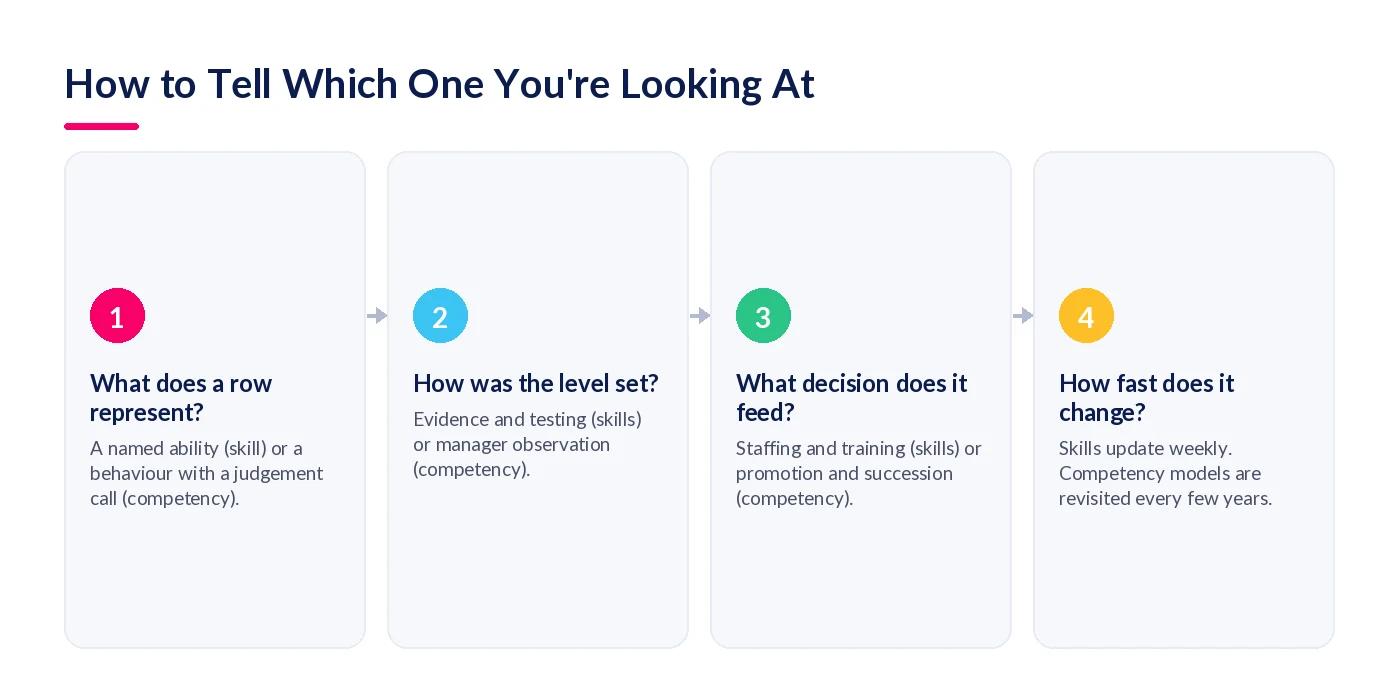
1. What does a row in the data represent?
If a row reads “Excel — Intermediate” or “Manual Handling — Certified”, that is a skill: a named, discrete, testable ability. If a row reads “Collaborates effectively across teams — Level 3”, that is a competency: a behaviour with a judgement call attached.
2. How was the level decided?
A test, a certificate, a demonstrated task, an assessor sign-off — that is skills assessment: evidence-based and largely repeatable between assessors. A manager’s rating based on observed behaviour over the last quarter, with no external evidence attached — that is competency assessment: judgement-based and harder to calibrate between managers.
3. What decision does it feed?
Gap analysis, shift or rota staffing, training needs, internal mobility into a specific task — skills framework territory. Promotion readiness, performance ratings, succession shortlists, pay-band justification — competency framework territory. If the same dataset is being asked to do both jobs, that is usually the moment it stops working for either.
4. Does it change fast or slowly?
Skills inventories should update constantly — someone finishes a course, passes a certification, is signed off on a new machine, and the record changes that week. Competency frameworks change rarely — the behavioural model itself might be revisited every two or three years, even though individual ratings against it are refreshed at each review cycle.

Where the Distinction Actually Costs You Money
This is not a semantic argument. Getting it wrong has three concrete costs.
Vendors sell you the wrong thing. A recurring trap: two vendors both market “competency management software”, one platform is genuinely built around behavioural competency modelling and calibrated review cycles, the other is a skills inventory with a rebrand. You only find out which one you bought when you try to run a succession shortlist and discover the system has no concept of a behavioural rating — only task certifications.
Frameworks get built backwards. A common mistake is starting with a long list of skills and trying to call it a competency framework by bolting on a rating scale. The result looks like a job description with forty individual abilities, no behavioural anchors, and no way to tell a manager what “good” looks like — because it was never designed to answer that question in the first place.
One tool gets asked to do the other’s job. Skills data is good at telling you who is certified to operate a machine today. It is a poor basis for a promotion decision, because it says nothing about how someone behaves under pressure, communicates, or leads. Competency ratings are good at describing potential and behaviour. They are a poor basis for shift staffing, because “strong stakeholder management” does not tell you who is qualified to sign off a permit to work this afternoon.
Building Both Without Starting Two Separate Projects
Most organisations that reach any real scale eventually need both, and the practical answer is not “pick one” — it is sequencing and shared scaffolding.
Start with roles, not lists. Before either framework, define the roles or role families you are building for. Both frameworks hang off the same role taxonomy, so building it once saves rebuilding it twice.
Build the skills layer first if the pressure is operational. If the immediate problem is “who is qualified to do this task today”, start with a skills framework: name the skills, define a proficiency scale (three to five levels is usually enough), and tie evidence — a certificate, a sign-off, a test result — to each rating. This is faster to stand up and produces a working skills gap analysis almost immediately.
Build the competency layer when the pressure is developmental or structural. If the immediate problem is “we cannot make consistent promotion or succession decisions”, start with a competency framework: define four to six core competencies plus role-specific ones, write behavioural indicators for each proficiency level, and pilot it in one function before rolling it out. Our guide to building a competency framework covers the full process.
Worked example. A 300-person manufacturer with a fresh compliance audit and a stalled succession plan sequenced rather than running both projects at once. Months one and two: a skills framework for machine operators — 40 named skills, four proficiency levels, evidence attached to every “certified” rating. This closed the immediate audit gap and fed a live skills matrix. Months three to five: a competency framework for supervisors and above — five core competencies, three role-specific ones, behavioural indicators at four levels, built on the same role taxonomy the skills project had already defined. The two systems now share role definitions and feed the same succession shortlist, without either one pretending to be the other.

How StaffCircle Handles Both, Instead of Forcing a Choice
One role taxonomy, two layers on top of it
StaffCircle’s skills and development tools and competency framework builder sit on the same role structure, so you are not maintaining two disconnected systems with two different lists of job titles.
Evidence-backed skills, behaviourally-anchored competencies
Skills carry attached evidence and expiry tracking where relevant — the same discipline SFIA applies through its level definitions. Competencies carry behavioural indicators per proficiency level, scored through structured reviews rather than an unanchored 1-5 slider.
Both feed the same gap-analysis and succession views
A skills gap and a competency shortfall show up against the same role in the same place, so a manager preparing for a talent review meeting is not reconciling two separate exports beforehand.
Built for audit as well as development
Where a role needs both a certified skill and a demonstrated competency — a supervisor who must be technically certified and shown to manage a team well — both records live against the one person, one role, with one evidence trail.
Final Thoughts
Skills frameworks and competency frameworks fail for the same underlying reason when they fail: someone tries to make one document answer two different questions. Keep the questions separate — can they do it, versus will they do it well in this role — and both tools stay useful instead of collapsing into a spreadsheet that satisfies nobody.
If you are starting from nothing, build the skills layer first where the pressure is compliance or staffing, and the competency layer where it is succession or promotion — on the same role taxonomy, so neither becomes a rebuild later. Book a demo to see how StaffCircle keeps both in one system.
FAQ
What is the difference between a skills framework and a competency framework?
A skills framework catalogues specific, testable abilities and rates them on a proficiency scale, mainly for training, staffing and gap analysis. A competency framework describes broader behaviours, knowledge and attitudes assessed qualitatively, mainly for hiring, reviews and succession. Skills answer what someone can do; competencies answer how well they are likely to do it in a role.
Is a skills matrix the same as a competency framework?
No. A skills matrix tracks technical abilities and proficiency levels for a team or role — it is narrower and typically quantitative. A competency framework is broader, covering behaviours and attributes tied to organisational values as well as role performance, and is typically assessed qualitatively. Many organisations run both together.
What is the difference between a skill and a competency?
A skill is a specific, learnable ability, such as using a piece of software or operating a machine. A competency is broader: the combination of skills, knowledge, behaviours and attitudes that predicts effective performance in a role, such as "manages ambiguity" or "influences without authority". A competency is typically built from several skills plus behavioural elements a skill list cannot capture on its own.
Do I need both a skills framework and a competency framework?
Most organisations that scale past a single site or a few dozen roles eventually need both, because they answer different questions. A skills framework alone cannot support promotion or succession decisions with any consistency; a competency framework alone cannot tell you who is certified to do a specific task today. Building both on the same role taxonomy avoids duplicating the underlying structure.
Which should we build first, skills or competencies?
Start with whichever problem is more urgent. If the pressure is operational — an audit, a staffing gap, unclear training needs — build the skills framework first, since it is faster to stand up and produces usable results almost immediately. If the pressure is developmental or structural — inconsistent promotion decisions, a stalled succession plan — build the competency framework first.
What is SFIA and how does it relate to a skills framework?
SFIA (the Skills Framework for the Information Age) is a published international standard covering more than 120 professional skills across seven levels of responsibility. Each level is defined by autonomy, influence and complexity, not just a numbered rating, which is a level of structural precision most internally-built skills frameworks lack. It is a useful reference model even outside technology roles for how to pair a skill with a meaningful level.
How many proficiency levels should a skills framework have?
Three to five levels covers most operational needs without becoming unwieldy to assess consistently — for example, aware, competent, proficient and expert. Standards built for very large, cross-industry use, such as SFIA, go to seven levels, but that level of granularity is rarely necessary inside a single organisation.
Can a competency framework be used for training needs analysis?
To some extent, but it is not the ideal tool. A competency framework will tell you that a team is weak on a behaviour such as "decision-making under pressure", which is useful strategic context, but it will not tell you which specific certifications or task-level skills are missing. A skills framework or skills gap analysis is the more precise tool for planning actual training content.
Who typically owns a skills framework versus a competency framework?
A skills framework is often owned jointly by operations, health and safety, or L&D, since it is tied closely to task performance and compliance evidence. A competency framework is more often owned by HR and senior leadership, since it underpins hiring, performance management and succession decisions across the whole organisation.
How often should each framework be reviewed?
Skills data should be reviewed continuously — certifications expire, people complete training, and records should reflect that within days or weeks. The competency model itself is more stable and is usually formally reviewed every two to three years, even though individual competency ratings are refreshed at each performance review cycle.
Can small businesses use both, or is this only worth it for large organisations?
Scale changes the effort involved, not whether the distinction matters. A ten-person business does not need a seven-level SFIA-style standard, but it still benefits from separating "can this person do the task" from "is this person ready for more responsibility". A lightweight version of both — a short skills list with evidence, and three or four plain-language competencies — scales down without losing the underlying logic.
What software is used to manage a skills framework and a competency framework together?
Look for a platform that builds both on one role taxonomy rather than treating them as separate modules with separate role lists. StaffCircle's skills and development and competency framework tools share role data so a skills gap and a competency shortfall surface against the same role record, rather than requiring two exports to be reconciled by hand.
Related articles
See StaffCircle in action
Book a personalised demo and see how StaffCircle drives performance, engagement and development.