Replacement Planning vs Succession Planning: The Difference
Here is a succession plan. It belongs to a 260-person building services contractor I will call Marlow Mechanical, a composite of several mid-sized firms I have spoken to, and it went to the board last spring as evidence that the company's key roles were covered.
| Critical role | Named successor | Status |
|---|---|---|
| Managing director | Operations director | Covered |
| Operations director | Contracts manager | Covered |
| Finance director | Financial controller | Covered |
| Contracts manager | Senior project manager | Covered |
| Compliance and H&S manager | Operations director | Covered |
| Estimating lead | Contracts manager | Covered |
| Service desk manager | Senior project manager | Covered |
| Payroll and HR lead | Financial controller | Covered |
Eight critical roles, eight names, eight "covered". The board minuted that succession risk was managed and moved on.
Now read the middle column again. There are only four people in it. Each of them is the answer to two different questions, none of them has a development plan that mentions the role they are down for, and one of them has never been told. This is not a succession plan. It is a replacement chart, and a thin one.
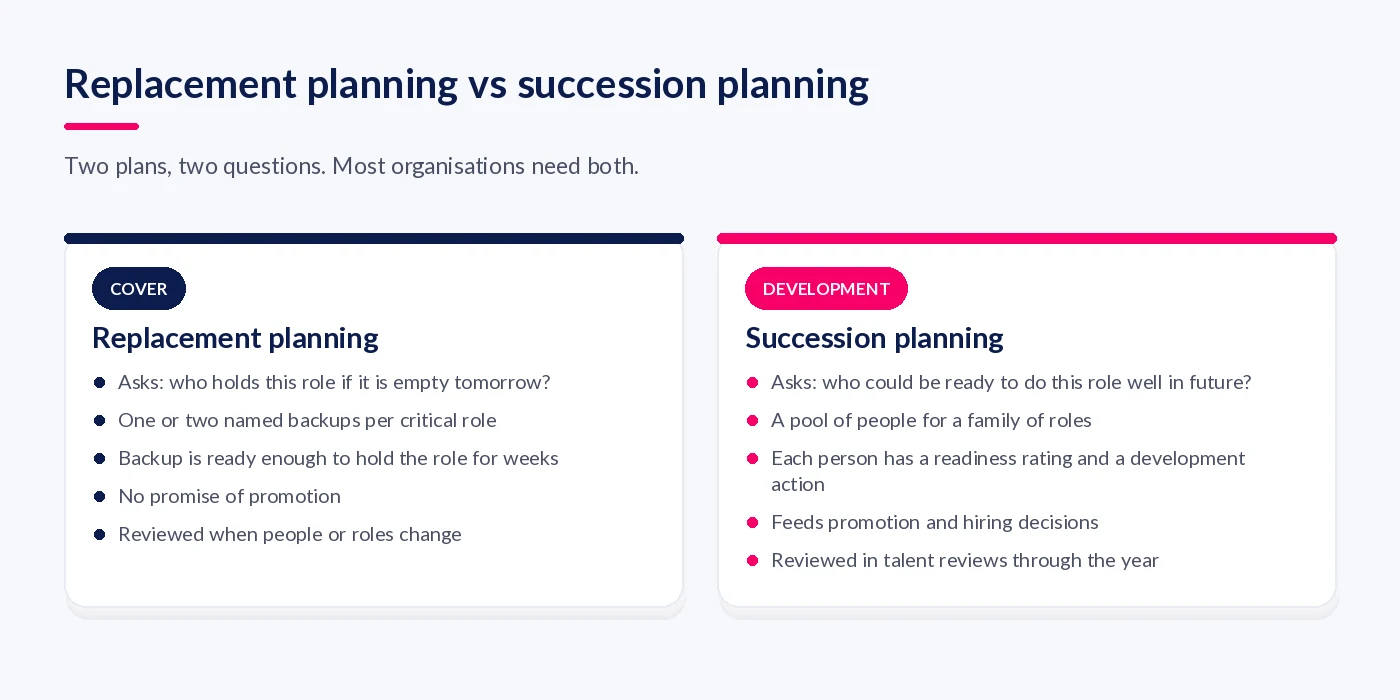
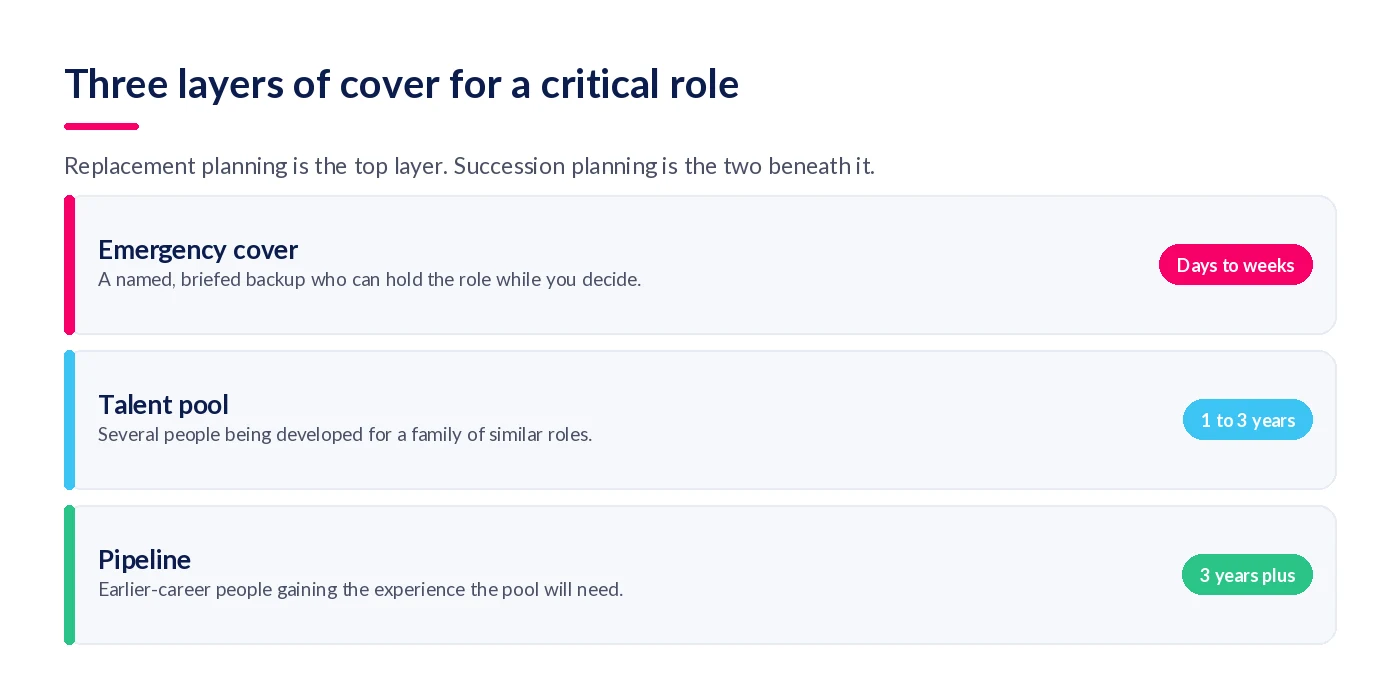
Replacement planning names a backup who can hold a critical role at short notice. Succession planning develops a pool of people over time so there are strong candidates when the role needs filling for good. The first manages this month's risk; the second builds next year's capability. You need both, and the trouble starts when a replacement chart is filed under "succession plan" and nobody builds the second half.
Key facts
- Replacement planning answers "who holds this role tomorrow?"; succession planning answers "who could do it well in future?"
- William Rothwell's research describes replacements as people who "are not promised promotions".
- The UK Corporate Governance Code asks for both orderly succession and a developed pipeline.
- In FCA-regulated firms, unapproved cover for a senior manager is limited to 12 weeks.

Two plans that answer different questions
The clearest statement of the difference comes from William Rothwell, the Penn State academic whose work most succession literature leans on. In a 2011 paper in the International Journal of Training and Development, he describes replacement planning as "a process of identifying short-term or long-term backups" so that someone can take responsibility for critical positions during emergencies. Replacements, he writes, "are not promised promotions". They are prepared to the point where they can hold the role long enough for the organisation to run a proper search.
He is equally direct about what it is not. Replacement planning "should not be confused with succession planning, which focuses on developing a pool of people to consider for promotion". The CIPD's succession planning factsheet frames succession the same way: it "focuses on identifying and growing talent to fill leadership and business-critical positions in the future". Growing is the operative word. A replacement chart identifies; it does not grow anyone.
A quick way to tell which one you are looking at is to ask what questions the document can answer.
A replacement plan should answer:
- If this role were empty tomorrow, who steps in?
- Do they know, and have they agreed?
- How long could they hold it before something slips?
A succession plan should answer:
- Who could be a credible candidate for this role, or roles like it, in one to three years?
- How ready is each of them today?
- What is each person doing this quarter to close the gap?
- Where is the pool too thin?
| Replacement planning | Succession planning | |
|---|---|---|
| Purpose | Continuity if a role is suddenly vacant | Strong candidates when a role is filled permanently |
| Unit | One role, one or two named backups | A family of roles, a pool of people |
| Time horizon | Days to months | One to three years and beyond |
| Development | A briefing and handover notes | A planned action for every person |
| What the person is told | You are our cover; this is not a promotion | You are being developed; this is not a guarantee |
| Main risk | False comfort from full boxes | Pools that are discussed but never developed |
Is your succession plan really a replacement chart? Five tests
Most comparisons stop at definitions. The more useful exercise is to audit the document you already have, because the label on the front is a poor guide to what is inside. Five tests will tell you.
1. Count people, not boxes
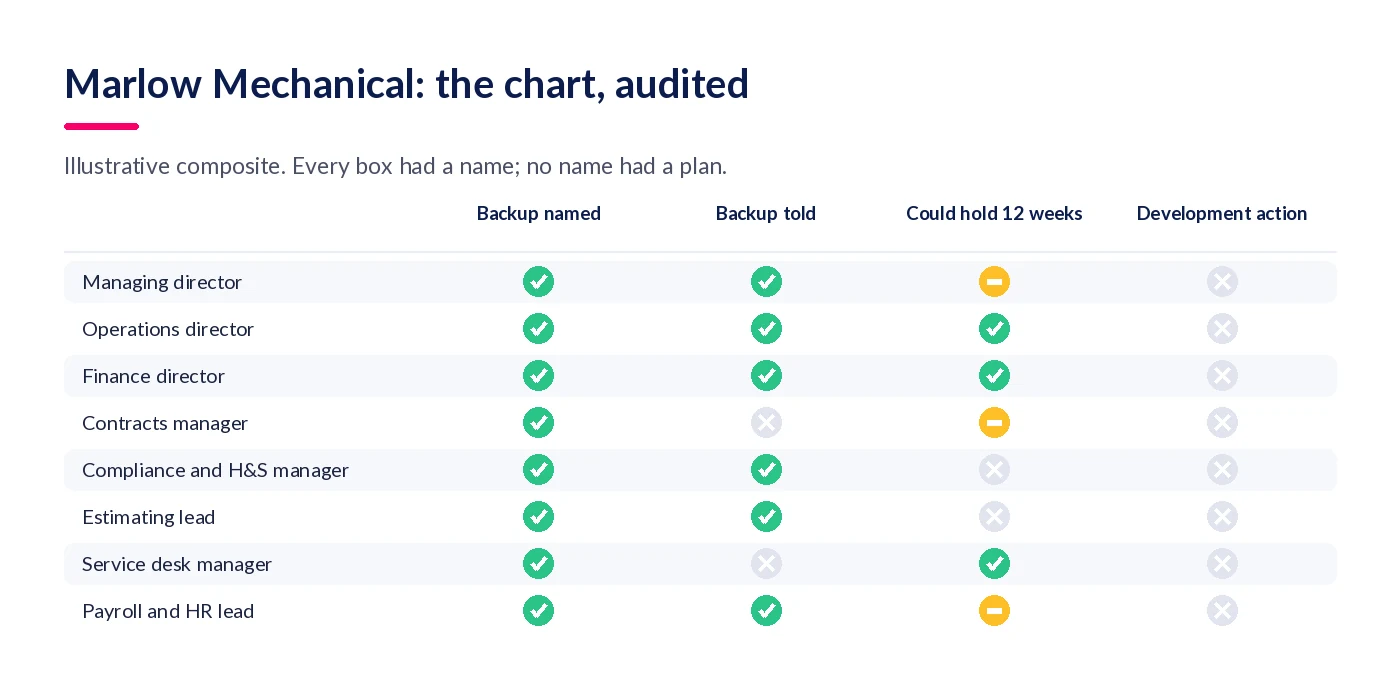
A chart looks complete when every box is filled. Count the unique names instead. Marlow's eight roles were covered by four people. If the operations director left, two roles would lose their backup on the same day.
2. Ask whether the backup has been told
A backup who does not know cannot prepare, and may not want the job. At Marlow the senior project manager, named against two roles, had never been told. She had also mentioned to a colleague that she was thinking about going part-time.
3. Ask how long they could hold it
"Could cover" hides a wide range, from three months without anything slipping to a fortnight of keeping the lights on. Record the honest answer in weeks.
4. Look for a development action
This is the test that separates the two plans. If no named person has a development action tied to the role they are down for, nobody is being grown. Marlow had eight names and no actions.
5. Check whether the cover has a clock on it
In regulated roles the law sets a limit on how long informal cover can last, and comparison articles tend to skip this entirely. Two UK examples:
- Financial services. The FCA Handbook's 12-week rule (SUP 10C.3A) exists to enable "cover to be given for temporary absences and reasonably unforeseen permanent departures" of senior managers. A firm can put a temporary replacement in place without approval "for up to 12 weeks", or until the FCA decides an application for a permanent replacement, provided that application is made within those 12 weeks.
- Health and social care. Under regulation 14 of the Care Quality Commission (Registration) Regulations 2009, when a registered manager will be absent "for a continuous period of 28 days or more", CQC must be notified in writing, and the notice has to include "the name, address and qualifications of the person who will be responsible" in the meantime.
In both cases a name in a box is not enough. The backup has to be someone who can lawfully do the job, and somebody has to own the deadline. The guide to building an emergency succession plan covers these deadlines in more detail.
Governance standards expect both halves too. The UK Corporate Governance Code 2024, which listed companies report against, says in Principle J that "an effective succession plan for the board and senior management should be maintained". Provision 17 then asks the nomination committee to "ensure plans are in place for orderly succession" and to "oversee the development of a diverse pipeline for succession". Orderly succession is the cover question. A developed pipeline is the growth question. One sentence, two plans.
When a replacement plan is exactly the right tool
None of this makes replacement planning the poor relation. For some situations it is the correct answer, and a full succession process would be overkill.
- Roles that cannot sit empty. Payroll, a site's only authorised signatory, the person who holds the admin rights.
- Regulated roles. Where a regulator has to be told, you need a qualified, briefed name before the vacancy, not a pool discussion after it.
- Single specialists in small teams. If there is no internal candidate, the honest replacement plan may be external: an interim provider, a retained former colleague, or documented procedures someone else can follow.
- Restructures and high turnover. When roles change every quarter, short-horizon cover is more use than a three-year pipeline for jobs that may not exist.
- A first step. Rothwell's paper describes an organisation that used replacement planning "as a starting point" for succession planning.
The mistake is not having a replacement chart. It is stopping there, or calling it something it is not. If you have not yet decided which roles deserve this attention, start with the method for identifying critical roles.
From replacement chart to talent pools in six steps
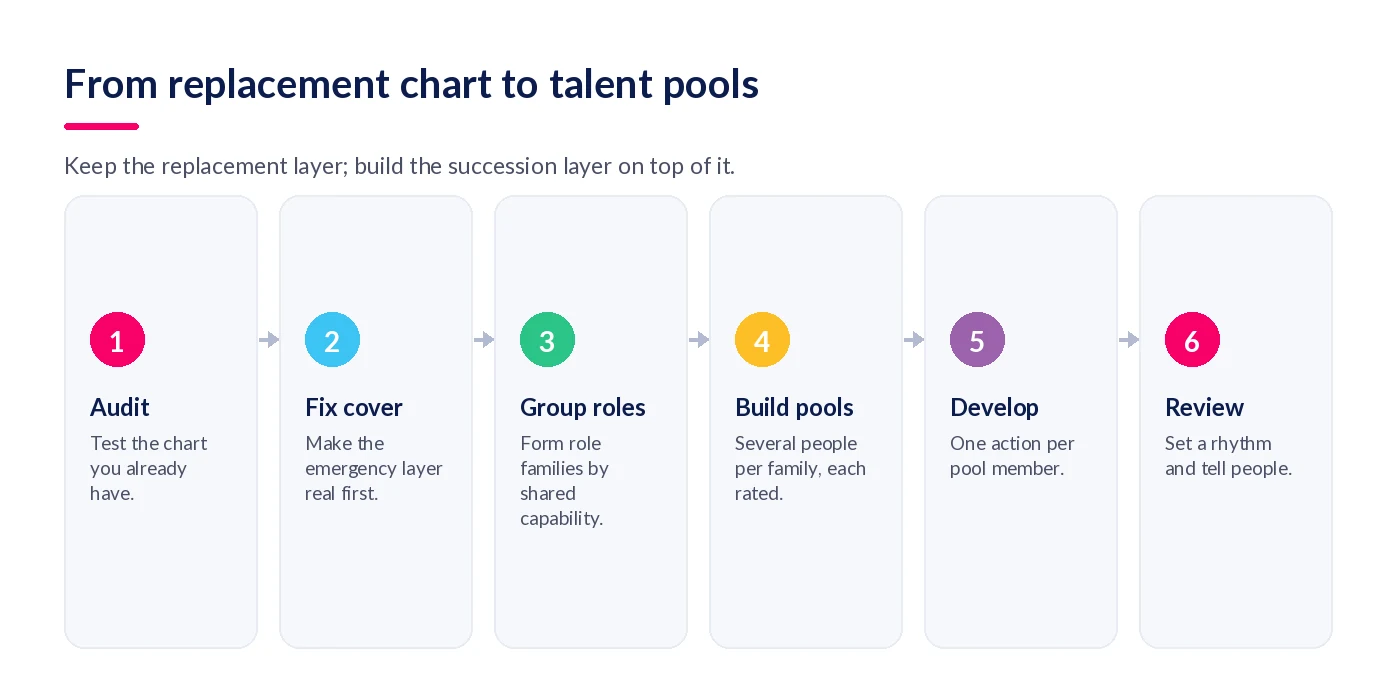
You do not need to throw the chart away. Keep it as the emergency layer and build the succession layer on top.
- Audit the chart you already have. Run the five tests on every role: backup named, unique names, backup told, weeks they could hold it, development action.
- Make the emergency layer real. Brief every backup, confirm they accept, cap each person at two roles and record any regulatory deadline.
- Group critical roles into families. Put roles that need broadly the same capability together, such as operational leadership or technical specialists.
- Build a pool for each family. Name several people per family, including some not yet ready, and give each a readiness rating.
- Give every pool member one development action. Agree a specific action that closes that person's largest gap and put it in their development plan.
- Review on a rhythm and tell people where they stand. Review cover twice a year and pools at each talent review, and explain what each status does and does not mean.
Why pools, not more names per box?
Adding a second and third name to every box multiplies the same weakness. With pools, you develop several people towards a family of roles, not one job. That spreads risk when someone leaves, gives you a choice when a vacancy opens, and stops any individual believing a specific job has been promised to them.
How ready is ready?
A pool is only useful if each member has an honest, evidence-based rating: "ready now", "ready in one to two years" and "ready in three or more" is enough to start with. The guide to succession readiness ratings covers how to define and calibrate them, and a regular talent review meeting is where they get challenged.
What counts as a development action?
Something specific that closes that person's largest gap. "Leadership course" is a wish. "Runs the hospital contract from January, with the operations director as sponsor" is an action. It belongs in the person's own development plan, not in a spreadsheet only HR opens.

Where the conversion stalls
The same four people end up in every pool
If the dependable names from the old chart simply reappear in each pool, nothing has changed. Require every pool to include at least one person who was not on the chart, and look a level further down than feels comfortable.
Pools get discussed but nobody is developed
An annual meeting that agrees who is in which pool, followed by eleven months of silence, is a replacement chart with extra steps. Measure the share of pool members with a live development action. The post on succession planning metrics suggests a small set worth tracking.
Nobody is told, so nobody prepares
Organisations keep plans secret to avoid disappointment, and create a different problem: people cannot prepare for something they do not know about. Tell backups and pool members what their status means and what it does not.
The emergency layer is forgotten
Some teams swing the other way. They build elegant pools and stop maintaining named cover, so when someone resigns on a Friday there is a three-year pipeline and nobody for Monday.
Marlow's chart, ninety days later
Here is what the same company did with its chart in one quarter. The numbers are illustrative, but the sequence is realistic for a firm this size.
| When | What Marlow did | Result |
|---|---|---|
| Weeks 1 to 2 | Ran the five tests on all eight roles | Four unique backups, one never told, no development actions, two roles with no workable cover |
| Weeks 3 to 4 | Briefed every backup, capped each at two roles, named second backups for compliance and estimating | Seven unique backups; the senior project manager declined one of her two roles |
| Weeks 5 to 8 | Grouped the roles into three families and built a pool for each | Operational leadership (five people), finance and people (three), technical specialists (four) |
| Weeks 9 to 12 | Agreed a readiness rating and one development action per pool member | Twelve people with an action in their development plan; two external hires flagged for the technical pool |
The chart did not disappear: every role still has a named emergency backup, and those backups now know. The pools surfaced people who were on nobody's radar in the spring. And the exercise produced a hiring decision, because the technical pool was too thin to develop from within.
The board paper changed as well. It no longer says "covered" eight times. It reports unique backups per critical role, the share of pool members with a live development action, and the roles where the pool is empty.
Where StaffCircle fits
Both layers depend on current information about people, which StaffCircle keeps in one place.
See who could step in, on live data
StaffCircle's Success Circles visualise competencies so you can spot strengths, gaps and ready successors, using live skills and performance data instead of last year's opinion. More on the employee development software page.
Turn a name into a development action
Personalised development plans let a manager and employee agree the specific action that moves someone from "could cover" to "could do the job", and keep it visible to both of them.
Keep the review in rhythm
Regular check-ins give managers a natural point to revisit development actions and readiness, so the plan is updated as part of normal management, not once a year before a board meeting.
What to do this week
Pull out whatever your organisation calls its succession plan and run the five tests. If you find a replacement chart, that is not a failure: it is the first layer, and you now know what the second one needs. If you would like to see how StaffCircle links skills, readiness and development plans, book a demo.
FAQ
What is the difference between replacement planning and succession planning?
Replacement planning names a backup who can hold a critical role at short notice, usually for a few weeks or months. Succession planning develops a pool of people over time so that there are strong candidates when the role needs filling permanently. Replacement planning manages immediate risk; succession planning builds future capability.
What is replacement planning in HR?
Replacement planning is the process of identifying short-term or long-term backups for critical positions so that someone can take responsibility in an emergency. The backup is prepared enough to keep the role running while the organisation decides on a permanent appointment. It does not involve a promise of promotion.
What is a replacement chart?
A replacement chart is a simple table or organisation chart that pairs each critical role with one or two named backups. Better versions also record whether the backup has been told and how long they could hold the role. On its own it is a cover plan, not a succession plan.
Is a backup list a succession plan?
No. A list of backups tells you who would step in tomorrow. A succession plan also shows who is being developed for the role, how ready each person is and what they are doing to close the gap. If nobody on the list has a development action, it is a replacement chart.
Do you need both replacement planning and succession planning?
Yes, for critical roles. Replacement planning covers the first days and weeks of an unexpected vacancy. Succession planning makes sure there are credible internal candidates when you appoint permanently.
When is replacement planning the right approach?
Use replacement planning for any role that cannot sit empty, for regulated roles where cover is time-limited, for small teams with a single specialist, and during restructures. It is also a sensible starting point for an organisation with no succession process yet.
What are the disadvantages of relying on replacement planning alone?
It creates a false sense of security. The same few dependable people tend to be named against several roles, backups are often not told or not ready, and nobody is developed for the permanent job.
How do you move from replacement planning to succession planning?
Audit the chart you have, make the emergency cover real, then group critical roles into families that need similar capability. Build a pool of several people for each family, rate each person's readiness, give each one a development action and review the pools on a regular rhythm.
How many successors should a critical role have?
There is no fixed rule. As a working guide, aim for one briefed emergency backup per critical role and a pool of two or three people at different stages of readiness. More important than the number is that no individual is the named backup for more than two roles.
Should employees be told they are a named backup or in a talent pool?
Yes. A backup who has not been told cannot prepare, and may not want the responsibility. Be clear about what it means: emergency cover is not a promise of promotion, and pool membership depends on continued performance and development.
How often should a replacement chart be reviewed?
Review it whenever a critical role holder or a named backup changes role, resigns or goes on long-term leave, and at least twice a year otherwise. Regulated and single-specialist roles deserve a quarterly check.
Related articles


See StaffCircle in action
Book a personalised demo and see how StaffCircle drives performance, engagement and development.