Succession Planning Without the 9-Box Grid (2026 Guide)
In many courses, curricula, onboarding sessions, and webinars, HR executives and managers have been taught the old succession-planning method, the 9-box grid. But if you are still using this outdated method, you are missing out on a lot, especially in this economy.
Imagine this: one of your senior employees has resigned. What would you do next? How do you choose the right candidate to replace senior roles? Would you lock yourself for hours with a three-by-three matrix on a whiteboard?
Well, I wouldn’t do that because I have a more advanced solution to this: Success Circles™ (StaffCircle)
If you want to know how Success Circles™is used as an alternative to the 9-Box Grid, this post is for you.
Why HR Leaders Are Avoiding the 9-Box Grid?
The decline of the 9-Box Grid has been accelerating for years, and by 2026, progressive people teams will phase it out entirely.
The 9-box grid is simply a 2D framework consisting of nine boxes arranged in a 3×3 format. It only evaluates employees based on two factors: Performance and Potential. And the ideal employee is selected based on the percentage of these.
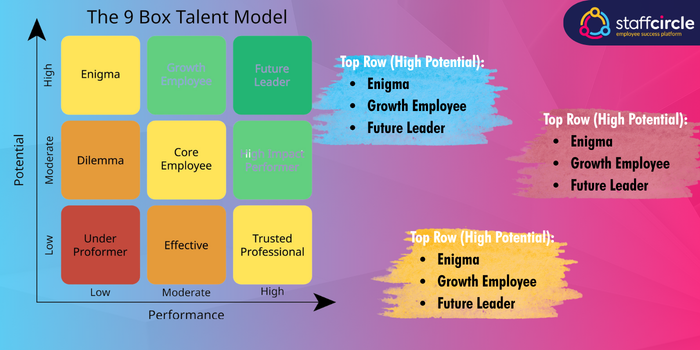
Here, the logic seems simple and effective. But we have problems that we are going to discuss below:
1. The Proximity Bias and Loud Performance
The 9-Box Grid relies heavily on human evaluation of the manager or co-leaders, making it highly susceptible to unconscious bias. Managers frequently mistake confidence for competence or elevate employees who simply have more face time with senior leadership.
This creates a culture where extroverted or highly visible employees are categorised as “high potential,” while quiet, highly effective contributors are left in the middle boxes.
2. The Fallacy of the Potential Axis
How exactly do you measure potential? Without deep data, “potential” is a guessing game. One manager might define it as the ability to move up two levels, while another views it as a positive attitude.
This ambiguity turns talent reviews into internal political debates in which the most vocal manager wins the best placement for their direct reports.
3. The Stigma Box Effect
Labelling an employee creates psychological anchoring. If a team member is placed in the “low performance, high potential” box (often labelled an “Enigma”) or the “high performance, low potential” box (a “Workhorse”), that label can stick for years.
If an employee discovers they have been overlooked because they were classified as low potential, they may become disengaged or start looking for opportunities elsewhere. For example, an analysis of 29,809 retail employees found that women were systematically assigned lower potential ratings than men, despite higher performance levels.
Conversely, employees identified as high potential may experience increased pressure to perform, which can lead to stress, burnout, and declining performance over time.
4. It is an Annual, Static Snapshot
Modern business changes rapidly. A static assessment conducted every twelve months is immediately outdated. An employee’s skills, motivations, and project outcomes fluctuate quarterly, yet the 9-Box Grid locks them into a fixed category for a full calendar year.
What Does Better Succession Planning Look Like?
To answer this question, our team conducted extensive research. We observed and analysed various succession planning modules used by top companies (e.g., Apple, Microsoft, McDonald’s, and JPMorgan Chase). Hence, we noticed shared patterns and key facts you need to know.
Pattern 1: Moving from Replacement Charts to Talent Pools
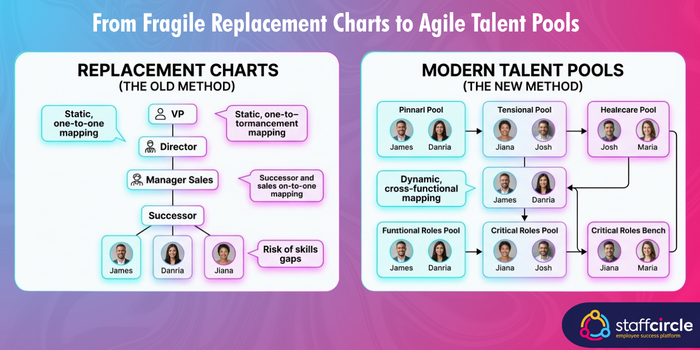
Traditional companies assign a single backup person to a single job title. Top companies don’t do this because a single named successor is a single point of failure. If that person leaves, the entire plan collapses.
Instead, they group high-potential leaders and develop them broadly. If any critical executive role opens up, they have an entire cohort of versatile, pre-vetted leaders to choose from, rather than just one person.
McDonald’s Succession Planning: Former McDonald’s CEO Jim Skinner institutionalised a rule that for every critical role, leaders must groom at least two successors: “One Ready Now, One Ready Future.” This specific bench depth allowed McDonald’s to survive the tragic, unexpected loss of two CEOs in less than a year without their stock or operations dipping.
Pattern 2: Prioritising Future Strategy over Legacy Cloning
A common trap is choosing a successor who behaves exactly like the current leader. Top companies look forward, not backward. They align their succession choices with where the market is going next.
- Microsoft: When Microsoft appointed Satya Nadella as CEO, he wasn’t chosen to copy Bill Gates or Steve Ballmer. He was intentionally pulled from the Cloud and Enterprise division because the board knew the company’s future relied on a massive strategic pivot to cloud computing.
- Apple: Steve Jobs didn’t pass succession to another creative visionary like himself. He spent years grooming Tim Cook as an operational and supply chain genius. It is because he knew Apple’s next phase required global operational scaling and institutional stability.
Pattern 3: Treating Succession as an Enterprise Risk
Only a few companies actually do succession planning the right way. What many don’t understand is that it carries very expensive and board-level risk. Here are some eye-opening benchmarks:
- Only 21% of organisations have a formal, documented succession plan, leaving the vast majority completely vulnerable to sudden departures.
- Merely 3% of Chief Human Resources Officers (CHROs) strongly agreed that they excel at selecting the right management candidates. And 64% of them are still using the 9-box grid method.
- Poor leadership can cost S&P 1500 companies an estimated $1 trillion annually in lost market value and disrupted execution.
- Data from the Wharton School reveals external executive hires cost 18-20% more than internal promotions.
Better succession planning doesn’t try to predict the future with perfect accuracy. Instead, it builds an agile, continuously developed internal bench that ensures the business can pivot seamlessly, no matter who walks out the door tomorrow.
Pattern 4: Making Succession Planning Continuous, Not Annual
Many organisations still treat succession planning as a once-a-year exercise. Leaders gather in a meeting, review a spreadsheet, identify potential successors, and then revisit the conversation twelve months later.
Leading organisations take a very different approach. They treat succession planning as an ongoing process that is integrated into performance management, leadership development, workforce planning, and career conversations.
Rather than asking, “Who could replace this leader today?”, they continually assess questions such as:
- Which employees are developing the skills needed for future leadership roles?
- What experiences or assignments do they need next?
- Which critical positions are becoming risk areas?
- How has business strategy changed, and what leadership capabilities will be required in the future?
This approach ensures that succession plans evolve alongside the business. Effective succession planning does not attempt to predict the future with perfect accuracy. Instead, it creates a deep and adaptable leadership bench that allows the organisation to respond confidently to change, minimise disruption, and maintain momentum regardless of who leaves, retires, or steps into a new role.
5 Modern Alternatives to the 9-Box Grid
So if the 9-box grid doesn’t work, what then? Here are 5 strong alternatives to the 9-box grid:
| Framework | Core Evaluation Axes | Primary Data Input | Frequency | Best Used For | Major Limitations |
|---|---|---|---|---|---|
| Traditional 9-Box Grid | Performance vs. Vague ‘Potential’ | Top-down (Direct Manager only) | Annual / Static | Legacy standardisation in stable environments | Proximity bias, toxic labels (‘Workhorse’), no growth path. |
| Success Circles™(StaffCircle) | Labeled, Customisable Competency Slices | Automated 360° (Manager, Peers, Self-assessment) | Continuous / Real-time | Mid-sized businesses and growth-focused cultures | Requires active multi-source feedback to stay accurate. |
| AI Predictive Profiles | Data-driven Lifecycle Variables & Metadata | Algorithmic scraping (Slack, LMS, project data) | Continuous / Real-time | Large enterprises (10,000+ employees) or fast-scaling tech | Risk of algorithmic bias, lacks human empathy or EQ tracking. |
| Performance-Values Matrix(Jack Welch) | Financial/KPI Results vs. Cultural Values fit | Management evaluation | Project-based / Annual | Board-level restructurings or cultural turnaround crises | Creates a culture of fear; flags toxic people but offers no blueprint to improve. |
| 4-Box Matrix | Current Skill vs. Motivation/Will | Manager’s current assessment | Quarterly / Project-based | Rapid, everyday team coaching alignments | Highly vulnerable to recency bias; oversimplifies leadership capability. |
| 16-Box Matrix | 4 Tiers of Performance vs. 4 Tiers of Potential | Top-down Calibration Sessions | Annual / Bi-annual | High-stakes executive C-suite planning | Extremely tedious to maintain; still relies heavily on top-down bias. |
1. Success Circles™ (Visual 360° Competency Radar)
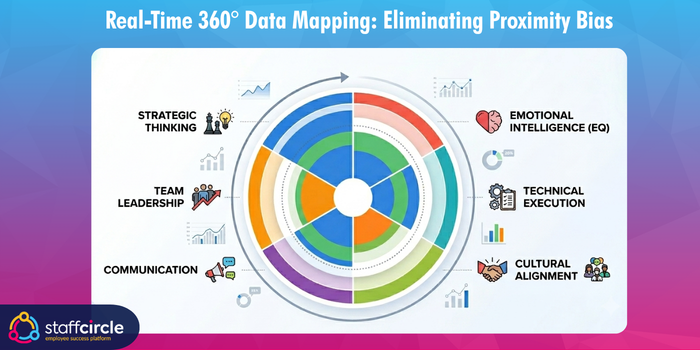
Success Circles™ is a fully automated, proprietary succession-planning tool that comes as a built-in feature of StaffCircle. If you are using the StaffCircle platform for hybrid or in-office work, you can easily access all employee data with nearly 100% accuracy. You just have to identify the critical competency factors you want to track employees’ progress against. This feature is also customisable, so you can add or remove other tracking factors at any time.
You can imagine a dynamic pie chart or radar graph where each coloured slice represents a critical competency (e.g., Communication, Emotional Intelligence, Cultural Alignment). The data isn’t just inputted by one boss; the software averages out continuous inputs from the manager, the employee’s self-assessment, and co-worker feedback (360°).
It works better because it is a living, real-time graphic that shifts as the employee learns. If an employee’s “Strategic Thinking” slice is low, it highlights an immediate, actionable Individual Development Plan (IDP) rather than stamping them with a blanket label like “Low Potential.
Around 93% of customers feel confident in the insights provided by Success Circles™, and 67% find succession planning effective and easy.
The platform provides a clear, data-driven visualisation of who possesses the required skills for a role, making it incredibly difficult for proximity bias or political maneuvering to dictate who makes the shortlist for advancement. Watch this video to see how it works:
2. AI-Driven Predictive Talent Profiles
AI-Driven Predictive Talent Profiles combine employee performance, skills, behaviours, learning activity, collaboration patterns, and career history to generate an AI-powered assessment of future potential, leadership readiness, and internal mobility opportunities.
Rather than guessing who has “future potential,” modern HR teams use data science platforms (such as Eightfold AI, Censia, and SAP SuccessFactors) that ingest massive amounts of data across the employee lifecycle to predict leadership success.
Machine learning models analyse real-time variables (such as project delivery times, learning management system (LMS) completion rates, internal networking patterns, and past performance trends) to surface high-upside individuals.
The AI scans de-identified metadata from communication tools (Slack, Teams, email). High-upside leaders naturally act as “bridges” between fragmented cross-functional teams, a trait that human managers rarely notice.
It reduces human favouritism and “proximity bias” (managers favouring people they see most often). It democratises succession by surfacing hidden gems across global offices that have the data profile of a future leader but might otherwise go unnoticed.
Are AI-Driven Predictive Talent Profiles Better Than Success Circles™ for effective succession planning?
AI-Driven Predictive Talent Profiles are particularly effective when organisations need to analyse millions of passive data points, including project outputs, learning progress, and digital collaboration patterns, to predict who is most likely to succeed in future leadership roles.
Predictive Profiles excel in enterprise-level environments (10,000+ employees), highly decentralised companies, or rapidly scaling tech firms. But there are chances of historical/algorithm data bias, lack of transparency, algorithm manipulation, lack of soft skills or EQ tracking, automation bias, and much more.
On the other hand, Success Circles™ excel in mid-sized businesses, tight-knit organisations, or cultures that place a strong emphasis on human development. Employees can visually see their “competency slices” shrink or grow. It feels fair because it includes peer and self-perspectives, removing the paranoia of a secret executive list.
Success Circles™ map behaviors, values, and leadership empathy far more accurately. If an employee’s performance slices are small, the manager and employee know exactly what training or stretch assignment to pursue next.
But you can get the best of both worlds with AI-Driven Predictive Talent Profiles generated by StaffCircle AI Assist. Working hand-in-hand with Success Circles™, StaffCircle AI Assist introduces an intelligent analytics layer across the platform.
StaffCircle AI Assist analyses performance, development, engagement, HR operations, meeting insights, and custom reporting to generate talent maps, identify emerging leaders, uncover skills gaps, produce succession reports, and recommend development actions using natural language queries. Managers can move directly from AI-generated insights to actions such as scheduling reviews, drafting feedback, setting objectives, or creating development plans, while maintaining human approval before changes are made.
As a result, organisations do not have to choose between AI analytics and human-centred talent development. Success Circles™ provide the visual competency framework for employee growth, while StaffCircle AI Assist strengthens succession planning with AI-powered analytics, talent mapping, automated reporting, and actionable recommendations. Together, they create a more transparent, data-driven, and development-focused succession planning strategy.
3. Jack Welch’s Performance-Values Matrix
While the 9-box grid measures performance against an employee’s future potential, Jack Welch’s Performance-Values Matrix focuses on a much harsher reality: what you deliver versus how you deliver it.
Coined during his tenure as CEO of General Electric, Welch argued that looking at performance numbers alone is hopelessly short-sighted. For effective succession planning, he charted employees across four quadrants on two independent axes: Results (Performance) and Culture Fit (Values).
Welch’s grid forces an organisation to build a structurally sound leadership bench. By systematically filtering out Type 4 managers, you guarantee that the next generation of executives will preserve, rather than destroy, the organisational culture.
It works by dividing talent into four quadrants. Type 1s (High Results/High Values) are fast-tracked for leadership. Type 2s (Low Results/High Values) receive coaching or lateral moves. Type 3s (Low Results/Low Values) are removed. Crucially, Type 4s (High Results/Low Values) are terminated because they may hit numbers but destroy culture.
Is Jack Welch’s Performance-Values Matrix Better Than Success Circles™ for effective succession planning?
Ideally, I won’t consider it alone for secession planning.
The biggest flaw in most succession plans is promoting a high-grossing manager who destroys team morale. Welch’s matrix explicitly mandates firing these “Type 4,” saving the company from cultural collapse.
For boards and CEOs during a restructuring or fast-paced crisis, it provides instant clarity. It takes minutes to look at a quadrant and know exactly who to promote (Type 1) and who to remove (Type 3).
While Welch’s matrix tells you who to promote, it doesn’t tell you how to help someone who is struggling. Success Circles™ break leadership down into specific competency “slices” (e.g., strategic vision, emotional intelligence), providing managers with a precise roadmap for employee growth. Success Circles™ aggregate 360-degree data, providing a much fairer, well-rounded picture of a future leader.
In modern corporate environments, labeling employees as “toxic” creates a culture of fear. Success Circles™ simply solves this by fostering transparency, collaboration, and high retention.
4. The 4-Box Skill vs. Will Matrix
For teams that want a matrix framework but find the 9-box overly complex and tedious to maintain, the simplified 4-box matrix strips the process down to actionable coaching behaviors. It replaces the vague concept of “Potential” with “Will” (motivation, engagement, drive) and pairs it with “Skill” (current capability). It creates 4 highly practical action plans instead of 9 ambiguous ones:
- High Skill / High Will: Delegate and fast-track them.
- High Skill / Low Will: Re-motivate or change their environment.
- Low Skill / High Will: Train, coach, and invest heavily.
- Low Skill / Low Will: Performance manage or transition out.
Is the 4-Box Skill vs. Will Matrix Better Than Success Circles™ for effective succession planning?
No. Again, I am not much in favour of this method because it’s simply too much work. Also, it is highly vulnerable to “recency bias.” A manager might rate an employee’s “Will” as low simply because they had a difficult month or are currently frustrated by a specific project, obscuring their actual long-term leadership potential.
Success Circles™ is vastly superior for building long-term talent pipelines and future readiness. True succession planning is about preparing them for what the job will require in three years. You can build an automated track record using data from peers, direct reports, and self-assessments, thereby eliminating a single manager’s bias.
5. 16-Box Talent Matrix
The 16-Box Talent Matrix (also known as the 4×4 matrix) is the high-precision evolution of the traditional 9-box grid.
While the 9-box grid is often criticised for being too blunt, the 16-box matrix splits performance and potential into four distinct tiers each.
This extra layer of granularity provides executive teams with much cleaner, data-driven clarity for high-stakes succession planning.
Managers evaluate employees across sixteen precise quadrants. The horizontal axis separates performance into Low, Solid, High, and Elite, while the vertical axis categorises potential into Trusted Expert, Growth, Accelerated, and Turn-Key. This structure maps talent into granular pools, distinguishing immediate C-suite successors (Turn-Key / Elite) from irreplaceable individual contributors who have no desire to manage (Trusted Expert / Elite).
In a 9-box grid, managers safely dump up to 60% of employees into the ambiguous middle box. The 16-box forces sharper, more definitive talent evaluations. It separates your good, reliable performers from your absolute Elite hyper-performers who drive exponential value.
By splitting potential into distinct tiers, it explicitly separates who is ready to step into a critical role tomorrow (Turn-Key) from those who need a 24-month development runway (Accelerated).
Is the 16 Box Matrix Better Than Success Circles™ for effective succession planning?
No. The 16-box matrix relies heavily on a top-down assessment from an employee’s direct boss, which is highly prone to favouritism. Success Circles™ aggregate data from peers, direct reports, and self-assessments, providing a well-rounded and objective view of a person’s capability.
A 16-box matrix tells you who is an “Operational Asset,” but it doesn’t tell you how to help them grow. A Success Circle explicitly highlights their exact skill deficiencies, creating an immediate, visible blueprint for their training and mentorship. Moreover, they can simply check their performance and actively participate in widening their own competency circles.
How to Run a Succession Planning Review in StaffCircle?
As I mentioned before, Success Circles™ is a built-in feature of our award-winning performance management software, StaffCircle. This software is highly efficient and widely trusted by HR leaders, managers, and employees across the UK, Canada, and the USA.
All employees and leaders can access StaffCircle via their mobile phone. Leaders can assign objectives or tasks, review them instantly upon completion, and offer rewards or feedback. As it allows you to integrate Microsoft 365, Zapier, Google Workspace, and Microsoft Teams, along with 30+ HRIS integrations, things go very smoothly. In other words, StaffCircle can understand the entire structure and give you the best solutions.
If you want to try it, you can request a demo. Rest, here’s how succession planning review works in StaffCircle.
Step 1. Enable the Succession Planning Dashboard
Before you can run the review, ensure that the dashboard is activated in your settings.
- Go to Settings (gear icon) in the bottom-left corner and select Organisation and Branding.
- Select the Beta Features tab at the top of the page.
- Switch on the toggle for the Succession Planning Dashboard.
- Log out and log back in to apply the changes.
Step 2: Create Or Add Competencies
Identify the positions that would cause immediate operational disruptions if left vacant. For each critical role, outline the required competencies, technical skills, and leadership behaviors directly within the StaffCircle platform to establish an objective success profile.
These can then be linked to all other parts of the platform, like Values, Awards and Behaviours, Review Feedback Questions and much more. Here’s a video guide on how it works:
If you don’t know how to map out the competencies and capabilities required for these key positions, here’s the guide for the StaffCircle Competency Framework.
Step 3: Establish Your Dynamic Success Circles™
Once competencies are set up, the system will automatically feed scores and information into a person’s Success Circles™ in real time.
Success Circles™ provide a highly visual, real-time graphical scorecard of an employee’s competency alignment. Each slice of the circle represents a competency, which can be linked to other StaffCircle functions (such as awards, objectives or company values) to provide an accurate, easy-to-understand representation of employee performance.
Individuals and managers can see their performance and competency alignment at any time. Clicking on the slices of the Success Circle will provide detailed information on what’s behind the scores.
Step 4: Evaluate Readiness and Address Capability Gaps
During your quarterly leadership reviews, open the Success Circle dashboards to visually analyse candidate readiness. Look directly at the data-driven fit scores to identify specific skill gaps, then deploy targeted development plans to help candidates close those gaps efficiently.
The Bottom Line
The reality in 2026 is simple: you cannot navigate a dynamic economy using static, biased spreadsheets. Relying on the 9-box grid to map your organisation’s future means risking boardroom disruption, losing your quiet superstars to competitors, and burning out your designated high potentials.
True succession planning is a continuous commitment to human growth. By moving away from rigid boxes and adopting Success Circles™ via StaffCircle, you replace subjective corporate politics with transparent, 360-degree talent data. You stop guessing who has “potential” and start visually tracking real-time capability.
Book a customised StaffCircle demo today and unlock the power of automated Success Circles™ for your team.
Frequently Asked Questions (FAQs)
What does StaffCircle cost?
StaffCircle pricing depends on your organisation’s size and the modules selected. Plans typically start at around £5 per user per month, with entry-level options available from around £2 per user per month. Premium plans can reach approximately £15 per user per month, depending on features and requirements.
How long does it take to set up Success Circles™ for succession planning?
Most organisations can implement Success Circles™ within 4 to 8 weeks.
During weeks 1–3, HR defines competencies, values and leadership criteria. Weeks 4–6 focus on system integrations, including HRIS, LMS and collaboration tools such as Microsoft Teams. By weeks 7–8, the platform is calibrated and provides real-time talent visibility, succession insights and bench-strength reporting.
Can I import historical performance or 9-box data into StaffCircle?
Yes. StaffCircle includes data import tools that allow you to upload historical performance reviews, manager ratings and talent data using CSV files.
How do employees react to real-time competency tracking?
Employee response depends largely on transparency. If introduced poorly, employees may worry about excessive monitoring.
When implemented openly, feedback is often positive, particularly from frontline and quieter employees. A visual competency dashboard gives employees a clear view of their strengths, development areas and recommended actions, helping them take ownership of their career development rather than waiting for annual reviews.
How do Slack and Microsoft Teams data contribute to competency scores?
StaffCircle does not read private messages. Enterprise privacy and security standards prohibit this. Instead, the platform uses approved collaboration data and integration activities, like peer recognition and collaboration signals.
How can frontline operations or manufacturing workers be included in succession planning?
Frontline employees should be included through a skills-based approach rather than relying on job titles alone. Success Circles™ provides mobile access through secure smartphone login, removing the need for company email accounts or desktop access. Employees can record certifications, technical skills and development achievements, while recognition and performance data help identify high-potential talent across operational teams.
Can small and medium-sized businesses use Success Circles™?
Yes. Organisations with 50 to 5,000 employees often benefit most from a skills-based succession approach. As these businesses grow, they need flexible talent pipelines rather than rigid talent matrices.
Can StaffCircle support hybrid, remote and deskless workforces from one platform?
Yes. StaffCircle provides a single platform for office-based, remote and frontline employees. It centralises communication, objectives, performance data and engagement activities in one place.
How can HR reduce halo effect and affinity bias during talent reviews?
Reducing bias requires a structured, evidence-based assessment. Start by using objective performance and development data before reviewing individual identities. Combine this with calibrated 360-degree feedback from peers, managers and direct reports. Visual frameworks such as Success Circles™ help shift discussions away from subjective opinions and towards measurable behaviours and competencies.
See StaffCircle in action
Book a personalised demo and see how StaffCircle drives performance, engagement and development.