What Is Employee Engagement? Definition and Drivers
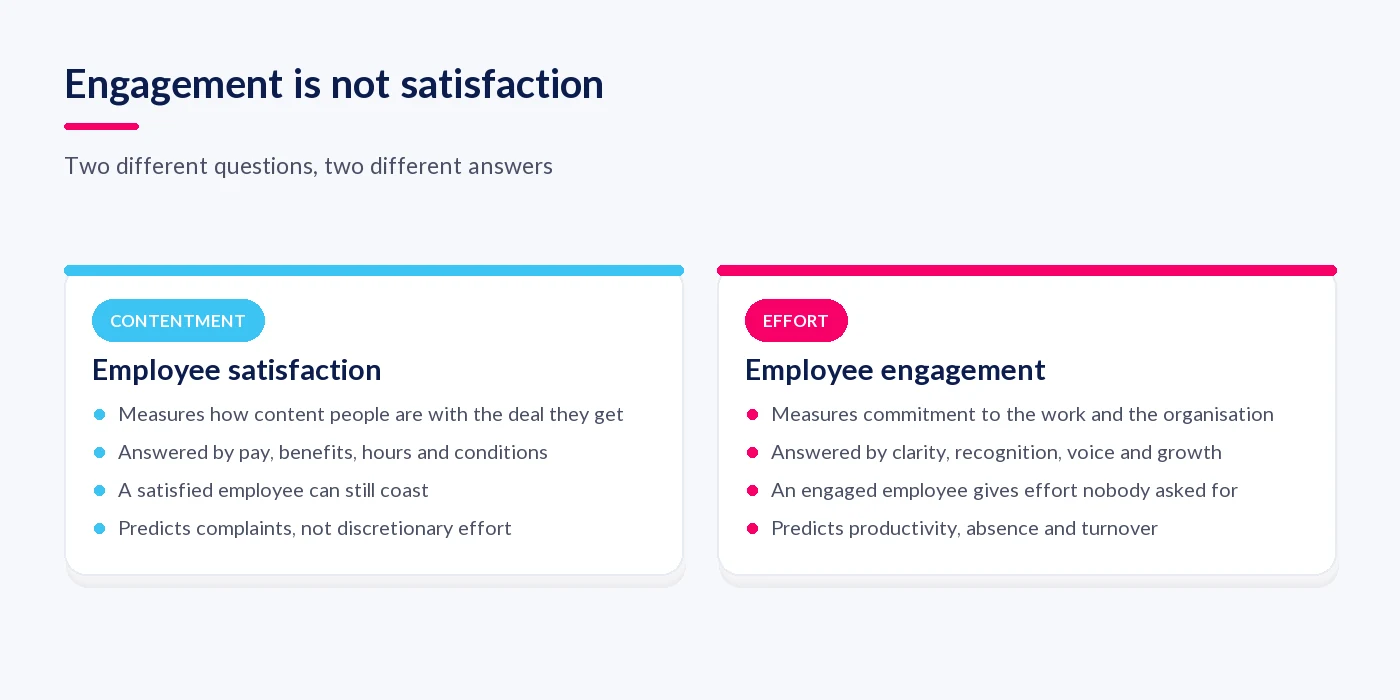
The clearest definition of employee engagement is the strength of a person's commitment to their work and their employer, measured by the discretionary effort they choose to give. It is not job satisfaction, which measures contentment with the deal. Engagement predicts productivity, absence and turnover; satisfaction mostly predicts complaints.
Key facts
- Gallup measured 10% of UK employees as engaged in 2025, against 20% globally.
- Engagement measures effort. Satisfaction measures contentment. The two move independently.
- Top-quartile engaged teams are 23% more profitable than bottom-quartile teams.
- Line managers own engagement day to day; HR owns the system behind them.
- An engagement score with no action attached lowers engagement rather than raising it.
What is employee engagement in HR?
In HR, employee engagement is a measurable construct rather than a mood: the strength of an employee's commitment to their work, their team and their employer. HR teams track it through surveys, an employee net promoter score and behavioural data such as absence and voluntary turnover, then hold line managers accountable for moving it.
That distinction matters because it changes who does the work. Engagement is not an HR programme that gets run at people once a year. It is an outcome produced hundreds of times a week in ordinary conversations between a manager and the people who report to them. HR's job is to make those conversations easy to have, visible when they are not happening, and connected to something — pay, progression, development — that people can see.
In the UK the baseline is low. Gallup's State of the Global Workplace UK country data put engagement at 10% of employees in 2025, below the Europe regional average of 12% and half the global figure of 20%. If your own numbers look poor, they are probably normal — which is precisely why moving them is worth something.
What is the difference between engagement, satisfaction, motivation and wellbeing?
They are four different things, and confusing them is why so much engagement work fails. Engagement measures commitment and effort. Satisfaction measures contentment with the terms of the job. Motivation measures the drive behind a specific task or goal. Wellbeing measures health at work. Somebody can be satisfied and disengaged, or engaged and unwell.
| Term | What it measures | A question that gets at it | What it predicts | Who owns it |
|---|---|---|---|---|
| Employee engagement | Commitment to the work and the organisation, expressed as effort | "I would recommend this organisation as a place to work" | Discretionary effort, productivity, absence, voluntary turnover | Line managers, enabled by HR |
| Employee satisfaction | Contentment with the terms and conditions of the job | "I am satisfied with my pay, hours and working conditions" | Grievances, offer acceptance, complaints about the deal | Reward and HR policy |
| Motivation | The drive behind a specific task, objective or goal | "I know what I am aiming for this quarter and why it matters" | Goal attainment and task completion, in the short term | The individual and their manager |
| Employee wellbeing | Physical, mental and financial health in the context of work | "My workload is manageable in most normal weeks" | Sickness absence, presenteeism, long-term ill health | Occupational health, HR and managers together |
The practical consequence: a benefits review will move satisfaction and barely touch engagement. A wellbeing programme will not fix a manager who never gives feedback. If you are trying to raise engagement, measure engagement — and read it next to the other three rather than instead of them.
What drives employee engagement?
Four things do most of the work, and they are not the ones organisations usually spend money on. Manager quality comes first by a distance, followed by clarity about what good looks like in the role, then everyday recognition and a sense that raising something changes something, then a visible path to grow. Perks sit a long way down the list.
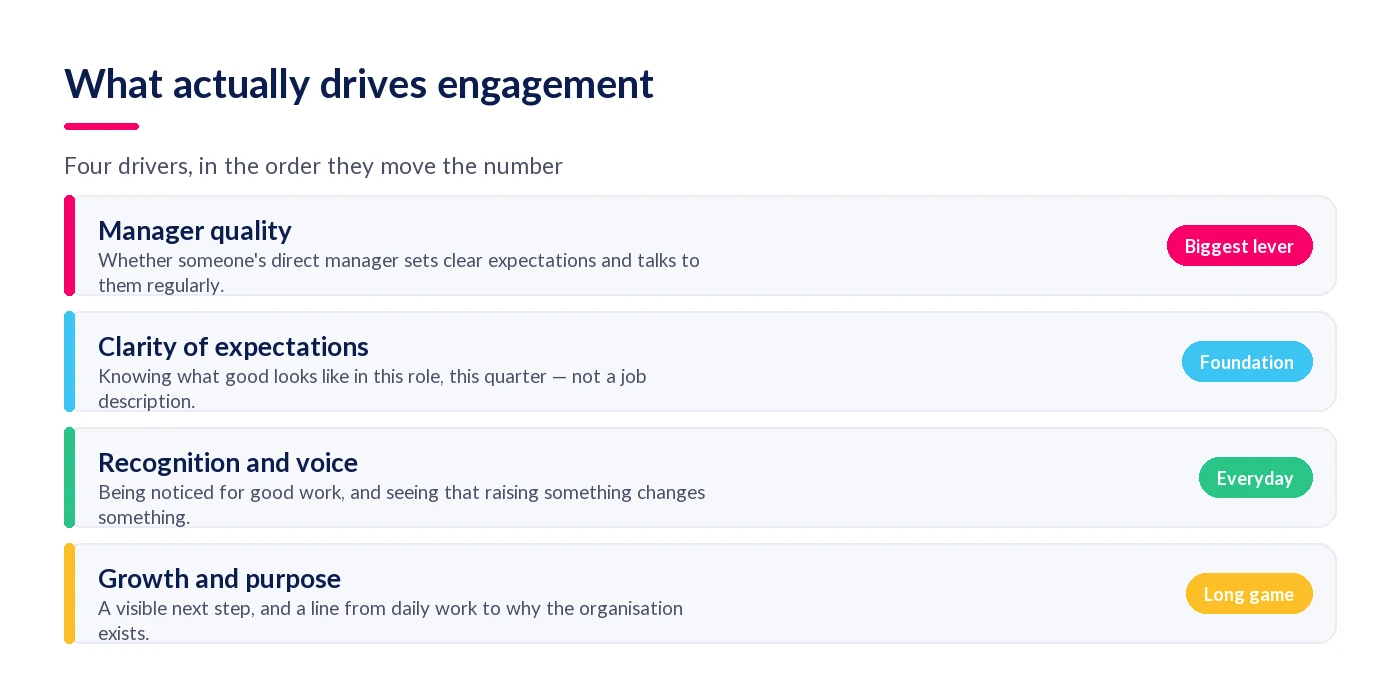
- Manager quality. Whether someone's direct manager sets clear expectations, notices their work and talks to them regularly. Almost every other driver is delivered through this one.
- Clarity of expectations. Knowing what a good quarter looks like in this specific role. A job description is not clarity; an agreed set of objectives is. Our guide to building a performance management system covers how that clarity gets structured.
- Recognition and voice. Being seen for good work, and having evidence that raising a problem leads to something changing. The second half is what most engagement surveys quietly destroy.
- Growth and purpose. A visible next step, and a line the employee can draw between their daily work and why the organisation exists. Written-down company values only help if decisions visibly follow them.
Frontline and deskless teams need the same four things delivered through completely different channels — no email, no desk, often no company login. Our ebook Deskless Not Voiceless: How to Engage Frontline Employees covers what changes when the workforce is not sitting at a screen.
Why is employee engagement important?
Because it is a leading indicator of things the board already cares about. Gallup's Q12 meta-analysis of 183,806 business units across 90 countries found top-quartile engaged teams were 23% more profitable and lost 78% less time to absenteeism than bottom-quartile teams. Engagement moves before absence, resignations and quality do.
That is the short version. The full evidence base, the outcomes it links to and the cost of ignoring it are set out in why employee engagement is important, and there is a wider figures round-up on our employee engagement statistics page.
How do you know whether your people are engaged?
You ask, in a structured and repeatable way, and then you check what the ask predicted against what actually happened. In practice that means three numbers from a survey — an eNPS score, a participation rate and an engagement index — read alongside behavioural data you already hold: absence, voluntary turnover, internal moves and overtime by team.
- How to measure employee engagement — the three metrics, with the arithmetic worked through.
- How to design an employee engagement survey — the seven-step process and the question wording that voids your data.
- How much employee engagement surveys cost — published price bands for 50, 250 and 1,000 employees.
One warning that applies to all three. Measuring engagement and then doing nothing visible with the result is worse than not measuring it, because you have now asked people to tell you what is wrong and demonstrated that telling you changes nothing.
How to engage employees
Start with the manager conversation, fix unclear expectations, make recognition visible, and close the loop on anything people have already told you. Those four are low effort and move the number fastest. Career pathways and reward redesign matter too, but they are quarters of work, not weeks, and they land badly on top of a broken one-to-one.
The prioritised version — every intervention scored on effort against expected impact, so you can pick what to do this quarter — is in how to improve employee engagement. It also covers what changes in manufacturing, retail and remote settings, where the same intervention can be low effort or impossible depending on how people actually work.
Who is responsible for employee engagement?
Line managers are responsible for it, and HR is responsible for the system that makes it possible. Engagement is produced in the relationship between a manager and their team, so no HR initiative can deliver it directly. What HR can do is make the expectation explicit, give managers the tools and prompts to meet it, and make it visible when a team has not had a conversation in two months.
Executive teams have a third, narrower job: making engagement a number that gets reported and asked about, alongside revenue and headcount. Engagement that nobody senior ever asks about becomes an HR hobby, and it stops moving.
StaffCircle exists to carry that system: real-time eNPS, pulse surveys and sentiment analysis alongside recognition and a central newsfeed that reaches desk-based, remote and frontline staff on the same day. Customers see 74% higher employee engagement — how that figure is measured is documented on our customer outcomes page. For practical tactics, see these internal communications that fix engagement problems.
If you want to see engagement measured and acted on in one place, take a look at StaffCircle's employee engagement software.
Frequently asked questions
What is the definition of employee engagement?
Employee engagement is the strength of an employee's commitment to their work and their organisation, expressed as the discretionary effort they choose to give. It is measured rather than assumed, usually through a survey score read alongside behavioural data such as absence, voluntary turnover and internal moves by team.
What are the main drivers of employee engagement?
Manager quality comes first, followed by clarity about what good looks like in the role, everyday recognition combined with genuine employee voice, and a visible path to grow. Pay and perks set a floor but rarely move engagement upward once that floor is met, which is why benefits reviews disappoint.
Is employee engagement the same as employee experience?
No. Employee experience is the sum of everything a person encounters at work, from recruitment through to exit, including systems, workplace and processes. Engagement is one outcome of that experience: how committed the person feels and how much effort they give. You design the experience to move engagement.
What are the three types of employee engagement?
Gallup classifies employees as engaged, not engaged or actively disengaged. Engaged employees are committed and give effort beyond the minimum. Not-engaged employees do the job and little more. Actively disengaged employees are unhappy at work and act on it, spreading the effect to colleagues around them.
Who is responsible for employee engagement in an organisation?
Line managers own it day to day, because engagement is created in the relationship between a manager and their team. HR owns the system that makes it possible: the measurement, the prompts, the visibility when conversations stop. Executives own making it a number that gets reported and questioned.
Related articles



See StaffCircle in action
Book a personalised demo and see how StaffCircle drives performance, engagement and development.