Employee Development Plans: Structure, Examples and Common Failures
An employee development plan is a short written agreement between a manager and an employee that names one or two specific skill gaps, sets a measurable goal against each, and lists the actions, support and review dates needed to close them. The plans that survive past month two share three traits: a narrow scope, actions with an owner and a date attached, and a review that rides inside a meeting that already happens rather than a new one nobody protects.
What Is an Employee Development Plan?
An employee development plan, sometimes called an individual development plan (IDP) or professional development plan (PDP), documents the skills or behaviours an employee is working to build, why they matter to the role or their next one, and how progress gets checked. It sits alongside a job description and a set of SMART goals rather than replacing either.
Two other documents get confused with it constantly, and treating them as interchangeable is one reason plans stall before they start:
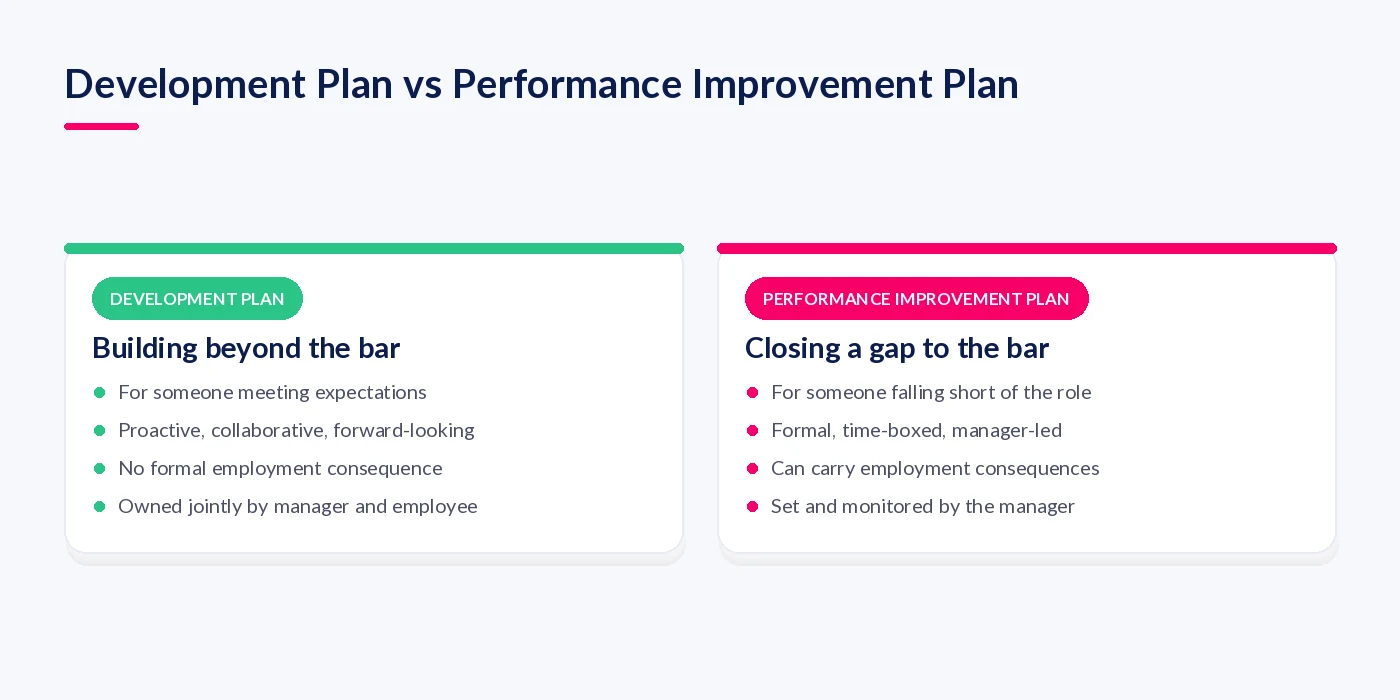
- A performance improvement plan (PIP) addresses someone falling short of the bar in their current role, on a formal timetable, sometimes with employment consequences attached. A development plan starts from the opposite premise — the person is meeting expectations and is building capability beyond them.
- A training calendar lists courses booked. A development plan states the capability a course is meant to produce and how you will know it worked. A course can appear inside a plan; it is never the plan itself.
A plan worth writing down answers four questions specifically enough that someone outside the conversation could read it and know what "done" looks like:
- What can this person not yet do, that the role — current or next — needs?
- What would "closed" look like, in terms a manager could observe or a peer could confirm?
- What is the person actually going to do differently this month, not just attend?
- Who checks in, and when — on a date that already exists in a calendar?
Why Most Development Plans Die in Month Two
The document itself is rarely the problem. Plans fail for a small, repeatable set of structural reasons rather than personal ones.
The Goal Is Too Broad to Fail
"Improve communication skills" cannot be checked, so nobody checks it. A goal that survives review time is written as a specific behaviour, in a specific setting, that either happened or did not — "run the Tuesday stand-up without a script by week six", not "get more confident presenting".
The Review Rides on a Meeting That Gets Cancelled First
A plan reviewed in its own dedicated monthly meeting dies the first time that meeting gets moved for something more urgent — and something more urgent always turns up. Plans that last get folded into a slot that already survives reprioritisation: the existing one-to-one, not a new calendar invite competing with it.
Completion Gets Confused With Capability
A course finished, a webinar attended and a certificate filed are activity, not evidence. Plans built around completion metrics generate exactly that — activity — while the behaviour at work stays unchanged, because nothing in the plan ever asked what the person would do differently once the course ended.
Nobody Owns It Once the Manager Changes
A plan that lives in one manager's notebook or a personal spreadsheet does not survive a reorganisation, a manager leaving, or a period of leave. The employee restarts from zero with whoever replaces them, and restarting from zero twice is usually the point people stop believing the process is real.
The Lever Most Articles on This Topic Never Mention
Every guide to development plans covers goal-setting frameworks. Almost none mentions that, in the UK, a request for time to train can carry statutory weight. Under section 63D of the Employment Rights Act 1996, an employee who has worked continuously for their employer for at least 26 weeks can make a formal application for time to study or train that will improve their effectiveness in the business. In organisations with 250 or more staff, the employer who receives that application must hold a meeting to discuss it — or agree to it in writing — within 28 days of receiving it, under regulation 4 of the Employee Study and Training (Procedural Requirements) Regulations 2010, and can only refuse on specific business grounds such as cost or an inability to reorganise work (see gov.uk's guidance on training and study at work). The right does not force approval and does not cover pay for the time itself — but it means a development action that keeps getting deprioritised in a large organisation is not purely a matter of managerial goodwill. It is worth building that request route into how plans get resourced, rather than discovering it when an employee cites the regulation.
Building a Plan That Lasts
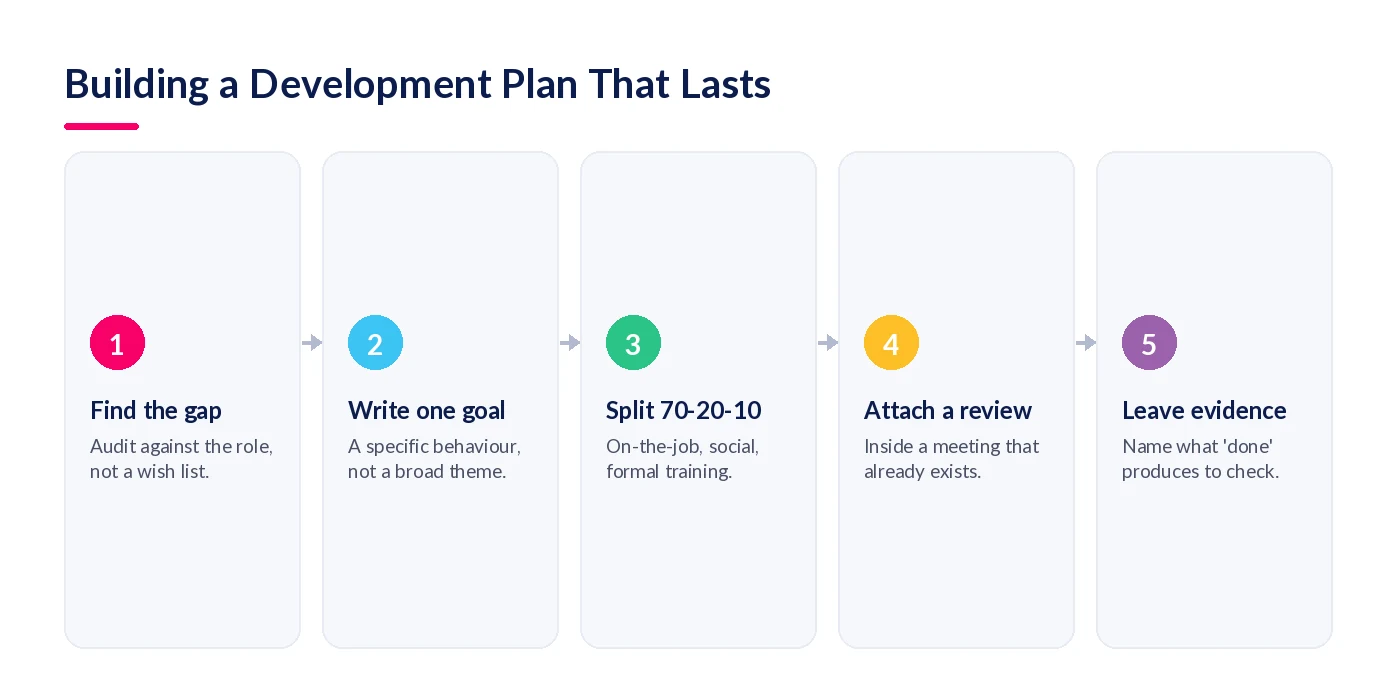
The structure below works whether the plan covers one skill or three. Skip a step and the plan tends to fail at exactly that point.
1. Start From a Gap, Not a Wish List
Compare what the role — current or next — actually requires against what the person can currently demonstrate. A quick skills gap analysis against a role standard produces a shorter, more defensible list than asking "what would you like to work on?", which tends to surface interests rather than gaps.
2. Write One Goal as a Behaviour
Cap it at one or two goals. Each should be written as a SMART goal — specific, measurable, achievable, relevant, time-bound — phrased as something the person will do, not a trait they will acquire. Three goals started at once usually means none finished.
3. Split the Actions 70-20-10
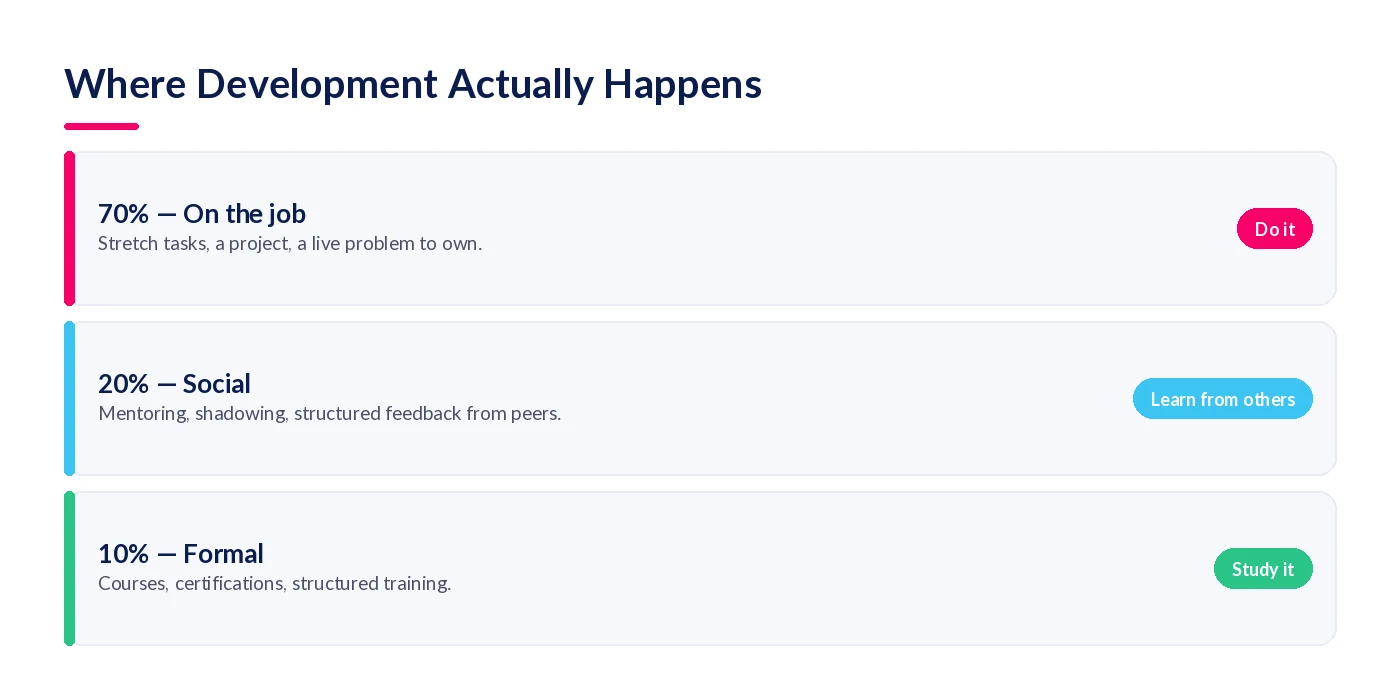
For each goal, list what the person will actually do under three headings: on-the-job practice, learning from other people, and formal training. Most of the weight should sit in the first two — which matters most when there is no training budget to draw on, since neither costs anything beyond time.
4. Attach the Review to a Meeting That Already Exists
Add a standing agenda item to the existing one-to-one rather than scheduling a separate development meeting. A five-minute check most weeks beats a fifty-minute review that keeps sliding to "next month".
5. Name What "Done" Leaves Behind
Decide up front what evidence closes the goal — a peer's confirmation, a manager's observation, a piece of work the person can point to. If the goal maps onto a defined proficiency level in a competency framework, use that level's behavioural anchor as the finish line instead of inventing a new one.
6. Put It Somewhere That Survives a Manager Change
A plan stored in a shared, structured record — rather than a notebook or a personal document — is the difference between a new manager picking up where the last one left off and the employee starting again from a blank page.
Where This Breaks Down
Deskless and Frontline Teams
A plan that only lives in an email or a desktop HR system is invisible to someone who never sits at a desk. Development actions for frontline staff need to be checkable on a phone, on shift, without asking someone else to open a laptop on their behalf.
Multi-Site and Remote Teams
A manager who does not see the work in person cannot rely on noticing progress; the plan has to specify what evidence gets reported back, by whom, and how often — otherwise "how's it going" becomes the entire review process.
The Plateaued Employee
Not every plan points at a promotion. For someone who is not chasing a next role, the goal should be framed as depth, breadth or influence in the current one — mentoring others, owning a wider slice of the work, or building a skill the team currently lacks — rather than forced into a career-ladder template that does not fit.
No Training Budget
This is the case the 70-20-10 split exists for. A stretch assignment, a shadowing arrangement or a structured feedback loop with a peer costs nothing beyond time, and for most skills — communication, delegation, prioritisation, stakeholder management — it teaches faster than a course would anyway.
A Worked Example
A team lead in customer support wants to move into a people-management role within a year. The gap identified in a skills conversation: she has never run a difficult feedback conversation without a script.
| Element | Detail |
|---|---|
| Goal | Run three unscripted feedback conversations with direct reports by week ten, each confirmed by the report as clear and specific. |
| 70% — On the job | Lead the next three 1:1s herself instead of her manager shadowing; note one thing to try differently after each. |
| 20% — Social | Debrief each conversation with her manager for ten minutes immediately after; observe one senior manager's feedback conversation by sitting in with the report's consent. |
| 10% — Formal | One internal workshop on structuring difficult conversations, already scheduled for month one — not a new course purchased for this plan. |
| Review | Standing five-minute item in her existing fortnightly 1:1 with her manager, weeks 2, 4, 6, 8 and 10. |
| Evidence of "done" | Three reports confirm the conversations felt clear; manager observes one unscripted; mapped against the "Coaches and gives feedback" behaviour at the next proficiency level in the team's competency framework. |
Notice what is absent: no external course beyond the one already scheduled, no vague "improve leadership" goal, and no new meeting invented to review it.
How StaffCircle Supports Employee Development Plans
One Record That Survives a Manager Change
Plans live against the employee, not in a manager's personal notes, so a change of manager means a handover rather than a restart.
Goals Tied to the Competency Framework
A development goal can map directly to a behaviour in the organisation's skills and development framework, so "done" is the same defined anchor a manager would use to assess anyone else at that level.
Reviews Live Inside the 1:1 That Already Happens
Development goals sit alongside performance goals in the same one-to-one and review cycle, so checking on them does not compete with a manager's calendar for a slot of its own.
Reachable by Frontline and Deskless Teams
Because the platform is mobile-first, an employee without a desk can see their plan, log progress and confirm a conversation happened from a phone on shift.
Final Thoughts
A development plan does not need more sections to work better — it needs fewer goals, actions that cost nothing but time, and a review slot that was already going to happen anyway. Get those three right and the plan outlives month two by default.
Want to see how development plans, competency frameworks and review cycles work together in one place? Book a demo or try the ROI calculator to see what closing skills gaps faster is worth to your team.
FAQ
What is an employee development plan?
An employee development plan is a written agreement between a manager and an employee that names one or two specific skill or capability gaps, sets a measurable goal against each, and lists the actions, support and review dates needed to close them. It sits alongside, not instead of, a job description and performance goals.
What is the difference between a development plan and a performance improvement plan?
A development plan is for someone meeting expectations who is building capability beyond the role, is collaborative, and carries no formal employment consequence. A performance improvement plan (PIP) addresses someone falling short of the current role's bar, runs on a formal timetable, and can carry employment consequences if targets are missed.
What should be included in an employee development plan?
At minimum: the specific gap identified, one or two goals written as observable behaviours, the actions the employee will take split across on-the-job practice, learning from others and formal training, who reviews progress and how often, and what evidence will confirm the goal is met.
How many goals should a development plan have?
One or two. A plan with three or more active goals usually means none of them get the attention needed to finish, and the plan reads as a wish list rather than a commitment.
How often should a development plan be reviewed?
Attach a short check-in to a meeting that already exists — most commonly the manager's regular one-to-one — rather than scheduling a dedicated development review. A five-minute check most weeks or fortnights outperforms a longer session that keeps getting rescheduled.
Is an employee development plan a legal requirement in the UK?
No, a development plan itself is not a statutory requirement. What is a statutory right, for employees with at least 26 weeks' continuous service in organisations of 250 or more staff, is the ability to make a formal request for time to train under section 63D of the Employment Rights Act 1996 — the employer must consider it and respond within set timescales, though it need not be paid or automatically approved.
What is the 70-20-10 model and how does it apply to a development plan?
It is a way of splitting development actions: roughly 70% on-the-job experience such as a stretch task, 20% learning from others such as mentoring or shadowing, and 10% formal training such as a course. Applied to a plan, it stops every goal defaulting to "book a course", which is often the slowest and most expensive route to the same capability.
Can you write a development plan without a training budget?
Yes. The 70% and 20% categories in the 70-20-10 split — stretch assignments, shadowing, structured peer feedback — cost nothing beyond time, and for most workplace skills they build capability faster than a course does. A plan is not weaker for containing no formal training line at all.
Who should write the development plan, the manager or the employee?
Both. The employee is best placed to say what they want to build toward; the manager is best placed to confirm what the role or the business genuinely needs and to commit the time to review it. A plan written by one party alone tends to either miss what the business needs or fail to secure the manager's buy-in to protect review time.
What is the right to request time to train?
It is a statutory right under section 63D of the Employment Rights Act 1996 allowing an eligible employee to formally request time for study or training that would improve their effectiveness in the business. In organisations with 250 or more staff, the employer must hold a meeting to discuss the request, or agree to it in writing, within 28 days of receiving it, and can only refuse on specified business grounds.
How is a development plan different from a career development plan?
In practice the terms overlap, but a "career development plan" usually spans a longer horizon and multiple future roles, while an "employee development plan" more often addresses the next quarter or two against the current or next role specifically. Either can use the same goal-actions-review structure.
What happens if an employee does not meet their development goals?
Nothing formal, by design — a missed development goal is not a disciplinary matter, unlike a missed target on a performance improvement plan. The right response is usually to revisit whether the goal, the actions or the timeline were realistic, and adjust rather than escalate.
How do you measure whether a development plan worked?
Define the evidence before the plan starts, not after: a peer's confirmation, a manager's direct observation, or a specific piece of work the person can point to. Course completion and attendance are the weakest form of evidence, because they show activity rather than a changed behaviour at work.
Should development plans be linked to a competency framework?
Where one exists, yes. Mapping a goal to a defined behavioural anchor in a competency framework gives "done" a consistent, pre-agreed definition instead of one invented for a single conversation, and it lets the same evidence feed both the development plan and any future promotion or succession conversation.
Related articles

See StaffCircle in action
Book a personalised demo and see how StaffCircle drives performance, engagement and development.