Skills Matrix: How to Build One That Survives an Audit
Quick answer: A skills matrix is a grid recording who holds which skill at what level across a team. Most stop there, which is why they fail an audit — a rating with no assessor, no evidence and no date is an opinion, not proof. An audit-ready skills matrix adds four things to every cell: who assessed it, what evidence backs it, when it was assessed, and when it needs reassessing. Build those in from the start and the matrix survives the moment someone asks you to prove it.
The gap tends to surface the same way every time. Someone builds a colour-coded grid — green for expert, amber for competent, red for training needed — rolls it out to the team, and everyone feels informed. Then an auditor, a client compliance team or an insurer's assessor asks a narrower question: show me the evidence behind this person's rating. The colours have nothing behind them, because nobody building the matrix was thinking about who would eventually be asked to defend it.
That is not a criticism of the format. A grid mapping people against skills is still the right shape for the problem. What is missing is what sits behind each cell. The Health and Safety Executive defines competence as “the ability to undertake responsibilities and perform activities to a recognised standard on a regular basis… a combination of skills, experience and knowledge”. Nothing in that definition is satisfied by a self-selected colour in a spreadsheet cell. It is satisfied by evidence, applied consistently, and kept current.
What Is a Skills Matrix?
A skills matrix is a grid mapping a group of people against the skills their roles need, with a level recorded in every cell — usually on a three-to-five-point scale from no experience to expert. It is used to spot gaps, plan training, staff a rota safely and support workforce decisions. If you need the fundamentals first — what to include, a worked example, and the six steps to build your first one — our companion guide covers that ground in full. This piece picks up from there: what changes when that matrix has to survive being read by someone whose entire job is to find the weak link in it.
Skills Matrix vs Competency Matrix vs Training Matrix
The three terms get used almost interchangeably, and the confusion matters because auditors and standards treat them differently. A competency matrix maps broader behaviours and capabilities — leadership, communication, decision-making — usually tied to a competency framework and career progression. A training matrix records which courses each person has completed and when, which is a completion record rather than a competence record. A skills matrix sits between the two: it records demonstrated ability in specific, usually technical or role-critical, tasks.
Our guide to skills compliance sets out why the completion-versus-competence distinction is the one an auditor actually tests. It applies just as much to a skills matrix as it does to a training record — a matrix that only reflects completed courses inherits the same weakness a training log has: it proves attendance, not ability.
Why Most Skills Matrices Fail an Audit
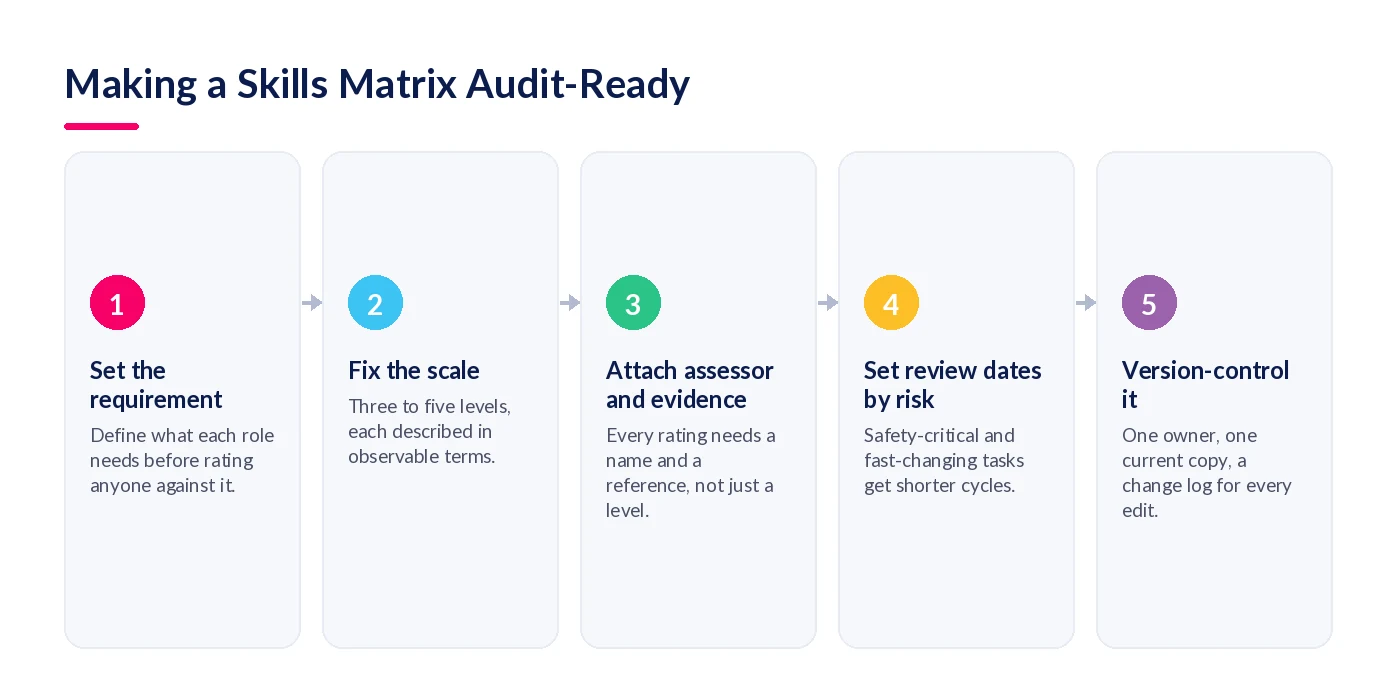
Auditors do not read a matrix in isolation. They pick a handful of names from it and trace each one back: the role's requirement, the rating recorded against it, and then the evidence that rating is true. A self-rated matrix breaks at the second step, because there is nothing behind the colour to trace. The rating was entered by the person it describes, with no independent check and no record of when it stops being trustworthy.
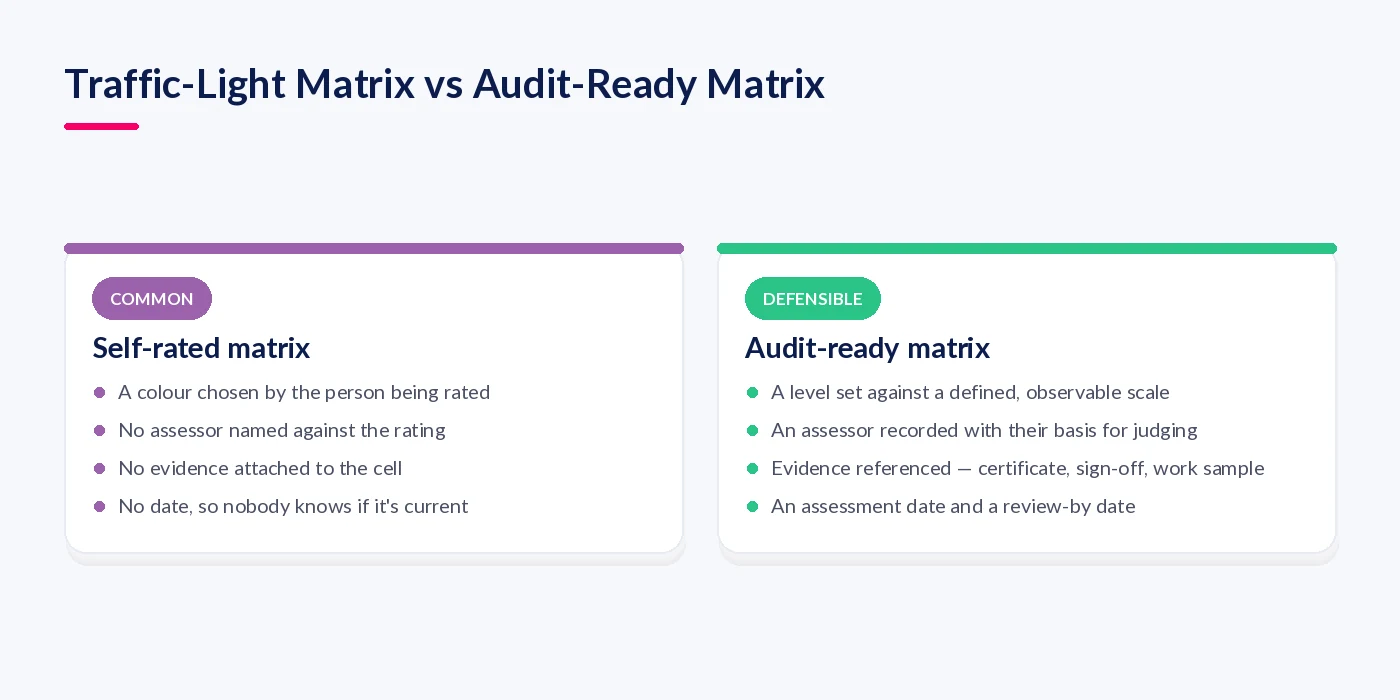
That is the pattern across almost every published skills matrix guide: a clear explanation of how to build the grid, a recommended proficiency scale, and a worked example — and then silence on what happens when someone outside the team has to trust it. The table below is the difference in practice.
| What a self-rated matrix shows | What an auditor actually asks for |
|---|---|
| A colour or number chosen by the person being rated | A level set against a defined, observable scale |
| No name against who confirmed the rating | An assessor recorded, with their basis for judging |
| No link to how the rating was reached | Evidence referenced — a certificate, an observation sign-off, a work sample |
| No date, so currency is a guess | An assessment date and a review-by date |
The Six Fields Every Audit-Ready Cell Needs
Turning a rating into a record means adding six things, not one. Most matrices already have the first two; almost none have all six.
- The requirement, named precisely. Not “fire safety” but “fire panel reset procedure, Building 3”. A vague requirement produces a rating nobody can defend, because it is not clear what was actually assessed.
- The level achieved, against a scale defined in observable terms before anyone was rated against it.
- Who assessed it, and what gives them standing to judge — a line manager, a qualified assessor, a technical authority or an external body.
- The evidence that supports it: a reference to the certificate, the observation note, or the work sample, not just a tick confirming one exists.
- The date it was assessed.
- The date it needs reassessing, and what would trigger an earlier review — a process change, new equipment, or an extended gap since the person last performed the task.
Add those six fields consistently and the matrix stops being an opinion poll and becomes a record — the same shift our guide to skills compliance describes as the evidence chain behind any competence claim. A matrix is simply that chain rendered as a grid instead of a list.
How to Build an Audit-Ready Skills Matrix
The build order matters as much as the content. Set the standard before you measure anyone against it, or the matrix ends up justifying ratings instead of testing them.
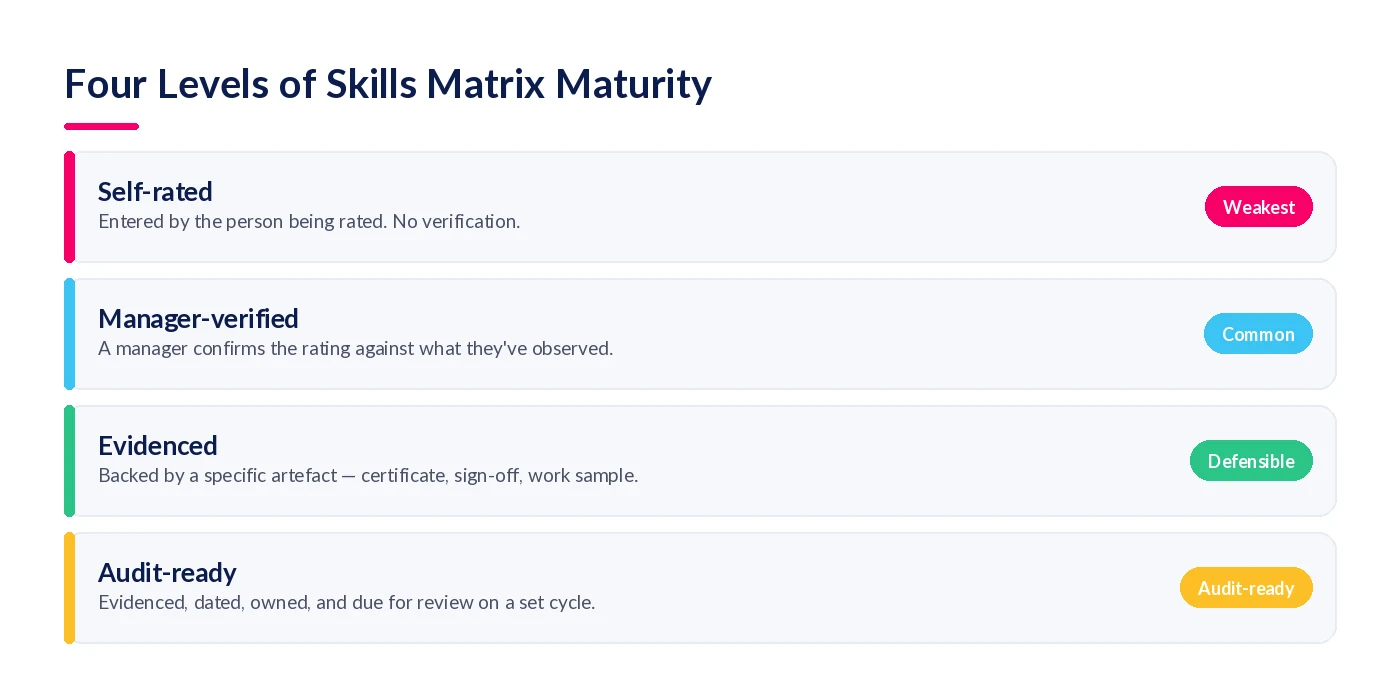
- Set the requirement, not the person. Define what each role actually needs to be able to do before rating a single individual. This is the step teams skip under time pressure, and it is the one that makes every later rating defensible.
- Fix the scale before anyone rates anything. Three to five levels, each described in observable terms — what someone at that level can actually do, not an adjective. An undefined scale produces ratings that mean something different in every row.
- Attach an assessor and evidence to every rating. A level with no name and no reference behind it is a self-assessment wearing a matrix's clothing. This is the single change that moves a matrix from a self-rated grid to a defensible one.
- Set review dates by risk, not by a fixed calendar. The HSE's guidance on competence is explicit that refresher training should be considered for tasks that are “infrequent, complex or safety critical”, which may include reassessment. A blanket annual cycle under-checks high-risk work and over-checks low-risk work.
- Put the matrix under version control, with one owner. A shared spreadsheet with no single source of truth and no change log is how “which copy is current” becomes an unanswerable question in the room with the auditor.
- Extend coverage deliberately, not by assumption. Under CDM 2015, regulation 8, whoever appoints a designer or contractor must take reasonable steps to satisfy themselves that the appointee has the necessary skills, knowledge and experience — a duty that does not stop at your own payroll. A matrix that only covers direct employees at one site misses subcontractors, agency staff and people working from other locations, and that gap is exactly where an auditor's sample tends to land.
Where Matrices Break Down in Practice
The Shared Spreadsheet Has Three Versions
One copy lives in someone's email from six months ago. Another is on a shared drive, edited by whoever last opened it. A third is the one a manager keeps locally because the shared version was “wrong last time”. None of them log who changed a rating or when, so there is no way to show an auditor which version was current on the date in question.
Self-Rated Colours Read as Confidence, Not Evidence
People are not deliberately dishonest when they self-rate, but confidence and competence are not the same measurement. A traffic-light matrix built entirely from self-assessment tells you how people feel about their own ability, which is useful for a development conversation and worthless as audit evidence.
Review Dates Exist on Paper, Not as Triggers
Plenty of matrices do have a “next review” column. Far fewer have anything that acts on it. A date sitting unread in a spreadsheet cell is not a control — it becomes one only when something alerts an owner before it lapses, and escalates if nobody responds.
Multi-Site and Subcontractor Blind Spots
A matrix built for one site's direct employees is the easy version. Extending it to a second site, a subcontractor crew or agency staff on a short placement is where most organisations stop, usually because nobody owns the extension. It is also, per the CDM 2015 duty above, exactly the population an appointing organisation is expected to have checked.
A Worked Example
Take a four-person facilities team responsible for a mechanical plant room. The requirements are isolation procedure, fire panel reset, working at height and permit sign-off. A traffic-light version of this matrix would show four coloured cells per person and stop there.
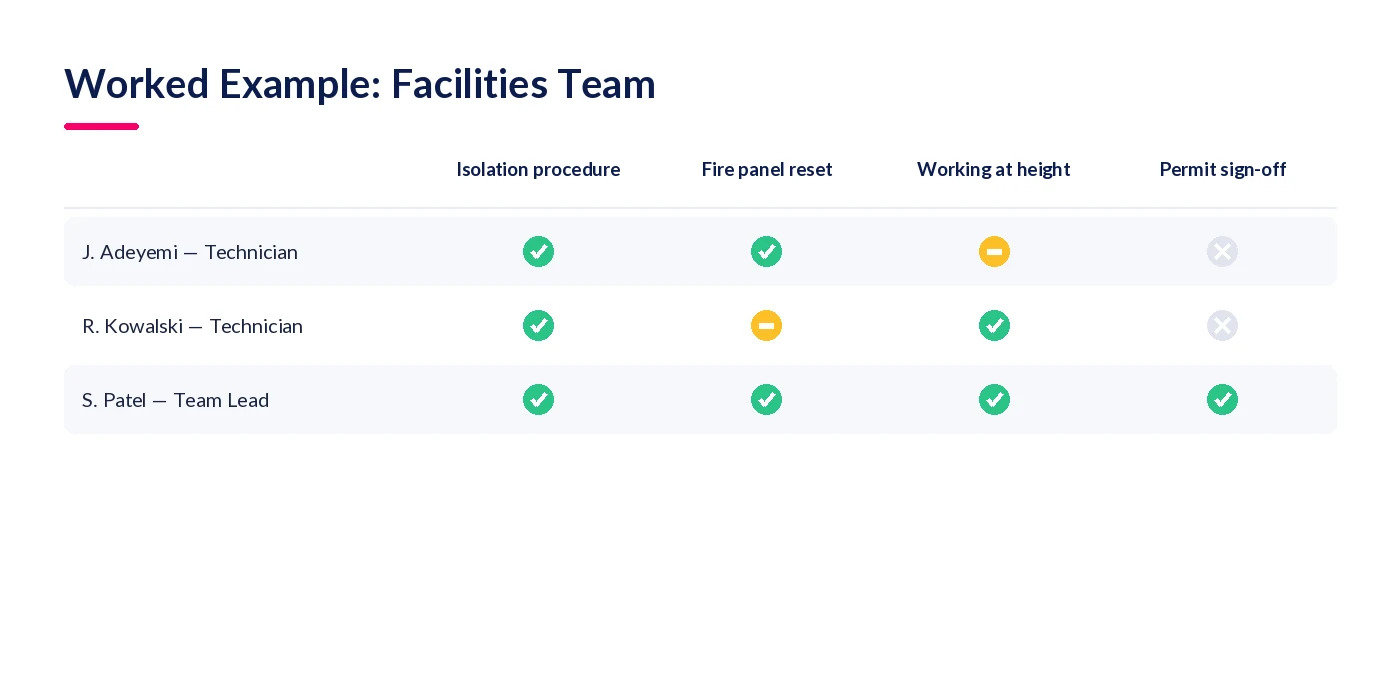
An audit-ready version of the same grid records, behind J. Adeyemi's “partial” rating for working at height: assessed by the site supervisor on a stated date, against the refresher-training standard rather than the original certificate, with the certificate reference attached and a review date six months out because the task is infrequent for this team. That single cell now answers all four of an auditor's questions without anyone needing to go looking for the answer separately.
If you are retrofitting this onto a matrix that already exists, start narrow. Pick the highest-risk requirement on the grid, add the six fields to every rating against it, and assign one owner to keep it current. Widen the coverage from there rather than trying to evidence the whole matrix in one pass — the partial version with real evidence behind it is a stronger audit position than a complete grid with none.
How StaffCircle Handles This
One Matrix, Not a Spreadsheet Nobody Owns
Role requirements are defined once in the skills and development framework and applied to everyone holding that role, so the matrix is generated from a single source rather than maintained by hand in parallel copies.
Evidence Attached to the Rating, Not Chased Afterwards
Assessor, evidence file and assessment date sit on the same record as the level itself, through StaffCircle's training and compliance capability, so a rating and its proof cannot drift apart into separate systems.
Reassessment That Escalates Instead of Sitting in a Cell
Review dates carry an owner and an alert window, so a lapsing rating becomes a task before it becomes a finding. Our skills compliance guide covers this expiry mechanism in more depth, including how it handles competence being withdrawn as well as granted.
One Export an Auditor Can Actually Follow
The matrix filters by role, site or requirement and exports with the evidence trail intact, so a sample audit request produces the record in one step rather than a collation exercise across spreadsheets, email and a filing cabinet. Related reading: running a skills audit and how to run a skills gap analysis once the matrix itself is trustworthy.
Final Thoughts
A skills matrix does not fail an audit because the grid is wrong. It fails because the cells hold opinions instead of records. Fix that at the level of a single cell — requirement, level, assessor, evidence, date, review date — and the rest of the matrix inherits the fix, one row at a time.
Start with the requirement that carries the most risk if it is wrong, and build outward from there. Book a demo to see how StaffCircle turns a skills matrix into evidence an auditor can actually follow.
FAQ
What is a skills matrix?
A skills matrix is a grid that maps a group of people against the skills their roles require, with a proficiency level recorded in every cell. It is used to spot skill gaps, plan training and staff work safely. An audit-ready version also records who assessed each rating, what evidence supports it, and when it needs reassessing.
What is the difference between a skills matrix and a competency matrix?
A skills matrix records demonstrated ability in specific, usually technical or role-critical tasks. A competency matrix maps broader behaviours and capabilities, such as leadership or decision-making, typically tied to a competency framework and career progression rather than a single task.
What is the difference between a skills matrix and a training matrix?
A training matrix records which courses someone has completed and when, which is a completion record. A skills matrix records the level of demonstrated ability itself. A person can be fully compliant on a training matrix and still lack the assessed competence a skills matrix is meant to show.
Is a skills matrix enough to pass an ISO 9001 audit?
Only if it links each rating to who assessed it and what evidence supports it. ISO 9001:2015 clause 7.2 requires organisations to determine competence requirements, ensure people are competent on the basis of education, training or experience, and retain documented evidence of that competence — a colour with nothing behind it does not satisfy the third part.
Why do auditors reject skills matrix spreadsheets?
Not because of the spreadsheet format itself, but because most spreadsheet matrices are self-rated with no assessor, no evidence reference and no reliable version history. An auditor samples a handful of names and traces each rating back to its evidence; a self-rated matrix has nothing to trace.
What should every cell in an audit-ready skills matrix record?
Six things: the precise requirement, the level achieved against a defined scale, who assessed it, the evidence that supports it, the assessment date, and the date it needs reassessing.
What proficiency scale should a skills matrix use?
Three to five levels, each described in observable terms rather than adjectives like “good” or “strong”. More than five levels tends to produce distinctions nobody can consistently apply, which weakens the rating rather than sharpening it.
Who should own and maintain the skills matrix?
One named owner per matrix, responsible for the current version and the change log. Ownership can sit with a line manager, a compliance lead or an HR business partner depending on the requirement, but it should never be implicit or shared without a single accountable person.
How often should a skills matrix be reassessed?
Set the cycle by risk and rate of change rather than a single fixed interval. Safety-critical tasks, tasks performed infrequently, and tasks affected by a recent process or equipment change justify shorter cycles than stable, low-risk requirements.
Can a skills matrix cover subcontractors and agency workers?
It should, wherever their work carries the same risk as a direct employee's. Under CDM 2015, whoever appoints a contractor or designer must take reasonable steps to check they have the necessary skills, knowledge and experience, which extends the evidence requirement beyond an organisation's own payroll.
Is a shared spreadsheet ever good enough for a skills matrix?
It can work for a small team with one clear owner, a single current copy and a habit of recording assessor, evidence and dates against every rating. It stops working once the team, the number of requirements, or the number of sites grows past what one person can track by memory.
What happens when a skill rating expires?
It should be flagged before the expiry date, not after, with an owner responsible for arranging reassessment. A rating that has lapsed without a recorded outcome should show as expired rather than simply disappearing from view, so the gap is visible rather than hidden.
Is a skills matrix the same as a skills framework?
No. A skills framework defines what good looks like across roles and supports development and workforce planning at an organisational level. A skills matrix is one output of applying that framework to a specific team — who currently holds which skill at what level.
Does a skills matrix need to account for multiple sites?
Yes, if the same role or requirement exists at more than one site. Competence assessed on one site, one machine or one process is not automatically transferable to another, so a matrix that only reflects one location can overstate readiness elsewhere in the organisation.
Related articles
See StaffCircle in action
Book a personalised demo and see how StaffCircle drives performance, engagement and development.