Skills Gap Analysis for AI Readiness: A Step-by-Step HR Guide
AI adoption is changing the skills organisations need. But how can HR leaders tell whether employees are ready to use AI in their roles?
The World Economic Forum's Future of Jobs Report 2025 found that 63% of employers consider skills gaps a major barrier to business transformation. This makes understanding workforce capabilities a business priority, not just an L&D exercise.
A structured AI skills gap analysis helps HR assess employees against role-specific requirements, identify capability gaps and decide where to invest in training or recruitment. An AI readiness assessment provides a clearer picture of whether employees have the skills and confidence to use AI effectively in their roles.
This guide explains how to rate AI skills across different roles, use a five-step assessment process and make informed train-versus-hire decisions.
What Does AI Readiness Mean for Different Job Roles?
AI readiness isn't the same for everyone. The skills an employee needs depend on their responsibilities, the AI tools they use and the decisions they make.
For example, a marketing employee may use generative AI to create content, while a finance professional may need to interpret AI-generated forecasts. An HR manager may need to understand algorithmic bias and assess AI-supported recruitment decisions.
Before conducting a skills gap analysis, identify the AI capabilities that matter for each role.
| Role | Relevant AI skills | What good looks like |
|---|---|---|
| HR and recruitment | AI literacy, responsible AI use, output validation | Uses AI-supported recruitment tools while checking recommendations for bias and accuracy. |
| Marketing | Prompt writing, content evaluation, AI-assisted analytics | Uses generative AI to support content creation and campaign analysis while reviewing outputs. |
| Finance | Data literacy, analytical thinking, AI output validation | Interprets AI-generated forecasts and checks assumptions before making decisions. |
| Customer service | AI-assisted communication, knowledge retrieval, problem-solving | Uses AI tools to find information and support customer responses while maintaining service quality. |
| IT and data teams | AI tool integration, data management, security and governance | Supports AI systems, manages data requirements and addresses technical risks. |
| Managers and team leaders | AI literacy, critical thinking, responsible decision-making | Understands where AI can support team performance and where human judgement is essential. |
These are starting points, not universal requirements. Your organisation should define the skills and proficiency levels based on its own AI strategy and the responsibilities of each role.
A role-based skills framework can help establish consistent expectations across departments.
How to Conduct an AI Skills Gap Assessment: 5 Steps
Once you know which roles are affected, you can assess whether employees have the capabilities to use AI effectively.
Follow these five steps to build a practical AI skills gap assessment.
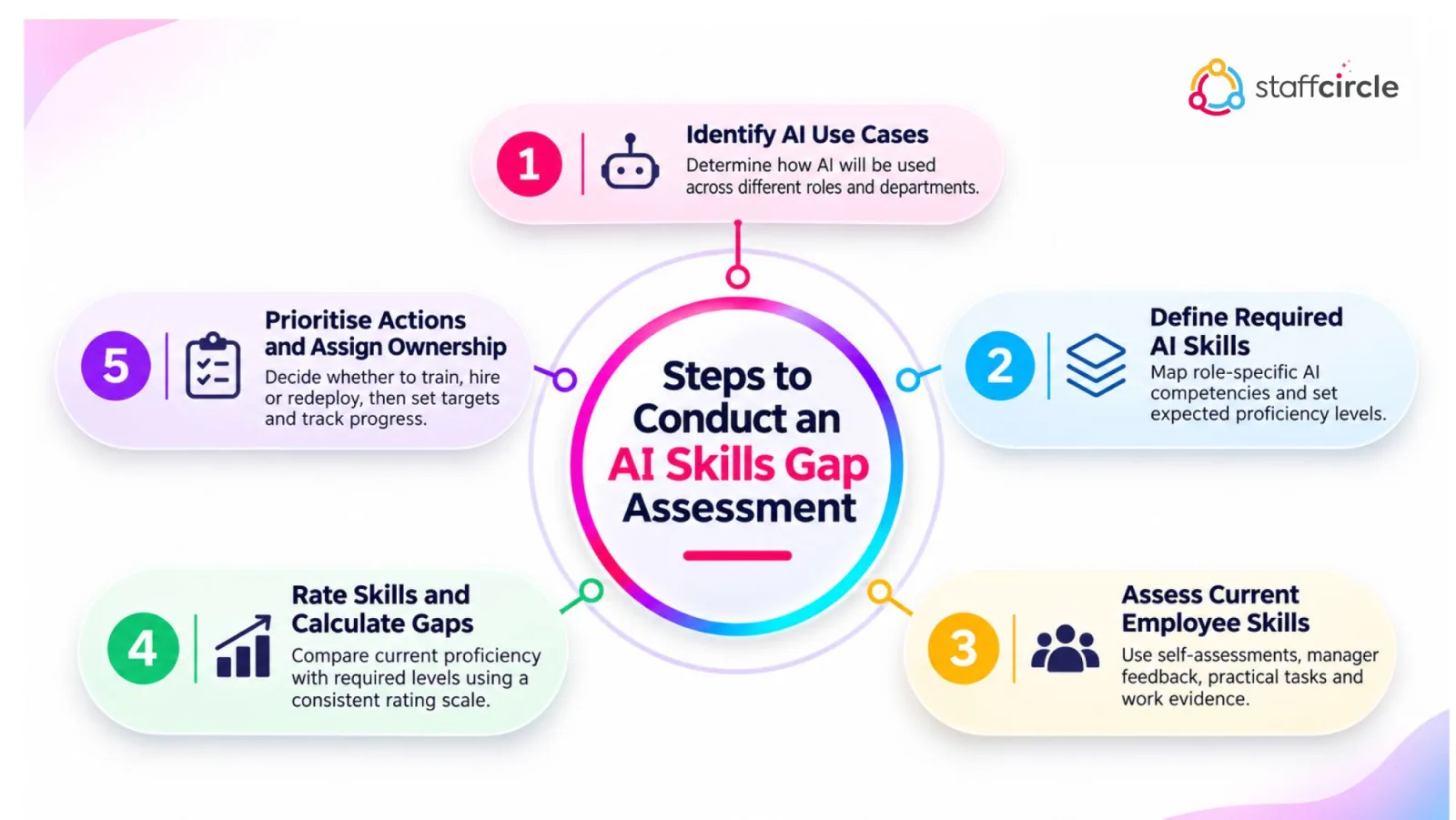
Step 1: Identify AI Use Cases for Each Role
Start by understanding where employees are expected to use AI.
Speak with department heads and managers to identify tasks that AI may support, improve or change. Focus on actual workplace applications rather than general assumptions about AI adoption.
For example, an HR team might use AI for recruitment administration, workforce reporting and employee development. Each application requires different skills.
Step 2: Define the Required AI Skills and Proficiency Levels
Translate each use case into specific skills.
For an AI-supported recruitment process, these might include:
- AI literacy and understanding of tool limitations.
- Prompt writing and effective tool usage.
- Data interpretation and output validation.
- Responsible AI use and bias awareness.
- Data privacy and information security.
Next, define the proficiency level required for each skill. A manager overseeing AI-supported recruitment may need a higher level of understanding than an employee using an approved tool for routine administration.
Step 3: Assess Employees' Current AI Skills
Conduct a workforce skills assessment to establish a baseline of employees' existing AI capabilities using multiple assessment methods.
Consider:
- Employee self-assessments: Understand employees' confidence and experience with AI tools.
- Manager feedback: Gather observations about practical skills and performance.
- Practical assessments: Ask employees to complete relevant tasks using approved AI tools.
- Work evidence: Review examples of AI-assisted work and how employees check the results.
Avoid relying entirely on self-assessments. Someone may feel confident using AI but still struggle to identify inaccurate outputs or handle sensitive information appropriately.
Step 4: Rate Skills and Calculate the Gaps
Compare each employee's current proficiency with the level required for their role.
Use a consistent rating scale so managers can assess employees fairly and HR can compare capability across teams.
The following four-level scale provides a practical starting point.
AI Skills Proficiency Rating Scale
| Rating | Level | Description |
|---|---|---|
| 0 | None | Has no experience or understanding of the skill. |
| 1 | Learning | Understands the basics but needs guidance or supervision to apply the skill. |
| 2 | Independent | Applies the skill independently to normal workplace tasks. |
| 3 | Can teach it | Handles complex situations confidently and can guide or train others. |
For example, if a role requires Level 3 in responsible AI use but an employee is currently at Level 1, there's a two-level gap to address.
Prioritise gaps based on more than the size of the difference. Consider how important the skill is to business outcomes, how frequently it's used and the consequences of poor performance.
A small gap in a critical security-related skill may deserve more attention than a larger gap in a low-impact capability.
Read more: AI Skills Matrix Template
Step 5: Prioritise Actions and Assign Ownership
Once you've rated employees, turn the results into clear actions.
For each priority gap, decide whether the best response is training, recruitment, redeployment or a combination of approaches.
Assign an owner, agree a target date and decide how you'll measure improvement. Set a date to reassess the skill so you can see whether the action has worked.
AI Skills Gap Analysis Example: Assessing an HR Recruitment Team
Consider an HR department introducing AI-supported recruitment tools. Before rolling them out, the HR Director wants to understand whether recruiters have the skills to use the technology responsibly and effectively.
The team assesses four key competencies using the proficiency scale above.
| AI competency | Required level | Current level | Gap |
|---|---|---|---|
| AI literacy | 2 | 1 | 1 |
| Prompt writing | 2 | 1 | 1 |
| Responsible AI use | 3 | 1 | 2 |
| Data interpretation | 2 | 2 | 0 |
Note: This is an illustrative example. Actual ratings should be based on role requirements and evidence from employee assessments.
The results reveal three development needs:
- AI literacy: Recruiters need a better understanding of AI capabilities and limitations.
- Prompt writing: Employees need practical experience using prompts to support recruitment tasks.
- Responsible AI use: The team needs stronger knowledge of bias, candidate data protection and human oversight.
Responsible AI use is the highest priority because the role requires Level 3, while the team's current rating is Level 1.
The HR Director can now make a more informed decision about the training required, the support managers should provide and whether specialist expertise is needed.
Should You Train Existing Employees or Hire New AI Talent?
Identifying a skills gap doesn't automatically mean you need to recruit.
In many cases, existing employees already have transferable skills that can be developed. However, some capability gaps may require specialist knowledge that isn't available internally.
The decision should depend on the skill required, the urgency of the need and the organisation's existing capabilities.
| Consideration | Train existing employees | Hire new talent |
|---|---|---|
| Existing capability | Employees have foundational or transferable skills. | Critical skills are missing internally. |
| Skill complexity | Skills can be developed through structured learning and practice. | Requires specialist or advanced technical expertise. |
| Time to capability | Employees can reach the required level within a realistic timeframe. | Internal development would take too long. |
| Business knowledge | Existing employees understand the organisation, processes and customers. | External expertise can introduce specialist knowledge or experience. |
| Long-term needs | Capability will be needed across several existing roles. | A dedicated specialist is needed to lead or maintain a function. |
When Should You Upskill Existing Employees?
Upskilling is often appropriate when employees have relevant foundational knowledge and can develop the required AI capabilities through training, coaching and practical experience.
For example, recruiters who understand candidate assessment may need targeted development in AI-supported recruitment, output validation and responsible AI use rather than an entirely new skill set.
Reskilling can also help employees move into roles that require different capabilities.
When Should You Hire AI Specialists?
Recruitment may be the better option when your organisation needs advanced expertise that existing employees cannot realistically develop within the required timeframe.
This could include specialist AI engineering, machine learning, AI architecture or technical governance roles.
You should also consider hiring when the capability is business-critical and there isn't enough time to build it internally.
A Combined Approach May Work Best
Training and recruitment aren't mutually exclusive.
You might hire one AI specialist to establish technical standards while upskilling existing employees to use AI tools in their everyday roles.
The goal is to build the right mix of capabilities, not simply increase the number of employees with AI training.
Calculate your team's skills gaps: Use StaffCircle's free Skills Gap Analysis Calculator to rate employees against role requirements, view skills coverage and identify which gaps to address first.
How StaffCircle Helps HR Assess and Develop Workforce Skills
Once you know which AI skills each role needs, the next challenge is keeping an accurate view of employee capabilities and turning assessment results into action.
StaffCircle brings competency frameworks, skills gap analysis and employee development together in one platform. This helps HR understand workforce capabilities and track how employees grow over time.
Here is how it supports the process.
Build role-based competency frameworks in minutes
StaffCircle’s AI-assisted Competency Framework identifies your base roles and builds a full framework in minutes. Each role is enriched with the skills, proficiency levels and career pathways needed to succeed, based on your industry and company context.
Spot skills gaps instantly
Once the framework is in place, skills gaps, missing roles and single-person dependencies are highlighted straight away. A real-time skills gap dashboard then shows where employees fall short of their role requirements.
Turn gaps into development plans
The platform helps HR create personalised, career-path-based development plans for each employee. This gives employees and managers clear objectives to work towards.
Keep frameworks current as AI changes roles
As roles and skills evolve, the AI-assisted technology adapts to new requirements. HR does not need to update frameworks manually every time AI changes how work gets done.
Find and grow internal talent
Success Circles show employee competencies at a glance, helping HR spot strengths, weaknesses and ready successors. This makes it easier to develop internal talent before hiring externally.
Explore StaffCircle’s AI-assisted Competency Framework to see how it can help your organisation build role-based skills frameworks and identify development opportunities.
How HR Can Make Skills Gap Analysis an Ongoing Part of AI Workforce Planning
AI capabilities and business requirements will continue to evolve. A skills gap analysis conducted today may not reflect the competencies your organisation needs six months from now.
That's why HR should treat AI skills gap analysis as an ongoing workforce planning activity, rather than a one-off assessment.
Here are four ways to make it part of your regular HR processes:
- Review skills regularly: Reassess employee capabilities as AI tools, job responsibilities and business priorities change. Schedule reviews at appropriate intervals rather than relying solely on the annual training cycle.
- Keep managers involved: Encourage managers to validate skills assessments, identify emerging capability gaps and discuss development needs during regular performance conversations.
- Connect skills with employee development: Link identified gaps to individual development plans, learning opportunities and career progression. This helps employees understand how building AI skills supports their growth.
- Use workforce data to guide decisions: Maintain visibility into employee competencies, proficiency levels and development progress. This makes it easier to identify internal talent, plan future capabilities and decide where recruitment may be necessary.
Conclusion
Successful AI adoption depends on more than technology. It requires employees with the right skills to use AI effectively, responsibly and confidently.
A structured skills gap analysis helps HR identify existing capabilities, uncover development needs and prioritise the skills that matter most. By connecting these findings to targeted upskilling, performance management and ongoing workforce planning, organisations can prepare employees for changing business demands.
The first step is understanding where your workforce stands today.
Ready to build a more capable, future-ready workforce? Book a StaffCircle demo to explore how competency frameworks and employee development tools can help you identify skills gaps and support continuous growth.
What is your organisation's biggest challenge when preparing employees for AI adoption?
Frequently Asked Questions
1. What is a skills gap analysis for AI readiness?
A skills gap analysis for AI readiness is a process of comparing employees' existing capabilities with the AI-related skills an organisation needs. It helps HR identify development needs, prioritise training and prepare employees to work effectively with AI.
2. How do you conduct a skills gap analysis step by step?
Start by defining your AI adoption goals and identifying the roles affected. Then assess existing employee skills, compare them with required competencies, prioritise gaps, choose how to address them and track development progress.
3. What AI skills do employees need most today?
Key skills include AI and digital literacy, data literacy, analytical thinking, role-specific AI proficiency and responsible AI use. Critical thinking, creativity and adaptability are also important for working effectively alongside AI.
4. How do you measure employees' AI literacy and readiness?
Use a combination of employee self-assessments, manager feedback, practical assessments and performance data. Evaluate whether employees understand AI capabilities and limitations, can use relevant tools and know how to verify outputs and handle information responsibly.
5. Should you upskill existing staff or hire new talent to close AI skills gaps?
The right approach depends on the skills required and the capabilities already available internally. Upskilling and reskilling can help retain organisational knowledge and develop existing talent, while recruitment may be necessary for specialist or advanced AI expertise.
6. How often should a skills gap analysis be repeated?
There isn't one fixed schedule for every organisation. Review skills regularly and reassess when AI tools, business priorities or job responsibilities change. Many organisations also align reviews with their performance and workforce planning cycles.
Related articles


See StaffCircle in action
Book a personalised demo and see how StaffCircle drives performance, engagement and development.