Succession Planning for Frontline and Deskless Teams
Denise handed in her notice on a Friday afternoon, two weeks after coming back from a family emergency she’d needed the time off for in the first place. She was the deputy manager of a 38-bed residential care home: the person who knew which residents needed to see a familiar face before their medication round, which agency staff could be trusted with a shift alone, and which receptionist at the GP surgery to call directly rather than sit in the practice’s queue. None of that was written down anywhere. Most of the nine care assistants on her rota didn’t have a work email address, so the “talent nomination” step in the group’s HR system, rolled out with some fanfare eighteen months earlier, had never once been used at that site. Nobody had been nominated as her successor, because nobody who could actually do the job had ever been able to log in.
Succession planning for frontline teams means identifying which shop-floor, care, warehouse and retail roles would genuinely disrupt operations if the person left with no notice, building a way to capture and pass on what they know that doesn’t depend on a laptop or a company email address, and testing a named successor’s readiness before the vacancy is real rather than after. It is the same discipline as executive succession planning, aimed at a workforce most succession software was never built to reach.
Why the Office Succession Playbook Doesn’t Reach the Floor
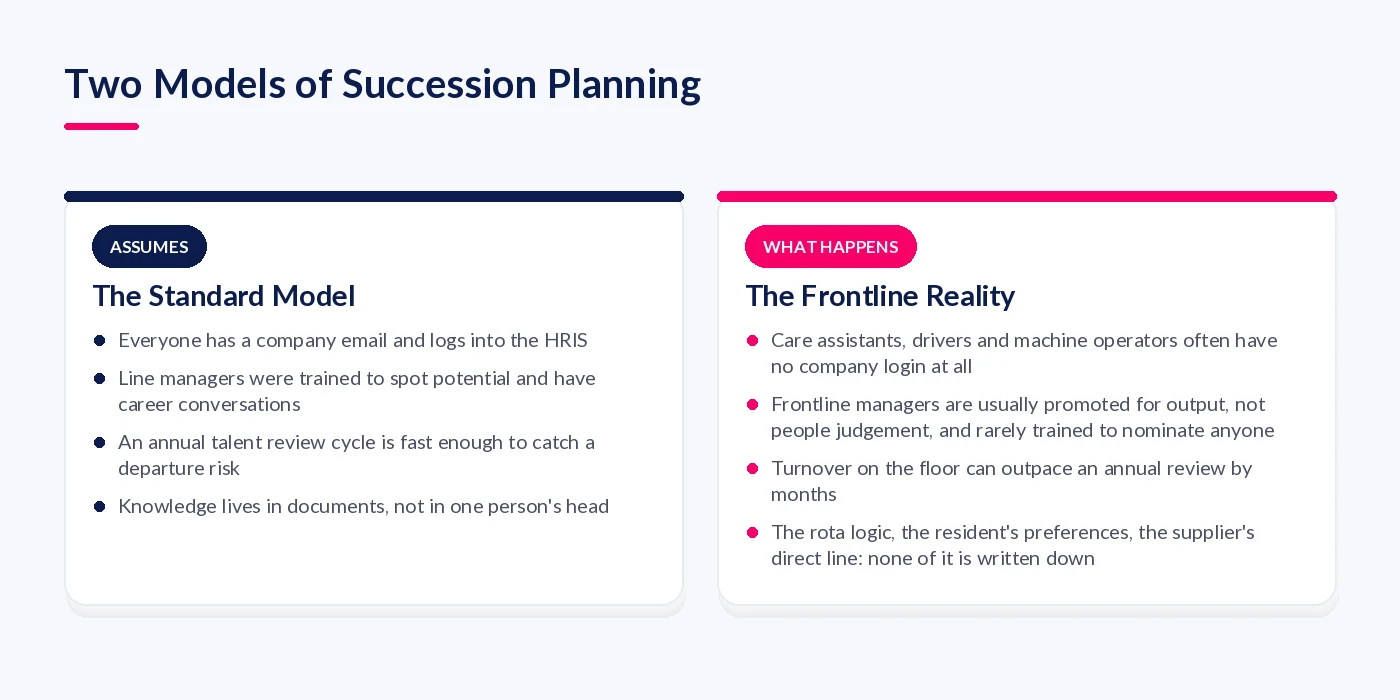
Most succession planning guidance, including StaffCircle’s own explainer on what succession planning is, was written with an assumption baked in: everyone eligible for a plan sits at a desk, has a manager who reviews them quarterly, and can be reached through the same system HR already uses for everything else. That assumption holds for a finance team. It breaks the moment you apply it to a workforce where the person closest to the operational risk has never opened the HRIS, because they’ve never had a reason to.
Before a frontline succession plan can work, it has to answer a shorter, harder set of questions than the standard model asks:
- Who currently holds knowledge or relationships that would create a real gap if they left today, not just a title that sounds senior?
- Can every eligible person be assessed and nominated, including the ones without a company email address?
- Is there a named backup with a readiness date, or just a name on a spreadsheet nobody has tested?
- Who trains the frontline manager to have this conversation, and how would you know if they hadn’t?
CIPD’s own succession planning guidance argues organisations should identify business critical roles at all levels within the organisation, not only senior leadership, and points out that older models of succession planning “failed to take account of non-managerial roles” whose loss could still be costly. A talented scientist who wants to stay in a research role, in CIPD’s example, is the office equivalent of a frontline supervisor who has no interest in becoming a regional manager but would still leave a real hole behind them.
Which Frontline Roles Actually Carry Succession Risk
Seniority is a poor proxy for criticality on the floor. The person who would cause the most disruption by leaving is often not the one with the grandest job title, but the one everyone quietly routes problems to. Four questions do a better job of sorting critical frontline roles than an org chart ever will:
Operational continuity. Would the line, shift or service physically stop, or noticeably degrade, if this person didn’t turn up tomorrow and nobody else knew what they knew?
Regulatory or safety accountability. Is this a role a regulator would specifically ask about, such as a registered manager, a fire marshal, a trained first responder or a certified machine operator? Regulation 18 of the Health and Social Care Act 2008 (Regulated Activities) Regulations 2014 requires that “sufficient numbers of suitably qualified, competent, skilled and experienced persons must be deployed” in a regulated care setting, and CQC’s own guidance on that regulation goes further, expecting “procedures to follow in an emergency that make sure sufficient and suitable people are deployed to cover both the emergency and the routine work of the service.” A provider that has never named who covers a registered manager’s absence is not meeting the spirit of that expectation, whatever the policy folder says.
Knowledge or relationship concentration. Does this person hold context, supplier contacts or informal trust that nobody else has, regardless of how junior the role looks on paper?
Scarcity of a ready replacement. Could someone step in within days, or would the gap need months of external hiring and a long ramp-up?
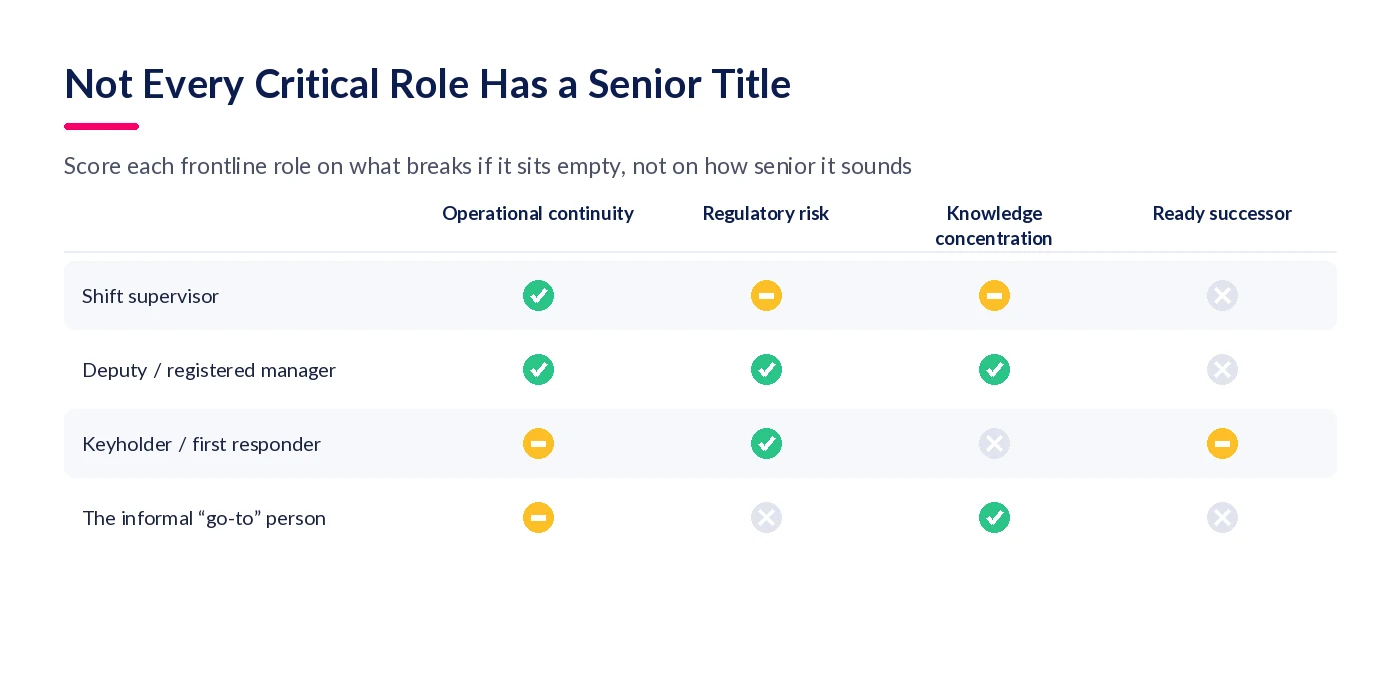
Score the roles on your own site against those four factors and the result rarely matches the org chart. A shift supervisor with no formal management title can outscore a manager two levels up, simply because the supervisor is the one who actually knows how the rota logic, the supplier relationships and the quiet workarounds fit together.

Getting the Knowledge Out of Someone’s Head Before They Leave
Once you know which roles matter, the harder problem is capturing what the current holder actually knows. Written job descriptions cover the explicit part of the role. They almost never cover the tacit part: the hundred small judgement calls a person makes without thinking about them, which is exactly the part that walks out the door with a two-week notice period.
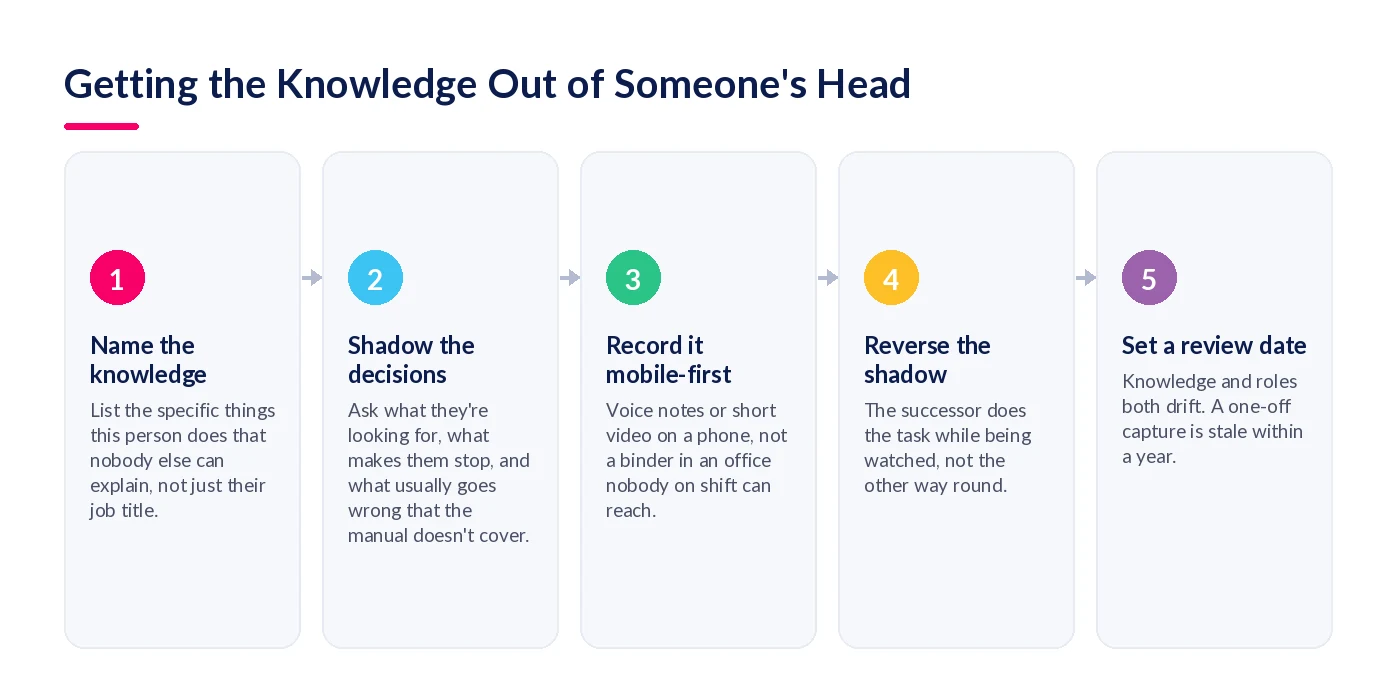
A structured approach beats an exit interview, because an exit interview happens after the knowledge is already halfway out the building. Five steps, roughly in order:
- Name the knowledge, not just the role. List the specific things this person does that nobody else could currently explain, rather than settling for a job title.
- Shadow around decisions, not tasks. When the expert does something, ask what they were looking for, what would have made them stop, and what usually goes wrong that the written instructions never mention.
- Record it somewhere the successor can actually reach without a desk. A short voice note or video on a phone beats a binder in an office nobody on shift ever visits.
- Reverse the shadow. Have the successor perform the task while being watched, not just watch it being performed. Doing something once under supervision surfaces gaps a conversation never will.
- Set a review date. Knowledge decays and roles change. A capture exercise done once, and never revisited, is stale within a year.

The Three Ways These Plans Quietly Fail
Most frontline succession plans don’t fail loudly. They fail by never actually being used, which only becomes visible the day someone hands in their notice.
The nomination sits behind something deskless staff can’t reach. If the only way to be considered is an email invitation to an HR portal, entire teams are structurally excluded before anyone has judged their potential. This is the single most common reason a group-wide succession programme never touches its own frontline.
A name is not a plan. Writing one person’s name next to a critical role, with no defined skills gap, no development activity and no readiness date, is a wish rather than a plan. It looks identical to a real one in a spreadsheet until the day it’s tested.
The manager doing the nominating was never trained to do it. Frontline managers are typically promoted for output, not for judgement about people, and are rarely given the training that CIPD recommends for identifying potential objectively rather than by “gut feel.” Left untrained, a manager defaults to nominating whoever they get on with best, which is a bias risk dressed up as a talent decision.
Three edge cases make this worse in practice. Subcontracted and agency staff often sit outside any succession conversation entirely, because nobody is clear whether the agency or the host site owns their development. Multi-site organisations frequently discover the only person who can do something works at a different location from the vacancy, with no mechanism for anyone to know that. And in a regulated sector, a missing succession plan is not just an operational risk: it is the kind of gap a CQC or HSE inspection is specifically designed to surface.
A 90-Day Starting Plan for a Site That’s Never Done This
A site with no frontline succession plan at all doesn’t need a five-year strategy. It needs a start.
Days 1 to 30: find out where the risk actually sits
List every role on site, score each one against operational continuity, regulatory accountability, knowledge concentration and replacement scarcity, and be honest about which five to eight roles would actually hurt if they emptied out tomorrow. Ask supervisors directly who they’d call if they were off sick for a month; the answer usually names the real successor faster than any nomination form.
Days 31 to 60: capture and nominate
Run the shadowing and knowledge-capture process against the highest-risk roles first. Name at least one potential successor per critical role, including people who don’t have a company email address, and record what specific gap stands between them and being ready.
Days 61 to 90: test readiness and set a cadence
Have each named successor actually perform part of the role, supervised, rather than simply confirming on paper that they could. Fix what the test exposes, then set a recurring review, ideally tied to whatever cycle the site already uses for one-to-ones, so the plan doesn’t quietly go stale the way the last one did.
How StaffCircle Supports Succession Planning Without Requiring a Desk
Records anyone on shift can actually reach
Succession data that only exists behind a desktop login is succession data half your workforce can never be assessed against. StaffCircle’s mobile app is built for people who clock in and out on a phone, not a laptop, so a frontline worker’s skills record, development conversations and readiness status live somewhere they can genuinely see and update themselves. As with any product capability claim, it’s worth confirming against your own rollout and role configuration rather than taking a vendor’s word for it, ours included.
Skills and competency records tied to the role, not the person’s memory
A readiness date only means something if it’s measured against a defined standard. Linking succession to a competency framework or a set of evidenced skills records turns “she’d probably be fine” into a specific, visible gap between where a candidate is now and what the role actually requires, which is a very different conversation with a regulator or an auditor than an unstructured opinion.
Talent pools instead of a single name
Following CIPD’s own recommendation to build pools of adaptable people rather than one name per box, succession tracking that supports two or three candidates per critical role, at different readiness levels, survives a second departure better than a plan built around a single backup who might leave next.
Structured one-to-ones for managers who’ve never run this conversation
Because frontline managers are rarely trained in succession conversations, a structured one-to-one framework with prompts built in does some of that training by simply making the right questions unavoidable, rather than assuming every manager already knows to ask them.
Final Thoughts
A succession plan that only reaches people with a company email address isn’t protecting the organisation from the risk that actually matters most: the deputy manager, the shift supervisor, the technician who knows the machine nobody else understands, all handing in their notice with no one ready to step in. Fixing that starts with naming the roles honestly, capturing what the current holder actually knows, and testing a successor before you need one, not after.
If you want to see how StaffCircle handles skills, competency and succession data for a workforce that isn’t sitting at a desk, book a demo, or use the ROI calculator to model what reducing frontline turnover and replacement cost would be worth against your own headcount figures.
FAQ
What is succession planning for frontline teams?
Succession planning for frontline teams is the process of identifying which shop-floor, care, warehouse or retail roles would disrupt operations if the person left unexpectedly, capturing what that person knows in a way that doesn’t depend on a desk or company email, and preparing a named successor whose readiness has actually been tested rather than assumed.
How is frontline succession planning different from workforce planning?
Workforce planning looks at the skills and headcount the whole operation needs and how to source them, including external hiring. Succession planning is narrower: it is specifically about developing named internal people who are ready to step into a specific critical role. On the frontline, the two need to work together, because a succession gap that workforce planning hasn’t flagged as a hiring risk tends to get discovered on the day someone resigns.
Which frontline roles need a succession plan?
Start with roles that score highly on operational continuity, regulatory or safety accountability, concentration of knowledge or relationships, and scarcity of a ready replacement. That is rarely the same list as the most senior job titles on site; the informal “go-to” person often carries more succession risk than someone with a bigger title and a shallower role.
How do you identify a successor for someone who has no formal deputy?
Ask the role holder directly who they would call if they were off sick for a month. The honest answer usually names the real informal successor faster than any nomination process, and it gives you someone concrete to start developing rather than a blank line on a form.
Can you do succession planning without company email addresses?
Yes, but only if the tools and process are built for it. A succession or talent system gated behind an email-based login structurally excludes anyone without one before their potential has even been assessed, which is the single biggest reason frontline succession programmes stall. Mobile-first access, SMS or app-based nomination, and manager-led conversations that don’t depend on a portal login are what make it possible.
How do you capture tacit knowledge before someone leaves?
Structured shadowing focused on decisions, not tasks, works better than a written handover document. Ask what the person is looking for, what would make them stop, and what usually goes wrong that the manual never covers, then have the successor perform the task under supervision rather than simply observing it once.
How many potential successors should each critical frontline role have?
More than one where possible. A single named backup is fragile, because that person can leave too. CIPD’s guidance favours building pools of people who are each capable of filling a variety of roles over naming one individual per box, which holds up better when more than one departure happens close together.
What happens to succession planning for subcontracted or agency frontline staff?
It usually falls through the gap between the agency and the host organisation, because neither side is clear who owns development for that person. If a subcontracted role carries real operational or regulatory risk, the contract and the succession process both need to say explicitly who is responsible for readiness, not leave it assumed.
Do CQC or other regulators actually require succession planning?
Not by that name, but the underlying expectation is there. CQC’s guidance on Regulation 18 (Staffing) expects providers to have “procedures to follow in an emergency that make sure sufficient and suitable people are deployed to cover both the emergency and the routine work of the service,” which in practice means knowing who covers a critical role’s absence before it happens, not after.
How long should knowledge transfer take before someone leaves?
Longer than a standard notice period allows, which is exactly why it needs to start before someone resigns rather than after. Treating succession as an ongoing process against your highest-risk roles, rather than a scramble triggered by a resignation letter, is the only way to avoid running knowledge transfer against a two-week clock.
What’s the difference between a backup and a successor?
A backup covers a role temporarily, often under pressure and without full training. A successor has been deliberately developed against the specific gaps between where they are now and what the role requires, and has been tested doing part of the job, not just told they’d probably manage.
How do you train frontline managers to run succession conversations?
Most frontline managers are promoted for output, not people judgement, and have never been shown how to spot potential objectively rather than defaulting to whoever they get on best with. A structured one-to-one framework with built-in prompts does some of that training by making the right questions part of a normal conversation, rather than assuming every manager already knows to ask them.
How much does losing a frontline supervisor actually cost?
Costs vary by role and sector, but they run well beyond the recruitment fee. The Frontline Workforce Index 2026, based on a survey of 2,000 UK frontline workers, put replacement cost exposure across UK retail and hospitality at £6.7bn, made up of £5.1bn in training costs and £1.6bn in lost efficiency. A supervisor role carrying knowledge, relationships or regulatory accountability typically costs more to lose than a role without those, because the gap outlasts the time it takes to fill the vacancy on paper.
Can software really help with succession planning for deskless workers?
It can, but only if it was built for that workforce rather than adapted from an office-first talent system. The test is simple: can someone with no company email address be assessed, nominated and shown their own readiness status from a phone, without a manager acting as the only channel in and out of the system.
See StaffCircle in action
Book a personalised demo and see how StaffCircle drives performance, engagement and development.