Skills Taxonomy vs Skills Framework: Which Do You Need?
"Do we need a skills taxonomy?" The question usually arrives after a vendor demo, or after someone senior has said the organisation should become "skills-based". Most of the pages answering it are written by companies that sell taxonomies, and many use "taxonomy", "framework", "ontology" and "library" as if they were the same thing. This post takes the questions HR teams actually ask, in the order they tend to ask them, and answers each one plainly.
A skills taxonomy is a classification that names and groups skills, with no link to your roles or to how well anyone performs them. A skills framework maps skills to your roles at defined proficiency levels. Most organisations of 200 to 2,000 people need a framework, and can borrow a public taxonomy rather than build their own.
Key facts
- ESCO describes 3,039 occupations and 13,939 skills, translated into 28 languages.
- The UK Standard Skills Classification, published 30 April 2026, defines 3,350 occupational skills.
- The UK classification is published under the Open Government Licence v3.0.
- SFIA 9 describes digital skills against seven levels of responsibility.
What is the difference between a skills taxonomy and a skills framework?
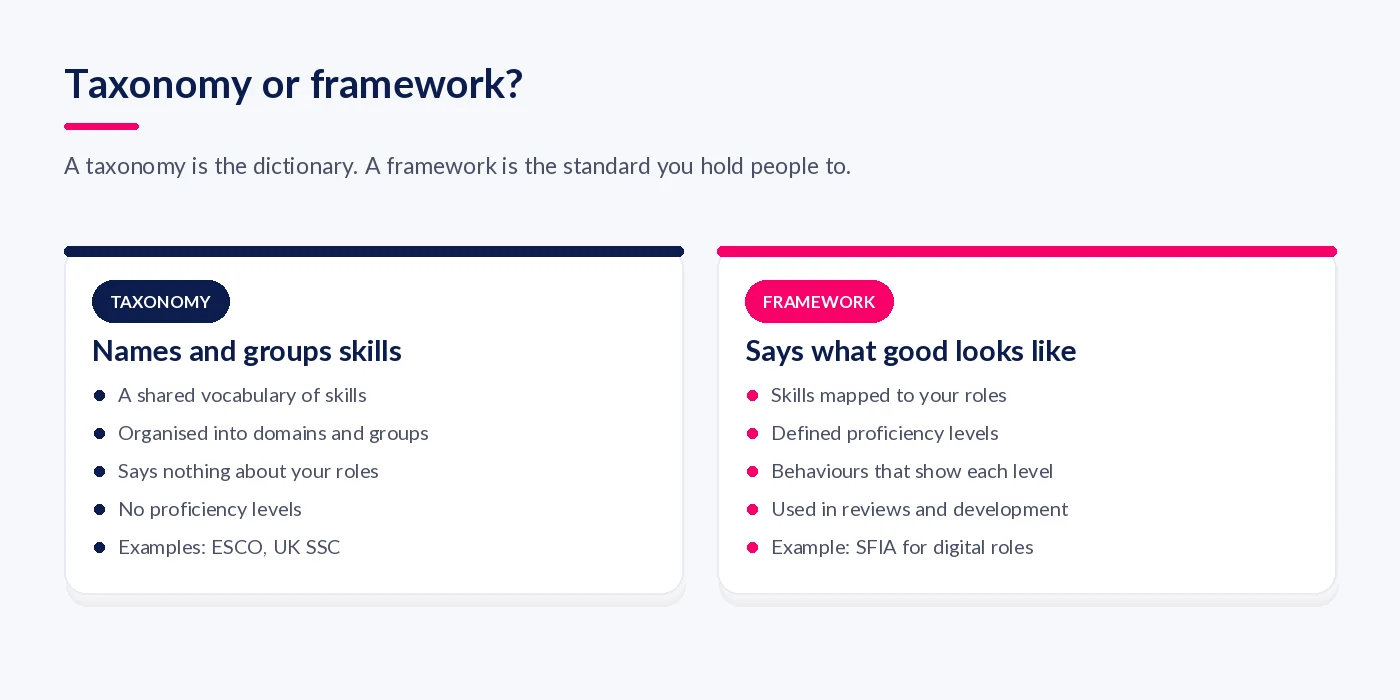
A taxonomy is a dictionary: it tells you what a skill is called and where it sits in a hierarchy. A framework is a standard: it tells you which skills a role needs and what each level of performance looks like. One is a vocabulary; the other is something you can hold people to in a review.
It helps to look at the questions each one can answer. A taxonomy can tell you:
- What do we call this skill, consistently, across every team?
- Which broader group does it belong to?
- Is "stakeholder management" the same thing as "managing stakeholders"?
A framework can tell you:
- Which skills does a site supervisor need, and at what level?
- What does "proficient" look like for that skill, in behaviour a manager can observe?
- Where is this person now, and what is the gap to the next role?
Where do ontologies, libraries and skills matrices fit?
Four neighbouring terms cause most of the confusion:
- Skills library: a flat list of skills, often a vendor's. Usually a taxonomy without the hierarchy.
- Skills ontology: a taxonomy plus relationships, such as which skills are adjacent to which, and which roles and courses connect to them. It powers recommendation engines.
- Skills inventory: the record of who holds which skills. It is data, not structure.
- Skills matrix: a grid of people against skills, usually with a rating in each cell. Our guide to what a skills matrix is covers it in more detail.

Why do so many skills taxonomy guides blur the two?
Because the line moves depending on who is selling. Several top-ranking guides describe a "taxonomy" that already includes proficiency levels and role mappings. At that point it is a framework with a different name. Others treat the taxonomy as the foundation and the framework as a later phase, which is closer to how the public bodies describe it.
The primary sources are clearer than the commentary. ESCO, the European classification, says it "works as a dictionary, describing, identifying and classifying professional occupations and skills" (ESCO). Skills England describes the UK Standard Skills Classification as "a set of standardised lists of the skills, knowledge and tasks required for UK occupations" (GOV.UK). Both are lists. Neither tells you what good looks like in your organisation.
SFIA, by contrast, calls itself a framework and behaves like one. It "defines the skills and competencies required by professionals who design, develop, implement, manage and protect the data and technology that power the digital world" (SFIA), and describes them against seven levels of responsibility, from "Follow" at level 1 to "Set strategy, inspire, mobilise" at level 7 (SFIA 9 levels). The levels are what make it a framework.
The distinction matters because the expensive part of any skills project is not naming skills. It is agreeing what each level looks like, role by role, and assessing people against it. A taxonomy does none of that. Our article on skills frameworks versus competency frameworks covers the other boundary people often confuse.
Which public skills taxonomies can a UK organisation borrow?
You do not need to invent a skills vocabulary. Several public classifications are free to consult, and one is now specific to the UK.
| Source | What it is | Scale | Cost and licence | Best used for |
|---|---|---|---|---|
| UK Standard Skills Classification | Taxonomy of skills, knowledge and tasks for UK occupations (Skills England, April 2026) | 22 skill domains, 106 skill areas, 607 skill groups, 3,350 occupational skills; 22,583 occupational tasks | Open Government Licence v3.0 | The most local starting point for UK roles |
| ESCO | European multilingual classification of skills, competences and occupations (v1.2.1) | 3,039 occupations, 13,939 skills, 28 languages | Free to consult online | Organisations with staff or hiring across several countries |
| O*NET | US occupational information database, sponsored by the US Department of Labor | Over 900 occupation profiles | Database under Creative Commons Attribution 4.0 | US operations; reference only for UK roles |
| SFIA 9 | Framework for digital and technology skills, with seven levels of responsibility | Skills across digital, data and technology work | Free for most internal use; a licence is needed for use across a large organisation | IT, data and digital teams |
| SOC 2020 (ONS) | Classification of jobs, not skills | 412 unit groups | Published by the ONS | Structuring job families before you add skills |
The UK Standard Skills Classification is new, and few vendor guides mention it yet; for a UK employer it is the obvious first reference. Check the SFIA licence before rolling it out: its licensing page lists "using SFIA across a large organisation" among the uses that need a licence, without giving a size threshold (SFIA licensing).
Do you actually need a skills taxonomy?
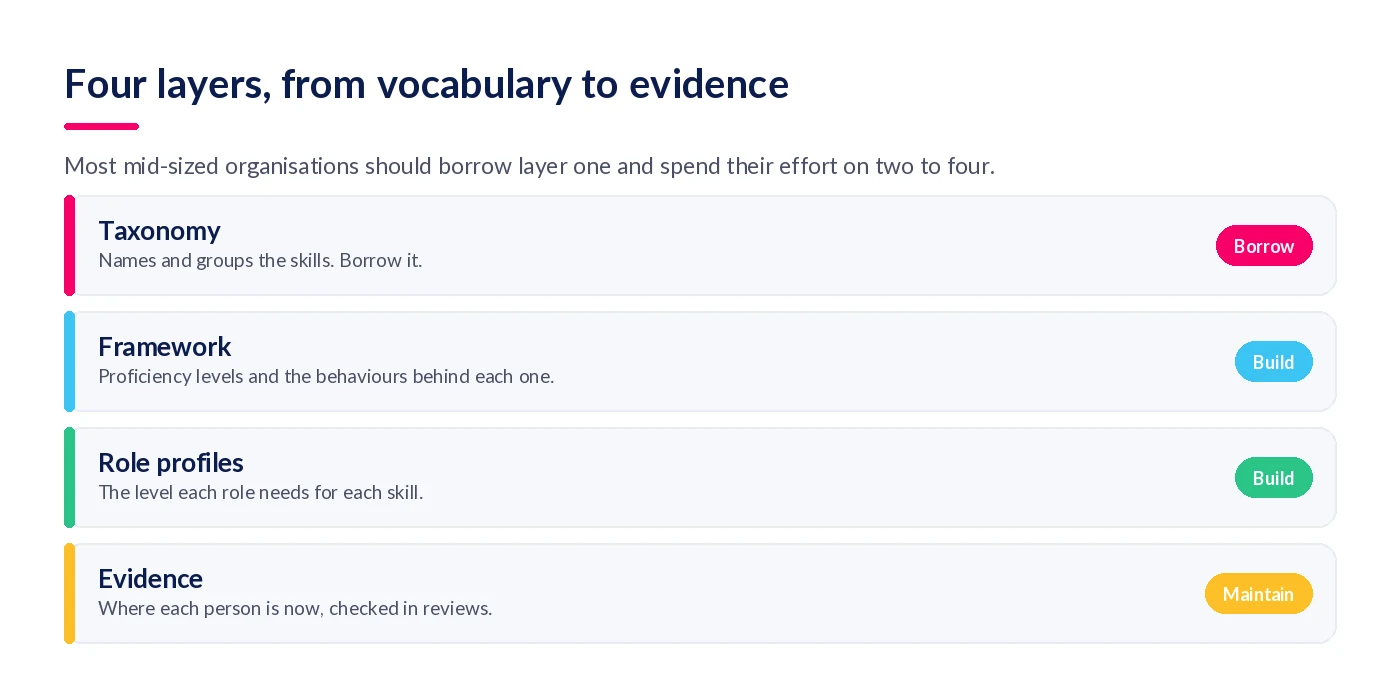
Most mid-sized organisations need a shared skills vocabulary, but not a taxonomy of their own. If you have fewer than a few dozen distinct roles, a framework built on a borrowed public taxonomy will do everything you need. Building your own is justified when you are matching skills at scale across thousands of job adverts, CVs or learning items, or when you operate in several languages.
| If this describes you | What you need |
|---|---|
| You want consistent reviews and development plans across teams | A skills or competency framework |
| You have a large digital or IT function | SFIA for those roles, alongside your own framework |
| You hire or operate across several countries and languages | ESCO as the shared vocabulary under your framework |
| You need to evidence competence to a regulator or client | A competence framework tied to the relevant standard, with records |
| You match skills automatically across thousands of CVs, adverts or courses | A taxonomy, usually bought or licensed rather than built |
The honest answer for most HR directors handed this question is: build the framework, borrow the vocabulary. Our guide to skills frameworks covers the structure in more depth.
How do you build a skills framework on a borrowed taxonomy?
Start from your roles, take a short list of skills from a public taxonomy, rewrite them in your own words, and spend most of your effort on proficiency levels and assessment.
- Start from your roles, not the taxonomy. List your role families first. Opening a 3,000-skill list before you know what you are looking for is how frameworks end up with 400 skills nobody uses.
- Pick a short list for each role family. From the taxonomy, choose the skills that genuinely separate good performance from great in that family. Somewhere around eight to fifteen per family is usually enough to work with.
- Rewrite the labels in your own language. Public taxonomies are written for statisticians and job-matching systems. Rename skills so a team leader recognises them, and keep the source reference beside each one.
- Set one proficiency scale. Use a single scale across the organisation, four or five levels, with the observable behaviour described at every level. This is the part no public taxonomy does for you.
- Set the expected level for each role. For every role, agree the level it needs for each skill. This turns a list into a standard that managers and employees can both see.
- Assess against evidence and review yearly. Rate people in reviews and one-to-ones against the descriptors, using evidence rather than self-declaration alone, and review the framework once a year.
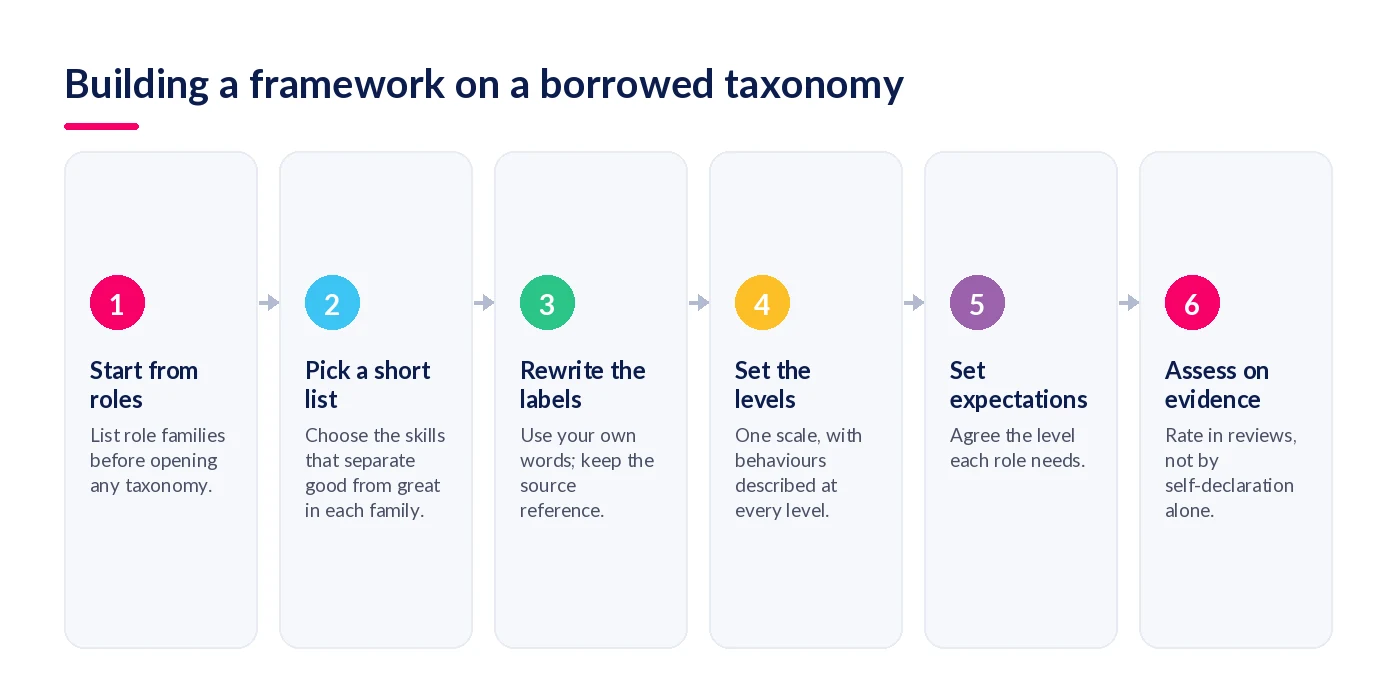
Step four is where frameworks succeed or fail. A level called "Advanced" means nothing until you write down what an advanced person does that an intermediate one does not. Our article on proficiency levels in a competency framework has worked examples of level descriptors.
Where do skills taxonomy projects go wrong?
Almost always in the same places: the list grows faster than anyone can maintain it, nobody defines what good looks like, and the data collected against it goes stale.
The list grows faster than anyone can maintain it
Even national bodies update their classifications in slices. O*NET's 31.0 release updated 208 occupations (O*NET database), and Skills England's report on the UK classification includes a whole section on how it should be maintained. If public bodies with dedicated teams treat maintenance as a project in its own right, a three-person HR team cannot keep a 3,000-skill internal list current. Keep yours short enough that someone can read it in one sitting.
Nobody can say what good looks like
A taxonomy with no levels produces profiles that list what people claim to know, not how well they do it. That is no help for promotion, pay or succession. If you only have time for one part of this, write the level descriptors.
Self-declared skills profiles nobody checks
Inviting every employee to tick skills from a long list creates a lot of personal data quickly. UK GDPR requires personal data to be "adequate, relevant and limited to what is necessary" and "accurate and, where necessary, kept up to date" (UK GDPR Article 5). A sprawling, self-declared profile that nobody reviews struggles on both counts. Collect only the skills you will actually use, and confirm them in reviews.
Frontline and regulated roles get left out
Skills projects often start in head office, where the public frameworks are richest. Care workers, engineers and operatives end up with nothing, though their competence is often the most regulated. Our guide to skills compliance covers what those roles need on top of a framework.
If the reason for all this is succession, our succession planning guide with free customisable templates shows how to connect skills levels to readiness decisions.
What does this look like in a 650-person organisation?
Take a composite example: a UK engineering services firm with 650 people. It has field engineers, a design office, an IT and data team of 14, and the usual finance, HR and operations functions. The board asks for a skills taxonomy. Here is how a borrowed-taxonomy approach plays out. The firm and its numbers are illustrative.
- Role families: HR groups 41 job titles into seven role families before opening any taxonomy.
- Vocabulary: it draws technical skills for engineers and designers from the UK Standard Skills Classification, and uses SFIA for the IT and data team.
- Short list: each family gets between eight and twelve skills, plus six behavioural competencies shared by everyone. The whole framework holds 74 skills, against 3,350 in the source classification.
- Levels: one four-level scale, with two or three observable behaviours written for each level of each skill.
- First cycle: managers rate each person in the next quarterly one-to-one, with evidence noted against each rating.
The board gets a consistent picture of skills and the gaps that matter. Nobody has to maintain a taxonomy.

How StaffCircle turns a skills vocabulary into a working framework
StaffCircle is built for the part a taxonomy leaves out: role expectations, levels and evidence.
Generate a framework for your own roles
StaffCircle's AI competency framework software uses your company information to generate role expectations with the skills and competency levels each role needs, which you then review and edit. Customers take around 40 minutes to build a competency framework, rather than spending months starting from a blank list.
Assess skills in the conversations you already have
Skills and competency ratings sit alongside objectives, one-to-ones and reviews in StaffCircle's employee development software, so evidence builds up in the normal rhythm of work rather than in a separate annual skills audit. Gaps feed straight into personalised development plans.
See readiness, not just a list
Success Circles brings skills, performance and development data together as a live, evidence-based alternative to the 9-box grid, so succession conversations start from assessed proficiency rather than from whoever was rated well last year.
Final thoughts
A taxonomy asks what a skill is called; a framework asks what good looks like in your roles and who is there yet. For most mid-sized organisations, the right move is to borrow the vocabulary from the UK Standard Skills Classification, ESCO or SFIA, keep the list short, and put the effort into levels and evidence.
If you want to see how StaffCircle builds a framework for your roles and keeps it current through everyday conversations, book a demo.
FAQ
What is a skills taxonomy?
A skills taxonomy is a structured classification of skills. It gives each skill a consistent name and groups related skills into a hierarchy, such as domains, areas and individual skills. It is a shared vocabulary. On its own it does not say which roles need which skills, or how well anyone performs them.
What is the difference between a skills taxonomy and a skills framework?
A taxonomy names and groups skills. A framework takes a selection of those skills, maps them to your roles and describes each one at defined proficiency levels, so managers can say what good looks like and where someone is now. You can run a framework without building a taxonomy, but not the other way round.
What is the difference between a skills taxonomy and a competency framework?
A competency framework usually describes behaviours as well as technical skills, written at proficiency levels for each role. A skills taxonomy is only a classified list of skills with no levels or role expectations. Many organisations use a competency framework for behaviours and draw its technical skills from a taxonomy.
Skills taxonomy vs skills ontology: what's the difference?
A taxonomy arranges skills in a hierarchy, with each skill sitting under a parent group. An ontology also records relationships between skills and other things, such as adjacent skills, roles and learning content. Ontologies power recommendation engines in large platforms. Most mid-sized employers never need to build one themselves.
What is the difference between a skills taxonomy and a skills inventory?
A taxonomy is the list of skills your organisation recognises. An inventory records which people hold which of those skills, and ideally at what level. The taxonomy is the column headings; the inventory is the data in the rows. An inventory is only useful if it is kept accurate and up to date.
Is a skills taxonomy useful for small and mid-sized companies?
A shared skills vocabulary is useful at any size, but building your own taxonomy rarely is. Organisations of 200 to 2,000 people usually get more value from borrowing a public taxonomy, picking a short list of skills per role family and putting their effort into proficiency levels and assessment.
Does a skills taxonomy need to be built from scratch?
No. Public taxonomies such as the UK Standard Skills Classification and ESCO are free to consult, and SFIA covers digital roles. Start from one of these, take only the skills your roles need, rewrite the labels in your own language and record the source reference so you can map back later.
What is an example of an established skills taxonomy?
ESCO, the European classification, describes 3,039 occupations and 13,939 skills in 28 languages. The UK Standard Skills Classification, published by Skills England in April 2026, defines 3,350 occupational skills in a four-level hierarchy. O*NET plays a similar role in the United States.
What is the UK Standard Skills Classification?
It is a set of standardised lists of the skills, knowledge and tasks required for UK occupations, published by Skills England on 30 April 2026. It runs from 22 skill domains down to 3,350 occupational skills, and is licensed under the Open Government Licence v3.0, so employers can reuse it.
Is SFIA a taxonomy or a framework?
SFIA describes itself as a framework, and it behaves like one. It defines skills for digital and technology professionals and describes them against seven levels of responsibility, from Follow to Set strategy. It is free for most internal use, but using it across a large organisation needs a licence.
How often should a skills taxonomy be updated?
There is no standard interval. A borrowed public taxonomy is updated by its publisher, so check for new releases once a year. Your own framework should be reviewed annually and whenever a role changes materially. Small, regular edits beat a large rebuild every few years.
Who owns a skills taxonomy in an organisation?
HR or L&D should own the list and the rules for changing it, so it stays consistent. Each role family needs a named owner in the business who decides which skills matter and what each level looks like. Without both, the list either sprawls or goes stale.
See StaffCircle in action
Book a personalised demo and see how StaffCircle drives performance, engagement and development.