How to Run a Skills Gap Analysis (With a Worked Example)
A skills gap analysis is the process of comparing the skill level a role actually requires against the skill level the people in that role currently have, so you can see exactly where the shortfall is and how big it is. Done properly it produces numbers, not impressions: a required score, a current score, a gap, and a priority order for closing it. Most guides describe the concept and stop there. This one works through a real, populated example — scores, averages, a gap calculation and a weighted priority formula — so you can see exactly how the arithmetic works before you run it on your own team.
What Is a Skills Gap Analysis?
A skills gap analysis measures the difference between the skill level a role needs and the skill level the people currently in that role actually have. It is a comparison exercise with two inputs — a required standard and a current reading — and one output: a gap you can rank, act on and re-measure.
A working analysis answers four questions, in this order:
- What does "good" look like for this role, in specific, assessable skills rather than a job title?
- How do the people currently in the role actually measure up against that standard?
- Where is the shortfall biggest, and which of those shortfalls actually matters to the business?
- What closes each gap, who owns that action, and when do you check it worked?
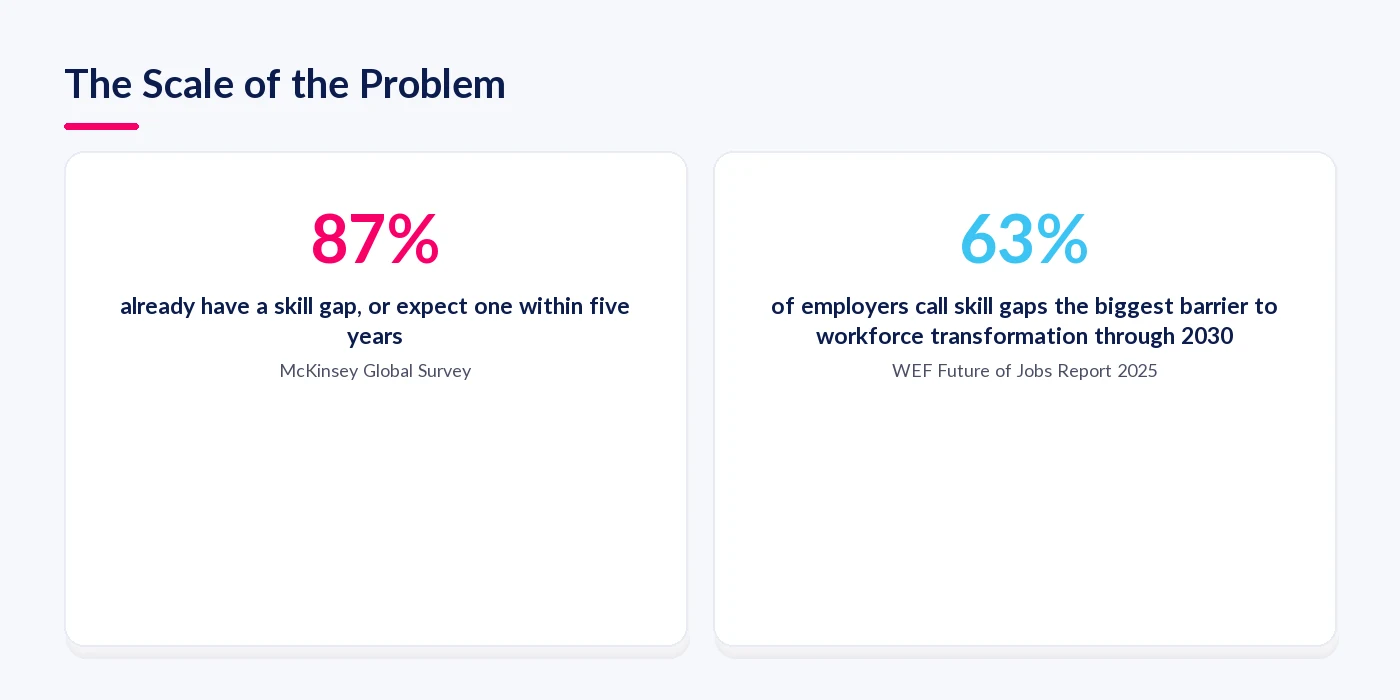
The scale of the problem is well documented, even if the exact figure depends who you ask. In a McKinsey Global Survey, 87% of executives and managers said their organisation already had skill gaps (43%) or expected them to develop within five years (44%). The World Economic Forum's Future of Jobs Report 2025 found skill gaps to be the single biggest barrier employers expect workforce transformation to hit through 2030, cited by 63% of the employers it surveyed.
Skills Gap Analysis vs Skills Audit vs Training Needs Analysis
These three terms get used interchangeably, but they answer different questions. A skills audit is an inventory — it records what skills your workforce has right now, with no reference to what a role requires. A training needs analysis starts from a performance or compliance problem and works backwards to the training that might fix it. A skills gap analysis sits between the two: it needs the audit's current-state data and produces the gap that a training needs analysis then designs a course around.
| Question it answers | Skills Audit | Skills Gap Analysis | Training Needs Analysis |
| Starting point | What skills exist today? | What's the gap between today and the required standard? | What training fixes an identified problem? |
| Needs a role standard? | No | Yes — this is the input that makes it a gap rather than a list | Sometimes |
| Output | A skills inventory | A ranked, scored list of gaps | A training plan or curriculum |
A competency framework is a related but separate thing again: it's the reusable library of role standards and proficiency levels that a skills gap analysis draws its "required" column from. Build the framework once; run the gap analysis against it as often as the role or the market changes.
The Worked Example Almost Nobody Shows You
Every guide to this topic describes the method in the abstract. Almost none of them run the actual numbers, so it's easy to nod along with "identify the gap, then prioritise it" without ever seeing what that looks like on a real team. Here's a full pass through one.
Say you manage a seven-person senior customer support team. You've defined five skills the role needs, each scored on a 1–5 scale (1 = no working exposure, 5 = expert enough to train others), and set a required level for each based on what the role actually demands day to day.
Start with the skill that matters most here — de-escalation and complaint handling. You collect a current-level score for all seven people, blending a manager rating with a short scored call review. The seven scores come back as 2, 3, 2, 4, 3, 2 and 3. Add them up (19) and divide by seven, and the team's current average is 2.7 against a required level of 4 — a gap of 1.3. Just as telling: only one of the seven people (14% of the team) actually meets the required standard. If you'd only asked the manager for a gut-feel read, you'd likely have heard "most of the team handle escalations fine" — the scored version tells a much less comfortable story.
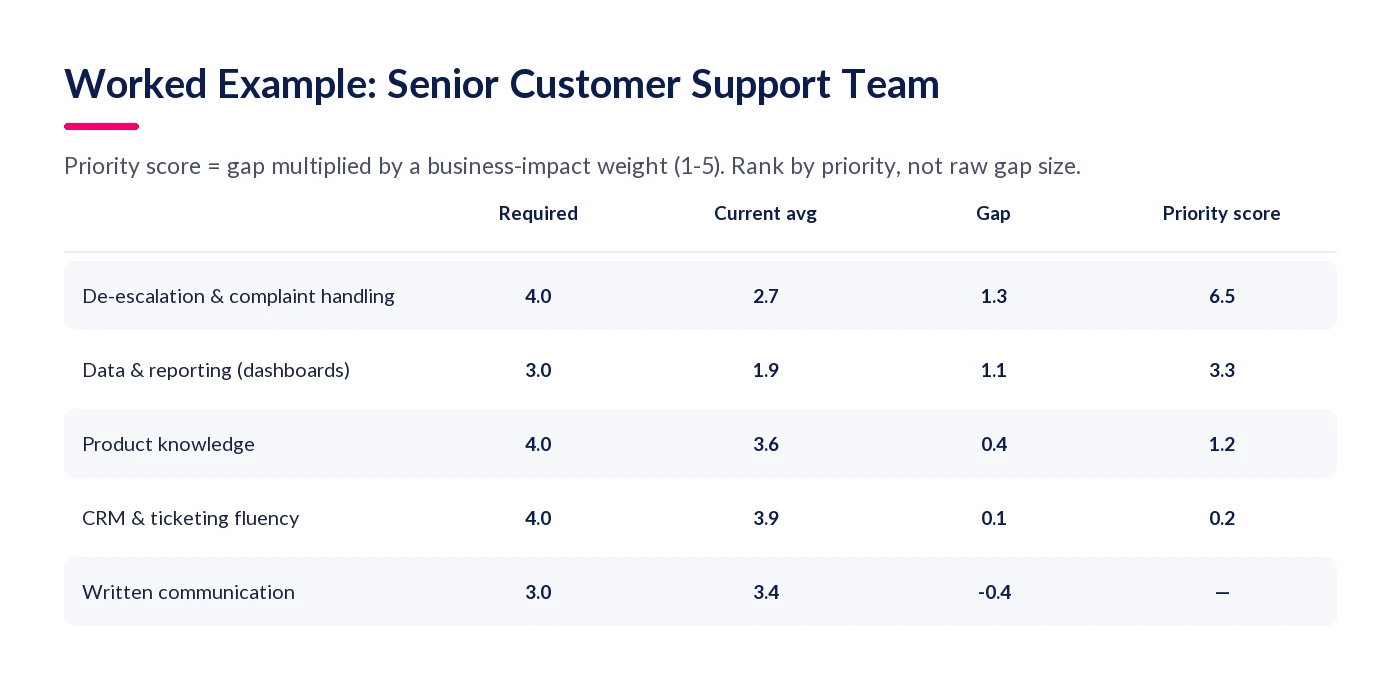
Run the same exercise across all five skills and you get a gap for each. The gap alone doesn't tell you what to fix first, though — a small gap in a critical skill can matter more than a large gap in a peripheral one. That's where a priority score earns its place: multiply each gap by a business-impact weight (1–5, set by the team's manager and the Head of Customer Experience, based on how often the skill is used, how costly a mistake is, and how much it's likely to change in the next 12 months).
- De-escalation and complaint handling — required 4.0, current 2.7, gap 1.3, impact weight 5, priority score 6.5
- Data and reporting (dashboards) — required 3.0, current 1.9, gap 1.1, impact weight 3, priority score 3.3
- Product knowledge — required 4.0, current 3.6, gap 0.4, impact weight 3, priority score 1.2
- CRM and ticketing fluency — required 4.0, current 3.9, gap 0.1, impact weight 2, priority score 0.2
- Written communication — required 3.0, current 3.4, gap –0.4 (a surplus, not a gap), no action needed
Rank by priority score rather than raw gap size, and de-escalation is the clear first move, data and reporting a close second, and the other two skills can wait for a normal development cycle rather than an urgent one. That ranked list, with the arithmetic behind it, is the entire point of running the numbers instead of relying on instinct.
How to Run a Skills Gap Analysis, Step by Step
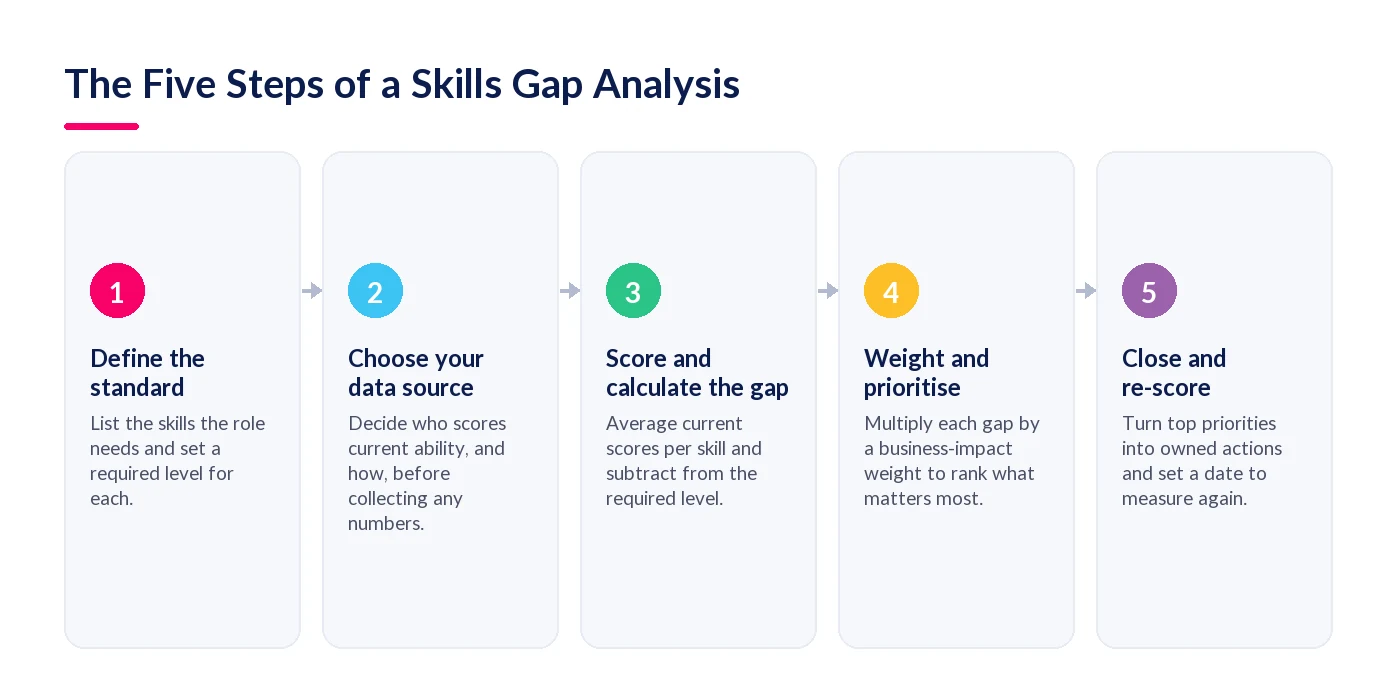
Step 1: Define the Required Standard
List the specific skills the role needs and set a required level for each on a consistent scale. Borrow from an existing skills framework or competency framework where you have one rather than inventing scales role by role — standards like SFIA for technical and digital roles, or the US Department of Labor's O*NET database for a wider range of occupations, give you a starting point instead of a blank page.
Step 2: Choose How You'll Score Current Levels
Decide who scores current ability and how, before you collect a single number — changing method halfway through makes the "before" and "after" incomparable. See the reliability trade-offs below before you pick.
Step 3: Score and Calculate the Gap
Collect the current-level scores, average them per skill (or per person, if you need individual as well as team-level detail), and subtract from the required level. A negative number is a surplus, not a gap — it needs no action, but it's worth knowing about for internal mobility.
Step 4: Weight and Prioritise
Multiply each gap by a business-impact weight, agreed with whoever owns the outcome the skill supports. This is the step almost every published guide skips, and it's the difference between a list of gaps and a list of what to do first.
Step 5: Build the Closing Plan and Set a Re-score Date
Turn the top two or three priority scores into named actions — coaching, shadowing, a course, a role change — each with an owner and a date. Then set a date to re-score, so the analysis becomes a cycle rather than a one-off document that goes stale the week after you finish it.
Choosing Whose Scores You Trust
Every method for gathering current-level data has a different failure mode, and almost no published guide compares them honestly. Pick the mix that fits the stakes of the skill you're measuring.
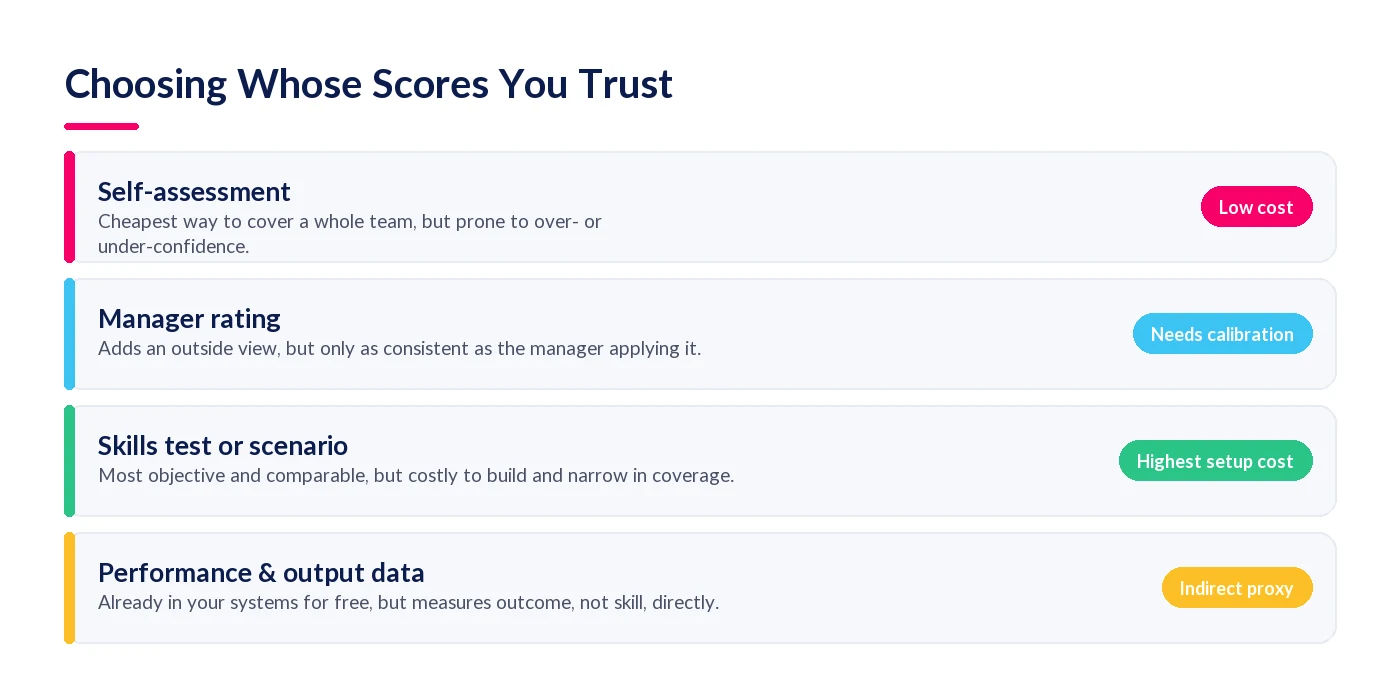
Self-assessment is the cheapest way to cover a whole team, but it's the least reliable on its own: people tend to over-rate skills they're weakest at and under-rate ones they've simply never had feedback on. Manager rating adds an outside view, but it's only as consistent as the manager doing it — two managers rating the same skill to different internal standards will produce numbers you can't compare across teams. A structured skills test or scored scenario is the most objective option, but it costs real time to build and only covers what you've bothered to test for. Performance and output data — ticket resolution time, error rates, review scores — is already sitting in your systems for free, but it measures the outcome of a skill, not the skill itself, so treat it as a proxy rather than a direct reading.
Where Skills Gap Analysis Breaks Down
Remote and Distributed Teams
You can't casually observe a distributed team the way you might overhear a call in an office. Replace observation with recorded evidence — call recordings, ticket-quality review, written work samples — and expect that evidence to take longer to gather than a manager's on-the-spot impression would.
Skills That Move Faster Than Your Analysis
For fast-changing skill categories — anything touching AI tools is the obvious current example — the "required" level you set at the start can be out of date by the time you finish scoring. Run these on a shorter cycle than the rest of your skill set, and treat the required score as a moving target you revisit, not a standard you set once and leave.
Small Teams and Thin Data
An average across three or four people swings wildly on a single outlier score, which makes a team-level average actively misleading at that size. Below roughly five or six people, look at individual scores directly and count how many fall below the required level, rather than reporting an average that one person's score can distort.
Only Measuring One Level
An organisation-level view hides exactly who needs help; an individual-only view never rolls up into workforce planning. Run both: individual scores to target development, and team or organisation averages to plan hiring, budget and succession at a level a leadership team can actually act on. This is close to how CIPD's own workforce planning guidance frames it — as a comparison of workforce supply against future demand, not a single-level exercise.
Running Yours in 30 Days
The scale rarely changes this much, but the timeline below fits a single team or role family without turning into a quarter-long project.
- Week 1: Pick the role, lock the skill list and the scoring scale, and agree who signs off the required level for each skill. Don't collect a single score before this is settled.
- Week 2: Gather current-level scores using the method (or blend of methods) you chose for each skill's stakes.
- Week 3: Calculate the gaps, agree impact weights with the relevant stakeholders, and produce the ranked priority list.
- Week 4: Turn the top two or three priorities into named actions with an owner and a date, and put a re-score date in the calendar — three to six months out, sooner for fast-moving skills.
How StaffCircle Supports Skills Gap Analysis
Skills Matrices Without the Spreadsheet
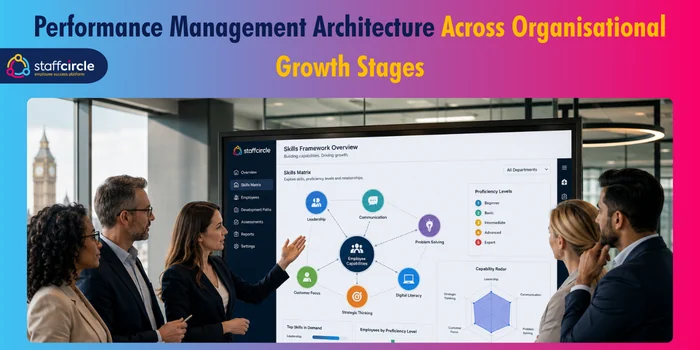
StaffCircle lets you set a required proficiency level per role and score people against it inside the same system that already holds their performance history, so the "required" and "current" columns live next to each other instead of in two documents you have to reconcile by hand.
AI Assist Surfaces the Gaps for You
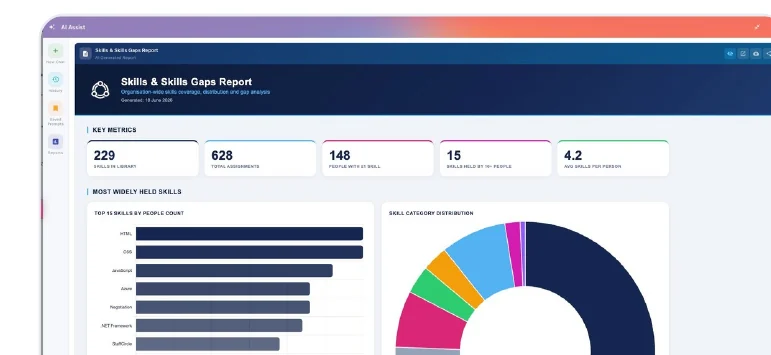
Rather than exporting scores to a spreadsheet to calculate gaps by hand, StaffCircle's AI Assist reporting can surface where the widest and most urgent gaps sit across a team, which is the step most guides — including the worked example above — expect you to do manually.
Turning a Gap Into a Development Plan
Once a gap is identified and prioritised, it can feed straight into an employee development plan tied to that specific skill, rather than a generic training assignment disconnected from the number that triggered it.
Company-Wide Reporting for Workforce Planning
Individual and team-level gap data rolls up into reporting a leadership team can use for budget and hiring decisions, which is the organisation-level half of the "measure both levels" point above.
Final Thoughts
A skills gap analysis is only as useful as the numbers behind it. Define the standard, score against it honestly, weight the result by what actually matters to the business, and you get a ranked list you can act on instead of a document that agrees with whatever anyone already believed about the team. Run it as a cycle, not a one-off, and it stays true as the role and the market underneath it keep moving.
If you want to see how a skills matrix, AI-surfaced gap reporting and development plans work together inside one system, book a demo and we'll walk through it against your own roles.
FAQ
What is a skills gap analysis?
A skills gap analysis is a comparison between the skill level a role requires and the skill level the people currently in that role actually have. It produces a required score, a current score, the gap between them, and ideally a priority order for closing each gap.
What is the difference between a skills gap analysis and a training needs analysis?
A skills gap analysis measures the size and location of a shortfall against a defined standard. A training needs analysis starts from an identified problem, often the output of a gap analysis, and designs the specific training or intervention that addresses it.
Is a skills gap analysis the same as a skills audit?
No. A skills audit is an inventory of the skills your workforce currently has, with no reference to a required standard. A skills gap analysis needs that inventory as an input, then compares it against what each role actually requires to produce a gap.
What is the difference between a skills gap analysis and a competency framework?
A competency framework is the reusable library of role standards and proficiency levels across your organisation. A skills gap analysis is the exercise of scoring real people against those standards for a specific role or team, at a specific point in time.
How often should you run a skills gap analysis?
Set the cycle by how quickly the role or the skill changes rather than a fixed company-wide calendar. Slower-moving skills can run on an annual or six-monthly cycle; fast-changing categories, such as anything touching new AI tools, need a shorter cycle because the required standard itself keeps moving.
How long does a skills gap analysis take?
For a single team or role family, a focused run — defining the standard, scoring current levels, calculating and prioritising gaps, and building a closing plan — typically fits into around four weeks. Scoring across many roles or a whole organisation takes longer in proportion to how many people need to provide or gather data.
What scale should you use to score current and required skill levels?
A simple 1–5 proficiency scale (from no working exposure to expert enough to train others) is the most widely used and easiest to explain consistently across a team. What matters more than the number of points on the scale is applying it consistently, so scores from different people or different rounds stay comparable.
Who should score current skill levels — the employee, their manager, or both?
Each source has a different failure mode: self-assessment is fast but prone to over- or under-confidence, and manager rating adds an outside view but only as consistent as the manager applying it. For higher-stakes skills, blend a manager rating with a structured test or scenario review rather than relying on either alone.
How do you prioritise which skills gaps to close first?
Multiply the size of each gap by a business-impact weight for that skill, agreed with whoever owns the outcome it supports. Ranking by that weighted priority score, rather than by raw gap size alone, stops you spending the first round of budget on a large gap in a skill nobody actually depends on.
Can a small team run a meaningful skills gap analysis?
Yes, but not by averaging. Below roughly five or six people, a team average can be swung heavily by a single outlier score, so look at individual scores directly and count how many people fall below the required level instead of reporting a mean.
How do you run a skills gap analysis for a remote or distributed team?
Replace casual observation with recorded evidence, such as call recordings, ticket-quality review or written work samples, since you can't rely on a manager overhearing performance the way they might in a shared office. Expect gathering that evidence to take longer than an informal read would.
What is a skills gap analysis template, and where do I start?
At minimum, a template needs a row per skill with columns for the required level, the current level (or average, for a team), the calculated gap, a business-impact weight, and the resulting priority score. Start from an existing skills or competency framework for the required-level column rather than setting standards from scratch for every role.
What should happen after a skills gap analysis is complete?
The ranked priority list should turn into named actions, each with an owner and a date, plus a re-score date so the exercise repeats rather than going stale. A gap analysis with no closing plan attached is just a more precisely measured problem.
Related articles

See StaffCircle in action
Book a personalised demo and see how StaffCircle drives performance, engagement and development.