SFIA Skills Framework: How to Use It in Your Organisation
Somebody in your IT function has asked whether you should “adopt SFIA”. Maybe it came up in a restructure, or a new head of engineering used it at their last employer. You need to know what it is, what it costs, how much work it is, and whether it fits the skills framework you already have. This post answers those questions in that order.
The SFIA skills framework (Skills Framework for the Information Age) is a published reference model that describes digital and IT professional skills across seven levels of responsibility, from Level 1 “Follow” to Level 7 “Set strategy, inspire, mobilise”. The current version, SFIA 9, was published in October 2024. Organisations use it to describe roles, assess skills and plan development. It is free for most internal use, but it is a reference, not a ready-made job structure: you still choose which skills and levels each of your roles needs.
Key facts
- SFIA 9 was published on 30 October 2024 and is the current version.
- SFIA 9 contains 147 skills, 26 of them new in this version.
- Seven levels of responsibility, defined by autonomy, influence, complexity, knowledge and business skills.
- Not every skill is defined at every level; Strategic planning starts at Level 4.
- SFIA 10 is in consultation, tentatively due between Q2 2027 and Q1 2028.
What is the SFIA skills framework?
SFIA is a common language for the skills digital and technology people use at work, maintained by the SFIA Foundation. It lists professional skills, groups them into categories, and describes each skill at the levels of responsibility where it applies. The Foundation describes it as offering a common language to describe roles across professional disciplines.
Used properly, it lets you answer questions that are otherwise settled by opinion:
- What skills does this role actually need, and at what level?
- Are two managers grading similar roles the same way?
- Where are the gaps across a team, a department or the whole IT function?
- What does someone need to show to move from engineer to senior engineer?
- Is our training budget going on the skills we are short of?
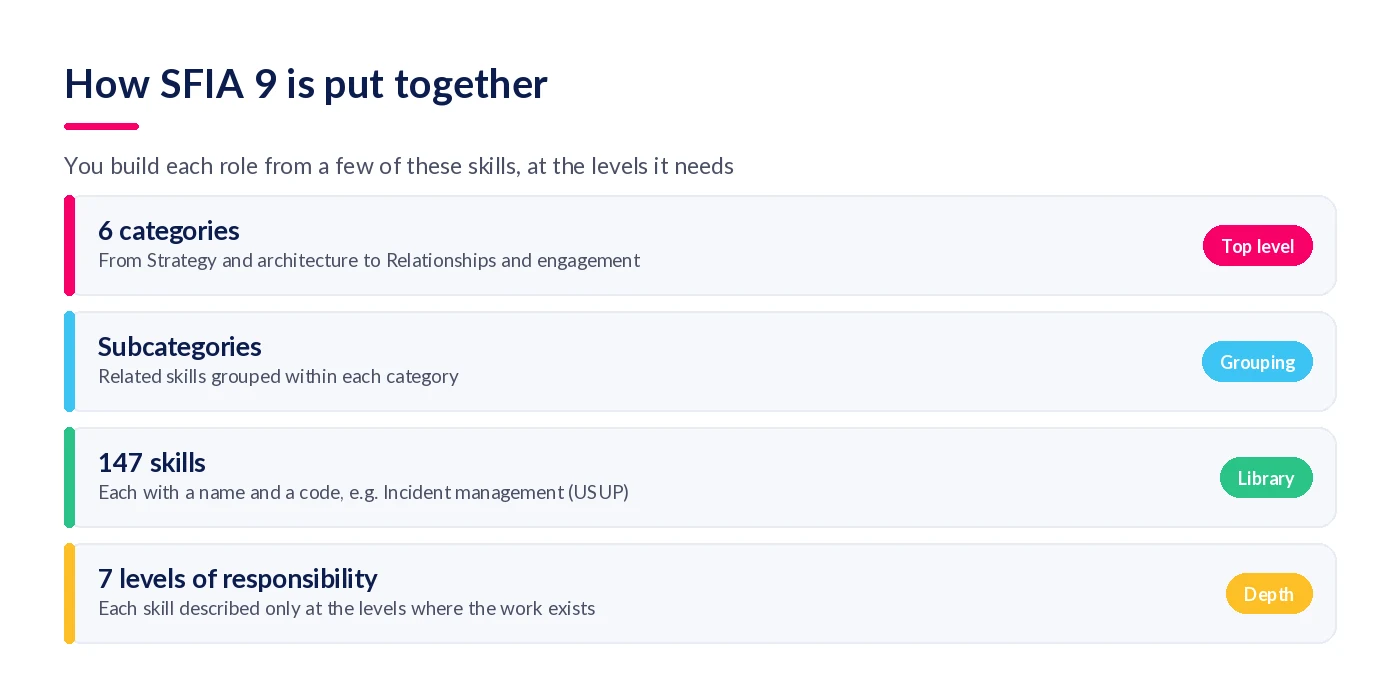
SFIA 9 organises its skills into six categories: Strategy and architecture; Change and transformation; Development and implementation; Delivery and operation; People and skills; and Relationships and engagement. Each category splits into subcategories, and each subcategory holds individual skills with a name and a four-letter code, such as Information security (SCTY) or Incident management (USUP).
How do the seven SFIA levels work?
Each SFIA level describes a degree of responsibility, not a job title or pay grade. Level 1 is someone who follows instructions under close supervision; Level 7 is someone who sets organisational strategy. The levels are defined the same way across every skill, so a Level 4 in data management means the same degree of responsibility as a Level 4 in software development.
The SFIA 9 levels of responsibility and their guiding phrases are:
| Level | Guiding phrase | What it looks like in practice |
|---|---|---|
| 1 | Follow | Routine tasks under close supervision; learning basic skills. |
| 2 | Assist | Helps others under routine supervision; handles routine problems. |
| 3 | Apply | Varied, sometimes non-routine work using standard methods; manages own work. |
| 4 | Enable | Diverse complex work; supports and guides others; works autonomously. |
| 5 | Ensure, advise | Authoritative guidance in their field; accountable for significant outcomes. |
| 6 | Initiate, influence | Significant organisational influence; shapes policy; accountable in key areas. |
| 7 | Set strategy, inspire, mobilise | Sets organisational vision and strategy; accountable for overall success. |
What separates one level from the next is a set of generic attributes common to every skill: autonomy, influence, complexity, knowledge, and business skills and behavioural factors. That is why the levels can be used across very different disciplines.
Why does a skill skip some levels?
Because the work does not exist at those levels. SFIA states that not all skills are defined at all seven levels. Programming/software development is defined from Level 2 to Level 6, Information security from Level 2 to Level 7, and Strategic planning (ITSP) starts at Level 4. If someone tells you a junior analyst is “Level 1 in strategic planning”, that is a sign the framework is being used loosely.
Is an SFIA level the same as a job grade?
No, and treating it as one is a common source of friction. A role's overall level of responsibility is a judgement about the role. The skill levels inside it can vary: a Level 5 architect might need Level 3 in a supporting skill. Pay grades can be mapped to SFIA levels, but that mapping is your decision, not something SFIA prescribes.
What changed in SFIA 9, and is SFIA 10 coming?
SFIA 9 was published on 30 October 2024 and is the version new adopters should use. According to BCS, it added 26 new skills, three new subcategories and 177 new skill level definitions, bringing the total to 147 skills. New skills include AI and data ethics, and a run of marketing and finance skills.
The SFIA Foundation's advice on moving to SFIA 9 is plain: any organisation new to SFIA should adopt SFIA 9, while organisations with significant SFIA 8 material should plan their own migration path rather than switch overnight.
SFIA 10 is in consultation. The Foundation says it is at the very early stages of deciding scope and tentatively expects publication between Q2 2027 and Q1 2028. That is not a reason to wait: the hard work of deciding what each role needs carries straight across to SFIA 10.
Is SFIA free? The licensing detail most guides skip
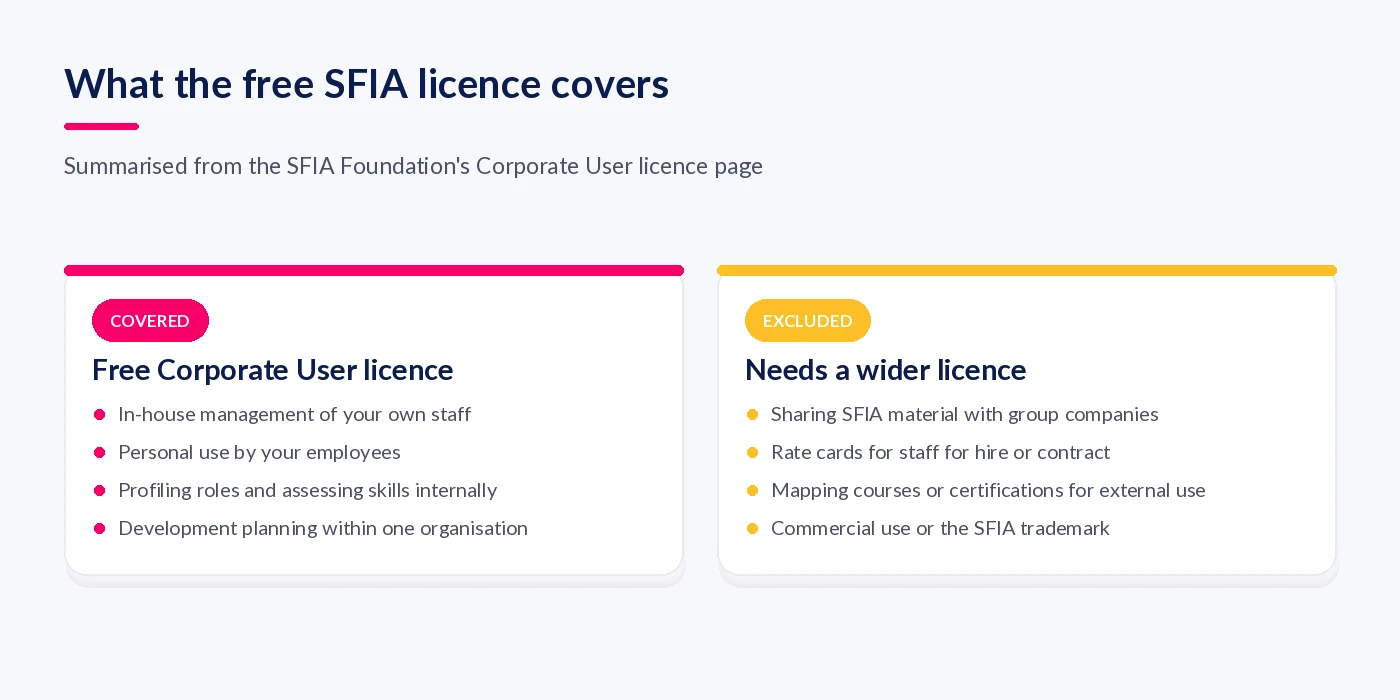
For most organisations using it to manage their own staff, yes. The SFIA Foundation's Corporate User licence is free and covers in-house management of staff and personal use by your own employees. But the exclusions are wider than most articles mention, and they catch people out.
The free licence excludes:
- any commercial exploitation of SFIA, and any use of the SFIA trademark;
- mapping training courses, qualifications or certifications for external use;
- using SFIA in a rate card for supplying people for hire or contract;
- distributing or publishing SFIA material in any form, even to other organisations in the same group.
That last point matters for groups. If your HR team builds an SFIA-based framework at the parent company and shares it with subsidiaries, the Foundation points you to the Extended Corporate User licence. Consultancies and IT service firms that put SFIA levels on rate cards or sales material need a fee-bearing licence too. If you are a large organisation, or you plan to share your framework beyond one legal entity, check the licence before you publish anything internally.
How do you adopt SFIA without boiling the ocean?
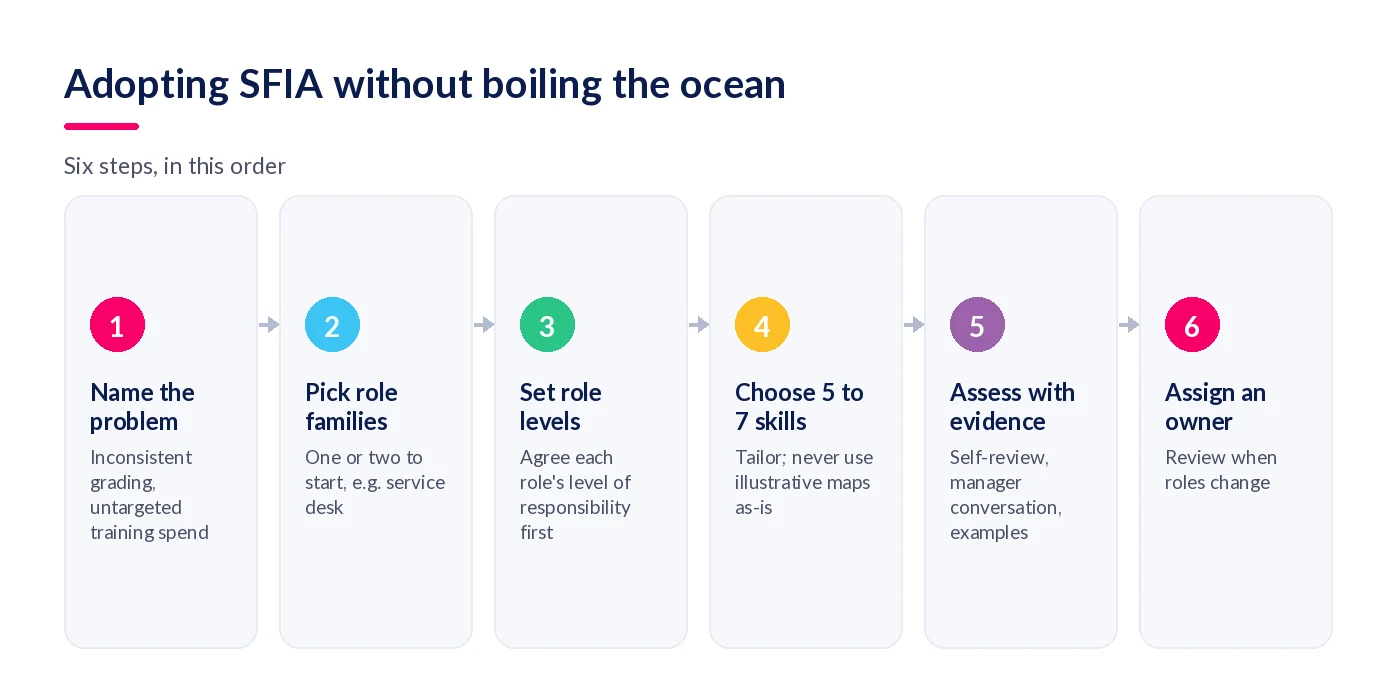
Start small and specific. Profile a handful of roles against a real problem, assess people against those profiles with evidence, and decide up front who keeps them current. The SFIA Foundation's own early guidance warns that it is “a common early mistake to treat the framework as if more coverage means better use”.
- Name the problem first. SFIA works best on a question you already care about: managers grading similar roles differently, training spend nobody can link to need, or a restructure that needs consistent role definitions. “We should implement SFIA” is not a problem statement.
- Pick one or two role families. Service desk and infrastructure, or software engineering, are typical starting points. Leave the rest until the first profiles have survived contact with managers.
- Set each role's level of responsibility. The Foundation's illustrative role mappings do not include levels; you decide them. Agree the overall level of each role before you choose any skills, using the generic attributes as your test.
- Choose five to seven skills per role. The Foundation says 5 to 7 skills is a pragmatic number to provide focus, and many roles need fewer. Its illustrative mappings carry the instruction not to use them off the shelf.
- Assess with evidence, not just self-rating. Combine a self-assessment with a manager conversation and examples of work. The Foundation warns that using SFIA mainly as a self-rating tool can quickly become a form-filling exercise.
- Give the profiles an owner. Decide who updates a profile when a role changes, and when profiles are reviewed. Without that, the work decays within a year.

A worked example: profiling a support engineer and a team lead
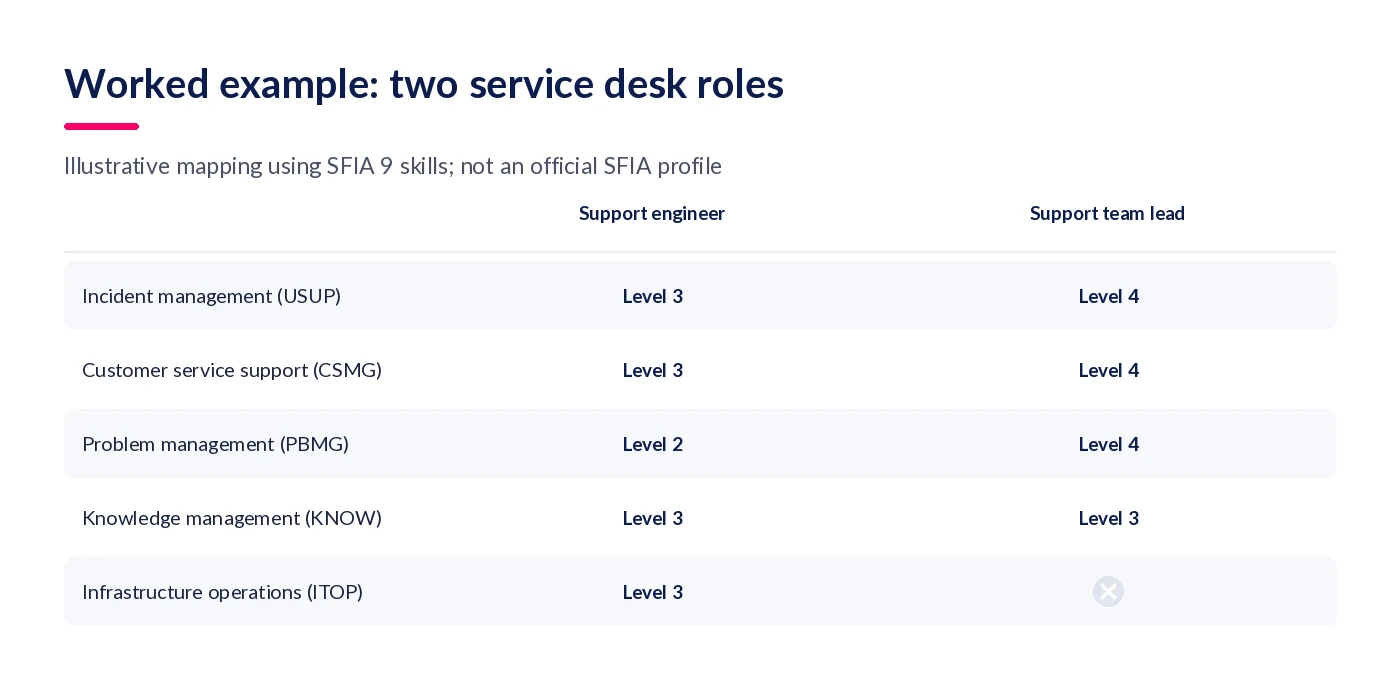
Here is what a small, usable profile looks like. Take a service desk team with two roles: support engineer and support team lead. The team lead's role is judged to sit one level of responsibility above the engineer's. Five SFIA 9 skills cover most of the work, and every one is defined at the levels used here.
| SFIA 9 skill (code) | Levels defined in SFIA 9 | Support engineer | Support team lead |
|---|---|---|---|
| Incident management (USUP) | 1–6 | Level 3 | Level 4 |
| Customer service support (CSMG) | 1–6 | Level 3 | Level 4 |
| Problem management (PBMG) | 2–5 | Level 2 | Level 4 |
| Knowledge management (KNOW) | 2–7 | Level 3 | Level 3 |
| Infrastructure operations (ITOP) | 1–5 | Level 3 | Not in profile |
Three things to notice. The profiles are short: five skills for the engineer, four for the lead. Next, the levels are not uniform. The engineer contributes to problem management at Level 2 but is not expected to own it, and the lead keeps knowledge management at Level 3 rather than inflating it. Finally, the lead drops infrastructure operations entirely, because coaching the team and owning problem records has replaced hands-on operations in that role.
The gap between the two profiles is now a development plan. An engineer who wants the lead role can see exactly which skills need to move and by how much, which is far more useful than “show more leadership”.
This mapping is an illustration, not an official SFIA profile. Your own will differ, and that is the point.
Where SFIA adoptions go wrong
Most failed SFIA projects fail for organisational reasons, not because the framework is wrong. These are the patterns the Foundation's own guidance warns about.
Too many skills per role
A profile with fifteen skills is not more accurate than one with six; it is harder to assess and nobody reads it. The SFIA forum guidance on skills-based job analysis says too many skills can reduce focus, overburden employees and make performance hard to evaluate. Its summary is memorable: “When in doubt, leave it out!”
Buying the tool before agreeing the profiles
The Foundation warns that if a tool arrives too early, the project can become over-focused on data gathering. Agree what good looks like for a few roles on paper first, then choose the system that will hold it.
Running it as a one-off project
Profiles written during a restructure and never touched again become a historical document. Review them as part of the development cycle and whenever roles change.
Expecting SFIA to cover everyone
SFIA describes digital, data and technology work, plus the people and relationship skills around it. It does not describe care, logistics or retail roles. If the rest of the organisation is on a different framework, decide early how the two fit together, or IT will end up with a parallel system nobody else understands.

How does SFIA fit with the rest of your skills framework?
Treat SFIA as the specialist layer for technology roles inside a wider organisational framework. Your organisation-wide skills framework sets the shared expectations, such as values, behaviours and core skills, while SFIA supplies the technical skill definitions for digital roles.
Three decisions make the join clean:
- Agree one proficiency scale or a mapping. If the rest of the business uses four or five proficiency levels, publish a simple mapping to SFIA's seven so a Level 4 means something to HR outside IT. The UK government's digital and data roles framework, for example, uses four skill levels: awareness, working, practitioner and expert.
- Keep behaviours in one place. SFIA 9 includes business skills and behavioural factors. If your company already has a behavioural competency framework, choose which one governs behaviour for IT staff rather than assessing it twice.
- Use the same taxonomy rules. SFIA skills should sit in your skills taxonomy like any other skill, with an owner and a review date, so that a skills gap analysis can run across the whole organisation.
Done this way, an engineer's SFIA profile and a warehouse supervisor's competency profile can sit in the same system and feed the same internal mobility conversations.
Where StaffCircle fits
StaffCircle does not replace SFIA, and it does not ship SFIA content. It gives you somewhere to put the role profiles you build, and to use them every day.
Role profiles in the same framework as everyone else
StaffCircle's competency frameworks let you define the skills and levels each role needs. You can build your technology roles from the SFIA skills you have chosen and keep them alongside the frameworks for the rest of the business, so IT is not running a separate spreadsheet.
Skills gaps that turn into development plans
Assess people against their role profile and the gaps appear on a live skills-gap dashboard. Each employee gets a personalised development plan, so the difference between support engineer and team lead in the example above becomes a set of objectives they own.
Assessment as part of the review cycle
Skills conversations sit inside one-to-ones and reviews in StaffCircle's performance management, so evidence is gathered through the year rather than in a once-a-year self-rating exercise.
Succession for critical technology roles
Role readiness against a profile shows who could step into a team lead or architect role next. Success Circles™ help you spot those successors early.
Final thoughts
SFIA has real depth, a clear licence and a published update cycle. Its value depends on restraint. Profile a few roles against a problem you actually have, keep each profile to a handful of skills, assess with evidence, and give someone the job of keeping it current. Do that, and the question “should we adopt SFIA?” becomes “which role family is next?”
If you would like to see how role profiles, skills gaps and development plans connect in one place, book a StaffCircle demo.
FAQ
What is the SFIA skills framework?
SFIA, the Skills Framework for the Information Age, is a published reference model describing digital and technology skills across seven levels of responsibility. Organisations use it to define roles, assess skills, plan development and build career paths for IT, data and digital staff.
What does SFIA stand for?
SFIA stands for the Skills Framework for the Information Age. It is maintained by the SFIA Foundation, which publishes the framework and its guidance at sfia-online.org.
What are the seven levels of SFIA?
The SFIA levels are: 1 Follow; 2 Assist; 3 Apply; 4 Enable; 5 Ensure, advise; 6 Initiate, influence; and 7 Set strategy, inspire, mobilise. Each describes a degree of responsibility, defined by autonomy, influence, complexity, knowledge and business skills.
What is the latest version of SFIA?
SFIA 9 is the current version. It was published on 30 October 2024 and contains 147 skills, 26 of them new. SFIA 10 is in consultation and tentatively expected between Q2 2027 and Q1 2028.
How many skills are in SFIA 9?
SFIA 9 contains 147 skills across six categories: Strategy and architecture; Change and transformation; Development and implementation; Delivery and operation; People and skills; and Relationships and engagement. Not every skill is defined at all seven levels.
Is SFIA free to use?
For most internal use, yes. The free Corporate User licence covers managing your own staff. Commercial use, rate cards, mapping courses for external use and sharing SFIA material with other organisations, even within your group, need a different licence.
Is an SFIA level the same as a job grade?
No. An SFIA level describes a degree of responsibility within a skill. A role can need different levels in different skills. You can map pay grades to SFIA levels, but that mapping is your organisation's decision, not part of SFIA.
How many SFIA skills should a role have?
The SFIA Foundation suggests five to seven skills per role as a pragmatic number to keep focus, and notes that many roles need fewer. Long lists make profiles harder to assess and less useful for development.
Can SFIA be used for non-IT roles?
Only partly. SFIA describes digital, data and technology work, plus related people, change and relationship skills. Roles in operations, care or retail usually need your own competency framework, with SFIA used for the technology roles alongside it.
What is the difference between SFIA and a competency framework?
SFIA is a published library of technology skill definitions with fixed levels. A competency framework is usually built by your organisation and often covers behaviours and values. Many organisations use SFIA for technical skills inside a wider competency framework.
How do you assess someone against SFIA?
Compare the person's work with the skill descriptions at the level their role requires. Combine a self-assessment, a manager conversation and real examples of work. Relying on self-rating alone tends to turn into a form-filling exercise.
Should we move from SFIA 8 to SFIA 9?
If you are new to SFIA, start with SFIA 9. If you have significant SFIA 8 material, the SFIA Foundation suggests planning your own migration path.
Related articles

See StaffCircle in action
Book a personalised demo and see how StaffCircle drives performance, engagement and development.