People Power in the Digital World: What Employees Expect in 2026
When we first published this piece in 2017, the disruptive force was the smartphone. Employees could suddenly see, on the bus home, what a competitor paid for the same job, what former colleagues said about their new employer and whether their own company's reviews were sliding. We argued that this transparency had shifted power towards employees and that the organisations which adapted would win. Nine years on the argument has held, but the forces behind it have changed enough that the piece deserved a rewrite rather than a tweak.
In 2026 the smartphone is table stakes. The new drivers are AI tools that have reset expectations of how quickly things should happen at work, a labour market that has stayed tight for skilled roles even as the wider economy has cooled, and a generation of employees for whom flexibility is not a perk but a condition of taking the job at all.

Where the Power Actually Shifted
Three things moved. Information moved: salary bands, employer ratings and the state of the job market are a search away, and pay transparency rules in the EU are pulling UK employers in the same direction whether or not the law requires it. Voice moved: an employee's view of their employer reaches thousands of potential recruits through review sites and professional networks. And the cost of leaving moved: with remote and hybrid roles common, an employee no longer has to relocate to change employer, so the pool of alternatives is national rather than local.
None of this makes employees unreasonable. It makes them informed. An informed employee compares their experience with the alternative, and the alternative is now easy to see.
Transparency: They Already Know the Market Rate
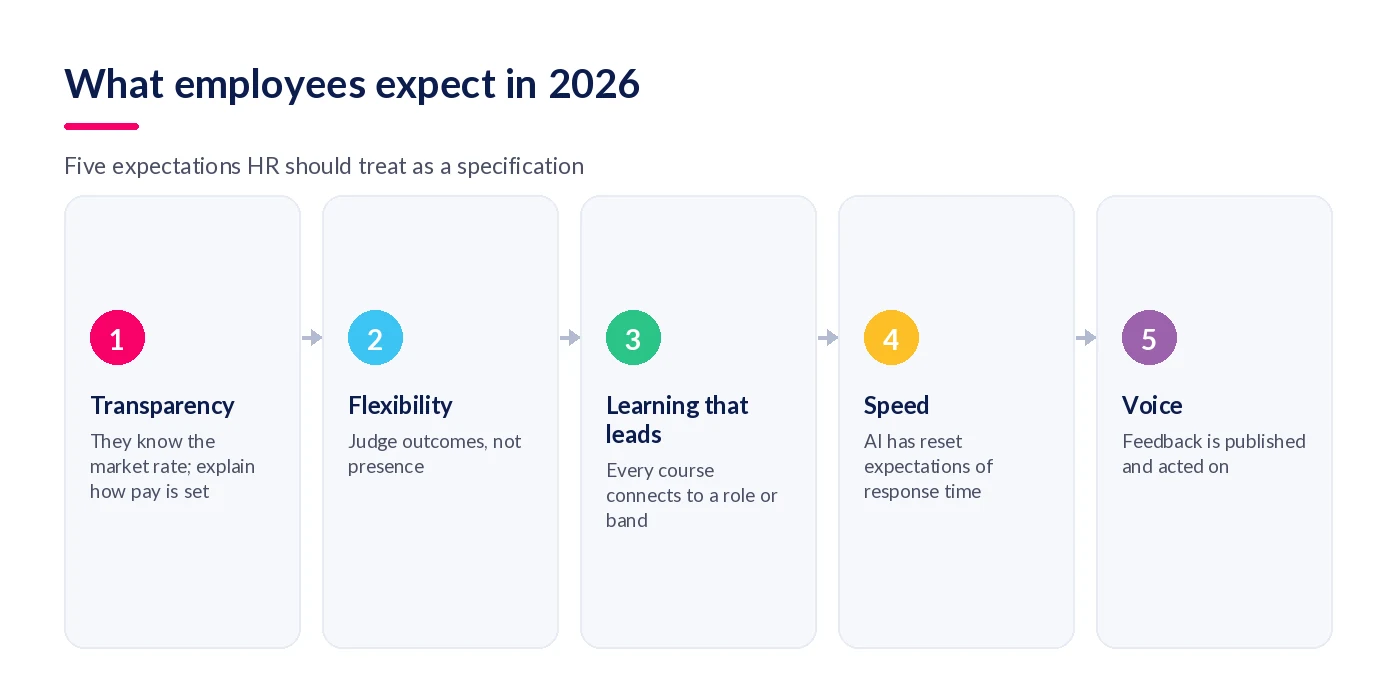
The single biggest change since 2017 is that pretending pay is private no longer works. Employees know roughly what the market pays, and they know when their own pay has fallen behind. The organisations that handle this well do not necessarily pay the most. They explain how pay is set, what the bands are, what moves someone between them and how performance feeds in. A performance process that produces clear evidence, recorded objectives, fair ratings and documented development, is what makes those explanations credible. Without it, a pay conversation is an argument.
Flexibility Became a Condition, Not a Perk
In 2017 flexible hours were a differentiator. In 2026 they are a filter: a meaningful share of candidates for desk-based roles will not consider a job that requires five days in an office, and existing employees treat a reversal of hybrid arrangements as a reason to look elsewhere. The management implication is that performance has to be judged on outcomes rather than presence, which means written objectives, recorded one-to-ones and feedback that does not depend on being in the same room. Our piece on performance management for hybrid teams goes into the mechanics.
Learning on the Employee's Clock
The frustration we described in 2017, missing development opportunities because the training clashed with the day job, has largely been solved by on-demand learning. What has replaced it is a different frustration: learning that is disconnected from progression. Employees will complete a course if they can see how it moves them towards a role, a band or a skill their organisation values. A development plan that links learning to objectives and to a visible career path is what turns a learning library into engagement.
AI Reset Expectations of Speed
This is the force that did not exist in 2017. Employees who use AI assistants to draft, summarise and answer questions at home now expect the same immediacy at work. A holiday request that takes a week, a policy question that goes into a queue, an objective that nobody updates for a quarter: each reads as a failure of care, not just of process. HR teams that use AI to answer routine questions, surface what is recorded about an employee and draft the first version of a review have more time for the conversations that matter. Our guide to how AI can be used in HR covers where it helps and where it does not.
Voice: Feedback Has to Go Somewhere
Asking employees what they think has become routine. Doing something visible with the answer has not. An engagement survey whose results disappear teaches people that their voice does not matter, which is worse than not asking. Short, regular pulse surveys, published results and a named owner for each action are the minimum. The guide to improving employee engagement sets out a practical cycle.
What HR Can Do This Quarter
- Write down how pay and progression are decided and publish it internally. If the performance process cannot support the explanation, fix the process.
- Move the judgement of performance from presence to outcomes: objectives, recorded one-to-ones, feedback against the objectives.
- Connect every learning resource to a skill, a role or a band so employees can see where it leads.
- Set a service standard for how quickly routine employee requests are answered, and use automation to meet it.
- Run a short pulse survey, publish the results and the actions, and repeat every six weeks.
Where StaffCircle Fits
StaffCircle gives employees the visibility they now expect, their objectives, feedback, recognition, development plan and one-to-one history in one place on desktop and mobile, and gives HR the evidence to explain pay and progression decisions fairly. Its AI Assist layer answers routine questions and drafts reviews from what is already recorded, so managers spend their time on the conversation rather than the paperwork. See how the engagement and culture tools work.
Final Thoughts
People power was never about employees having the upper hand. It is about employees having information, and behaving rationally on it. The organisations that thrive in 2026 are the ones that stopped treating that as a threat and started treating it as a specification: be transparent, be flexible, make development lead somewhere, respond quickly and act on what people tell you.
FAQ
What do employees expect from employers in 2026?
Transparency about pay and progression, genuine flexibility in where and when work happens, development they can access on their own schedule, fast and visible responses to their feedback, and technology at work that is at least as good as the apps they use at home.
What is people power in the workplace?
It is the shift in bargaining power towards employees created by transparent information: salary data, employer reviews, visible job markets and instant communication. Employees can now compare their employer with the alternative in minutes, which changes how they expect to be treated.
How does technology improve employee engagement?
By making the things employees care about visible and fast: objectives they can see, feedback they receive promptly, recognition that reaches everyone, learning they can do on their own time and a single place to ask for what they need. Technology that only adds admin does the opposite.
About the author
Mark Seemann is the CEO and Founder of StaffCircle, the AI performance management platform for mid-sized organisations. He writes about performance management, employee development and the practical use of AI in HR. Connect with Mark on LinkedIn.
Related articles
See StaffCircle in action
Book a personalised demo and see how StaffCircle drives performance, engagement and development.