Will AI replace HR jobs?
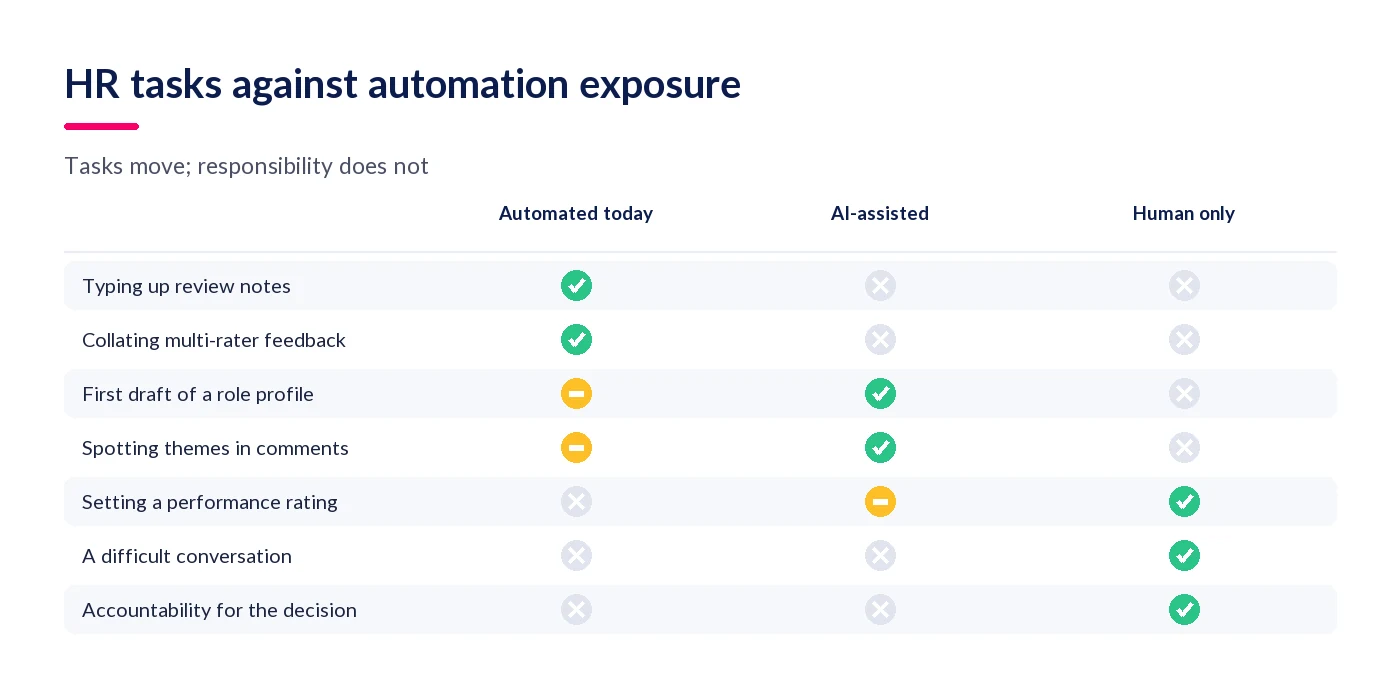
The honest answer is that AI is already replacing parts of HR jobs, not the jobs themselves. Admin, collation and first-draft writing are genuinely being automated. Judgement calls, difficult conversations and accountability for a decision about a person are not, because someone has to be answerable for them. Below is what the evidence supports in both directions, including a task-by-task exposure assessment and the labour-market projections behind it.
Key facts
- AI is displacing HR admin, collation and first-draft writing, not whole HR roles.
- CIPD analysis puts 41% of an HR assistant's time on routine, automatable tasks.
- The World Economic Forum projects 170 million new jobs and 92 million displaced by 2030.
- Accountability for a decision about a person cannot be delegated to software.
Which HR tasks is AI already replacing?
AI is already replacing four kinds of HR task: turning conversations into written records, collating scattered inputs, producing first drafts, and reading large volumes of free text. Concretely, that means typing up review notes, assembling multi-rater feedback, drafting role profiles, competencies, objectives and development plans, coding open survey comments, and answering routine policy questions. None of these is a judgement about a person, which is exactly why they went first.
This is not a forecast. Where AI is embedded in the performance process, organisations report up to 90% less performance admin. Read that claim carefully, because the wording is the point: it is a claim about admin, not about headcount. The reviews still happen, the conversations still happen, and a manager still sets every rating. What disappears is the typing, the chasing and the assembly.
Which HR tasks will AI not replace?
AI will not replace the tasks where a person has to be answerable for the outcome: setting a performance rating, running a difficult conversation, selecting for redundancy, deciding a grievance, and exercising judgement where the relevant context was never written down anywhere. It can prepare the evidence for all of these. It cannot own the conclusion.
The reason is worth being precise about, because it is not a temporary capability gap. A model can produce a fluent, defensible-sounding rationale for almost any decision about a person. It cannot be held responsible for that decision. When an employee appeals, a works council asks, or a tribunal reviews, the question is who decided and on what basis — and "the system suggested it" is not an answer that survives contact with any of those. Better models do not close that gap, because it is not a gap in reasoning quality. It is what accountability means.
There is a second, quieter category: the work that depends on context nobody recorded. Why this manager and this employee cannot be put on the same project. Which restructure will land badly with which team. Whether somebody's dip in performance is capability or something happening at home. That knowledge lives in relationships, and no amount of data in the system substitutes for it.
How exposed is each HR role to automation?
Exposure varies enormously by role, and it tracks one variable: how much of the job is routine processing versus personal interaction and judgement. Administrative and transactional roles are highly exposed. Business-partner and director roles are not. The table below sets out our assessment role by role, and is explicit about which lines are grounded in published research and which are our own judgement.
| HR role | What AI can take on today | Exposure | Basis |
|---|---|---|---|
| HR administrator or assistant | Data entry, collation, routine query responses, document drafting | High | CIPD analysis puts 41% of an HR assistant's time on routine, repetitive tasks with high automation potential |
| Payroll and timekeeping clerk | Checking, reconciliation and routine queries | High | The Future of Jobs Report 2025 names payroll clerks among the fastest-declining occupations to 2030 |
| Recruitment coordinator | Scheduling, interview note-taking, candidate communication drafts | High | Our assessment: the role is largely coordination and collation, both of which automate well |
| Recruiter or talent partner | Sourcing lists, screening shortlists, structured interview notes | Partial | Our assessment: the judgement about a candidate, and the selling of the role, stay human |
| Learning and development specialist | Content drafting, needs analysis, skills mapping | Partial, high augmentation | CIPD puts training and development specialists at the highest potential for augmentation, at 68% |
| HR business partner or HR manager | Meeting prep, collation, first-pass analysis and reporting | Low | CIPD finds 62% of an HR manager's time involves personal interaction, which carries lower AI exposure |
| HR Director or CPO | Board reporting packs, scenario modelling drafts | Low | Our assessment: the role is accountability for people decisions, which cannot be delegated to software |
The research rows come from CIPD's analysis of AI exposure in the HR profession, written by senior labour market economist James Cockett, which mapped HR occupations against task-level data rather than surveying opinion — you can read CIPD's analysis quantifying the impact of generative AI on HR in full. It places HR administrative occupations in the top 20 occupations most exposed to AI, and also places HR managers and directors in the top 20 for exposure to large language models specifically. That combination is easy to misread. High exposure to a language model means a lot of the role involves producing text, not that the role is about to disappear.
Where the table says "our assessment", that is exactly what it is: our reading, not a published figure. We would rather label it than dress it up as research.
If you want the practical counterpart to this analysis, our free guide The 2026 Definitive Guide to Using AI Tools in HR works through the HR processes that automate well, with templates and the current research.
What do the labour-market projections say?
The best-sourced projections describe churn rather than collapse. The World Economic Forum's Future of Jobs Report 2025, built on responses from more than 1,000 employers representing over 14 million workers across 55 economies, projects 170 million new jobs created and 92 million displaced by 2030 — a net gain of 78 million roles. That is a large reshuffle, and it is not the same story as mass job loss.
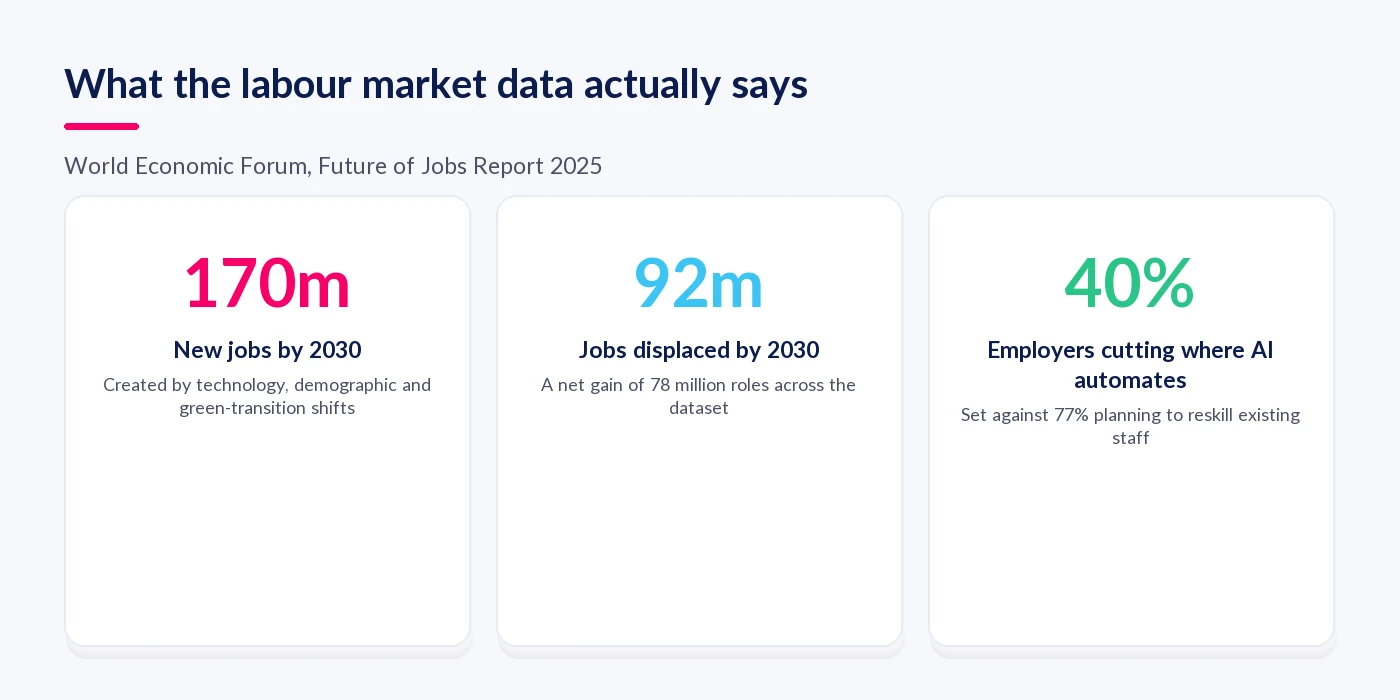
Two figures from the same employers deserve to be read together. Forty per cent expect to reduce their workforce where AI can automate tasks. Seventy-seven per cent plan to reskill and upskill existing staff between 2025 and 2030. Most organisations expect to do both, which is the honest reading of the data and the reason single-number headlines about AI and jobs tend to be misleading. The full World Economic Forum Future of Jobs Report 2025 sets out the method.
The occupational detail matters more than the totals for anyone working in HR. Among the fastest-declining roles the report names are postal service clerks, executive secretaries and payroll clerks. That is administrative work. The roles it expects to grow fastest are in technology, data and AI, alongside human-centred work in care, education and delivery. The pattern is consistent with the task-level evidence: routine processing contracts, and work that depends on people does not.
Will HR headcount fall?
In some functions it already has, and the roles that go first are administrative rather than professional. But the evidence does not support a general collapse in HR headcount, and nobody has published a credible HR-specific figure. We are not going to invent one, because an estimate dressed as data is worse than saying plainly that this is not yet known.
What can be said with more confidence is that three different things are happening in different organisations, and they are easy to confuse for each other:
- Same headcount, different work mix. The most common outcome so far. The admin load drops, and the time goes into analysis, manager coaching and governance work the function never had capacity for.
- Fewer administrative roles, more specialist ones. The HR administrator role shrinks while people-analytics, reward and AI-governance roles appear. Net headcount is broadly flat but the shape of the team changes, and that transition is hard on individuals even when the total does not move.
- Genuine reduction. Where an HR function was mostly transactional — processing, records, routine queries — automation removes a large share of the work and the team does get smaller. This is real, and pretending otherwise does nobody any favours.
Which of the three you get depends far more on what your HR function currently spends its time on than on which AI tool you buy.
What should HR professionals do about it?
Move deliberately towards the work that does not automate, and get good at supervising the work that does. In practice that means five things, and none of them requires becoming technical.
- Get good at reviewing AI output, not writing prompts. Prompting is a shallow skill with a short half-life. Spotting that a generated review summary has flattened a difficult conversation into blandness is a deep one, and it is the skill the whole human-in-the-loop model depends on.
- Own AI governance before it is handed to you. HR usually inherits the workforce AI policy, employee monitoring questions and the consultation that comes with them. Being the function that shaped that policy is a materially stronger position than being the one that administers somebody else's.
- Get fluent in your own data. When AI does the collation, the scarce skill becomes knowing which question is worth asking and whether the answer is plausible.
- Protect the difficult conversation as a craft. It is the least automatable thing HR does and, in most organisations, the least deliberately developed.
- Learn what you are signing. If your name is on the confirmation, you need to understand what the system did and where it can be wrong. Our guide to why ISO 42001 matters for AI governance in HR is a reasonable starting point.
If you want the practical version of this, how to use AI in HR sets out the adoption sequence and the sign-off boundaries, and how AI can be used in HR maps the use cases across the function.
The uncomfortable summary
If your HR role is mostly typing, collating and chasing, a meaningful share of it is genuinely automatable now, and saying otherwise would not be a kindness. If your role is mostly judgement, conversation and accountability, the automatable part is the admin that has been getting in the way of it. Most HR jobs are a mix, and the honest question is not whether AI replaces the job but what proportion of your week currently sits in the first category.
To see what the drafting-and-collation half looks like when it is handled properly, with a person confirming every output, take a look at StaffCircle Intelligence.
Frequently asked questions
Will AI replace HR jobs in the future?
Not wholesale. AI is replacing tasks inside HR jobs rather than the jobs themselves, and the tasks going first are administrative: typing up notes, collating feedback, first-draft writing. Roles built almost entirely on that work are genuinely exposed. Roles built on judgement, negotiation and accountability are far less so.
Which HR jobs are most at risk from AI?
Administrative and transactional roles: HR administrators and assistants, payroll and timekeeping clerks, and recruitment coordinators. CIPD analysis puts 41% of an HR assistant's time on routine, repetitive tasks with high automation potential, and the World Economic Forum lists payroll clerks among the fastest-declining occupations to 2030.
Can AI do the work of an HR manager?
Only parts of it. CIPD analysis finds 62% of an HR manager's time involves personal interaction, which has much lower AI exposure than routine processing. AI can prepare the pack, draft the letter and surface the pattern. It cannot run the grievance meeting or carry the consequences of the outcome.
Will AI reduce HR headcount?
Sometimes, and mostly in transactional teams. Nobody has published a credible figure for HR-specific headcount change, so we are not going to estimate one. What the evidence supports is a shift in the work mix: less collation and typing, more analysis, governance and judgement work per person.
What skills should HR professionals learn to stay relevant?
Three things. Reviewing AI output critically, which is a harder skill than writing prompts. Owning AI governance, because HR usually inherits the workforce AI policy. And the human work AI cannot touch: difficult conversations, negotiation, and making a defensible decision about a person and standing behind it.
Related articles

See StaffCircle in action
Book a personalised demo and see how StaffCircle drives performance, engagement and development.