Performance Management for Growing UK Businesses (Practical 2026 Guide)
Scaling a business in the UK is a uniquely challenging journey. When an enterprise expands from a tight-knit founding team to a multi-site operation, the informal check-ins and verbal promises that used to keep everyone aligned suddenly stop working.
By 2026, UK business owners and HR leaders face a double-edged sword: a rapidly shifting regulatory environment alongside an increasingly distributed, hybrid and deskless workforce.
Performance management (PM) is no longer an annual “box-ticking” exercise mandated by HR. It is the operational engine that dictates whether a growing business scales smoothly or buckles under administrative friction.
This guide provides a practical, straightforward roadmap to structuring performance management for growing UK businesses, addressing specific regulatory requirements, stage-by-stage growth models and technology requirements.
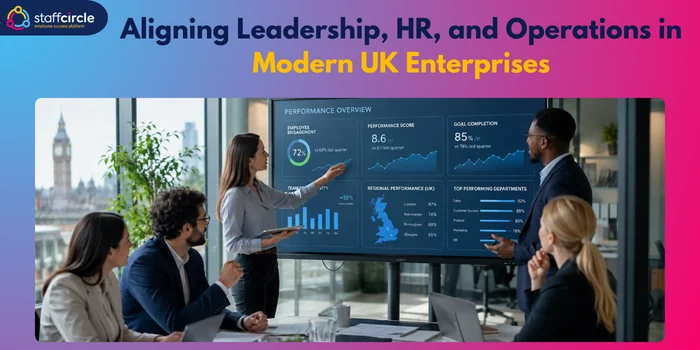
What Performance Management Looks Like at 50, 100 and 500 Employees
The performance management system a business needs is different at every size, and it has to evolve as the organisation grows.
What works for a 20-person startup will cripple a 200-person enterprise, and the formal structures required at 500 employees will stifle a business of 50. Understanding what your company actually needs at its current stage matters more than copying anyone else’s process.
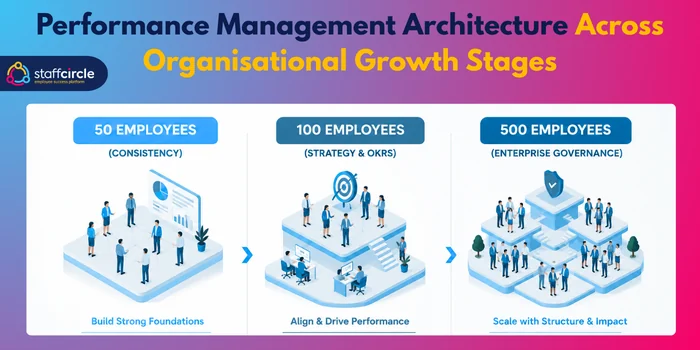
Stage 1: The 50-Employee Threshold (Establishing Consistency)
At 50 employees, founders can no longer maintain a personal pulse on every individual’s daily output. Middle management is usually fresh in their roles, often promoted for technical excellence rather than people management skills.
Here, the biggest danger is inconsistent manager behaviour. One team gets weekly coaching; another gets total silence until an annual review. At this stage, the goal is establishing baseline consistency without creating overwhelming bureaucracy:
- Standardised 1-on-1 Frameworks: Implement lightweight, repeatable agendas for regular check-ins to ensure managers are coaching, not just checking status updates.
- Core Goal Alignment: Establish 3 to 5 core SMART goals per employee to align individual effort with basic department targets.
- Values Recognition: Introduce peer-to-peer appreciation tools linked to core company values to reinforce culture as teams grow beyond a single room.
Stage 2: The 100-Employee Milestone (Connecting Strategy to Execution)
At 100 employees, siloing becomes an operational threat. Departments (Sales, Product, Operations, Marketing) start pulling in different directions, and executive strategy gets lost in translation.
Here, the problem is operational drift and recency bias. When reviews only happen annually, managers judge employees on the last three weeks of work rather than a full year of contributions. Meanwhile, team goals drift out of alignment with corporate strategy.
At 100 employees, the organisation must connect daily execution directly to company strategy:
- Cascading OKRs: Transition to Objectives and Key Results (OKRs) that cascade directly from executive leadership down to individual contributors.
- Quarterly Check-Ins: Replace or supplement the annual review with quarterly performance reviews supported by continuous, real-time feedback.
- Competency Frameworks: Introduce formal job families and competency models so employees have clear, transparent visibility into promotion criteria and progression paths.
Stage 3: The 500-Employee Enterprise (Governance, Talent Pools and Calibration)
At 500 employees, performance management directly intersects with risk management, retention and succession planning. Manual chasing of completed appraisals by HR becomes mathematically impossible.
Here, challenges include unchecked manager bias, inflated performance ratings and invisible top performers. Without centralised governance, lenient managers give everyone top marks while strict managers penalise high achievers, leading to frustration and attrition among your best talent.
At the enterprise scale, performance management requires automated governance, objective talent identification and deep analytics:
- Automated Review Lifecycles: HR requires fully automated appraisal workflows that route approvals, manage self-assessments and trigger manager sign-offs without manual chasing.
- Performance Calibration: Implement formal calibration sessions across department leads to normalise scoring and eliminate individual manager bias.
- 9-Box Talent Grids: Utilise objective performance vs. potential matrices to identify high-potential (HiPo) employees, map critical succession pools and target development budgets effectively.
- Real-Time HR Analytics: HR teams need live dashboards to track real-time performance trends, engagement sentiment and potential flight risks before turnover spikes occur.
At the 500-employee level, StaffCircle acts as a centralised governance platform. It automates complex performance review lifecycles, aggregates performance and engagement data into real-time analytics dashboards, and provides talent management tools (including 9-box grids) to help leadership maintain objective oversight across the entire enterprise.
UK-Specific PM Challenges: Compliance, Holiday Law and Appraisal Norms
Performance management software developed primarily for global or US markets often requires adaptation for UK organisations. UK employers operate within a distinct legal and workplace framework, where employment legislation, statutory leave requirements and established HR practices all influence how employee performance should be managed.
1. Working Time Regulations and Employee Wellbeing
The UK’s Working Time Regulations 1998 set minimum standards for working hours, rest breaks and paid annual leave. While there is currently no statutory “right to disconnect”, employers are expected to support employee wellbeing and avoid working practices that encourage excessive hours or undermine appropriate rest.
Performance management software should therefore avoid creating unnecessary pressure through constant notifications or expectations of out-of-hours activity. Features such as configurable notification settings, flexible goal updates and asynchronous feedback help organisations promote productivity while supporting healthy work-life boundaries.
2. Holiday Pay, Statutory Leave and Fair Performance Reviews
Employee performance should always be considered in the context of statutory leave and authorised absences. UK employers must manage annual leave, statutory sick pay (SSP), parental leave, maternity leave and other protected absences while complying with employment legislation and the Equality Act 2010.
Modern performance management platforms should provide managers with the context needed to interpret performance fairly. For example, a temporary decline in objectives may reflect a period of parental leave or long-term sickness rather than reduced capability. Integrating absence data with performance records helps organisations make more informed decisions and reduces the risk of discriminatory or unfair performance assessments.
3. Structured Appraisals and Continuous Feedback
Many UK organisations have moved away from annual appraisals and forced ranking models in favour of continuous feedback, coaching and evidence-based performance conversations. Guidance from HR bodies such as the CIPD also emphasises ongoing development over infrequent, high-pressure reviews.
Effective performance management software should support this approach by providing:
- Clear competency frameworks and measurable objectives.
- Private, continuous one-to-one feedback and coaching conversations.
- Evidence-based performance records collected throughout the review period to support fair, objective appraisal discussions.
By aligning technology with UK employment practices and legal requirements, organisations can create performance management processes that are more transparent, consistent and supportive of long-term employee development.
Top Performance Management Platforms for UK Businesses – Ranked
Selecting the right performance management software for a UK organisation depends on your workforce structure, data compliance needs and current HR tech stack. When evaluating software for a growing UK workforce, systems must be assessed on ease of adoption, frontline accessibility, local compliance and feature integration.
Below is a direct comparison of the top 6 platforms evaluated for UK businesses.
| Platform | Primary Architecture | UK/EU Hosting & Compliance | Frontline Workforce Accessibility | Key Integrations & Features | Best Suited For |
|---|---|---|---|---|---|
| StaffCircle | All-in-One Performance, Engagement & Talent Development | UK-hosted on Microsoft Azure (UK regions), UK GDPR compliant, ISO/IEC 27001:2022 certified, ISO/IEC 42001:2023 certified (AI management) and Cyber Essentials | Yes (SMS and Employee ID login available for deskless workers; no corporate email required) | 30+ HRIS, Microsoft Teams, Google Workspace, OKRs, 360 Reviews, Power BI, Sage, IRIS, Workable, Zapier, API and more | UK organisations with hybrid, frontline or multi-site workforces |
| HiBob (Bob) | Global Core HRIS with Performance & Engagement | Global cloud infrastructure with UK/EU data hosting options and UK GDPR compliance | Limited (mobile app available but employees require authenticated user accounts) | Microsoft Teams, Slack, payroll integrations, Time Off, Performance Reviews, Surveys, Workflows | Mid-market and multinational organisations needing a modern HRIS |
| Personio | European All-in-One HR Platform | EU-hosted (Germany), GDPR compliant | Limited (mobile app available but primarily designed for office-based HR workflows) | Core HR, Payroll, Performance Reviews, Probation Management, 360 Feedback, Recruiting | Small-to-medium European businesses seeking an integrated HR platform |
| BambooHR | SMB HRIS & People Platform | Regional hosting (US, Canada or Ireland) with UK GDPR and EU GDPR compliance | Limited (full-featured mobile app, but employees require standard authenticated accounts) | HRIS, Goal Tracking, Performance Management, 1:1 Templates, ATS, Time Tracking, Integrations | Small and growing businesses looking for straightforward HR administration |
| Lattice | Performance Management & People Success | US-hosted with GDPR compliance and international security standards | Limited (designed primarily for knowledge workers and office-based employees) | OKRs, 360 Reviews, Compensation, Career Development, Slack, Microsoft Teams, HRIS integrations | Medium to large organisations focused on performance, engagement and compensation |
| Leapsome | Performance, Learning & Employee Engagement | EU-hosted (Germany), GDPR compliant, ISO 27001 certified | Limited (web and mobile access available, but not purpose-built for deskless workforces) | Learning Management, AI Copilot, Career Frameworks, OKRs, 360 Reviews, Surveys, HRIS integrations | Fast-growing European businesses wanting performance management and learning in one platform |
1. StaffCircle
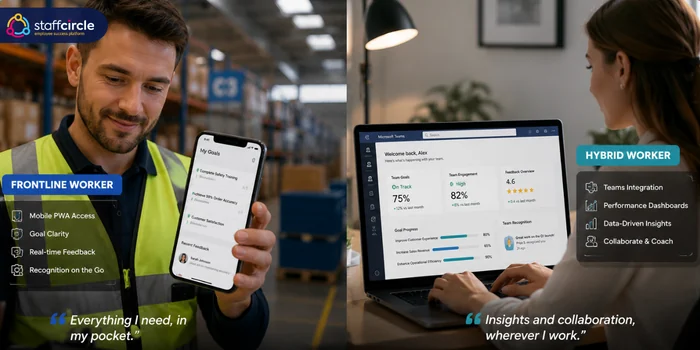
StaffCircle is a leading performance management platform for growing UK organisations with hybrid, multi-site and frontline workforces, providing a unified solution that combines performance management, continuous engagement and skills development within a single, secure environment. Developed in the UK and hosted on Microsoft Azure’s UK South and UK West data centres, the platform supports UK GDPR compliance while maintaining robust security credentials, including ISO/IEC 27001:2022 certification, ISO/IEC 42001:2023 certification (AI management), Cyber Essentials accreditation and annual independent third-party penetration testing. Its key operational strength lies in supporting frontline accessibility: employees without desktop setups or corporate email accounts can securely access OKRs, complete 1-on-1 check-ins and receive continuous feedback through a mobile Progressive Web App (PWA), while office-based staff can manage reviews directly within Microsoft Teams.
Supported by an extensive integration ecosystem (including IRIS Cascade, Sage, Microsoft 365, Google Workspace, Workable and Power BI), StaffCircle connects HR processes across field and office environments, helping organisations improve workforce visibility, employee engagement and performance.
For a quick walkthrough of how the platform operates in practice, check out this StaffCircle Beginner Tutorial.
2. HiBob
HiBob is a modern HR platform that combines core HR, performance management, employee engagement, compensation and workforce planning within a unified HCM solution. It is particularly well suited to growing mid-market organisations and international businesses seeking a single platform with a strong focus on employee experience.
HiBob includes performance reviews, goal management, employee surveys, compensation planning, workflow automation, and integrations with Microsoft Teams, Slack and leading payroll providers. Its mobile application supports employee self-service and manager workflows but is primarily designed for authenticated employees with organisational accounts rather than SMS-based frontline access. Compared with dedicated performance management platforms, HiBob’s performance capabilities are delivered as one component of its broader HCM suite.
3. Personio
Personio is one of Europe’s leading HR platforms for small and medium-sized businesses. Hosted within the EU and designed to support GDPR compliance, it centralises HR administration, recruiting, time management, payroll preparation and performance management within a single platform. It supports goal setting, continuous feedback, probation reviews and performance conversations, with performance management delivered as part of its broader HR suite rather than a dedicated talent management solution. Personio is best suited to organisations seeking an integrated HR platform with embedded performance management rather than an advanced specialist platform focused on talent development or frontline workforce performance.
4. BambooHR
BambooHR is a user-friendly HR platform designed primarily for small and growing businesses. It provides employee records, onboarding, time-off management, applicant tracking, performance management and employee self-service through web and mobile applications. BambooHR offers regional data hosting options, including Ireland for eligible European customers, to support regional data residency and privacy requirements. The platform includes goal tracking, performance reviews and 1-to-1 meeting tools, with performance management integrated into its broader HR suite. While it supports core performance processes, it does not provide the advanced OKR management, succession planning or workforce analytics typically found in dedicated performance and talent management platforms. It is best suited to organisations seeking straightforward HR administration with integrated performance management.
5. Lattice
Lattice is a people success platform built around performance management, employee engagement, compensation and career development. It is particularly popular among technology companies and knowledge-based organisations. Its strengths include advanced 360-degree feedback, goal management, compensation planning, career frameworks and people analytics. As a US-based platform supporting GDPR compliance for international customers, Lattice is well suited to digitally connected workforces and is primarily designed for knowledge workers rather than organisations with large frontline or shift-based employee populations.
6. Leapsome
Leapsome is a European people enablement platform that combines performance management, employee engagement, learning and development, goal management and AI-powered HR workflows. Hosted in Germany and certified to ISO 27001 standards, it is particularly attractive to European organisations seeking an integrated people development platform. It offers comprehensive performance reviews, learning management, competency frameworks, career progression, engagement surveys and AI-assisted HR features. While mobile access is available, Leapsome is primarily designed for digitally connected knowledge workers, with fewer capabilities specifically tailored to large deskless or frontline employee populations. It is particularly well suited to fast-growing organisations seeking to combine learning, performance and employee development within a single platform.
Why UK-Built Software Matters for HR Compliance
Managing workforce compliance in the UK requires navigating a distinct legal landscape, from UK GDPR and data residency considerations to employment legislation such as the Employment Rights Act and HMRC payroll requirements. While many global HR platforms support UK organisations, software developed specifically for the UK market often provides capabilities and integrations that are more closely aligned with local regulatory and operational needs.
1. Data Residency & UK GDPR Support
Many UK-developed HR platforms offer the option to host employee data within UK-based data centres (such as Microsoft Azure UK South and UK West), helping organisations meet internal data residency requirements and simplify compliance with UK GDPR.
- Local Data Hosting: Employee records, performance data and HR documents can remain within UK infrastructure where required by organisational policies.
- Privacy & Compliance Workflows: Features such as Subject Access Request (SAR) management, retention policies, audit logs and data deletion workflows help organisations meet UK GDPR obligations and Information Commissioner’s Office (ICO) expectations.
2. Alignment with UK Employment Practices
UK-built platforms are often designed with local employment processes in mind, reducing the need for extensive configuration.
- Statutory Processes: Support for UK leave policies, probation management and employment documentation can help organisations manage common HR processes consistently.
- Audit Trails: Built-in records of performance reviews, objectives, check-ins and employee acknowledgements provide documentation that can support internal governance and employment-related investigations or disputes.
3. Integration with the UK HR & Payroll Ecosystem
Many UK HR platforms provide native integrations with widely used regional payroll and HR systems, reducing manual administration and improving data consistency.
- Payroll Connectivity: Integrations with platforms such as IRIS, Sage and Xero enable employee and payroll information to flow more efficiently between systems.
- Operational Efficiency: Automated synchronisation helps reduce duplicate data entry and supports accurate reporting across HR, payroll and finance functions.
4. Security & AI Governance
Security and responsible AI governance are becoming increasingly important considerations when selecting HR software.
- Recognised Security Standards: Many UK-developed platforms maintain certifications such as ISO 27001, Cyber Essentials or Cyber Essentials Plus, together with regular independent penetration testing.
- Responsible AI: Organisations increasingly look for vendors that demonstrate transparent AI governance through standards such as ISO 42001, helping ensure AI-assisted HR processes are deployed responsibly and with appropriate oversight.
StaffCircle: Built for UK Businesses from Day One
When we founded StaffCircle in 2017, our team wasn’t looking to build just another HR platform. After more than two decades of building technology businesses, we repeatedly encountered the same challenge across UK organisations: connecting leadership, managers and frontline employees through a consistent approach to performance and development.
And the main question: how do you maintain a high-performance culture across a workforce split between desks, homes, warehouses and field locations?
Many HR and performance management systems were originally designed for office-based workforces, where employees have corporate email accounts and spend most of their day behind a desk. Yet the UK economy depends on a far broader workforce. From healthcare, logistics, manufacturing and retail to construction, hospitality and field services, millions of employees work away from traditional office environments. These workers often face greater barriers to participating in performance conversations, receiving feedback and staying connected with organisational goals.
That’s why we built StaffCircle from day one as a UK-developed platform designed to support both frontline and office-based employees.
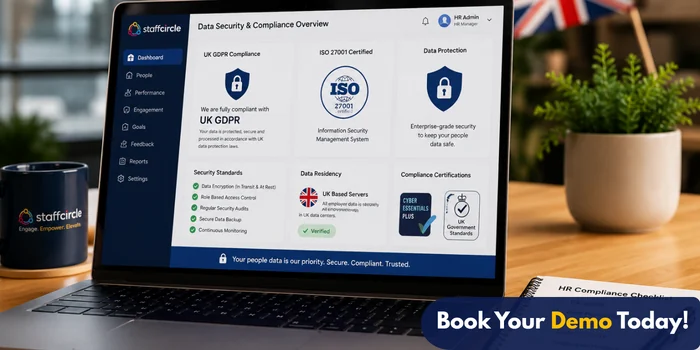
- UK-Hosted Infrastructure & GDPR Support: StaffCircle is hosted on Microsoft Azure’s UK South and UK West data centres, helping organisations meet UK data residency requirements while supporting compliance with UK GDPR through features such as audit trails, retention controls and Subject Access Request (SAR) workflows.
- Security & AI Governance: Protecting employee data is fundamental. StaffCircle is ISO/IEC 27001:2022 certified and ISO/IEC 42001:2023 certified, Cyber Essentials accreditation, and undergoes annual independent third-party penetration testing to help organisations meet modern security and AI governance expectations.
- Supporting Every Employee: StaffCircle was designed to include employees regardless of where they work. Our Progressive Web App (PWA) enables frontline and deskless workers to securely access objectives, feedback and check-ins without requiring a traditional desktop setup, while office-based employees can manage reviews, OKRs and 1-to-1 meetings directly within Microsoft Teams.
- Built for the UK HR Ecosystem: StaffCircle integrates with widely used business applications including IRIS Cascade, Sage, Microsoft 365, Google Workspace, Workable, Power BI and other HR and payroll systems, helping organisations reduce manual administration and maintain consistent employee data across platforms.
- Modular Rollout Strategy: Avoid software paralysis. Launch simple peer recognition and internal newsfeeds in month one, introduce structured 1-on-1s in month two, and cascade company-wide OKRs in month three.
Bottom Line
Choosing the right performance management approach is not simply about buying software. It is about building a system that grows with your business, supports managers and helps employees perform at their best. As your organisation expands, structured goals, regular feedback, fair appraisals and data-driven insights become essential for maintaining consistency and engagement. By selecting a platform that aligns with UK employment practices, compliance requirements and your workforce structure, you can create a performance management process that improves productivity, strengthens employee development and prepares your business for sustainable long-term growth in an increasingly competitive market.
See StaffCircle in action – book your personalised demo today.
FAQs
Does UK PM software integrate with BrightHR, Sage or IRIS?
Yes. StaffCircle features direct API connectors and integration capabilities designed specifically for the UK software ecosystem. It synchronises employee data with major UK systems, including IRIS Cascade, IRIS Staffology, Sage and BrightHR. This auto-sync functionality eliminates duplicate data entry by keeping your central HR database, payroll records and performance platform aligned automatically when employees join, change roles or leave the company.
How do we handle performance management for employees on probation in the UK?
StaffCircle provides structured probation review templates that run automated 30, 60 and 90-day check-in workflows. This creates a clear paper trail of objectives, support provided and competency checks, ensuring you remain compliant with ACAS guidelines if you need to extend or end a probation period.
Can we run 360-degree appraisals without overwhelming managers?
Yes. StaffCircle allows HR to set up automated, lightweight 360-degree feedback cycles. You can control reviewer limits, use simple rating scales alongside qualitative feedback, and automatically compile peer feedback directly into the manager’s final review interface to save hours of manual compilation.
How does StaffCircle help with UK ACAS capability procedures?
If an employee is underperforming, StaffCircle allows managers to set up structured performance improvement plans (PIPs) with specific, time-bound objectives and weekly check-in logs. The system records all meeting notes, goal updates and agreed actions, providing a transparent, auditable paper trail that adheres strictly to ACAS code of practice requirements.
How often should performance reviews be conducted in a growing UK business?
There is no one-size-fits-all schedule, but many UK organisations are moving away from annual-only appraisals. Quarterly performance reviews combined with regular one-to-one meetings and continuous feedback help managers identify challenges earlier, recognise achievements and keep employee goals aligned with business priorities.
What is the difference between performance management and performance appraisal?
Performance management is an ongoing process that includes goal setting, coaching, continuous feedback, employee development and regular progress reviews. A performance appraisal is a formal assessment conducted at a specific point in time, often annually or quarterly. Modern organisations treat appraisals as one part of a broader performance management strategy.
When should a growing company invest in performance management software?
Many organisations begin looking for dedicated performance management software when they reach around 50 employees. At this stage, manual spreadsheets and informal manager check-ins become difficult to manage consistently across teams, increasing the risk of inconsistent reviews and unclear objectives.
What features should UK businesses prioritise when choosing performance management software?
UK businesses should look for goal management, continuous feedback, one-to-one meeting tools, competency frameworks, performance reviews, analytics, succession planning, HRIS integrations, UK GDPR support, audit trails and flexible access for both office-based and frontline employees.
Can small businesses benefit from performance management software?
Yes. Small businesses often benefit from introducing structured performance processes before rapid growth creates management challenges. Implementing regular check-ins, clear objectives and documented feedback early helps establish consistent management practices as the organisation expands.
How does performance management improve employee retention?
Employees are more likely to stay when they understand expectations, receive regular feedback and can see opportunities for career development. Continuous performance management helps managers recognise achievements, address concerns early and support professional growth before disengagement leads to higher turnover.
What are OKRs, and why are they useful?
Objectives and Key Results (OKRs) are a goal-setting framework that connects company objectives with measurable outcomes. They help ensure employees understand how their work contributes to wider business goals while improving alignment across departments.
Is performance management software suitable for hybrid and remote teams?
Yes. Modern platforms enable managers and employees to set goals, provide feedback, complete reviews and conduct one-to-one meetings regardless of location. This helps maintain consistency across office-based, hybrid, remote and frontline workforces.
How can businesses reduce bias during performance reviews?
Bias can be reduced by documenting feedback throughout the review period, using measurable objectives, introducing competency frameworks, holding calibration sessions and evaluating performance against consistent criteria rather than recent events or subjective opinions.
Can performance management software support employee development?
Yes. Most modern platforms combine performance reviews with learning and development tools, personalised development plans, competency tracking, career pathways and skills assessments, helping employees build capabilities while supporting future succession planning.
How long does it take to implement performance management software?
Implementation timelines vary depending on organisation size and system complexity. Small businesses may deploy a platform within a few weeks, while larger organisations with multiple integrations, custom workflows and enterprise governance requirements may require several months.
Does performance management software replace HR systems?
No. Performance management software usually complements existing HR systems rather than replacing them. Many organisations integrate it with HRIS, payroll, recruitment and learning management platforms to create a connected employee experience while keeping workforce data synchronised.
Related articles
See StaffCircle in action
Book a personalised demo and see how StaffCircle drives performance, engagement and development.