Which Performance Management Tools Combine OKRs, Feedback & Reviews?
In 2026, the best performance management platforms (such as StaffCircle) unify OKRs, continuous feedback, and automated reviews into a single tool. This consolidation reduces administrative software bloat, improves data accuracy for evaluations, and boosts frontline employee engagement.
If you are an HR leader, you have probably experienced the frustration of switching between different software just to manage employee performance.
On any given day, managers might use one platform to update company goals and OKRs, another to give employee feedback, and a third system — or even a spreadsheet — to complete performance reviews.
Using separate tools creates unnecessary problems. Goal updates get missed, feedback is scattered across different systems, and performance reviews become stressful tasks that look only at the past instead of helping employees improve for the future.
In 2026, more organisations are moving away from this approach. They need a single performance management platform where company goals, ongoing feedback, and performance reviews are all connected in one place. This gives managers a clear view of employee performance and makes the entire process simpler and more effective.
Why HR teams are consolidating their PM tool stack
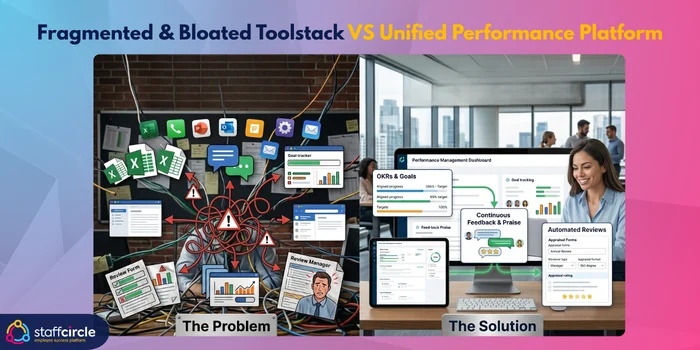
The days of using separate HR tools for goals, feedback, and performance reviews are coming to an end. More organisations are replacing multiple systems with a single platform because it is easier to use, more efficient, and more cost-effective.
Employees are tired of too many apps
Research from Microsoft’s Work Trend Index found that employees spend 57% of their working time communicating rather than creating, making it increasingly important for HR tools to integrate into everyday workflows instead of requiring employees to switch between multiple applications.
When employees have to switch between several platforms to complete simple tasks, they are less likely to use them regularly. Updating goals, sharing feedback, or checking progress becomes an extra step that many people put off. A single platform makes these tasks easier to complete and helps keep employees engaged.
All performance data stays in one place
When goals, feedback, and performance reviews are stored in different systems, managers have to spend time gathering information before a review. Important updates can be missed, and reviews may focus only on recent events.
A unified platform keeps everything together. Managers can see employee goals, ongoing feedback, and past performance in one place, making reviews more accurate, balanced, and useful.
Lower costs and less administration
Deloitte’s 2026 Human Capital Trends research highlights that organisations are increasingly consolidating HR technology to reduce software complexity, improve employee adoption, and simplify IT administration.
Managing several HR tools often means paying multiple subscription fees, handling different contracts, and maintaining separate integrations and security checks.
Using one platform reduces software costs and simplifies administration. It also makes life easier for HR, IT, and procurement teams because there is only one system to manage.
Understanding the true cost of performance management software
Subscription pricing is only one part of the total investment. Businesses should also consider implementation, data migration, integrations with existing HR systems, employee training, and ongoing support when comparing platforms. A solution with a lower monthly price may require significant manual setup or additional third-party tools, increasing long-term costs. Choosing a platform that combines these capabilities into a single system can reduce administrative overhead, speed up adoption, and deliver a better return on investment over time.
What to look for in an all-in-one PM platform
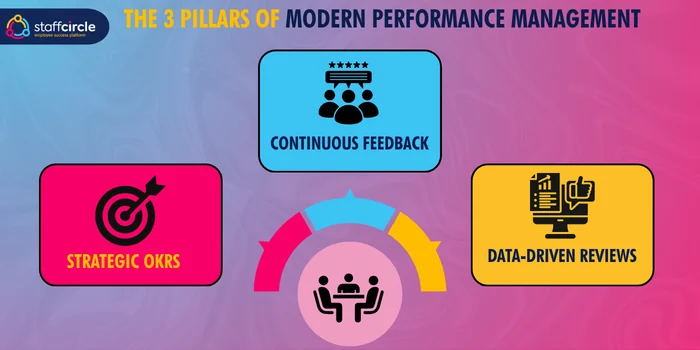
If you are evaluating platforms that promise to combine OKRs, feedback, and reviews, you must look past basic marketing checklists. A truly integrated platform must satisfy these three foundational areas:
1. Direct strategic alignment (OKRs to daily work)
The platform should connect high-level corporate OKRs directly to individual, role-specific SMART goals. When an employee works on a key result, they should see exactly how their daily tasks support the company’s broader business targets.
2. High-frequency, low-friction feedback
Continuous feedback must be easy to share. Look for platforms that integrate directly with everyday communication tools like Microsoft Teams. This ensures managers and peers can easily log real-time feedback, share recognition, and note 1-on-1 takeaways without leaving their active workspaces.
Gallup research shows that employees who receive meaningful feedback every week are nearly four times more likely to be engaged than employees who receive feedback only once a year or less. This is one reason many organisations are replacing annual appraisal systems with continuous performance management.
3. Automated, data-driven review cycles
The platform should automate the administrative work of reviews. This includes sending automated notifications, setting up structured appraisal templates, and pulling in historical goal achievements and peer feedback automatically. This transforms performance reviews from stressful chores into meaningful, growth-focused conversations.
How to choose the right performance management platform
Not every performance management platform is built for the same type of organisation. Before comparing vendors, consider how well each solution aligns with your workforce, existing technology, and long-term business goals.
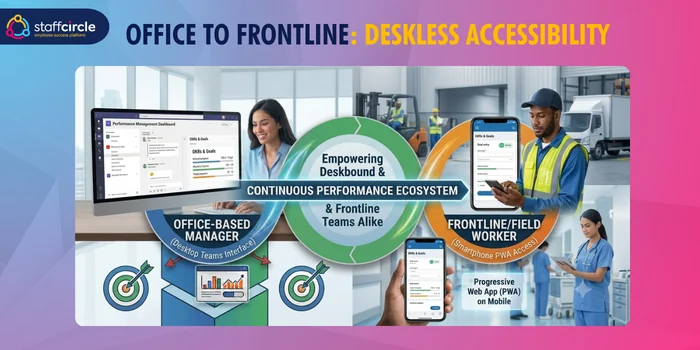
- Workforce type: Consider whether your employees work primarily in an office, remotely, or on the frontline. Organisations with deskless or shift-based workers should prioritise mobile accessibility and simple login options to encourage adoption.
- Integrations: Choose a platform that integrates with your existing HRIS, payroll, collaboration, and productivity tools. Seamless integrations reduce manual data entry, improve data accuracy, and simplify administration.
- Mobile accessibility: Employees are more likely to update goals, provide feedback, and complete reviews when they can access the platform from any device. Mobile-friendly platforms are especially valuable for distributed and frontline teams.
- Automation: Look for software that automates reminders, review cycles, workflows, and reporting. Automation reduces administrative effort and helps managers maintain consistent performance conversations throughout the year.
- Scalability: Select a platform that can grow with your organisation. The solution should support increasing employee numbers, new business units, and evolving performance management processes without requiring a complete system replacement.
- Reporting and analytics: Comprehensive dashboards and performance insights help HR teams identify trends, measure engagement, monitor goal progress, and make evidence-based talent decisions.
- Compliance and security: Ensure the platform meets your organisation’s regulatory and data security requirements, including GDPR compliance, role-based permissions, audit trails, and secure data storage.
- Customer support: Consider the quality of onboarding, implementation assistance, training, and ongoing customer support. A responsive support team can significantly improve user adoption and help your organisation realise value more quickly.
By evaluating platforms against these criteria rather than comparing feature lists alone, organisations can choose a solution that delivers long-term value, encourages employee adoption, and supports future business growth.
Top 5 platforms that combine OKRs, feedback, and reviews
Here is an objective look at the top five platforms leading the market in 2026, each offering a distinct approach to unified performance management.
1. StaffCircle
StaffCircle is built specifically to bridge the gap between white-collar office workers and frontline or deskless employees. The platform connects high-level OKRs directly to personal development plans, continuous feedback, and formal review cycles.
Because it operates as a mobile-first Progressive Web App (PWA) and integrates deeply with Microsoft Teams, StaffCircle ensures that deskless employees can access and update their performance metrics without needing a corporate computer. It is also the only major player engineered, hosted, and supported entirely within the UK, making it a go-to choice for businesses concerned with strict data privacy.
2. Lattice
Lattice is a highly customisable people management platform designed for larger, office-first enterprises. It connects strategic goal setting (OKRs) directly with regular 1-on-1 agendas, praise channels, and structured 360-degree review cycles. Lattice offers powerful analytics dashboards to help HR teams identify performance trends. However, its complex features can feel overwhelming for smaller businesses or deskless workforces.
3. 15Five
15Five focuses on strengthening manager-employee relationships. The platform centres around a weekly check-in process where employees share quick updates, note their morale, and track progress against their OKRs. This weekly data feeds directly into their bi-annual Best-Self Review process. While highly effective for coaching, 15Five is primarily tailored for remote or hybrid office teams and does not natively support complex shift-based or frontline environments.
4. Leapsome
Leapsome is a highly automated platform that blends OKRs, continuous feedback, and reviews with dedicated learning paths. It uses automated triggers to launch review cycles based on employee milestones, such as work anniversaries or probation periods. While its automation is excellent for saving time, the initial setup can be complex and typically requires a dedicated platform owner to manage.
5. Teamflect
Teamflect is designed specifically for organisations that run entirely on Microsoft 365. It integrates directly inside Microsoft Teams, allowing users to track OKRs, share continuous feedback, and run reviews without opening a separate browser. While highly convenient for Microsoft-centric offices, its dependency on the Microsoft 365 ecosystem makes it less suitable for organisations that use alternative productivity tools.
Feature comparison table: OKRs + feedback + reviews
All five platforms combine goals, feedback, and reviews, but they are engineered for different types of workforce. The table below summarises how each one approaches unified performance management.
| Platform | OKRs & goal alignment | Continuous feedback | Automated reviews | Frontline / deskless | Best suited for |
|---|---|---|---|---|---|
| StaffCircle | OKRs cascaded to role-specific SMART goals & PDPs | Real-time, via mobile PWA & Microsoft Teams | Automated cycles, templates & reminders | Yes — mobile-first PWA, SMS / employee-code login | Mixed office & frontline UK workforces |
| Lattice | OKRs linked to 1-on-1 agendas | Praise channels & ongoing feedback | Structured 360-degree cycles | Limited — office-first | Larger, desk-based enterprises |
| 15Five | OKRs tracked via weekly check-ins | Weekly check-ins & morale tracking | Bi-annual Best-Self Reviews | Limited — remote / hybrid | Coaching-led remote & hybrid teams |
| Leapsome | OKRs blended with learning paths | Continuous feedback | Milestone-triggered automated cycles | Limited — office-first | Automation-heavy L&D-focused teams |
| Teamflect | OKRs inside Microsoft Teams | Feedback inside Microsoft Teams | Reviews inside Microsoft Teams | Only within the Microsoft 365 ecosystem | Microsoft 365-centric offices |
Common mistakes to avoid when choosing performance management software
Selecting a performance management platform is a long-term investment, and focusing only on feature lists or pricing can lead to poor adoption and costly migrations later. Before making a decision, avoid these common mistakes:
- Choosing the cheapest option over the best fit. A lower subscription cost may come with limited functionality, expensive add-ons, or higher implementation costs.
- Ignoring employee adoption. Even the most feature-rich platform will fail if employees and managers find it difficult to use. Look for intuitive interfaces and integrations with tools your workforce already uses.
- Prioritising features over usability. Hundreds of features are of little value if managers struggle to complete reviews or employees rarely update their goals. Ease of use should be a key evaluation factor.
- Overlooking frontline and deskless employees. If part of your workforce does not have regular access to a desktop or corporate email, ensure the platform offers mobile-friendly access and simple authentication methods.
- Not checking integration capabilities. A performance management platform should connect with your existing HRIS, payroll, and collaboration tools to eliminate duplicate data entry and maintain a single source of truth.
Ending your evaluation with these considerations helps ensure you choose a platform that delivers long-term value, encourages organisation-wide adoption, and supports future business growth.
Which performance management platform is right for your business?
Choosing the right performance management platform depends on your organisation’s size, workforce, and priorities. While all five platforms combine goals, feedback, and reviews, each is designed for different business needs. If your workforce spans both the office and the frontline — and UK data residency matters — a mobile-first, all-in-one platform is likely to deliver the strongest adoption and the fastest return.
Why StaffCircle is the only UK-built all-in-one option
For organisations operating in the UK and Europe, choosing a performance platform involves more than just evaluating software features. It is also about data security, localised support, and workforce inclusivity.
Complete compliance with UK GDPR
StaffCircle is designed, developed, and hosted entirely within secure UK-based cloud data centres. This localised infrastructure ensures strict compliance with UK GDPR standards. Your sensitive employee performance data, appraisal records, and succession plans remain protected under UK jurisdiction, completely insulated from international data-sharing complications.
A platform built for the entire workforce
Most major HR platforms are built in Silicon Valley for traditional, desk-bound employees. StaffCircle is engineered differently. We recognise that many UK workforces — across manufacturing, healthcare, logistics, and construction — do not sit behind a desk all day.
Our mobile-first Progressive Web App (PWA) allows frontline and field staff to securely log in using SMS verification or unique employee codes. This connects every single team member to your corporate culture, feedback loops, and strategic OKRs without requiring a corporate email address or a laptop.
Direct, localised customer support
When you partner with StaffCircle, you bypass global call centres and generic help tickets. You work with a dedicated, UK-based customer success team that understands the local business landscape. We provide hands-on, expert guidance from initial data migration to ongoing system optimisation, ensuring your platform adoption remains strong over the long term.
The bottom line
Legacy, fragmented performance tools fail because they introduce administrative bloat and ignore frontline, non-desk employees.
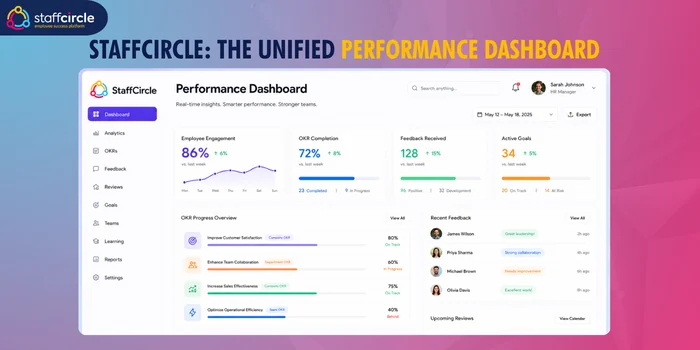
By unifying OKRs, feedback, and reviews into a single mobile-first platform, StaffCircle eliminates software paralysis, drives up to 74% higher engagement, and slashes HR manual work by 90%. It is the ultimate consolidated platform built to connect your entire workforce, from the office to the field. Book a demo today.
FAQs
What are OKRs? Do I need a separate OKR tool?
OKRs (Objectives and Key Results) are a goal-setting framework used to align individual work with high-level corporate strategies. You do not need a separate OKR tool. Using an isolated app for OKRs disconnected from your performance reviews often leads to poor employee adoption. A consolidated platform like StaffCircle links your OKRs directly with regular 1-on-1 check-ins and performance reviews, ensuring goals are updated naturally as work happens.
How does StaffCircle ensure deskless workers use the platform?
StaffCircle uses a lightweight Progressive Web App (PWA) that doesn’t require heavy downloads. Frontline and field employees can access the platform securely on their personal mobile devices using simple SMS tokens or employee IDs. This removes the need for corporate email addresses or complex login processes, making it easy for shift-based or field staff to stay connected.
Can we transition our existing Excel performance reviews into StaffCircle?
Yes. StaffCircle comes with 12 pre-configured, industry-standard templates, but it is also highly customisable. Your dedicated Customer Success Manager will help you digitise your existing Excel review forms, ensuring your custom evaluation questions and scoring scales transfer smoothly into the automated platform.
Does StaffCircle integrate with our existing HRIS/payroll systems?
Yes. StaffCircle features built-in connectors that integrate with major HR and payroll systems like Microsoft Dynamics 365, Sage, and IRIS Cascade. This keeps your employee directory updated automatically across all platforms, eliminating the need for manual data entry.
How long does it take to implement the platform?
A typical implementation for mid-market businesses takes between four and eight weeks. Our team guides you through every step, from clean data migration to training your line managers. By using a gradual, modular rollout, we ensure your team builds consistent usage habits without feeling overwhelmed.
What is the difference between OKRs and performance reviews?
OKRs (Objectives and Key Results) define what employees and teams should achieve over a specific period, while performance reviews evaluate how employees performed against those goals and other competencies. OKRs encourage continuous progress throughout the year, whereas performance reviews provide structured feedback and identify development opportunities. An all-in-one platform connects both so managers can assess performance using real-time goal progress instead of relying on memory alone.
Why should businesses replace separate OKR, feedback, and review tools?
Using separate systems often creates duplicate work, inconsistent employee data, and lower adoption because employees need to switch between multiple applications. A unified platform centralises goals, continuous feedback, and performance reviews in one place, making it easier for managers and employees to keep information up to date while reducing administrative work for HR teams.
Can small and medium-sized businesses benefit from all-in-one performance management software?
Yes. Small and medium-sized businesses often have limited HR resources, making efficiency especially important. A single platform can automate review cycles, simplify goal tracking, reduce manual administration, and provide managers with a complete view of employee performance without investing in multiple software solutions.
How much does performance management software typically cost?
Pricing varies depending on the provider, company size, features, and implementation requirements. Some vendors charge per employee each month, while others offer custom enterprise pricing. Beyond subscription costs, businesses should also consider implementation, training, integrations, and long-term support when comparing platforms.
Can performance management software improve employee engagement?
Yes. Employees are generally more engaged when they receive regular feedback, understand how their work contributes to company objectives, and have clear development opportunities. Modern performance management platforms support continuous conversations rather than relying solely on annual reviews, helping employees stay motivated throughout the year.
What industries benefit most from unified performance management platforms?
Almost every industry can benefit, but organisations with distributed or frontline workforces often see the greatest improvements. Manufacturing, healthcare, logistics, retail, hospitality, construction, and field services all benefit from having goals, feedback, and reviews available through mobile-friendly platforms that employees can access from anywhere.
How do integrated performance management platforms reduce manager bias?
Integrated platforms capture goal progress, feedback, recognition, and coaching conversations throughout the year. Managers can review this historical information during appraisals instead of relying only on recent events, helping reduce recency bias and making performance evaluations more balanced and evidence-based.
Can performance management software replace spreadsheets?
Yes. Modern performance management platforms eliminate many of the limitations of spreadsheets by automatically tracking goals, storing feedback, scheduling review cycles, and generating reports. Unlike spreadsheets, they also provide secure access controls, audit trails, and real-time updates across the organisation.
What features should businesses prioritise when choosing performance management software?
Look for software that combines goal management, continuous feedback, performance reviews, analytics, mobile accessibility, HRIS integrations, workflow automation, reporting, and role-based permissions. Businesses should also evaluate ease of use, scalability, implementation support, and integration with collaboration tools such as Microsoft Teams.
How long does it take employees to adopt a new performance management platform?
Employee adoption depends on the complexity of the platform, implementation approach, and training provided. Most organisations achieve higher adoption when the system is easy to use, integrates with existing workflows, and is introduced gradually with ongoing support rather than through a single company-wide rollout.
Related articles
See OKRs, feedback & reviews in one platform
StaffCircle unifies goals, continuous feedback and automated reviews in a single mobile-first platform — built for office and frontline teams alike.