AI Governance for HR Leaders: Why ISO 42001 Matters

AI in HR touches some of the most sensitive data your organisation holds: performance ratings, salary information, health records, disciplinary history. Using AI on that data without proper safeguards isn’t a technical detail — it’s a compliance risk. As AI use accelerates, governance can’t be an afterthought.
The good news is that getting the structure in place now, while you have breathing room, costs less and causes less disruption than doing it under pressure after something has gone wrong.
Why governance can’t wait
HR teams using AI for decisions about people will increasingly need to document how those systems work, what data they use, and how human oversight is maintained. Regulators and boards are asking the questions now. Building that framework early is far cheaper than retrofitting it during an audit or after an incident.
What ISO 42001 is — and why it matters
ISO/IEC 42001 is the first international standard for AI management systems. It lays out a structured way to manage AI-related risks across ethics, transparency, accountability and data governance. For HR leaders comparing AI platforms, certification is a clear signal that a vendor has built governance into the product rather than adding it as an afterthought. Organisations already certified to ISO 27001 (information security) can reach ISO 42001 significantly faster, because the two standards share the same underlying structure.
StaffCircle is ISO/IEC 27001:2022 certified and ISO/IEC 42001:2023 certified, with geo-protected hosting in UK and US data centres.
Standalone tools vs governed platforms
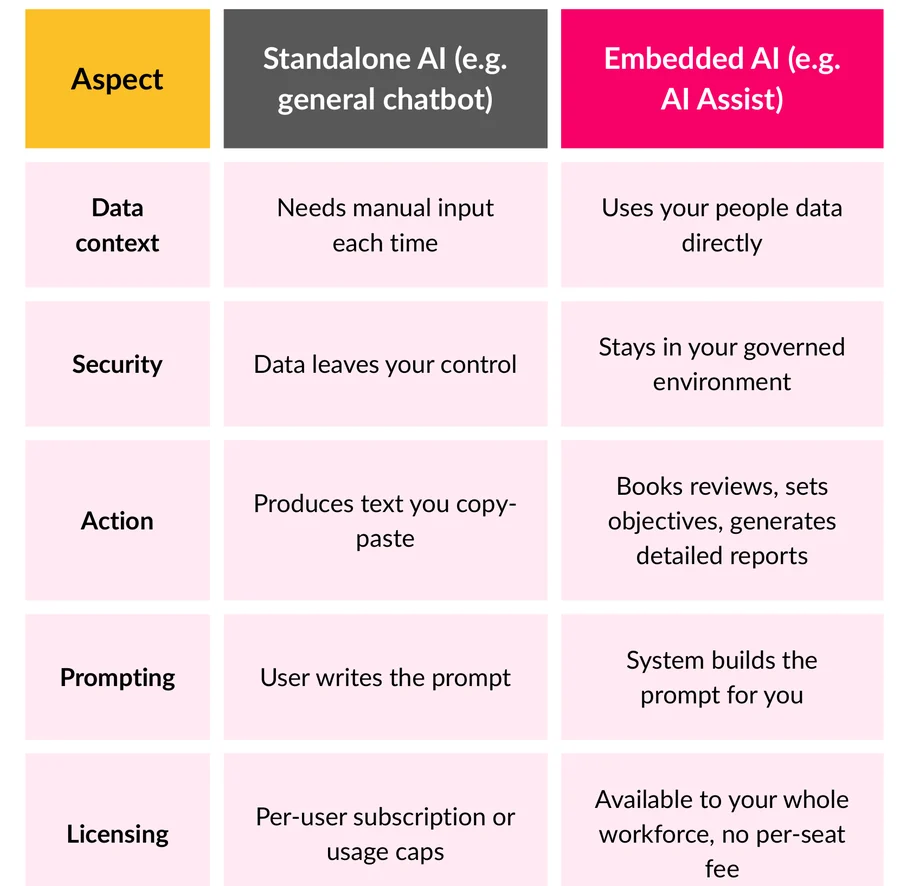
A lot of the risk enters through the side door. When someone pastes employee performance data into a public AI tool, that data leaves your controlled environment — a real exposure under GDPR, the EU AI Act and UK data protection law. AI embedded in your HR platform keeps that data inside your governed environment, where it’s covered by the same controls as the rest of your people data.
The controls to look for
When you evaluate an AI platform for HR, a short checklist covers most of the risk:
- Recognised certifications — ISO/IEC 27001:2022 certified for information security and ISO/IEC 42001:2023 certified for AI management.
- Regional, geo-protected hosting — you know where your data lives.
- Human-in-the-loop by design — nothing is created, updated or deleted without an explicit yes.
- Clear data-flow documentation — the vendor can explain, plainly, how your data is used and protected.
- Secure interoperability — standards like the Model Context Protocol (MCP) so data moves between tools without exposure.
StaffCircle’s AI Assist is built to this standard: it runs on frontier AI inside a geo-protected, compliant environment, and every action is confirmed before anything happens.
Build governance into selection, not after an incident
One of the most common and costly mistakes in AI adoption is leaving governance until something breaks. Setting up a framework reactively, after a data incident, is expensive and avoidable. Make it part of your selection criteria from the start — and if a vendor can’t clearly explain how your data is protected and where it’s hosted, treat that as a red flag.
See how AI Assist brings frontier AI to HR inside a governed, certified environment.
Related articles
Meet AI Assist
Frontier AI for HR inside a governed environment — ISO/IEC 27001:2022 & ISO/IEC 42001:2023 certified, geo-protected hosting, and a confirmation before every action.