Succession Planning Framework: 7 Steps From Critical Roles to Readiness
TL;DR: A succession planning framework connects business-critical roles with suitable successors and prepares those employees for future responsibilities. Use seven steps to define role requirements, assess successor readiness, assign development plans and review progress. Track coverage and readiness gaps so leaders know where the organisation faces a succession risk.
Succession planning is the proactive process of identifying and developing internal talent to fill key leadership roles before they become vacant. Without it, a sudden vacancy can disrupt projects and put client relationships at risk.
By cultivating a pipeline of prepared successors, businesses ensure long-term stability and a seamless transition during unexpected departures.
SHRM reports that only 22% of HR leaders had a formal succession plan in 2025, even though 42% of talent management executives identified succession strategy as a priority for 2026. A list of potential replacements does not close this gap; HR needs a succession planning framework to identify critical roles, define required competencies, assess potential successors and track readiness.
This guide explains seven succession planning process steps to build that framework, from identifying critical positions to creating employee development plans and reviewing successor progress.
Table of Contents
- What Does a Succession Planning Framework Include?
- How to Build a Succession Planning Framework in 7 Steps
- What Are the Different Succession Planning Readiness Levels?
- Which Succession Planning Model Should Your Organisation Use?
- How Can Success Circles Support Your Succession Planning Process?
- Build a Succession Planning Framework That Prepares Your Workforce
- Frequently Asked Questions
What Does a Succession Planning Framework Include?
A succession planning framework includes four key areas. It helps HR and business leaders plan for employee departures, internal promotions, retirement and unexpected vacancies.
The framework connects four key areas:
- Critical roles: Positions that have a direct impact on business continuity, revenue, operations or compliance.
- Successor identification: Employees whose skills, experience and career interests match future role requirements.
- Readiness assessment: An evaluation of how prepared each potential successor is to take on a specific role.
- Development planning: Activities that help employees close skill gaps and gain the experience required for the target position.
These areas form a continuous process. HR identifies the roles that need succession coverage, defines what success looks like in each position, assesses potential successors and prepares them through targeted development. It works alongside workforce planning, which sets out the roles and skills the organisation will need in future.
What does the seven-step succession planning framework look like?
Use this sequence to build and maintain your plan:
Identify critical roles → Define role requirements → Identify potential successors → Assess readiness → Assign readiness ratings → Create development plans → Review progress
Each stage produces information for the next. For example, HR cannot assess whether an employee is ready for a role without first defining the skills and experience that role requires.
How to Build a Succession Planning Framework in 7 Steps
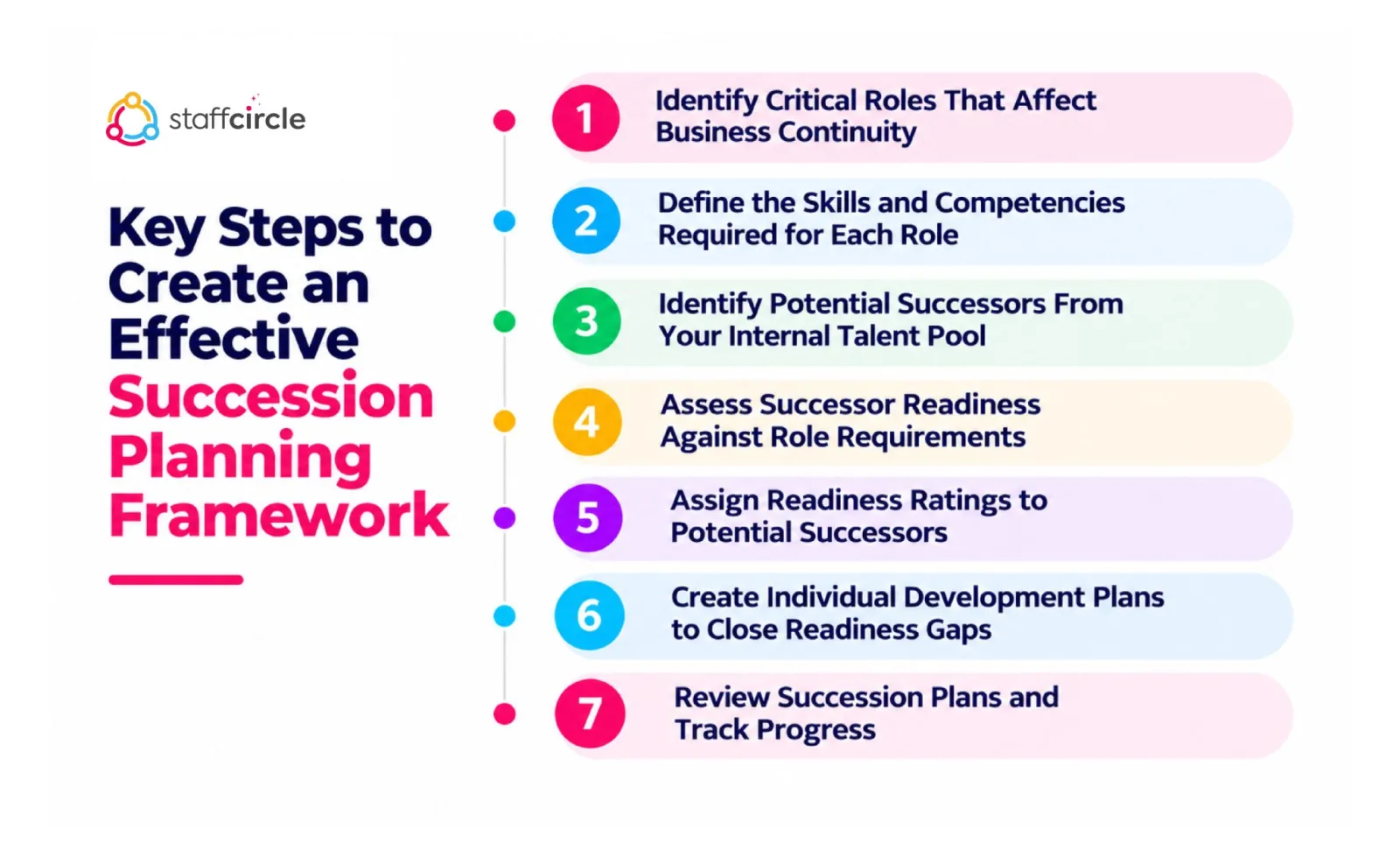
Step 1. Identify Critical Roles That Affect Business Continuity
Start by identifying positions that would create significant business disruption if the employee left. Do not limit this exercise to senior leadership. A technical specialist, plant supervisor, operations manager or compliance expert can hold knowledge that the organisation cannot replace at short notice.
Assess each position against four factors:
- Business impact: Would a vacancy affect revenue, customer delivery or daily operations?
- Replacement difficulty: How long would it take to find and train a suitable replacement?
- Knowledge concentration: Does one employee hold specialist knowledge that others cannot access?
- Operational risk: Could the vacancy create safety, compliance or service delivery issues?
For example, a manufacturing company may depend on one maintenance engineer who understands a specialised production system. Although the role may not sit within senior management, the employee's departure could interrupt production.
Rank roles by the risk their vacancy creates. This gives HR a clear starting point and helps leaders direct succession planning resources towards the positions that need them most.
Step 2. Define the Skills and Competencies Required for Each Role
Once you identify critical roles, document what an employee needs to perform each role. A job description may explain current responsibilities, but a succession plan also needs to define the skills and experience required for future success.
Create a success profile for each position. Include:
- Technical knowledge and role-specific skills.
- Leadership, communication and decision-making abilities.
- Relevant qualifications and work experience.
- Expected proficiency in each competency.
- Experience required to handle future business priorities.
A competency framework helps HR define the skills, knowledge and behaviours employees need to perform a role at each proficiency level.
Example: Operations Manager success profile
| Requirement | Expected capability |
|---|---|
| Technical knowledge | Understand production processes and quality standards |
| People management | Allocate work, manage performance and resolve team issues |
| Decision-making | Respond to operational problems and manage competing priorities |
| Compliance | Apply workplace safety and regulatory requirements |
| Experience | Lead projects and manage cross-functional teams |
These competencies also provide the foundation for employee assessment. StaffCircle lets organisations configure company competencies and connect them with review questions, objectives, feedback and awards. Success Circles uses these signals to build a view of how employees demonstrate the competencies expected by the organisation.
Step 3. Identify Potential Successors From Your Internal Talent Pool
Review your workforce to find employees who could meet the requirements of each critical role. Use performance records, competency assessments, work experience and feedback from managers to build an initial list.
Look for employees who demonstrate:
- Skills that match the target role.
- Experience with similar responsibilities.
- The ability to handle greater responsibility.
- Interest in career progression or the target role.
- A willingness to take on new assignments.
Consider more than one potential successor for each critical role where the available talent allows it. Relying on a single candidate creates another point of risk if that employee resigns, changes career plans or does not progress as expected.
Apply the same selection criteria across teams. Ask managers to support nominations with evidence, such as project outcomes, demonstrated competencies and examples of decision-making. This reduces the influence of personal preferences and visibility bias.
Step 4. Assess Successor Readiness Against Role Requirements
An employee's current performance does not prove that they can succeed in a different role. A strong individual contributor may need people management experience before taking over a team. A department manager may need financial or strategic experience before moving into an executive position.
Compare each candidate's current capabilities with the success profile created in Step 2. Use evidence from:
- Performance reviews and goal outcomes.
- Competency assessments.
- Manager feedback and 360-degree feedback.
- Previous projects and stretch assignments.
- Relevant qualifications and work experience.
Record the gaps between the employee's current capabilities and the target role's requirements. For example, a potential operations manager may understand production processes but lack experience in budget planning and cross-functional decision-making.
HR teams need evidence from more than one performance review to assess an employee's development. Success Circles brings together information from reviews, 360-degree feedback, objectives, recognition and development activity. This gives managers a broader view of employee capabilities when discussing potential successors.
To make readiness decisions more consistent, HR needs clear criteria for each category. Explore our guide to succession readiness ratings to understand what Ready Now should mean.
Step 5. Assign Readiness Ratings to Potential Successors
Readiness ratings show how much preparation an employee needs before they can take on a critical role. HR should assign each rating based on demonstrated skills, relevant experience and progress against the role's success profile.
Use consistent criteria across departments. Document the evidence behind each rating and review it with the employee's manager and relevant business leaders.
Avoid treating a high performance score or a manager nomination as proof of readiness. A candidate needs to demonstrate the capabilities required for the target position.
Many organisations use the traditional 9-box grid to assess employee performance and potential. However, HR teams should understand its limitations before using it to make succession decisions.
Step 6. Create Individual Development Plans to Close Readiness Gaps
A readiness rating has limited value if it does not lead to action. Use the gaps identified during the assessment to create an individual development plan (IDP) for each potential successor.
Match each activity to a capability the employee needs to build. For example:
| Readiness gap | Development activity | Evidence of progress |
|---|---|---|
| Limited budget experience | Manage a department budget | Present and explain budget decisions |
| Limited team leadership | Lead a cross-functional project | Feedback from project members and stakeholders |
| Lack of technical knowledge | Shadow the current role holder | Complete role-specific tasks |
| Limited strategic exposure | Participate in business planning | Contribute to a documented business plan |
Development activities can include mentoring, coaching, job shadowing, stretch assignments and cross-functional projects.
Set a clear owner, milestone and review date for each activity. Connect these plans with performance reviews and employee development discussions so managers can track progress and address gaps.
The next step is to connect identified competency gaps with development activities. StaffCircle supports personalised development plans linked to competencies and objectives, helping managers record skill and development goals and follow employee progress.
Step 7. Review Succession Plans and Track Progress
A succession plan needs regular review because employees change roles, develop new skills, leave the organisation and revise their career goals. Business priorities and role requirements can also change.
Schedule talent review meetings with HR and business leaders to discuss:
- Changes in critical role requirements.
- Successor performance and readiness ratings.
- Progress against individual development plans.
- Roles with no identified successor.
- Retention risks among potential successors.
- New employees who may fit the succession pool.
Update the plan after major changes, such as a reorganisation, acquisition, leadership departure or change in business strategy. Maintain an emergency succession plan for unexpected vacancies where the organisation needs an immediate response.
Regular talent reviews help HR and business leaders discuss successor readiness, calibrate assessments and agree on development actions.
Learn how to run a talent review meeting that leads to clear decisions.
What Are the Different Succession Planning Readiness Levels?
Succession readiness levels help HR communicate how prepared each potential successor is to take on a specific role. They also help leaders decide where to invest in development and where external recruitment may be necessary.
| Readiness level | Meaning | HR's next action |
|---|---|---|
| Ready Now | Has demonstrated the capabilities required to take on the role. | Prepare the transition and arrange knowledge transfer. |
| Ready in 1–2 Years | Has the required foundation but needs further experience or competency development. | Assign targeted development activities and review progress. |
| Ready in 3–5 Years | Shows potential but needs broader experience and sustained development. | Create a long-term development plan with clear milestones. |
| No Identified Successor | No internal candidate currently meets the role's requirements. | Develop internal talent or plan external recruitment. |
These timelines are a suggested model, not a universal standard. An organisation should set readiness periods based on the complexity of each role, the time needed to build the required skills and the level of risk attached to a vacancy.
HR should also record the evidence behind each rating. This prevents readiness labels from becoming subjective opinions that vary between managers.
Which Succession Planning Model Should Your Organisation Use?
An effective succession planning model defines how an organisation identifies and prepares employees for future roles. The right approach depends on the number of critical positions, the skills required and the organisation's talent structure.
| Model | How it works | Best suited for |
|---|---|---|
| Position-based model | Identifies potential successors for specific critical positions. | Organisations with specialised roles or positions that carry high operational risk. |
| Talent pool model | Develops a group of employees with skills suited to several related roles. | Organisations with multiple positions that require similar competencies. |
| Leadership pipeline model | Prepares employees to move through successive leadership levels. | Organisations developing future managers and senior leaders. |
You can combine these approaches. For example, a manufacturing company may use position-based succession for specialist engineering roles and a talent pool model for operations and department management positions.
The model should support the organisation's actual workforce needs. A succession planning template can help HR record the critical role, current role holder, potential successors, readiness rating, skill gaps, development actions, action owner and next review date.
How Can Success Circles Support Your Succession Planning Process?
A succession planning framework depends on accurate information about employee performance, competencies and development. When this information sits across separate records and spreadsheets, HR teams may struggle to assess employee capabilities and track readiness for future roles.
StaffCircle's Success Circles brings these insights together through a succession planning dashboard. It uses data from performance reviews, 360-degree feedback, objectives, check-ins, recognition and development activities to help HR identify future leaders, review succession opportunities and understand employee development needs.
Here's how it supports key parts of the process:
- Build an evidence-based view of employee capabilities
- Identify future leaders and succession opportunities
- Connect capability gaps with employee development
- Move beyond manual 9-box assessments
Build a Succession Planning Framework That Prepares Your Workforce
A succession plan loses value when it names potential replacements but leaves their readiness untested. Without clear role requirements and development actions, critical positions remain exposed when employees leave.
StaffCircle supports the performance reviews, competency management and employee development processes that help HR assess employee capabilities and track development progress. These processes can provide useful evidence for succession discussions.
Want to connect employee performance with future role readiness? Book a demo to see how its people management capabilities can support your talent development process.
Frequently Asked Questions
1. How many successors should an organisation identify for each critical role?
Aim to identify two or more potential successors for high-risk roles when the internal talent pool allows it. A single successor leaves the organisation exposed if that employee leaves or becomes unavailable. The number should reflect the role's risk, replacement difficulty and available talent.
2. What is the difference between succession planning and replacement planning?
Replacement planning identifies someone who can fill a vacancy when an employee leaves. Succession planning prepares employees for future responsibilities through skills assessment, development activities and readiness reviews. Replacement planning addresses immediate cover, while succession planning builds a longer-term talent pipeline.
3. Should employees know they are part of a succession plan?
Organisations should communicate development opportunities and career expectations without promising employees a specific promotion. Clear communication helps employees understand the skills they need to build and gives them a chance to discuss their career interests. HR should also apply fair assessment criteria across the workforce.
4. What KPIs should HR use to measure succession planning success?
Track a focused set of measures that show role coverage, employee readiness and development progress:
- Critical-role coverage: Percentage of critical roles with at least one identified successor.
- Ready-now coverage: Percentage of critical roles with at least one ready-now successor.
- Bench depth: Number of suitable successors available for each critical role.
- Internal fill rate: Percentage of critical vacancies filled by internal candidates.
- Successor retention: Percentage of identified successors who remain with the organisation.
- Development progress: Completion of planned activities and improvement in assessed competencies.
Review these measures together. A high number of nominated successors does not prove that employees are ready to take on the roles.
5. Can small businesses use a succession planning framework?
Yes. Small businesses can start with a short list of roles that carry the greatest operational risk. Document the responsibilities, essential knowledge, backup employees and training required for each role. A simple spreadsheet can support the first version of the plan, with formal reviews as the business grows.
6. How often should an organisation update its succession plan?
Review succession plans at least once a year and schedule quarterly discussions for high-risk roles. Update the plan after major changes, including employee departures, promotions, restructuring or shifts in business priorities. Readiness ratings should reflect current evidence rather than an employee's assessment from the previous year.
Related articles


See StaffCircle in action
Book a personalised demo and see how StaffCircle drives performance, engagement and development.