What is a competency framework?
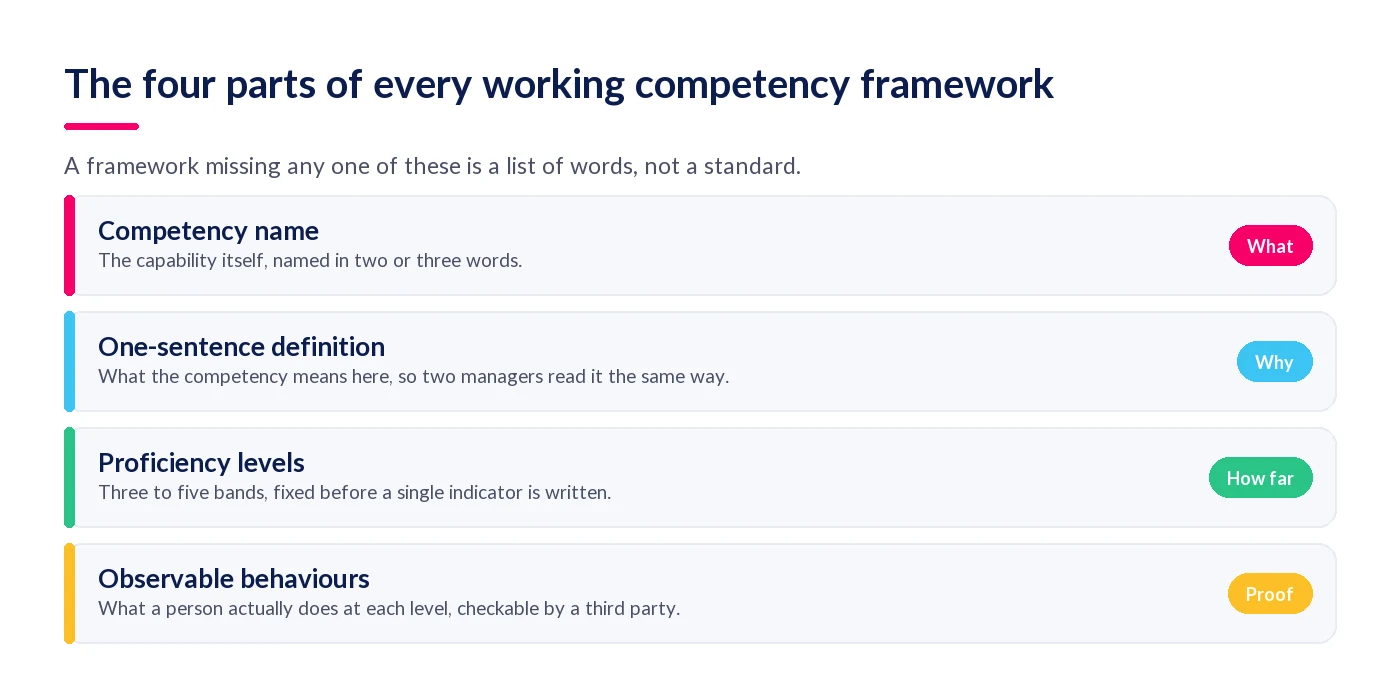
A competency framework is a structured description of the skills, knowledge and observable behaviours a role requires, written out across defined proficiency levels, so everyone can see what good looks like at their grade and at the one above it. It sets the standard; it does not list the tasks.
Key facts
- Every working framework has four parts: a name, a definition, levels and observable behaviours.
- Most individual roles need eight to twelve competencies, split into core and functional.
- Three to five proficiency levels is the working range across published frameworks.
- The UK Civil Service Success Profiles framework defines nine behaviours, rewritten for each grade.
- A framework that feeds no decision is a document, not a standard.
What are competencies?
Competencies are the specific, describable capabilities a person needs to do a job well: what they know, what they can do and how they behave while doing it. A competency is not a personality trait and not a task. It is written so that two different managers, watching the same person work, would reach the same conclusion about whether the standard is being met.
That last test is what separates a competency from a nice-sounding phrase. "Strong communicator" is an opinion. "Handles an unwelcome message with someone who disagrees, without escalating the disagreement" is a competency, because you can watch for it and evidence it.
Competencies split into two groups, and the split matters more than most frameworks admit:
- Core competencies apply to everyone in the organisation, from the newest starter to the executive team. Accountability, communication and collaboration usually sit here.
- Functional competencies belong to one role family only. Consultative selling, database administration and clinical assessment are functional; there is no point holding a finance analyst to them.
What is a competency framework used for?
A competency framework is used to make people decisions consistent and defensible. The same written standard drives hiring criteria, appraisal ratings, development plans, promotion and succession decisions, so a person is judged against the role rather than against whoever happened to interview or manage them. Without one, each manager applies a private, unwritten bar.
In practice, five decisions rely on it:
- Hiring. The framework supplies the interview criteria and the scoring scale, which is what makes a competency-based interview comparable across candidates.
- Appraisal. Ratings anchor to written behaviours instead of recall of the last six weeks.
- Development. The gap between a person's current level and the level their role requires is the development plan, already written.
- Progression and pay. Grade boundaries become explainable, which matters a great deal if your framework underpins pay bands.
- Succession. Bench strength becomes measurable, because "ready for the next role" has a definition. Our guide to succession planning covers how that connection is built.
If succession is the reason the framework landed on your desk, the Succession Planning Guide with free customisable templates gives you the accompanying templates without you having to draft them from scratch.
What does a competency framework look like?
A competency framework looks like a table: one row per competency, a one-sentence definition, and a column for each proficiency level containing the behaviour you would actually observe at that level. Below is a complete starter framework of six core competencies at four levels, written so you can copy the structure and change the wording to fit your roles.
| Competency | Definition | Level 1 — Developing | Level 2 — Capable | Level 3 — Proficient | Level 4 — Leading |
|---|---|---|---|---|---|
| Accountability | Owns commitments and the outcome, including when the outcome is poor. | Completes agreed tasks on time, and flags a slip before the deadline passes. | Manages own workload without prompting and re-plans when priorities change. | Takes ownership of a team outcome, including work delivered by other people. | Holds peers to their commitments and accepts accountability for cross-team results. |
| Communication | Gets the right message to the right person in a form they can act on. | Explains own work clearly, and asks when something is unclear. | Adapts message and channel to the audience, in writing and in person. | Delivers an unwelcome message to someone who disagrees, without escalating it. | Sets the narrative for a function and represents it credibly outside the organisation. |
| Decision making | Reaches a sound decision at the right speed, with the information available. | Follows the defined process and escalates anything that falls outside it. | Resolves routine problems independently and spots what genuinely needs escalating. | Diagnoses the cause behind a recurring problem and proposes a fix, not a workaround. | Decides with incomplete information and is accountable for the trade-off made. |
| Collaboration | Works productively with people who do not report to them. | Contributes to team tasks and shares information without being asked. | Works effectively with colleagues outside the immediate team. | Builds agreement between groups with competing priorities and no shared manager. | Creates the conditions for collaboration across functions and removes the blockers. |
| Developing self and others | Grows own capability, and deliberately grows other people's. | Acts on feedback and completes agreed learning. | Seeks feedback actively and coaches a new starter through an unfamiliar task. | Develops others deliberately, with a plan and a regular check-in. | Builds capability across a function and grows successors for critical roles. |
| Changing and improving | Makes the way the work gets done better, not just busier. | Suggests improvements to own tasks and adopts new tools willingly. | Redesigns a step in a process and checks whether it actually improved. | Leads a change affecting other teams and works through the resistance to it. | Sets the improvement agenda and sponsors change that reshapes how the function operates. |
Three things about that table are deliberate. Each level names a different observable action rather than a more enthusiastic version of the same one. Every level stays on the same subject and widens the radius of responsibility. And the definitions are one sentence, because a definition that needs a paragraph will not be read.
The pattern is drawn from real published frameworks. The UK Civil Service Success Profiles behaviours, published under the Open Government Licence, define nine behaviours and rewrite each one separately for every grade band from Administrative Officer to Director General. SFIA, the Skills Framework for the Information Age, does the opposite and arguably better: it writes seven generic levels of responsibility once, then applies that same ladder to every technical skill. For more level-by-level wording drawn from both, see our competency framework examples.
How many competencies should a framework have?
Eight to twelve competencies per role is the practical ceiling: enough to describe the job honestly, few enough that a manager can hold them in mind during an appraisal conversation. Split that as roughly five or six core competencies applying to everyone, plus three to six functional ones for the role family.
Frameworks fail at both extremes. Four competencies are too coarse to distinguish two people doing the same job differently. Twenty-two means nobody reads past the fifth, ratings get filled in mechanically, and the framework quietly becomes a compliance exercise. If you cannot cut to twelve, you are probably describing three different roles as one.
How do you build a competency framework?
You build a competency framework by scoping one role family, separating core from functional competencies, fixing the number of levels before drafting, writing each level as an observable action, and then attaching the finished framework to a live decision within the first month. Five steps, in that order.
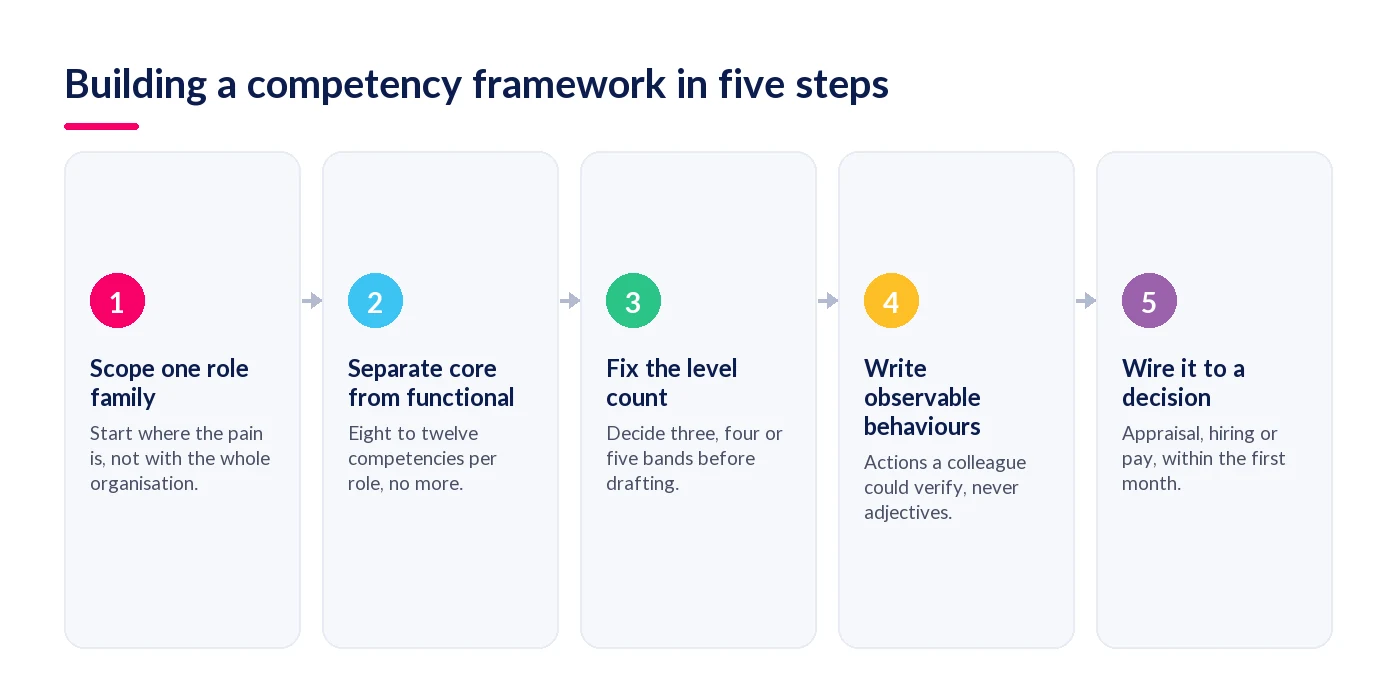
- Scope one role family, not the organisation. Pick the family causing the most pain now: highest turnover, most inconsistent appraisal ratings, or a live compliance requirement. Whole-organisation first drafts are the single most common reason a framework never ships.
- Separate core competencies from functional ones. List the five or six behaviours you expect of everyone, then the three to six capabilities specific to this family. Keep the total at eight to twelve.
- Fix the number of proficiency levels before writing a single indicator. Choose three, four or five and commit. Adding a level halfway through drafting means rewriting every competency you have already finished.
- Write each level as an observable action. "Diagnoses the cause" is checkable; "has strong analytical skills" is not. If two reasonable managers could disagree about whether a colleague meets a level, the wording is not finished.
- Attach it to a live decision inside a month. Use it in the next appraisal round or the next job advert in that family. A framework tested against something real in week four survives; one filed for later does not.
The drafting is the slow part, and it is the part that most often stalls. StaffCircle's AI competency framework builder compresses it to around 40 minutes by generating a first-draft framework from your real roles, with proficiency levels and career pathways already structured, which you then edit and validate rather than write from a blank page. The validation conversations with role-holders still matter, and no tool removes them, but they are far easier to have against a draft than against an empty template. Our step-by-step guide to building a competency framework covers the groundwork in more depth, and the competency framework article index collects the rest of the series.
Once the framework exists, two things make it useful rather than ornamental: a way to hold each person's current level against the role standard, which is what a skills matrix does at team level, and a shared answer to what makes an employee competent, so ratings mean the same thing in every department.
Frequently asked questions
How long does it take to build a competency framework?
Drafting one role family takes most teams two to four weeks of part-time effort: a week to list competencies, a week to draft levels, and a week or two of validation with role-holders. Software that generates a structured first draft removes most of the drafting, not the validation.
What is the difference between core and functional competencies?
Core competencies apply to everybody in the organisation, whatever their job, and usually cover accountability, communication and collaboration. Functional competencies belong to one role family and describe technical or specialist capability, such as consultative selling or clinical assessment. Most roles need both, weighted towards core at junior levels.
How many proficiency levels should a competency framework have?
Three to five. Four works for most organisations, because it gives a clear entry level, two working levels and a leading level without creating boundaries you cannot defend. Every additional level is another judgement call a manager has to justify in an appraisal conversation, so add one only if it describes a real distinction.
Who should own the competency framework?
HR owns the structure, consistency and review cycle. The line owns the content, because managers and role-holders are the only people who know what good actually looks like in that job. Frameworks written entirely inside HR read as generic; frameworks written entirely by the line stop being comparable across departments.
Does a small organisation need a competency framework?
Below about thirty people, informal judgement usually works. Past that, managers start applying different bars to the same job, appraisal ratings drift apart, and promotion decisions become hard to explain. A short framework covering one or two role families is normally the right first step, not an organisation-wide one.
Consistent people decisions start with a written standard, and you can see how one is built and used in StaffCircle's competency framework tools.
Related articles

See StaffCircle in action
Book a personalised demo and see how StaffCircle drives performance, engagement and development.