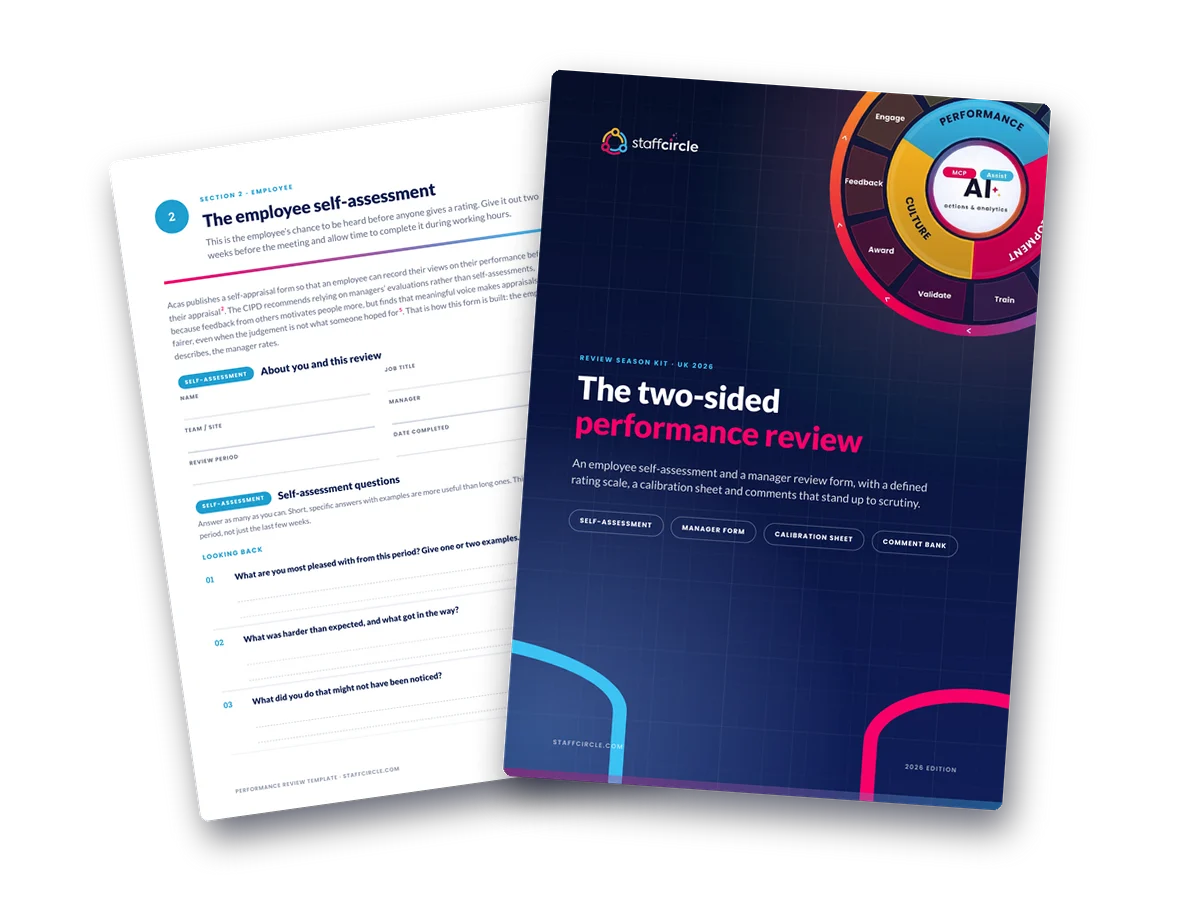
Performance Review Template: with an employee self-assessment form
Many review templates give you a list of competencies and a 1 to 5 scale with a label but no description. This one gives the employee a real say before the meeting, tells managers what each rating means, and helps HR check the scores are fair across teams.
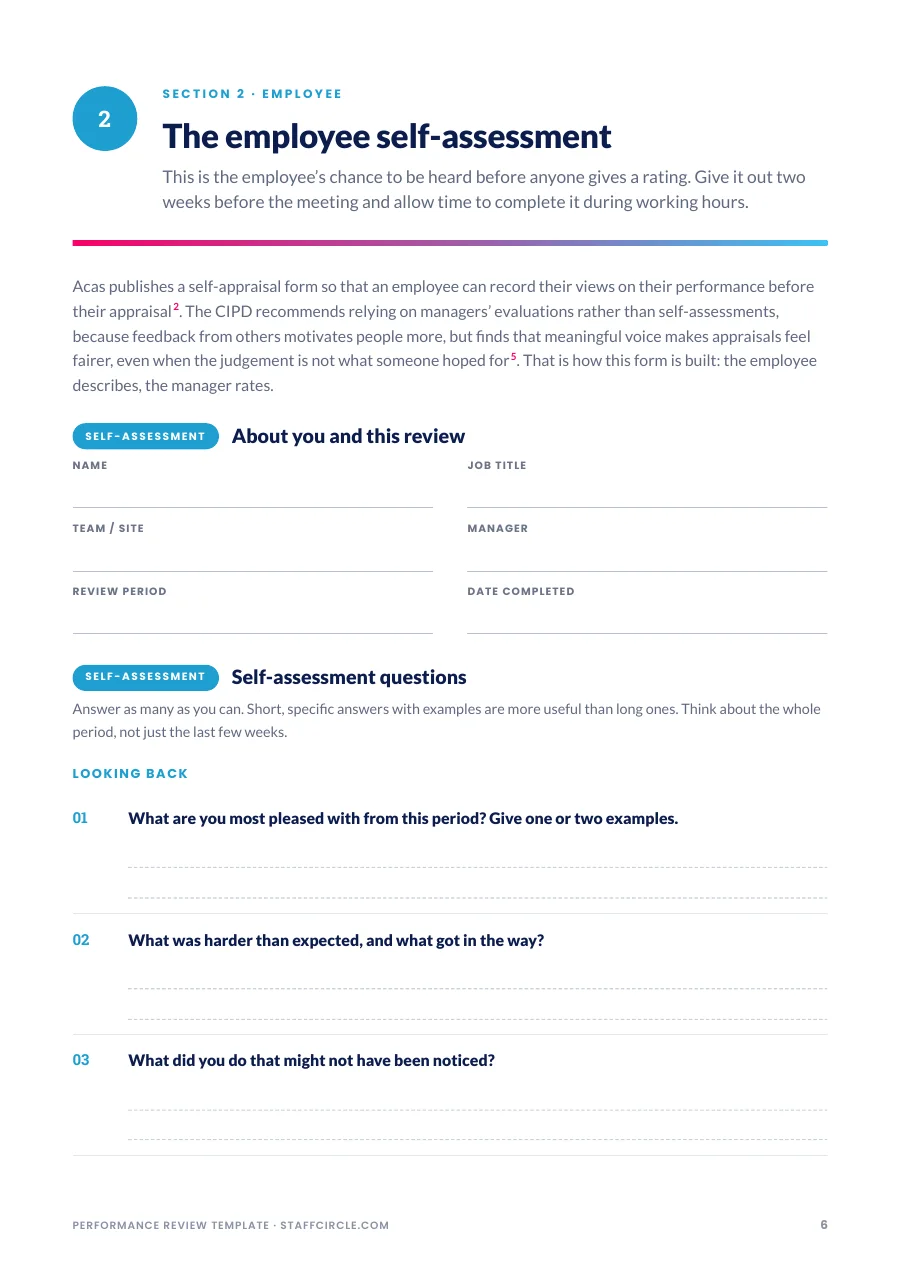
- An employee self-assessment form, plus a short version for shift and site workers
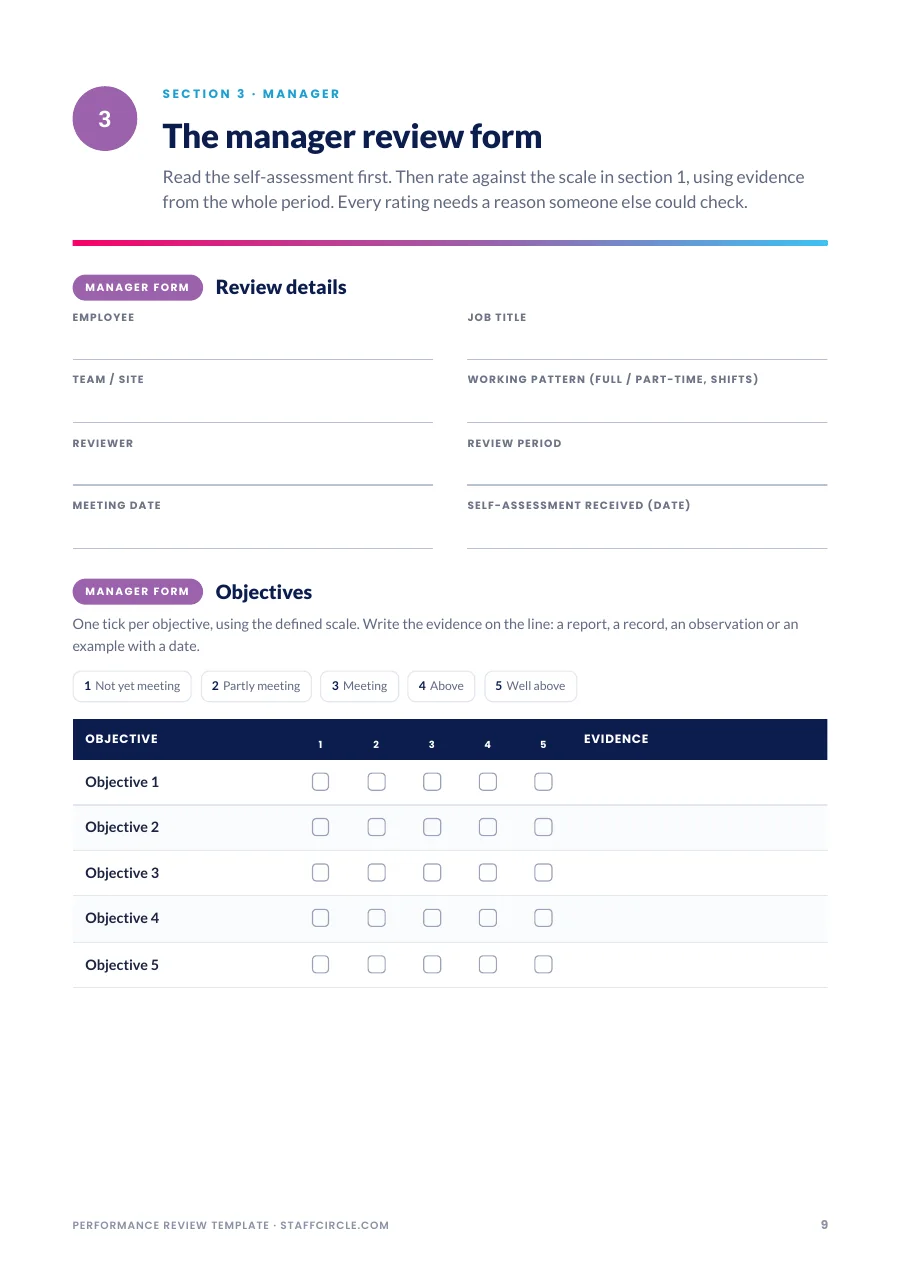
- A manager review form covering objectives, values, development and wellbeing
- A 5-point rating scale with a plain description of every level
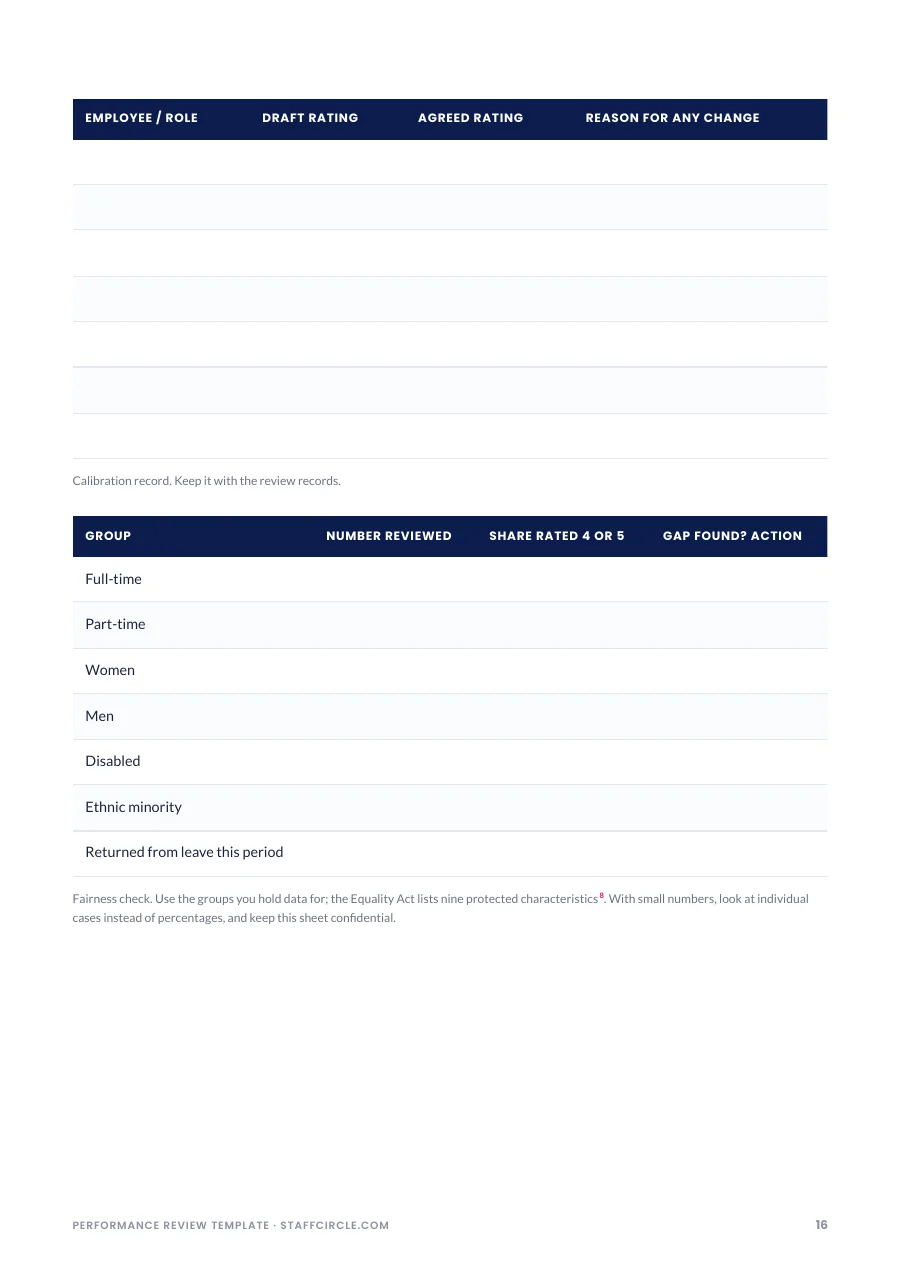
- A calibration sheet and a fairness check for HR
- A comment bank that swaps vague or loaded phrases for evidence
Get your free template
Fill in your details to get the PDF and the editable Word version. We’ll email you the PDF too.
We’ll only use your details to send the template and relevant StaffCircle content. See our privacy policy.
Trusted by teams at leading organisations


Six sections, ready to print or edit
Set up the review cycle
Timeline, a defined rating scale and why pay and development belong in separate conversations.
The self-assessment
Questions the employee answers before the meeting, with a one-page version for people without a desk.
The manager review form
Objectives with evidence, values with behaviours, an overall rating and sign-off.
Development and wellbeing
A development plan and a wellbeing check-in that records only what it needs to.
Calibration and bias checks
A calibration meeting in six steps, a record sheet and a fairness check by group.
Comments that hold up
Vague and loaded phrases rewritten as evidence, with example comments at each rating.
A performance review should be a conversation with two sides
If two managers could give the same work different ratings, the scale is not finished yet.
Search for a performance review template and you will find plenty of forms. Most share the same shape: a header, a list of competencies, a 1 to 5 scale and a box for comments. In the templates we reviewed, few explain what a 3 actually means, how the employee gets a say, or how to check that two managers are scoring the same work the same way.
There is no law that says you must run appraisals. The Equality and Human Rights Commission’s employment code says the Equality Act does not require them, but that it is good practice if resources permit (EHRC). Acas suggests holding reviews at least once a year, keeping a written record and sharing it with the employee afterwards (Acas).
Start with the employee’s view
A self-assessment gives the employee time to think about the year before they walk into the room. Acas publishes a simple self-appraisal form for exactly this purpose (Acas). The CIPD’s research is worth knowing here: it recommends relying on managers’ evaluations rather than self-assessments, because feedback from others motivates people more, but finds that meaningful employee voice makes appraisals feel fairer (CIPD). So this template uses the self-assessment to prepare and to be heard, not as a second score.
Define the scale before anyone uses it
The CIPD suggests avoiding forced distributions and using a scale with more categories, for example five rather than three. A five-point scale only works if every point is described. The template gives each level a plain description and the kind of evidence you would expect to see.
Check the scores are fair
The EHRC code points out that low appraisal scores can affect pay, bonuses, promotion and development. It recommends transparent, objective criteria applied consistently, and monitoring results so that any significant gap in scores apparently linked to a protected characteristic is investigated. That is the basis for the calibration sheet and fairness check in the template.
What the template includes
- Self-assessment. Questions on the year, the evidence and the support they need, with a one-page version for shift and site workers.
- Manager review form. Objectives with an evidence line beside every rating, and values described as behaviours.
- Development and wellbeing. A plan with dates, and a check-in that keeps health details off the form.
- Calibration. A six-step meeting, a record sheet and a fairness check.
- Comment bank. Vague or loaded phrases rewritten as evidence.
Five steps to a fairer review
- Agree the scale and what each level means before the cycle starts
- Give employees the self-assessment two weeks before the meeting
- Rate against evidence from the whole period, not the last month
- Calibrate across teams and look for gaps between groups
- Hold the development conversation separately from any pay decision
Download it as a printable PDF and an editable Word file. For more, read our guides to writing a self-evaluation, performance review calibration and self-appraisal examples, or our guide to performance reviews. StaffCircle brings reviews, self-assessments, objectives and one-to-ones together, so evidence can build up through the year.
Performance reviews: common questions
Is a performance review a legal requirement in the UK?
No. The EHRC employment code says the Equality Act does not require employers to conduct appraisals, although it is good practice if resources permit. If you do run them, the scoring must not discriminate because of a protected characteristic.
How often should performance reviews happen?
Acas says it is a good idea to hold them at least once a year, with regular check-ins, sometimes known as one-to-ones, in between. The CIPD describes performance management as a continuous cycle, not an isolated event.
What should a performance review template include?
At least: the review period, objectives with the evidence for each rating, values or behaviours, development needs and actions, an overall rating, space for the employee’s comments and a sign-off. This template adds a self-assessment, a defined scale, a wellbeing check-in and a calibration sheet.
Should the employee rate themselves?
They can, but treat it as their view, not the score. The CIPD recommends relying on managers’ evaluations rather than self-assessments, because feedback from others motivates people more, while finding that meaningful employee voice makes appraisals feel fairer. This template asks employees how each objective went, in words, and leaves the rating to the manager.
What is calibration?
A meeting where managers compare their proposed ratings against the same scale before they are shared, so the same work gets the same rating across teams. The EHRC code recommends monitoring results and investigating any significant gaps apparently linked to a protected characteristic.
Can an employee bring someone to their appraisal?
There is no statutory right. The right to be accompanied applies when a worker is invited to a disciplinary or grievance hearing. You can still allow a companion, and it may be a reasonable adjustment for a disabled employee.
Can employees ask to see their review notes?
Usually, yes. The ICO gives a request for a copy of appraisal notes as an example of a subject access request. Employers must respond without delay and within one month, which can be extended by up to two months for complex requests. Write every note as if the employee will read it.
How long should we keep performance review records?
There is no set period. The ICO says the UK GDPR does not set specific time limits and that you must not keep personal data for longer than you need it. Set a retention period in your policy and stick to it.
Can I edit the template?
Yes. The download includes a printable PDF and an editable Word version, so you can add your own values, objectives and logo.
Run reviews that feel fair on both sides of the table
A self-assessment, a manager form, a defined scale, a calibration sheet and a comment bank, as PDF and Word.