Internal Mobility: Filling Roles From a Skills Framework Instead of a Job Board
Every internal mobility guide gives you the same fix: post vacancies internally before you post them externally, and give existing staff first refusal. Follow that advice for a year and your internal fill rate barely moves. The job board was never the mechanism that was broken.
What actually decides whether an employee moves is a single, undocumented judgement call: does someone with authority believe this person is ready for the next job? Without a skills record that everyone trusts, that judgement defaults to whoever knows the candidate best — usually their current manager, who also has the least incentive to let them go. A vacancy list does nothing to change who makes that call, or what evidence they're allowed to use to make it.
Internal mobility is the practice of filling open roles with existing employees — through promotion, lateral moves or short-term assignments — rather than external hiring. It only works at scale when a documented skills framework gives employees, managers and HR a shared, evidenced answer to "is this person ready?", because without that record the decision defaults to manager opinion, and the research on manager talent hoarding says that opinion is rarely in the employee's favour.

What Internal Mobility Actually Covers
Most people use "internal mobility" loosely to mean any move that doesn't involve an external hire. In practice it covers several distinct kinds of movement, and a programme that only handles one of them isn't really an internal mobility programme — it's a promotion policy with a new name.
- Vertical moves — a promotion into a role with more scope, seniority or pay.
- Lateral moves — a move sideways into a different function or team, usually to build a broader skill set rather than to advance immediately.
- Stretch assignments and projects — short-term, often part-time moves into a piece of work outside someone's current role, used to test readiness before a permanent move.
- Redeployment — moving someone into a different existing role, often in response to restructuring, site closure or a change in demand.
It's also worth separating internal mobility from two things it gets confused with. Succession planning is a confidential, leadership-focused exercise: a small number of people are identified against a small number of critical roles, usually without the wider workforce knowing. Internal mobility is the opposite in spirit — it's meant to be visible and open to anyone who meets the bar, not a shortlist HR keeps in a locked spreadsheet. And an "internal talent marketplace" is a piece of software, not a policy: a platform that matches people to open roles or projects using stored skills data. You can run internal mobility without one. What you cannot do is run it credibly without the skills data that platform is built to surface.
Why the Job Board Doesn't Fix the Real Problem
Posting a vacancy internally solves a visibility problem. It does nothing about the two problems that actually stop people moving: managers who have a direct incentive to keep their best people, and a lack of trustworthy data on who is actually ready to move.
The Manager Is the Bottleneck, Not the Employee
The pattern researchers call talent hoarding is straightforward: a manager is measured on their team's output, so releasing a strong performer is a direct, personal cost to them, paid immediately, for a benefit — a better-functioning internal labour market — that accrues to the whole organisation and to nobody's individual scorecard. Sign-off sits with exactly the person who loses the most from saying yes.
A 2024 study published in MIT Sloan Management Review by Cornell's JR Keller and Penn State's Kathryn Dlugos analysed close to 100,000 internal applications submitted to roughly 10,000 open jobs by more than 3,000 hiring managers at one large US company. Their finding cuts directly against the logic that makes hoarding feel rational: managers who let strong performers move on didn't lose out. They became more attractive to future applicants and to their own remaining team. As the researchers put it, "managers must be willing to give up talent if they wish to become talent magnets."
There's a second finding from the same research pair worth taking seriously if your programme currently lets people apply and quietly rejects most of them: internal candidates who are turned down are considerably more likely to leave the organisation altogether than people who never applied. Being rejected early in the process, before an interview, makes that worse; losing out to another internal candidate rather than an external hire makes it less damaging. An internal mobility programme that generates applications and then handles rejection badly can cost you the people it was meant to retain.
The Business Case Managers Aren't Shown
Manager hoarding also survives because nobody shows the manager what the alternative costs. Research by Wharton's Matthew Bidwell, comparing external hires with internal promotions into similar roles in investment banking, found that external hires are paid 18–20% more than internally promoted staff, receive significantly lower performance ratings for their first two years, and leave — through being let go or quitting — at higher rates during that period. If they survive past two years, they do go on to be promoted faster than internal movers, but the first two years are expensive and uncertain by comparison. Every internal move a manager blocks eventually becomes an external hire somewhere in the business, at that cost. The manager rarely sees that bill; it lands on someone else's budget months later.
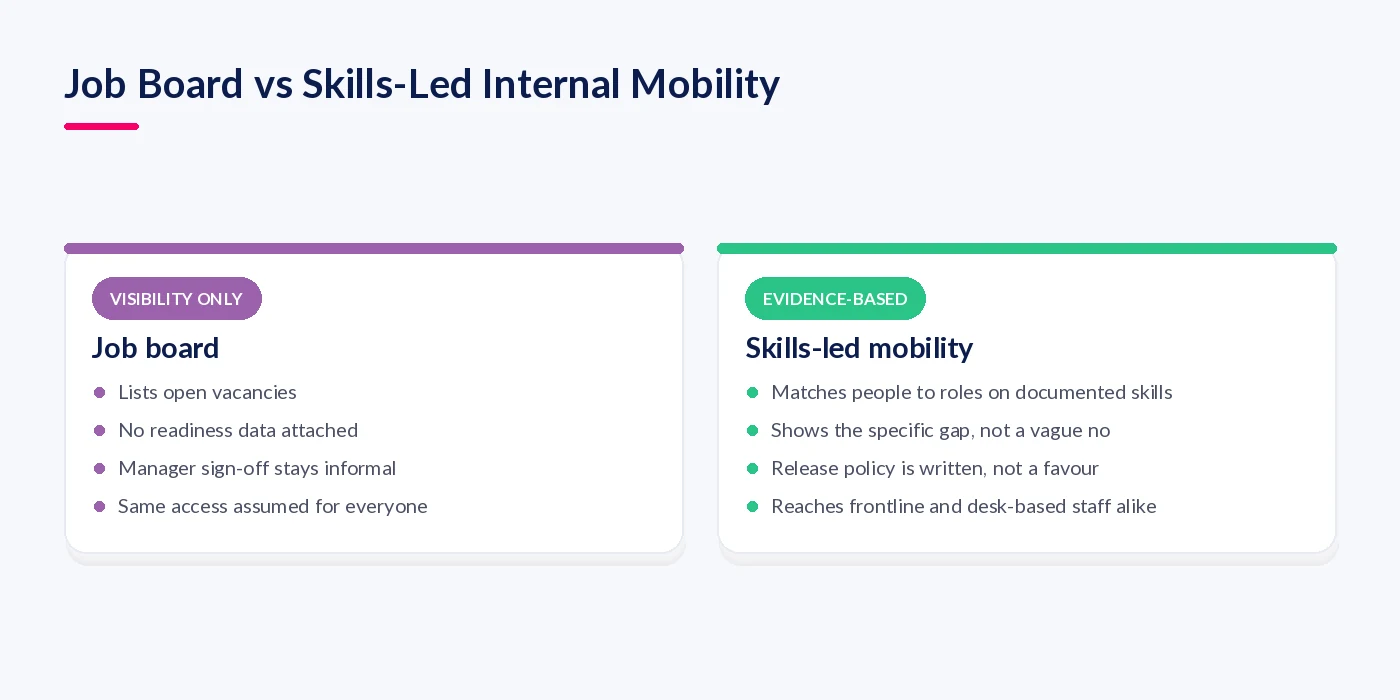
What a skills framework actually changes is the second problem: it replaces "I don't think they're ready" with a specific, checkable claim — which competencies the role requires, at what level, and which of those the employee has already demonstrated and where the gap sits. That doesn't remove the manager's incentive to say no. It removes their ability to say no without being specific about why, to a person, in front of HR, against a record everyone can see. That's a much harder conversation to have on a hunch.
Turning a Skills Framework Into a Mobility Engine
None of this works if the "skills framework" is a wiki page nobody has opened since the workshop that produced it. Making it operational for mobility takes five things, roughly in this order.
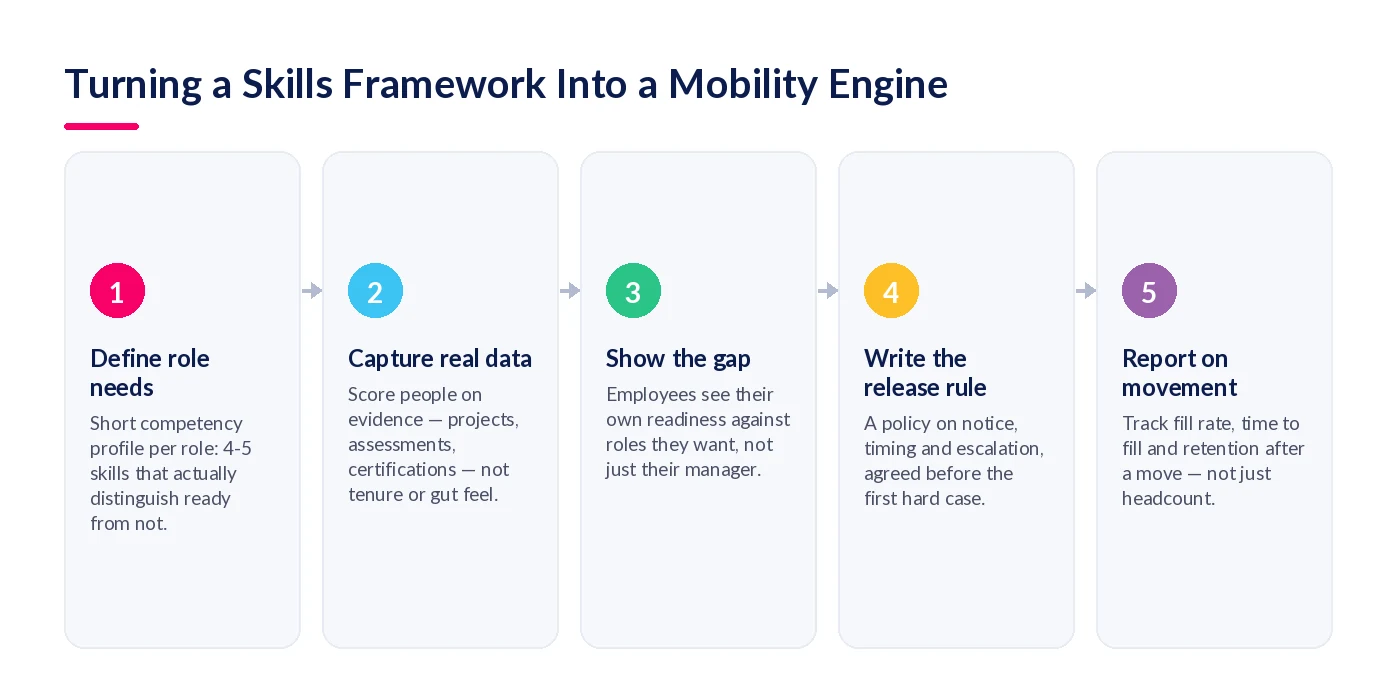
Step 1: Define What Each Role Actually Needs
Start from the roles you fill most often internally, not every role in the business. Each one needs a short competency profile: the four or five skills or behaviours that actually distinguish someone who can do the job from someone who can't, at a stated proficiency level, not a copied job description.
Step 2: Capture Current Skills Data, Not Assumed Data
Score people against those profiles using evidence — a completed project, a manager assessment, a certification — rather than tenure or a manager's general impression. A profile built from assumption is worse than no profile, because it looks authoritative while being wrong.
Step 3: Show the Gap to the Employee, Not Just the Manager
If only the manager can see where someone sits against a target role, you've built a better hoarding tool, not a mobility one. Employees need to see their own gap against roles they're interested in, so they can act on it before a vacancy exists.
Step 4: Write Down the Release Rule
A written internal mobility policy should state, in advance, how long someone needs to be in a role before they can move, what notice a manager can require, and what happens if a manager objects — ideally an escalation to HR with a time limit, not an informal veto. Put the rule in writing before the first difficult case, not during it.
Step 5: Report on Movement, Not Just Headcount
Track internal fill rate, time to fill internally versus externally, and retention twelve months after a move. If you already run talent review meetings for your succession pool, extend the same discipline to mobility: a documented readiness rating beats a manager's recollection every time someone asks why a role went external.
Where This Breaks Down
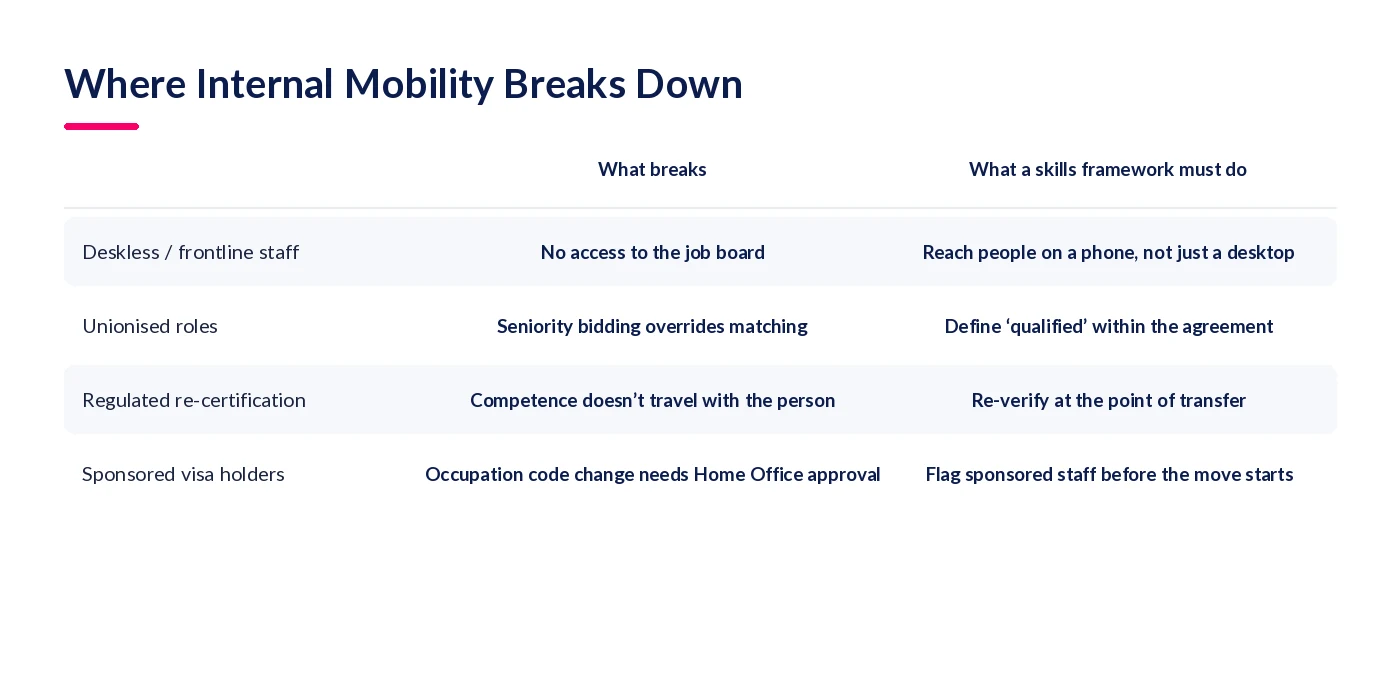
Most internal mobility advice is written for a single-site, non-unionised, desk-based workforce with no regulatory overlay. Plenty of employers aren't that, and the edge cases are exactly where a skills-framework approach earns its keep — or exposes that it was never properly built.
Deskless and Frontline Workers
An internal job board assumes people check email and browse an intranet during their working day. Warehouse operatives, retail staff and field technicians often don't have a desk, a corporate inbox or spare time on shift to look. If your skills data and your mobility postings live somewhere only reachable from a laptop, your frontline workforce is structurally excluded from the programme regardless of what the policy says.

Unionised and Collectively Bargained Roles
Where a collective agreement is in place, vacancy filling is often governed by seniority-based bidding rather than open competition: the role goes to the most senior qualified bidder, not necessarily the best skills match. A skills framework still has a role here — establishing "qualified" against an agreed standard — but it has to work alongside the agreement, not attempt to override it.
Regulated Roles Needing Re-certification
A move between sites, equipment or product lines can mean someone who was fully competent in their previous role isn't automatically competent in the new one, even doing similar work. Treat this as a skills compliance question at the point of transfer, not an assumption that competence travels with the person.
Sponsored Skilled Worker Visa Holders
An internal promotion for a UK Skilled Worker visa holder isn't always a simple manager sign-off. Immigration advisers note that a role change requires a fresh Home Office change-of-employment application, and the employee cannot start the new role until it's approved, if the move changes the job's occupation code under the Skilled Worker route. A like-for-like promotion that keeps the same occupation code and meets salary requirements doesn't trigger this. Build a check for sponsored staff into the process rather than discovering it mid-move.
The Redundancy Case Nobody Talks About
Almost every internal mobility article treats it as a growth-and-retention topic. It's also, in the UK, a legal obligation with teeth — and it's the clearest argument for having real skills data rather than a vacancy list.
Acas guidance is direct: when someone is at risk of redundancy, an employer "must try and move anyone selected for redundancy into other jobs within their organisation instead" — offering what's called suitable alternative employment. That offer has to be in writing, made before the current contract ends, for a genuinely different role, and due to start within four weeks of the old one finishing. Employees generally shouldn't have to compete for it through an open process. If a suitable existing vacancy isn't offered, the employee can bring an unfair dismissal claim to an employment tribunal.
That duty is impossible to discharge properly without accurate, current skills data. "Suitable" isn't a subjective call you can make from a manager's memory of what someone used to do three years ago — it means matching a real vacancy against what this specific person can actually do now. A business that can't produce that match quickly, for a named individual, at the point a redundancy consultation opens, is relying on the same job-board logic this whole article argues against: hoping the right vacancy and the right person happen to be visible to each other at the right moment, rather than being able to show it. A live skills framework turns "did we look hard enough for an alternative role?" from a defensive question into a two-minute report.
How StaffCircle Supports Internal Mobility
Skills Profiles That Stay Current
StaffCircle's skills and development tools let you build role-based competency profiles once and keep them updated through ongoing assessment, rather than a one-off exercise that goes stale within a year. See how to implement a skills framework across your organisation for the build process itself.
Readiness Visible to Employees, Not Just HR
Employees can see their own progress against roles they're interested in, so the conversation with their manager starts from a shared record instead of a request out of nowhere.
An Audit Trail for Redeployment and Restructuring
When a redundancy consultation opens, HR can pull a defensible, evidenced answer to who could suitably move into an available role — the record the Acas duty above actually requires, rather than a scramble through spreadsheets and managers' memories.
Reachable From a Phone, Not Just a Desk
The StaffCircle mobile app puts skills profiles and development conversations in front of frontline and deskless staff directly, so a mobility programme doesn't quietly exclude the people least likely to be at a desk.
Final Thoughts
Fix the visibility problem if you like — post vacancies internally, build a nicer portal, send the email. It won't hurt. But it also won't move your internal fill rate on its own, because the vacancy list was never what stood between your employees and the next role. A manager's incentive to keep them, and the absence of any record specific enough to argue with, were. Book a demo to see how StaffCircle turns skills data into internal moves you can actually evidence.
FAQ
What is internal mobility?
Internal mobility is the practice of filling open roles with existing employees rather than external candidates, through promotion, lateral moves, stretch assignments or redeployment. It is distinct from simply posting vacancies internally, because moving people at scale requires a way to judge readiness that both the employee and the manager trust.
What is the difference between internal mobility and succession planning?
Succession planning is a confidential exercise focused on a small number of critical or leadership roles, usually run without the wider workforce's knowledge. Internal mobility is meant to be open: any employee who meets the bar for a role can be considered for it, not just people on a shortlist HR maintains privately.
What is the difference between an internal talent marketplace and a job board?
A job board lists open vacancies for people to browse and apply to. An internal talent marketplace is software that actively matches people to roles or projects using stored skills data, surfacing opportunities an employee might not have thought to search for. The marketplace is only as good as the skills data behind it — without it, a marketplace is just a job board with a better interface.
What should an internal mobility policy include?
At minimum: how long an employee needs to be in a role before applying elsewhere internally, what notice period a manager can require, how disputes between a manager and an employee get escalated and resolved, and a stated time limit on that escalation so a move can't be blocked indefinitely by silence.
Why do managers block internal moves?
Because they are measured on their team's output, and releasing a strong performer is an immediate, personal cost to them for a benefit that accrues to the wider organisation rather than to their own scorecard. Research on this pattern, sometimes called talent hoarding, has found the opposite of what managers assume: those who let good people move on become more attractive to future applicants, not less.
Should employees have to tell their manager before applying for an internal role?
This is contested. Requiring disclosure upfront lets a manager quietly discourage the move before it's reviewed; no disclosure at all can blindside a manager and damage trust. A written policy that fixes when disclosure happens, rather than leaving it to convention, avoids both problems.
Is there a reliable benchmark for a good internal mobility rate?
Be cautious of any percentage quoted as an industry standard — most figures circulating online are unsourced rules of thumb, not findings from a named study. Track your own rate against your own fill-time and retention numbers over time, rather than chasing a benchmark that can't be traced to its source.
What internal mobility metrics should you track?
Internal fill rate, time to fill internally versus externally, and retention twelve months after a move matter most. All three depend on documented skills data to compare against; without it, "fill rate" just measures how often you got lucky.
Is internal mobility enough to retain talent on its own?
No. It removes one specific reason people leave — the belief that growth is only available elsewhere — but it doesn't fix pay that's out of step with the market or a genuinely unclear career path. Treat it as one input to retention alongside pay benchmarking and clear role progression, not a substitute for either.
Does internal mobility hurt diversity if moves depend on who a manager knows?
It can, if readiness is judged informally on a manager's personal impression of who's "ready," because that impression tends to reproduce whoever already looks like the people already in the role. A documented skills framework doesn't remove bias on its own, but it gives everyone a specific, checkable standard to hold a decision against, rather than an unexaminable gut call.
Is it cheaper to hire externally or promote internally?
Research comparing external hires with internal promotions into similar roles found external hires are paid 18–20% more, receive lower performance ratings for their first two years, and leave at higher rates during that period — though those who stay past two years are then promoted faster than internal movers. The upfront cost and risk of an external hire is consistently higher than an internal one doing a comparable job.
What happens if you reject an internal candidate for a role?
Research following rejected internal applicants over several years at one large company found they were considerably more likely to leave the organisation than people who never applied, particularly if they were rejected early in the process rather than after an interview. Handling internal rejection with a clear, specific explanation of the gap matters as much as the mobility programme that generated the application in the first place.
Do redundancy rules require employers to offer internal roles first?
In the UK, yes. Acas guidance states an employer must try to move anyone selected for redundancy into another suitable role within the organisation before dismissing them, and failing to offer a genuinely suitable existing vacancy can lead to an unfair dismissal claim. Identifying what counts as "suitable" depends on having accurate, current data on what the person at risk can actually do.
Do sponsored visa holders need approval to move roles internally?
For a UK Skilled Worker visa holder, it depends on whether the new role sits under a different occupation code. A like-for-like promotion within the same code and salary requirements doesn't need a fresh application; a move that changes the occupation code does, and the employee cannot start the new role until the Home Office has approved it. Check this before agreeing a start date, not after.
Related articles
See StaffCircle in action
Book a personalised demo and see how StaffCircle drives performance, engagement and development.