Succession Planning Software: How to Build a Bench You Can Actually Rely On
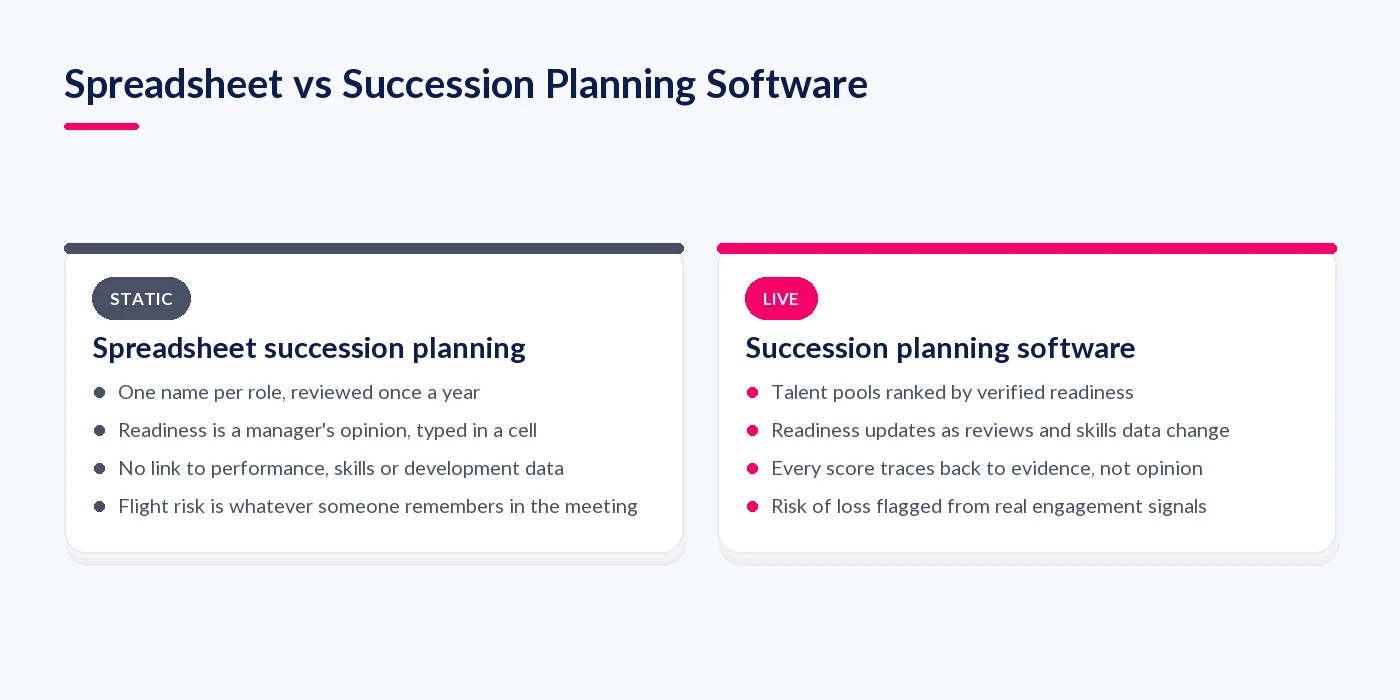
Succession planning software is a system that replaces the annual, spreadsheet-based talent review with a live record of who could step into your critical roles, how ready they really are, and what is slowing them down. Instead of a single name typed against a job title once a year, it tracks readiness against evidence — performance data, verified skills, development progress — and flags risk of loss before a departure becomes a crisis. The result is a talent pipeline you can defend in a board meeting, not just describe in one.
What Is Succession Planning Software?
Succession planning software is a dedicated platform for identifying, developing and tracking the people who could fill your organisation's most critical roles if the current holder left tomorrow. It sits next to your performance and HR systems rather than replacing them, pulling in review scores, skills data and career history to build a picture of readiness that updates on its own.
A working system answers five questions about your leadership pipeline, on demand:
- Which roles would cause real damage to the business if they were vacant tomorrow?
- Who could step into each one, and how ready are they, really?
- What is holding each candidate back, and does anyone own closing that gap?
- How likely is the current role holder to leave, and what happens if they do?
- Can we show, with evidence, why we rated someone the way we did?
Succession Planning Software vs Workforce Planning Software
The two get bundled together constantly, and they solve different problems. Workforce planning is budget and headcount led: it forecasts how many people you need, in which roles, against demand and cost. Succession planning is people-specific: it identifies named individuals, or pools of individuals, who could grow into your most critical positions, and tracks what needs to happen for that to be true. You need both. Workforce planning tells you the shape of the organisation you are building; succession planning tells you whether you have the people to fill it. For a deeper look at where the two overlap and where they diverge, see our workforce planning vs succession planning guide.
The Governance Duty and the Bias Problem Most Buying Guides Skip
Search for "succession planning software" and you get feature checklists and tool round-ups. What you rarely get is the reason this stopped being optional for larger organisations, or hard evidence of why the traditional way of doing it quietly discriminates against your best people. Both change how you should build a business case for this.
Why Listed Companies Cannot Treat This as Optional
The UK Corporate Governance Code 2024 is explicit. Principle J states that "an effective succession plan for the board and senior management should be maintained," and that "both appointments and succession plans should be based on merit and objective criteria," while promoting "diversity, inclusion and equal opportunity." Provision 17 goes further, requiring the board to establish a nomination committee that must "ensure plans are in place for orderly succession to both the board and senior management positions, and oversee the development of a diverse pipeline for succession."
Two details in that text matter more than they first appear. First, the Code defines "senior management" broadly — "the executive committee or the first layer of management below board level, including the company secretary" — so this is not only a board-level obligation. Second, Provision 23 requires the annual report to describe the nomination committee's approach to succession planning and the gender balance of senior management and their direct reports, which means the plan has to survive external scrutiny, not just exist in a private document. For a UK-listed company, "we keep a list of possible successors in a spreadsheet" is not a credible answer to an investor asking how that duty is being discharged.
The Hard Data on Why Gut-Feel Ratings Fail Half Your Talent
The other gap is evidential. Plenty of pages mention, in passing, that the 9-box grid can be "subjective." Few cite a study. Benson, Li and Shue (2022) analysed 29,809 management-track employees at a large North American retail chain that rates staff on a Nine Box grid, and the results are stark.
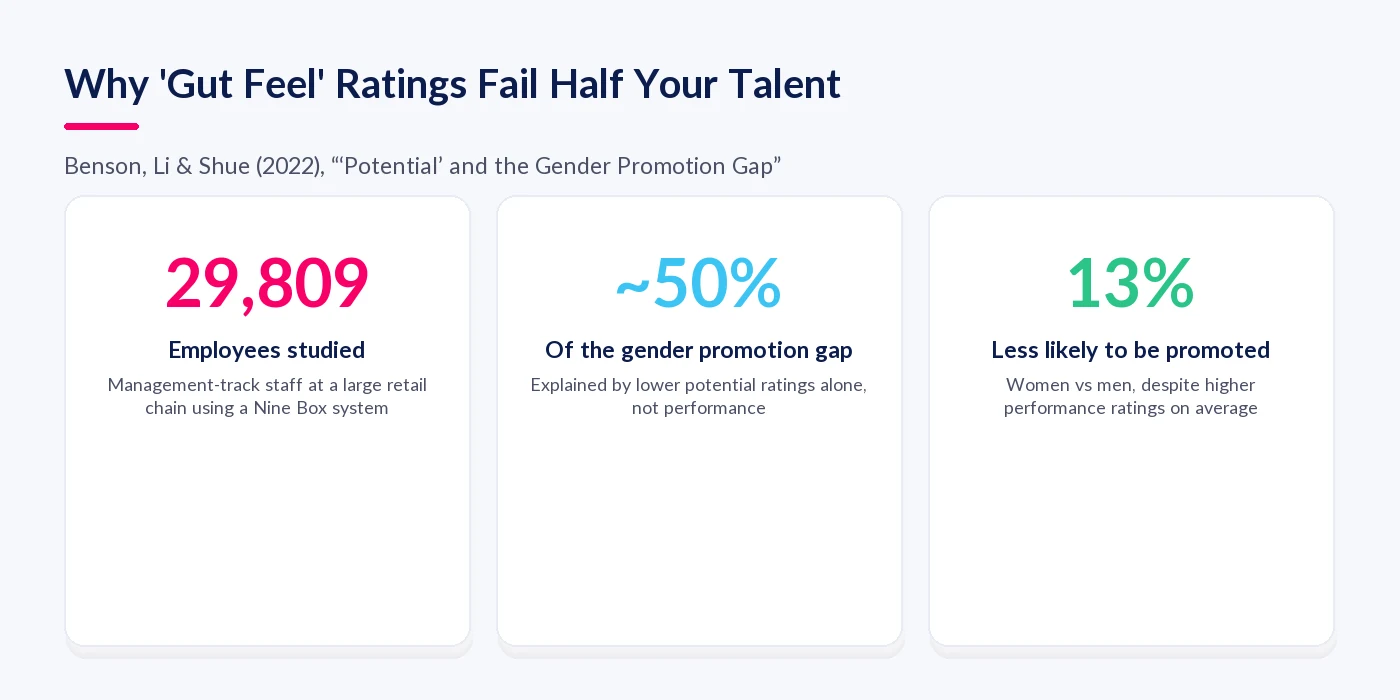
Women in the dataset received higher performance ratings than men on average, and were 7.4% more likely to earn the top performance rating. Despite that, they were 12% more likely to receive the lowest potential rating, and 15% and 28% less likely to receive the middle and highest potential ratings respectively. Differences in potential ratings alone account for roughly half of the overall gender promotion gap, and women were 13% less likely to be promoted than men. Crucially, the researchers checked whether this was justified: it was not. Women subsequently outperformed male colleagues who received the same potential rating, and were less likely to leave the firm, not more. The bias was not tracking anything real; it was just bias.
This matters for software, not just fairness. A "9-box, once a year, in a meeting room" process has no mechanism to catch this, because the rating is the only record. Software that ties readiness to specific, logged evidence — a completed assessment, a documented outcome, a verified skill — gives you something to audit when a pattern like this one shows up in your own data. Our guide to succession planning without the 9-box grid covers the mechanics of that shift in more depth, and how to measure potential without repeating the grid's weakest axis is worth reading alongside it.
How Succession Planning Software Actually Works
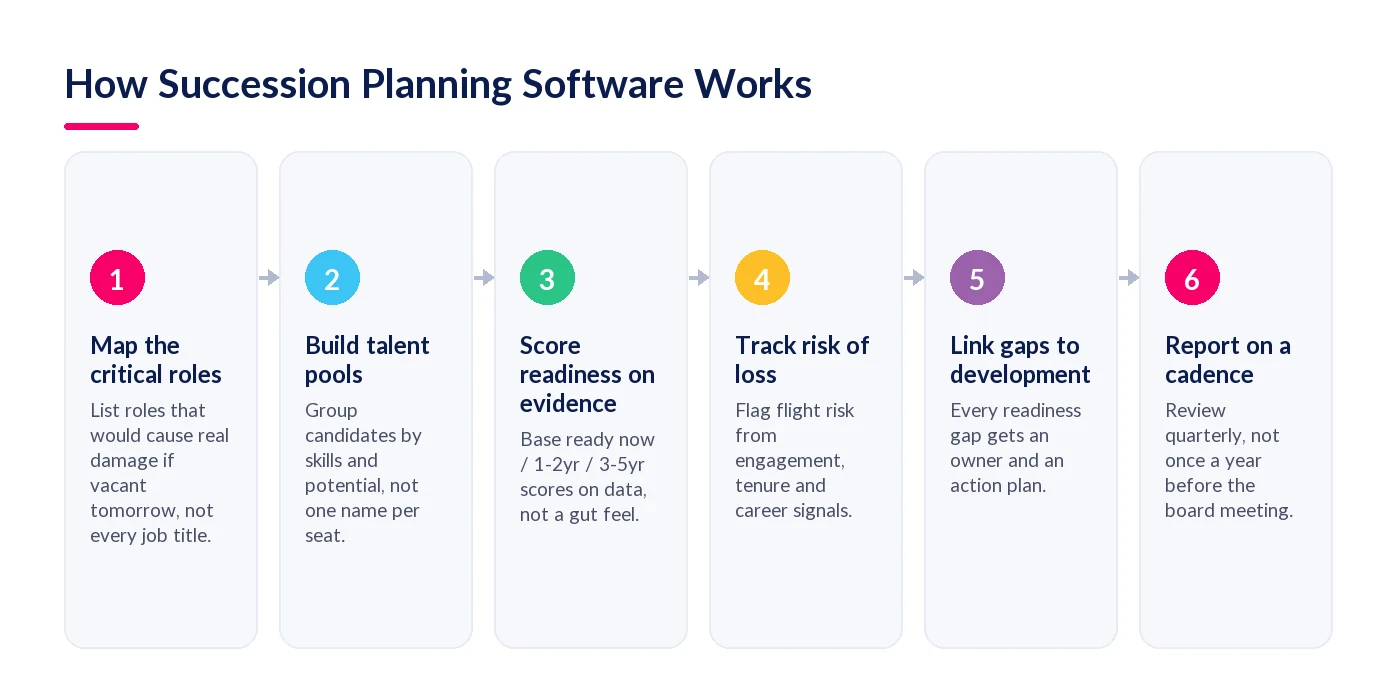
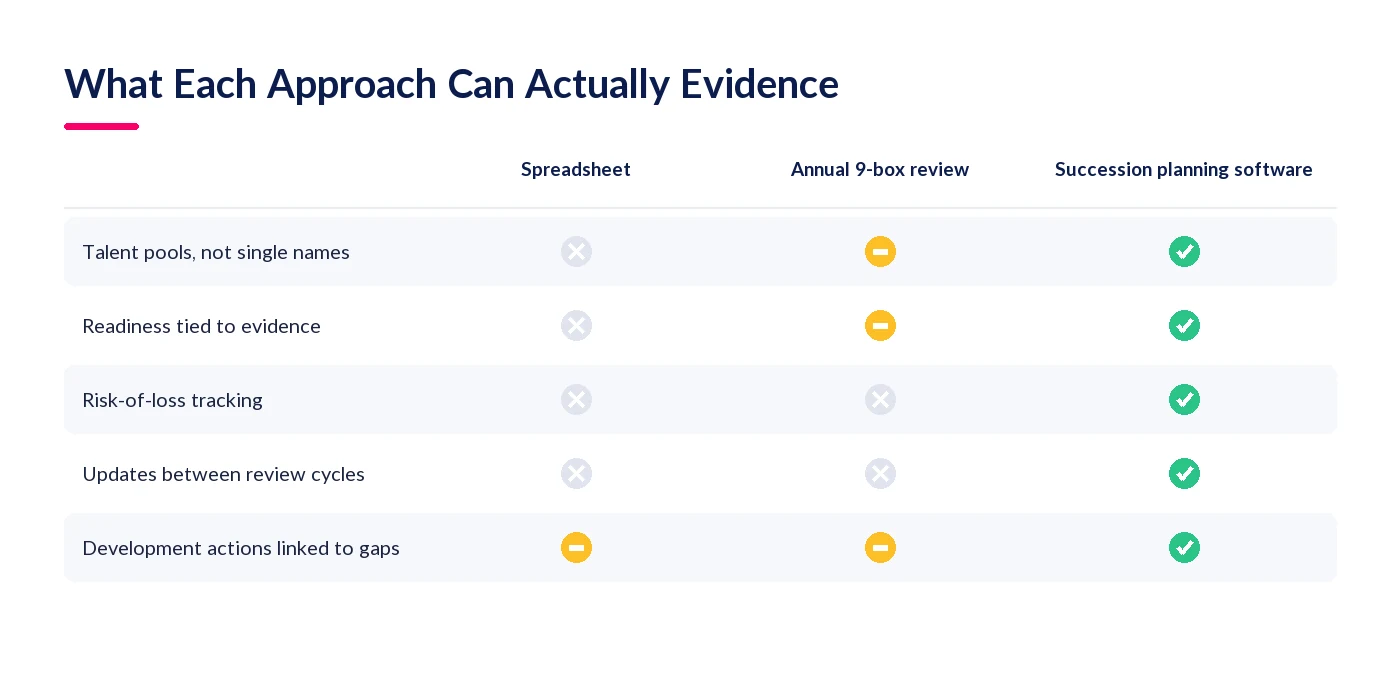
Strip away the vendor branding and the mechanics are consistent across every serious platform. Six things have to happen, in roughly this order, and most of the value sits in the transitions between them — the places a spreadsheet has no way to connect.
Step 1: Map the Critical Roles
Start with roles, not people: which positions would cause real operational, financial or reputational damage if they sat empty for three months? For most organisations this is a short list — a handful of executive roles plus a set of specialist or site-critical positions — not every job title on the org chart.
Step 2: Build Talent Pools, Not Shortlists
Replace the single-name entry with a pool of candidates grouped by skills, experience and demonstrated potential. A pool survives someone leaving; a shortlist of one does not. Modern platforms let you filter and rank a pool automatically as new data arrives, rather than rebuilding it from memory at the next review.
Step 3: Score Readiness on Evidence
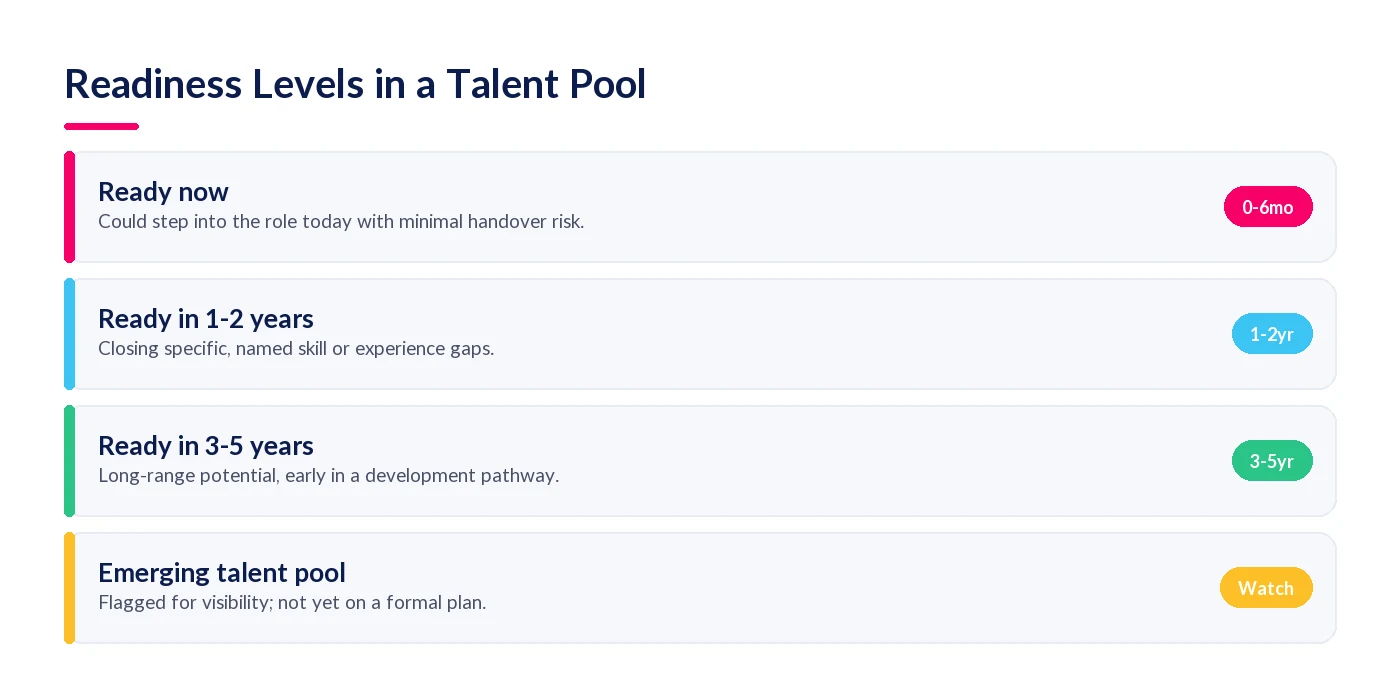
Readiness is commonly scored across three horizons — ready now, ready in one to two years, and ready in three to five years — but the horizon matters less than what it is based on. A defensible score cites the specific competency gaps, assessments or outcomes behind it, so the rating survives someone asking "why?"
Step 4: Track Risk of Loss Alongside Readiness
A ready successor for a role held by someone who is also about to leave is not a plan, it is a coincidence you got away with. Risk of loss is typically assessed against signals like tenure, time since last promotion, compensation relative to market, engagement trends and performance trajectory, flagged automatically rather than reconstructed from a manager's memory of a corridor conversation.
Step 5: Link Every Gap to a Development Action
A readiness score with no attached action is just a label. Each identified gap needs an owner, a development activity and a review date, ideally drawing on the same competency framework used elsewhere in the business, so succession and development are the same conversation rather than two separate ones.
Step 6: Report on a Cadence, Not Once a Year
Readiness that only gets reviewed before the annual talent meeting is stale for eleven months of the year. Software that updates scores as performance reviews close, assessments complete or roles change lets you report bench strength quarterly, or on demand, rather than reconstructing it under time pressure.
Where Succession Planning Breaks Down
The Single-Name List
Naming one successor per role looks tidy and fails the moment that person is promoted, leaves, or turns out not to want the job. A pool of two or three candidates at varying readiness levels survives all three.
The Annual Snapshot
A rating taken once a year is, by definition, wrong for most of it. Someone's readiness can change materially in a quarter — a stretch assignment completed, a qualification gained, a difficult project mishandled — and a system that only asks once a year has no way to notice.
No Manager Buy-In
Software cannot generate honest input a line manager refuses to give. If the process feels like a compliance exercise rather than a genuine investment in their team, ratings default to whatever is fastest to type, which is exactly how bias like the pattern above creeps back in unchallenged.
Data That Is Stale by the Time It Matters
Succession software that is not connected to live performance, skills and engagement data is just a nicer-looking spreadsheet. The value is in the connection, not the interface.
Overbuilding Governance for a 40-Person Company
Not every organisation needs a nomination committee and a formal Code-aligned process. A smaller business can get most of the benefit from two or three well-maintained talent pools around its genuinely critical roles, reviewed quarterly. Match the process to the actual risk, not to what a listed company down the road is required to do.
A 90-Day Plan to Stand Up Succession Planning Software
You do not need a finished framework before you start seeing value. Sequence it by risk.
- Month 1 — Scope the critical roles and current gaps. Identify the roles that would hurt if vacant, and be honest about which ones currently have no viable internal successor at any readiness horizon.
- Month 2 — Build talent pools and set readiness criteria. For each critical role, name a pool of two to four candidates and agree, in writing, what evidence justifies each readiness level. This is where a documented competency framework pays for itself.
- Month 3 — Connect risk of loss and switch on reporting. Layer in flight-risk signals for both the current role holder and the successors, then set a quarterly review cadence so the plan updates itself instead of being rebuilt from scratch each time someone asks for it.
How StaffCircle Approaches Succession Planning
Talent Pools Built from Everyday Signals
Success Circles™ builds a live view of bench strength from activity already happening on the platform — performance reviews, 360 feedback, objectives and check-ins, recognition, and development activity — rather than a once-a-year workshop. Employees are grouped into emerging, established and future-leader pools that update as the underlying signals change.
Readiness Levels Tied to Your Competency Framework
Because StaffCircle's AI-powered competency framework defines what "good" looks like for every role, readiness scoring has a fixed reference point instead of a manager's private judgement. That is the same evidence chain a nomination committee, or simply a sceptical line manager, would want to see behind any rating.
Risk of Loss, Flagged Automatically
Success Circles surfaces flight-risk signals alongside readiness, so a role with a strong successor but a departing risk of loss on the incumbent gets visibility before it becomes an emergency, rather than after.
An Evidence-Based Alternative to the 9-Box Grid
StaffCircle positions Success Circles explicitly as a live alternative to the 9-box grid: continuous signals in place of an annual, opinion-based placement exercise. Given the documented bias risk in subjective potential ratings, replacing a once-a-year judgement call with a continuously evidenced score is not a cosmetic upgrade, it is a governance improvement.
Final Thoughts
Succession planning software is not a nicer dashboard for the same annual guesswork. Done properly, it replaces a single name in a spreadsheet cell with a pool of evidenced candidates, replaces an annual opinion with a readiness score you can defend, and replaces "we'll worry about it if they hand in their notice" with a risk-of-loss signal you saw coming. For a UK-listed business, it is also how you evidence a duty the Corporate Governance Code already places on your nomination committee. For everyone else, it is how you stop finding out who was ready only after the role is already empty.
FAQ
What is succession planning software?
Succession planning software is a platform that identifies, develops and tracks candidates for an organisation's critical roles. It replaces a static, spreadsheet-based list with a live record of readiness, backed by performance, skills and development data that updates automatically.
How is succession planning software different from workforce planning software?
Workforce planning software forecasts headcount, budget and skills supply against business demand. Succession planning software identifies specific people, or pools of people, who could grow into named critical roles and tracks the development work needed to get them there. Most organisations need both, used together.
Is a spreadsheet enough for succession planning?
A spreadsheet can work for a very small organisation with one or two critical roles reviewed informally. Beyond that it fails structurally: it holds no link to performance or skills data, readiness is whoever's opinion was typed into the cell, and nothing updates between review meetings, so decisions get made on stale information.
What are readiness levels in succession planning?
Readiness levels describe how soon a candidate could step into a role. The common convention is three horizons: ready now, ready in one to two years, and ready in three to five years. The horizon matters less than what justifies it — a defensible score is tied to specific evidence, not a general impression.
What does risk of loss mean in succession planning?
Risk of loss, sometimes called flight risk, measures how likely a person is to leave the organisation, based on signals such as tenure, time since last promotion, compensation relative to market, and engagement trends. It applies to both the current role holder and their identified successors.
How often should a succession plan be updated?
As an ongoing process rather than an annual event. Readiness should update whenever a relevant input changes — a performance review closes, a development milestone completes, or a 360 cycle finishes — with a formal review at least quarterly so bench strength is never more than a few months stale.
Do UK companies have a legal duty to plan for succession?
UK-listed companies operate under the UK Corporate Governance Code 2024, which requires the board's nomination committee to maintain an effective succession plan for the board and senior management, and to report on its approach in the annual report. It applies on a comply-or-explain basis rather than as statute, but investors treat it as a hard expectation.
Is the 9-box grid biased?
Peer-reviewed research analysing 29,809 employees at a firm using a Nine Box system found women received substantially lower potential ratings than men despite receiving higher performance ratings, and that this gap accounted for roughly half of the overall gender promotion gap. The lower ratings were not justified by subsequent performance or attrition.
What is a talent pool, and how is it different from naming one successor?
A talent pool is a group of two or more candidates for a role, ranked by readiness and updated as new data arrives. Naming a single successor looks simpler but collapses the moment that person is promoted, leaves, or declines the role — a pool survives all three.
Who should own succession planning, HR or the board?
For UK-listed companies, ownership sits explicitly with the board's nomination committee, which cannot delegate the duty to HR alone. HR typically runs the underlying data and process, but accountability for the plan itself sits with the committee.
Does succession planning software need to connect to performance management data?
Yes, or its readiness scores are opinions rather than evidence. The value of dedicated software over a spreadsheet is precisely that readiness, skills and development data update automatically from systems already in use, rather than being manually re-entered.
Is succession planning only necessary for large or listed companies?
No. The statutory reporting duty applies mainly to listed companies, but any organisation with roles that would be costly to leave vacant benefits from a talent pool and a readiness view. Smaller organisations can scale the process down to a handful of genuinely critical roles rather than adopting a full governance framework.
What is the difference between a skills framework and succession planning?
A competency or skills framework defines what capability looks like for every role across the organisation. Succession planning uses that same framework as its reference point, applying it specifically to who could grow into critical roles and what evidence supports each readiness score.
Related articles

See StaffCircle in action
Book a personalised demo and see how StaffCircle drives performance, engagement and development.