Why is employee retention important?
The business case for employee retention is straightforward: Gallup puts the cost of replacing one person at between half and twice their annual salary, and the largest part of that is output lost while a replacement gets up to speed. Retention protects capability, customer relationships and margin at once.
Key facts
- Gallup puts replacement cost at between half and twice the leaver's annual salary.
- Ramp-up loss is usually the largest cost component and the one never budgeted.
- UK average staff churn was 34% across 2022 and 2023, on CIPD analysis of ONS data.
- Some turnover is healthy. Zero turnover in a growing business is a warning sign.
Why employee retention is important
Employee retention matters because the cost of a departure is far larger than the cost of the recruitment that follows it, and almost none of that cost appears in a budget line. Gallup's analysis puts the total at between one-half and two times the departing employee's annual salary. Underneath the money sit three things a business cannot buy back quickly: institutional knowledge, customer relationships and the confidence of the team that stays.
Scale gives that figure teeth. CIPD analysis of ONS Annual Population Survey data found average staff churn across UK workers running at 34% between January 2022 and December 2023, ranging from 25% in public administration and defence to 52% in hospitality. At that rate, a 300-person business is replacing a meaningful share of its workforce every year, and paying the full cost of doing so every time.
The reason retention rarely gets the attention it deserves is that it has no invoice. Recruitment fees arrive as a bill someone has to approve. Four months of half-productivity from a new starter arrives as nothing at all, which is why it is both the largest component and the one nobody argues about.
What does losing one person actually cost?
Take a real role and work it through. An experienced operations coordinator on a £35,000 salary sits in the middle of Gallup's published range at roughly one times salary, so the working total is £35,000 per departure. The table below breaks that total into its components, so you can see where it goes and replace each line with your own figures.
| Cost component | How to work it out | Worked figure | Share of total |
|---|---|---|---|
| Recruitment fees and advertising | Agency fee, job board spend, or internal recruiter time at loaded cost | £5,250 | 15% |
| Manager and interviewer time | Hours across shortlisting, interviews and decision, at loaded hourly cost | £1,400 | 4% |
| Vacancy cover | Overtime, temporary cover, or work simply not done during the empty weeks | £4,000 | 11% |
| Onboarding and training | Induction, system access, formal training and buddy time | £2,300 | 7% |
| Ramp-up gap | Output shortfall between day one and full productivity | £18,900 | 54% |
| Handover and knowledge loss | Documentation, relationship transfer, and rework caused by lost context | £3,150 | 9% |
| Total | Anchored on Gallup's published half-to-double salary range | £35,000 | 100% |
Be clear about what is sourced and what is not. The £35,000 total is anchored on Gallup's published range for a salary of this size. The split between the six components is a set of assumptions, offered so you can see the shape of the cost and substitute your own agency rates, cover costs and ramp-up period. It is a model to argue with, not a benchmark to quote.
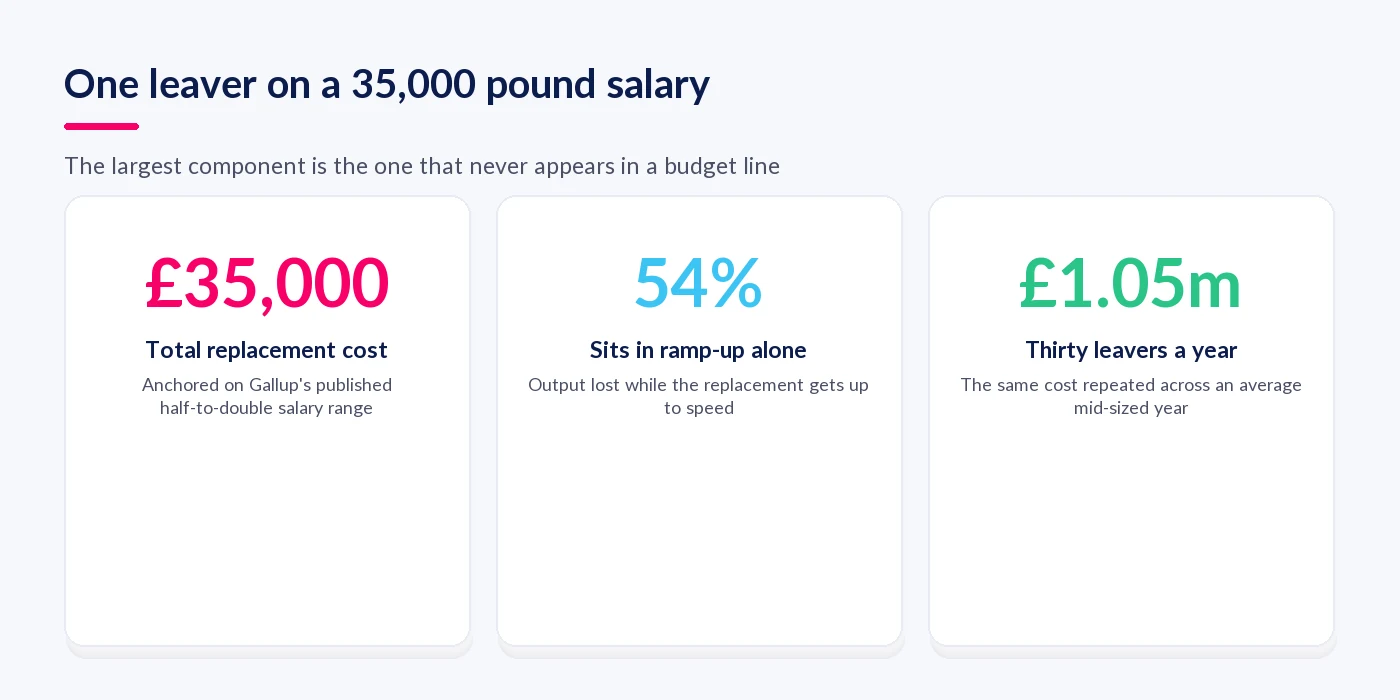
Now scale it. A business losing 30 people a year on that average carries £1.05 million of replacement cost annually. Reducing departures by a fifth, from 30 to 24, saves £210,000 without touching pay, headcount or price. At the upper end of Gallup's range, where senior and hard-to-fill roles sit, the same 30 departures cost £2.1 million.
That is the version of the retention argument a finance director engages with, because it is expressed as cost avoided rather than culture improved. Rebuild the table with your own agency rates, cover costs and ramp-up period, then multiply by your own departure volume, worked out using how to calculate employee retention rate.
Which of those costs never appear in a budget line?
Four of the six components above are effectively invisible to normal financial reporting: the ramp-up gap, vacancy cover absorbed as unpaid overtime, manager time spent recruiting instead of managing, and knowledge loss. Together they are around three-quarters of the total. Only recruitment fees and formal training reliably produce a document that someone approves, which is precisely why retention gets discussed as a cultural issue rather than a financial one.
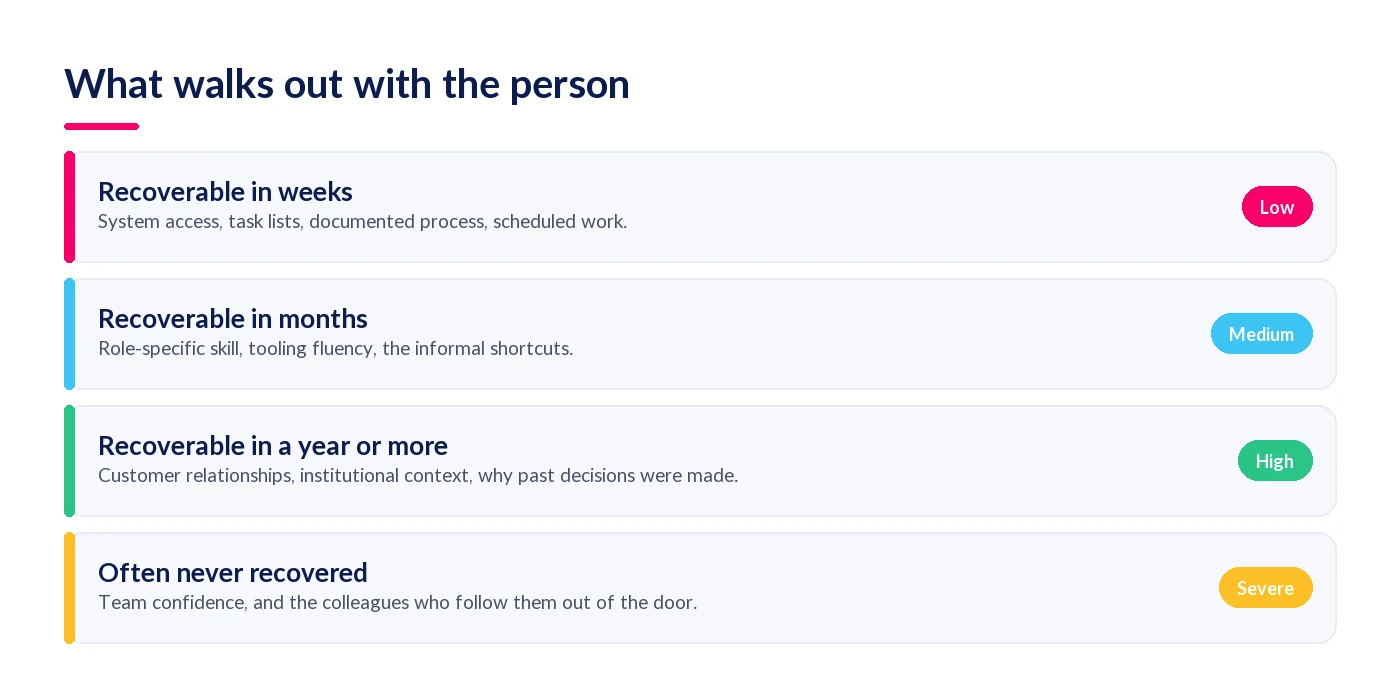
It helps to sort the loss by how long it takes to rebuild:
- Recoverable in weeks. System access, task lists, documented process, scheduled work. Real cost, but bounded and mostly a handover problem.
- Recoverable in months. Role-specific skill, tooling fluency, the informal shortcuts that never made it into a process document. This is where most of the ramp-up gap sits.
- Recoverable in a year or more. Customer relationships, supplier history, and institutional context: why a past decision was made the way it was. In account management and field service the customer feels this immediately.
- Often never recovered. Team confidence, and the colleagues who follow a respected leaver out of the door within six months. A single senior departure can trigger several more, and none of them shows up as a cost of the first.
There is also a knock-on cost inside the team. Every departure redistributes work onto people who were already fully loaded, which is the mechanism by which one resignation becomes three. The link between staffing stability and employee productivity runs in both directions, and it is why a rising exit rate tends to accelerate rather than level off.
When is high turnover not a problem?
Turnover is only a problem when the wrong people are leaving. Zero turnover means nobody is being promoted out, nobody is being managed out and no new thinking is arriving, which is its own kind of decay. A retail or hospitality business with a genuinely seasonal model may run high headline churn indefinitely and be entirely healthy, because its cost of replacement per role is low and its ramp-up period is short.
Three questions separate expensive turnover from harmless turnover:
- Who is leaving? Losing your weakest and your strongest performers produces the same headline rate and completely different consequences.
- How replaceable is the role? A role with a four-week ramp-up and a deep local labour market costs a fraction of a role with a nine-month ramp-up and three qualified candidates in the region.
- Is anyone else exposed? A departure from a role with a named, ready successor is an inconvenience. The same departure with nobody behind it is a delivery risk, which is the whole argument for succession planning.
Our free guide covers mapping successors and readiness, with customisable templates: the Succession Planning Guide.
How StaffCircle makes the cost visible before it lands
The cost above is only avoidable if you can see it forming. That means knowing which roles are exposed, who is genuinely ready to step up and where capability gaps are stalling progression, before a resignation rather than after one. StaffCircle keeps performance, skills and readiness on a single record, so exposure in critical roles is a report rather than a memory.
Customers report 57% lower employee turnover, and that page documents what the figure measures and how it is calculated. The mechanism is the unglamorous part: closing the capability and progression gaps that make people leave, which is what the skills and development module exists to do.
Final thoughts
Employee retention is important because a departure costs roughly what you pay the person for a year, and three-quarters of that cost never reaches a budget line. Work the number for your own salary bands and departure volume, present it as cost avoided, and be honest about which turnover is healthy. Then decide which interventions to run first, and make sure everyone reading your report agrees on what employee retention means.
To see role exposure, successor readiness and skills gaps on one record, book a demo.
Frequently asked questions
What are the costs of high employee turnover?
Recruitment fees, interviewer time, vacancy cover, onboarding and training, the output gap while a replacement gets up to speed, and knowledge that leaves with the person. Gallup puts the total for one leaver at between half and twice their annual salary, and ramp-up is usually the largest slice.
Is some employee turnover healthy?
Yes. Zero turnover means nobody is being promoted out, nobody is being managed out, and no new thinking is arriving. The figure worth watching is not the headline rate but who is leaving: losing your weakest performers and your strongest performers produces the same number and completely different problems.
How does employee retention affect customers?
Every handover resets a relationship. In account management, support and field service the customer notices immediately, because context has to be rebuilt from scratch. Long-tenure teams also make fewer errors on non-standard work, which is exactly the work that generates complaints when it goes wrong.
Why does employee retention matter to the board?
Because it is a leading indicator of both cost and delivery risk. A rising exit rate in critical roles shows up in missed delivery dates and recruitment spend two quarters later. Presented as a cost per leaver multiplied by leaver volume, retention becomes a budget conversation rather than an HR one.
What is the biggest hidden cost of losing an employee?
The output gap while the replacement gets up to speed. Recruitment fees are visible and get scrutinised; the weeks or months of reduced output never appear on an invoice, so they are rarely counted. In the worked example on this page that single component is over half the total.
Related articles
See StaffCircle in action
Book a personalised demo and see how StaffCircle drives performance, engagement and development.