How to improve employee retention
The most effective way to improve employee retention is to work in priority order: fix the first 90 days, protect the one-to-one, publish a visible next step, close the skills gaps that block promotion, and hold stay conversations in critical roles. Interventions ranked by leverage beat long lists.
Key facts
- Gallup found managers account for at least 70% of the variance in team engagement.
- Most avoidable exits are decided in the first 90 days, not the first year.
- Raising pay improves retention only where pay is genuinely the binding problem.
- Retention work shows in first-year cohorts a quarter before the headline rate moves.
Why do employees actually leave?
Most avoidable resignations trace back to one of four causes: a manager relationship that is not working, an onboarding period that left someone unable to do the job well, no visible next step after roughly eighteen months, or pay that has drifted below the market for that specific role. Everything else in the exit-interview data tends to be a symptom of one of those four.
It matters which one you are facing, because the four have completely different costs and completely different lead times. Manager quality is the largest of them and the least visible in a survey average. Gallup's research across business units found that managers account for at least 70% of the variance in employee engagement scores, which means two teams inside the same company, on the same benefits and the same policies, will produce very different exit rates depending on who runs them. The CIPD's Good Work Index 2025 points the same way: employees with positive views of their line manager were less inclined to consider leaving.
The practical implication is uncomfortable. An organisation-wide engagement initiative spreads effort evenly across managers who do not need it and managers who do. Retention work that lands is almost always targeted at specific teams, specific tenure bands and specific roles.
How to increase employee retention
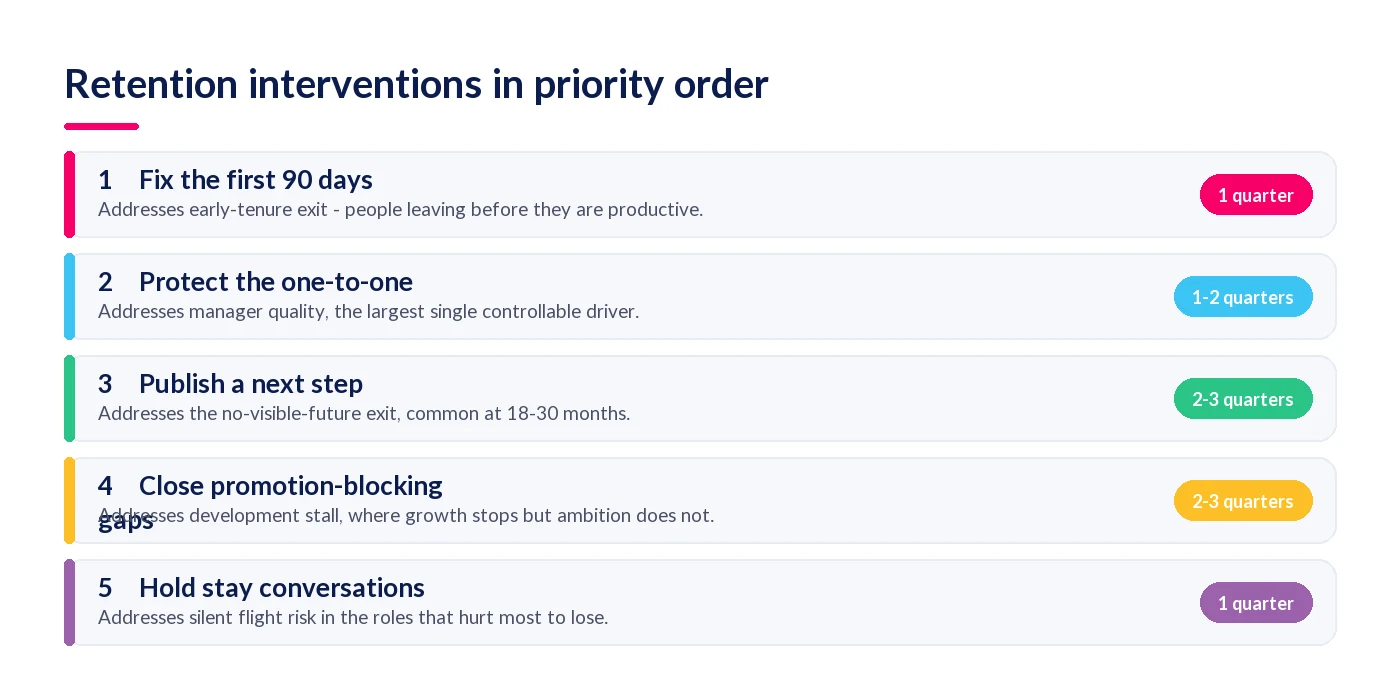
Work in priority order rather than running everything at once. The table below ranks seven interventions by leverage: how much retention they move, how quickly, and how much they depend on someone else's budget. Each row names the driver it addresses, because an intervention that does not map to a driver you actually have is just activity.
| Priority | Intervention | Retention driver it addresses | Who owns it | Time to first effect |
|---|---|---|---|---|
| 1 | A written first-90-days plan for every starter, with a named buddy and 30/60/90 reviews | Early-tenure exit: people leaving before they are productive | Line manager, HR checks completion | One quarter |
| 2 | Short, frequent one-to-ones that cannot be cancelled, with a written note on the record | Manager quality, the largest single controllable driver | Line manager | One to two quarters |
| 3 | A stay conversation with everyone holding a role you cannot replace quickly | Silent flight risk in the roles that hurt most to lose | Head of function | One quarter |
| 4 | A published progression route for every role family, with the criteria for each step | No visible next step, common between 18 and 30 months | HR with heads of function | Two to three quarters |
| 5 | Close the three skills gaps most often blocking promotion into the next grade | Development stall: growth stops but ambition does not | Learning and development, with the line | Two to three quarters |
| 6 | Benchmark pay for the specific roles you keep losing, not the whole organisation | Pay drift in identifiable pockets | Reward and finance | One to two quarters |
| 7 | Publish what changed as a result of exit and pulse feedback, by name of change | The belief that nothing ever changes | Executive sponsor | Two quarters or more |
Two things about the ordering are deliberate. Pay sits at six, not one, because a general uplift is the most expensive intervention available and leaves the other five drivers untouched: if people are leaving because of their manager, a rise buys a delay rather than a decision. And publishing what changed sits last not because it does not matter but because it only works once something actually has changed.
The first 90 days, in detail
Priority one deserves unpacking, because it is where the largest share of avoidable exits is decided and it costs nothing but attention. The four steps below are the minimum viable version.
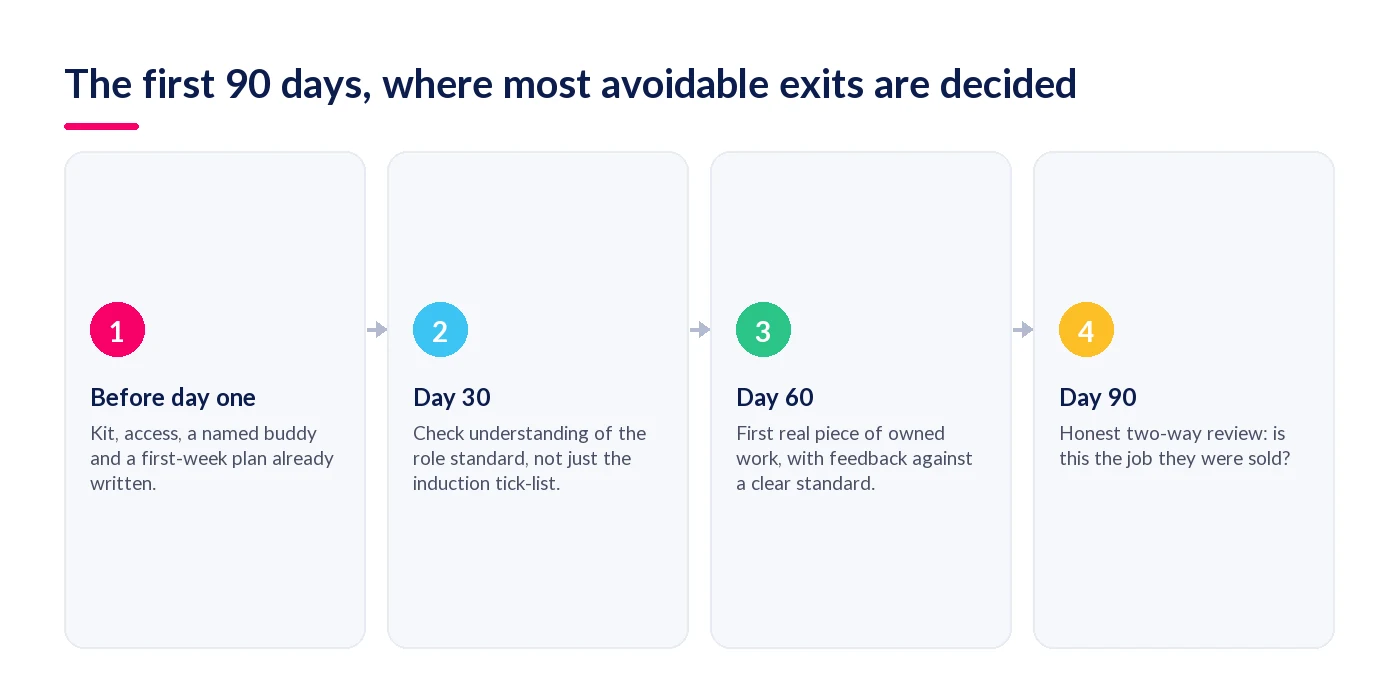
- Before day one, remove every avoidable friction. Kit, system access, a named buddy and a written plan for the first week, all in place before they arrive. A starter who spends week one waiting for a laptop has already learned something about how the organisation runs.
- At day 30, check understanding of the standard, not the induction tick-list. Ask them to describe what good performance in this role looks like. If their answer does not match their manager's, you have found the gap while it is still cheap to close.
- At day 60, give them one real piece of owned work with real feedback. Confidence comes from delivering something that mattered and being told specifically why it was good or not. Shadowing for two months produces neither.
- At day 90, hold an honest two-way review. Ask directly whether the job matches what they were told at interview. Where it does not, you have a hiring-brief problem to fix for the next intake, not just a person to reassure.
If the progression side of this is where you are weakest, our free guide includes customisable templates for mapping successors and development routes: the Succession Planning Guide.
How to improve employee retention and motivation
Retention and motivation overlap but they are not the same target, and treating them as one is why so much retention spend lands badly. Retention asks whether someone stays. Motivation asks whether they bring discretionary effort while they do. You can hold a demotivated person for years with good pay and a poor market, and that is a worse outcome than a clean exit.
Four levers move both at once, which is why they are worth doing first:
- Clarity about what good looks like. Ambiguity is demotivating in its own right. Someone who cannot tell whether they are doing well assumes they are not, and starts looking. A clear standard, written down and referred to in one-to-ones, does more for motivation than any recognition scheme.
- Recognition that is specific and close to the event. Naming the actual thing someone did, within days, carries far more weight than a quarterly award. Generic praise reads as noise.
- Autonomy over method. Motivation collapses fastest when someone is accountable for an outcome but not trusted to choose the approach. Agree the outcome and the constraints, then leave the method alone.
- A next step that is real. Not a promise of promotion, but a named capability to build and an honest view of what it opens up. This is where a visible route matters more than a vacancy.
The route itself needs a source of truth, or it becomes a promise nobody can honour. Mapping who is genuinely ready for the next role, and who could cover a critical one, is the same exercise as succession planning, and the 9-box grid is still the fastest way to get a first read on it across a team.
How do you tell whether any of it is working?
Judge retention work on leading indicators for the first two quarters and on the headline rate only after a year. The annual retention rate is a twelve-month lagging measure, so a programme that is genuinely working will show almost nothing in it for six months, and teams that judge themselves on it too early usually abandon the intervention just before it lands.
Four measures worth tracking, in the order they move:
- Onboarding completion and 90-day review completion. Available inside a month. If managers are not completing the reviews, nothing downstream will happen.
- First-year retention by intake cohort. Moves within two quarters and is the earliest real signal.
- Internal mobility rate. A rising share of roles filled internally is usually the first evidence that a published progression route is believed.
- Overall retention rate, segmented. Last to move. Read it by team and tenure band, and understand how to calculate employee retention rate correctly before you present it, because retention and turnover are not inverses of each other.
How StaffCircle supports retention work
Every intervention above depends on line managers doing something consistently, and on somebody being able to see whether they did. That visibility is the gap most retention programmes fall into. StaffCircle holds objectives, one-to-one notes, skills and readiness on a single record, so 90-day review completion, development progress and progression readiness are reportable rather than anecdotal.
Customers report 57% lower employee turnover and 74% higher employee engagement, and that page documents what each figure measures and how it is calculated. On the progression side, Success Circles builds bench strength from everyday signals rather than an annual talent review, and the skills and development module is where the capability gaps behind a stalled promotion actually get closed.
Final thoughts
Improving employee retention is a sequencing problem more than an ideas problem. Fix the first 90 days, protect the one-to-one, then build the progression route and close the capability gaps behind it. Put pay sixth rather than first, and give the work three quarters before you judge it on the headline rate. It helps to be clear on what each departure actually costs and on what retention means before you ask for the budget.
To see 90-day reviews, development plans and progression readiness on one record, book a demo.
Frequently asked questions
How do you improve employee retention quickly?
Nothing structural moves inside a month, but two things move inside a quarter: a real first-90-days plan for every new starter, and a stay conversation with everyone in a role you cannot afford to lose. Both are cheap, both are entirely within a line manager's control.
What are the main causes of poor employee retention?
Four causes account for most avoidable exits: a manager relationship that is not working, an onboarding period that left someone unable to do the job, no visible next step after eighteen months, and pay that has drifted below the market for that specific role.
Does raising pay improve employee retention?
It works where pay is the binding constraint and nowhere else. Benchmark the roles you actually lose rather than the whole organisation, because a general uplift is expensive and leaves the real cause untouched. If people leave citing their manager, a pay rise buys a short delay.
How long does it take to improve employee retention?
Expect one to two quarters before first-year retention moves, and two to three before the headline annual rate does. The headline figure is a twelve-month lagging measure, so judging a programme on it after a single quarter will always look like failure even when the work is landing.
What is a stay interview?
A short structured conversation with someone you already have, asking what would make them leave and what makes them stay. It costs a manager thirty minutes and surfaces the fixable issues an exit interview only reveals once it is too late to act on them.
Related articles

See StaffCircle in action
Book a personalised demo and see how StaffCircle drives performance, engagement and development.