What is employee retention?
The simplest definition of employee retention is the organisation's ability to keep the people it already employs: the share of an existing group still on the payroll at the end of a defined period. It is deliberately narrow, and it is not the same thing as turnover, attrition or churn.
Key facts
- Retention measures the people you kept. Turnover, attrition and churn all measure departures.
- An internal move counts as retention, because the person is still employed.
- Attrition strictly means a departure where the post is not refilled.
- UK average staff churn was 34% across 2022 and 2023, on CIPD analysis of ONS data.
What does employee retention mean?
Employee retention means keeping the people you already have. As a measure it is the percentage of the employees on your payroll at the start of a period who are still on it at the end, with anyone who joined during the period excluded from the calculation entirely. Used more loosely in conversation, it also covers the whole set of practices that make people want to stay.
Two features of the definition do most of the work, and both are routinely missed.
The first is that retention is about employment, not about the job. Someone promoted into a bigger role, or moved sideways into a different team, has been retained. An internal move is a retention success, which is why internal mobility is one of the most reliable levers for improving the headline figure rather than something separate from it.
The second is that retention only ever looks backwards at a group that already existed. New starters are invisible to it. That is a deliberate design choice, not an oversight: it is what makes retention a clean answer to "did we keep the workforce we built?" It is also what makes retention a poor proxy for exit volume, because a business could lose fifty new starters in a year and its retention rate would not move at all.
Retention, turnover, attrition and churn: what is the difference?
These four words describe genuinely different things and are used interchangeably in most HR reporting, which is where a great deal of confusion about workforce data begins. Retention counts people who stayed. Turnover counts departures against average headcount. Attrition counts departures where the post is not refilled. Churn is the loosest of the four and usually describes total movement in and out. The table below separates them.
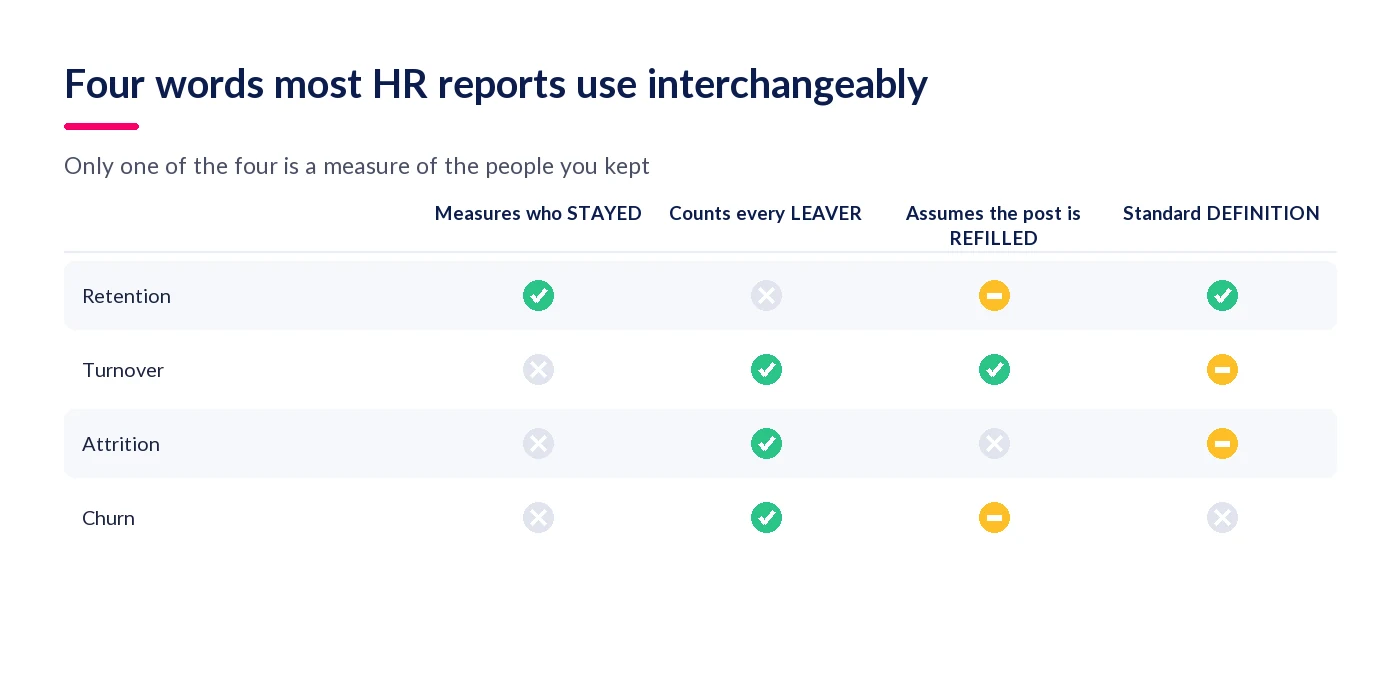
| Term | What it measures | Usual denominator | How standard is the definition? | When it is the right word |
|---|---|---|---|---|
| Retention | The share of an existing group still employed at the end of a period | Opening headcount of that group | Consistent across most sources | Reporting whether you kept the people you already had |
| Turnover | The rate at which people leave, with the expectation that the post is refilled | Average headcount over the period | Mostly consistent, though some exclude involuntary exits | Reporting the volume and cost of exits you had to absorb |
| Attrition | Departures where the post is not refilled, so headcount shrinks | Average headcount, or an absolute count of posts lost | Widely used loosely as a synonym for turnover | Reporting structural headcount reduction |
| Churn | Total movement in and out of the workforce over a period | Varies, often headcount at a single point in time | Least standardised of the four | Describing overall workforce volatility |
The attrition row is the one that catches people out. In its strict sense, attrition is what happens when someone leaves and the role goes with them, so the business is smaller afterwards. Turnover is what happens when someone leaves and you replace them. Our guide to attrition rate works through the voluntary, involuntary, internal and demographic variants of that measure in detail, which is worth reading alongside this page if attrition is the word your own reporting uses.
The reason precision matters is practical rather than pedantic. If a board paper says "attrition is 18%", the right first question is which of the four things above the author actually measured, because the answer changes what you should do about it. And if the paper derives one measure from another, the numbers are wrong: retention and turnover use different numerators and different denominators, which is why 100 minus your retention rate is not your turnover rate. The arithmetic is set out in how to calculate employee retention rate.
What does a retention figure look like in context?
A retention rate on its own is close to meaningless without a comparison, and the two comparisons worth having are your own trend and your sector. CIPD analysis of ONS Annual Population Survey data found average staff churn across UK workers of 34% between January 2022 and December 2023, made up of 27.4% who moved employer and 6.6% who were not working a year later. Sector variation is wide, from 25% in public administration and defence to 52% in hospitality.
Read alongside that national picture, a single organisational figure needs three qualifiers before it means anything:
- Which population? Permanent employees only, or every contract type. Seasonal contracts ending on schedule are not retention failures and should not sit in the headline.
- Which period? A rolling twelve months is stable. A single quarter in a team of thirty moves several points on one resignation.
- Which segment? Overall retention routinely hides a first-year cohort losing a quarter of its starters, and it hides losses in the handful of roles you cannot refill quickly.
Where is retention won across the employee lifecycle?
Retention is decided long before anyone resigns, and mostly at four points: how honestly the role was described at hire, whether onboarding produced capability and belonging inside 90 days, whether there is a visible next step around the eighteen-month mark, and whether an internal move is genuinely available when someone outgrows their job. A resignation is the last event in that sequence, not the point at which it can be influenced.
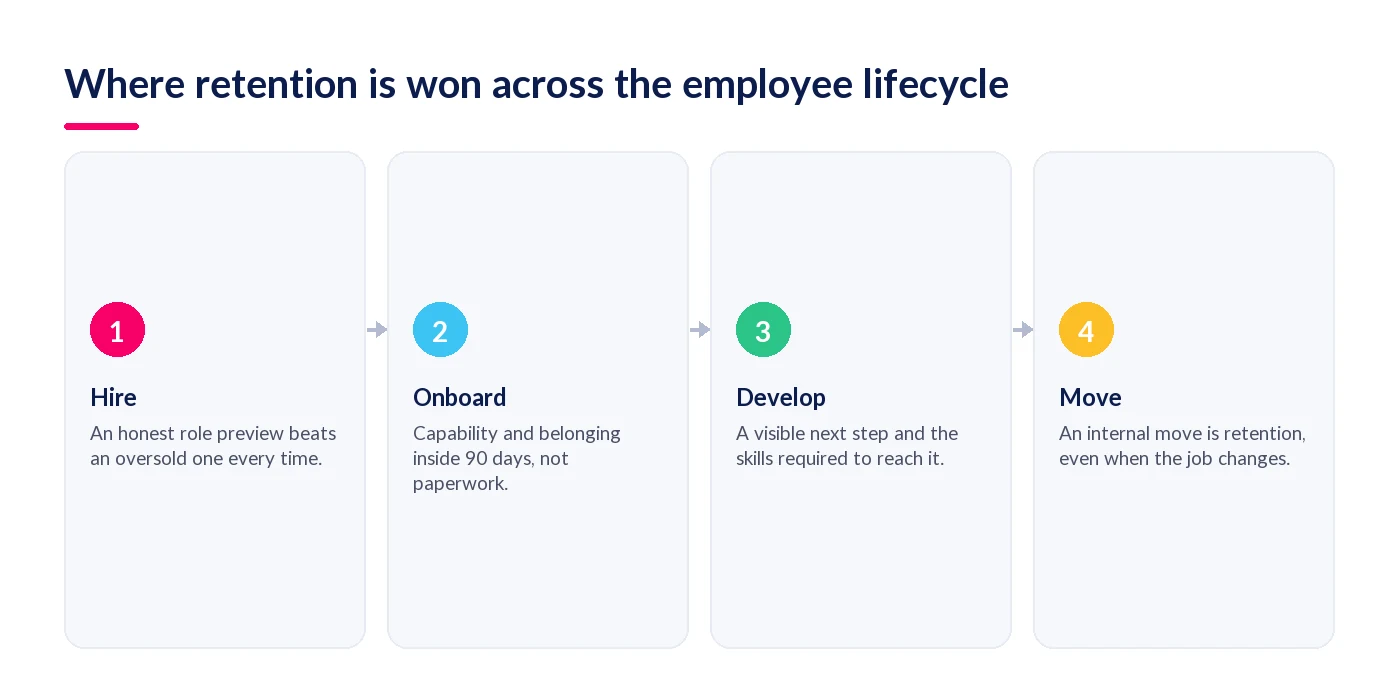
- Hire. An honest role preview retains better than a flattering one. Overselling a job buys a signature and costs you a first-year exit.
- Onboard. The first 90 days should produce someone who can do the work and feels part of the team. Paperwork completion is not the same thing.
- Develop. A visible next step, plus the specific capability needed to reach it. Vague encouragement is worse than nothing, because it sets an expectation nobody owns.
- Move. When someone outgrows a role, an internal move keeps them. Where no route exists, the market provides one.
This is also why retention data and succession data belong together. A role with a named, ready successor is a manageable risk; the same role with nobody behind it is a single point of failure. Our free guide covers mapping that, with customisable templates: the Succession Planning Guide.
Why do organisations track retention separately from turnover?
Because the two answer different management questions. Retention tells you whether the workforce you built is still intact, which is a capability and succession question. Turnover tells you the volume and cost of the exits you had to absorb, which is a recruitment budget and manager workload question. A business can look fine on one and poor on the other, and the two situations call for entirely different responses.
The clearest example is a fast-growing business. Hire heavily, lose a chunk of those new starters, and turnover climbs sharply while retention barely moves, because the established workforce is perfectly settled. The right response is to fix onboarding and the hiring brief, not to launch a company-wide engagement programme aimed at people who were never going anywhere. Reading only the turnover figure would have pointed you at the wrong problem, and expensively.
How StaffCircle treats retention as a live signal
Retention becomes useful the moment it stops being an annual number and starts being a segmented, current one attached to the reasons behind it. StaffCircle holds performance, skills, development progress and readiness on a single record, so retention can be read by team, tenure band and role criticality, with the review history sitting next to each departure rather than in a separate file.
Customers report 57% lower employee turnover, and that page documents what the figure measures and how it is calculated. On the progression side, Success Circles builds bench strength from everyday signals rather than an annual talent review, and the skills and development module is where the capability gaps behind a stalled internal move get closed.
Final thoughts
Employee retention means keeping the people you already have, measured against the group you started the period with. Keep it distinct from turnover, attrition and churn, insist on knowing which of the four any figure in front of you actually measures, and always segment before you draw a conclusion. From there, the two questions worth answering are what a departure really costs you and which interventions to run first.
To see retention, skills and successor readiness on one record, book a demo.
Frequently asked questions
What is employee retention in HR?
In HR reporting it is a percentage: the share of the employees you had at the start of a period who are still employed at the end of it. Used more loosely in conversation, it means the whole set of practices that make people want to stay.
What is the difference between employee retention and turnover?
Retention looks at the group you started with and asks how many stayed. Turnover looks at every departure in the period and divides by average headcount. Different numerators, different denominators, which is why subtracting your retention rate from 100 does not give you your turnover rate.
Is attrition the same as employee retention?
No, and it is not quite the same as turnover either. Attrition strictly means a departure where the post is not refilled, so headcount falls. Many reports use it loosely as a synonym for turnover, which is why any figure labelled attrition should be read with its definition attached.
Does an internal move count as retention?
Yes. Retention asks whether the person is still employed, not whether they hold the same job. A promotion or a sideways move into another team is a retention success, and internal mobility is one of the strongest levers you have for improving the headline rate.
Why do organisations track retention separately from turnover?
Because they answer different management questions. Retention tells you whether the workforce you built is still intact, which matters for capability and succession. Turnover tells you the volume and cost of exits you had to absorb, which matters for recruitment budget and manager workload.
Related articles
See StaffCircle in action
Book a personalised demo and see how StaffCircle drives performance, engagement and development.