What makes an employee competent?
A competent employee is one who can reliably do what their role requires, to a defined standard, today. Competence has four parts: knowledge, skill, behaviour and currency. Miss any one of them and the rating will not survive a manager's challenge, an audit, or a bad day on site.
Key facts
- Competence is knowledge, skill, behaviour and currency, all four at once.
- A certificate proves attendance; an assessment against a standard proves competence.
- Competence expires, so every rating needs a date and a review point.
- CDM 2015 requires the skills, knowledge and experience necessary to fulfil the role.
- Self-assessment is a starting point, never the evidence itself.
What does competency mean?
Competency means a specific, observable capability that a role requires, described clearly enough that two people watching the same work would agree on whether the standard was met. Competence, the related word, means the state of actually meeting those requirements. One is the yardstick; the other is the measurement taken against it.
The distinction sounds academic and is not. A framework holds competencies. A person holds competence, or does not, at a point in time, in a particular role. Confusing the two produces the most common failure in capability management: an organisation with a beautifully written framework and no idea who currently meets it. Our guide to what a competency framework is covers the yardstick side; this page is about the measurement.
What are the four dimensions of employee competence?
Competence has four dimensions, and a genuinely competent employee satisfies all four: knowledge of what the work requires, the skill to execute it, the behaviour to do it properly under real conditions, and currency, meaning it is still true now. Three out of four is not a rating, it is a risk.
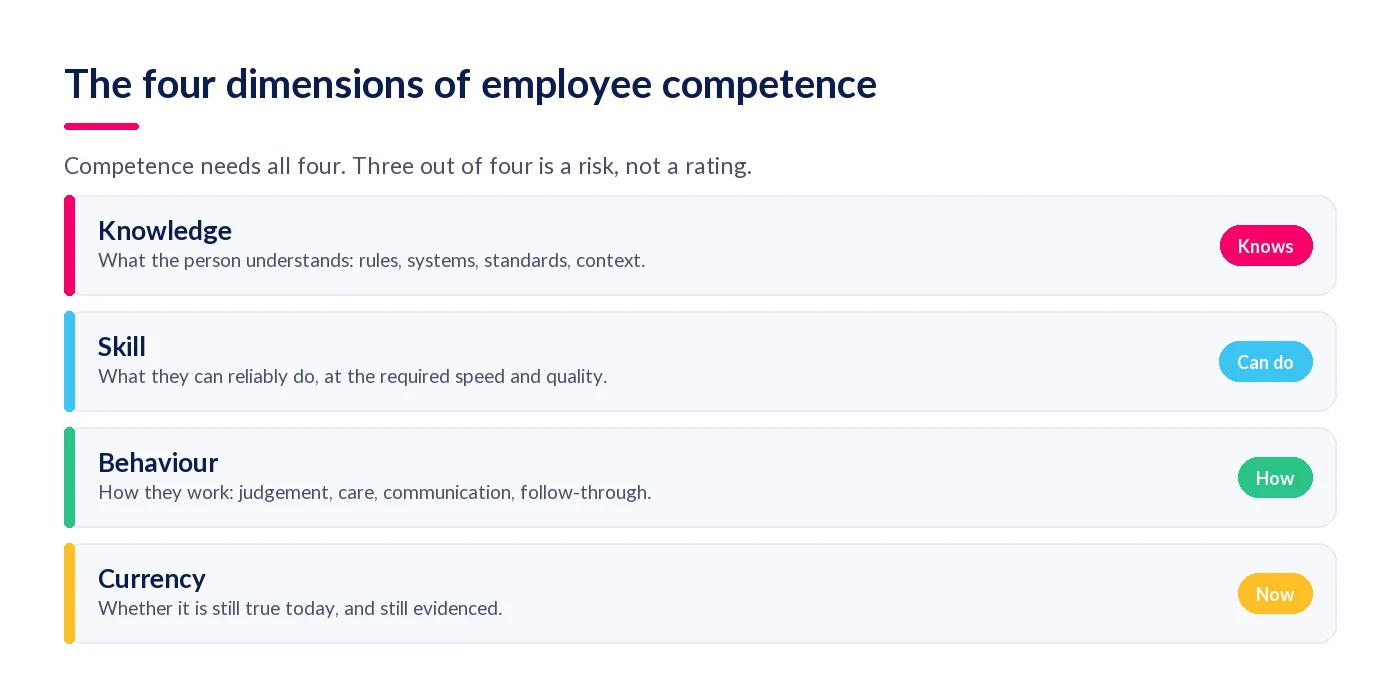
Each dimension fails in a recognisable way:
- Knowledge without skill is the person who can describe the procedure fluently and has never run it unsupervised.
- Skill without knowledge is the person who does the task well by habit and cannot adapt when the situation changes shape.
- Knowledge and skill without the behaviour is the technically capable colleague who cuts corners, skips the handover, or will not raise a problem early.
- All three without currency is the most dangerous, because the record still says competent. Someone assessed four years ago on a system that has since been replaced is not competent on today's system, however good the original assessment was.
What evidence proves an employee is competent?
Only evidence that ties a named person to a written standard on a specific date proves competence. Attendance records, tenure and general managerial impressions feel like proof and are not, because none of them state what the person was judged able to do or who judged it. The table below sets out what actually counts, dimension by dimension.
| Dimension | What actually proves it | What only looks like proof | Who should confirm it |
|---|---|---|---|
| Knowledge | A dated assessment or structured questioning against defined criteria, including the edge cases and the escalation rules. | Course attendance. A completed e-learning module with an unlimited retry. | A qualified assessor or senior practitioner, not the trainer who delivered the content. |
| Skill | Observed performance of the real task, or a work sample checked against the same criteria used for everyone else. | Years in the role. A self-rating with no second opinion. A manager saying they have never had a problem. | Someone who performs the task at or above the required level. |
| Behaviour | Multiple observations across different situations, against level wording specific enough that two managers would agree. | A single appraisal rating. Popularity. Absence of complaints. | The line manager, corroborated by at least one other observer or by peer feedback. |
| Currency | A live record with an assessment date, an expiry or review date, and a note of what changed since. | A certificate with no expiry check. A framework last reviewed two years ago. | Whoever owns the record, with a scheduled review rather than an ad hoc one. |
| Judgement under pressure | How the person handled a real incident, near miss or escalation, reviewed after the event. | A scenario answered in an interview or a workshop. | The manager who was there, plus whoever reviewed the incident. |
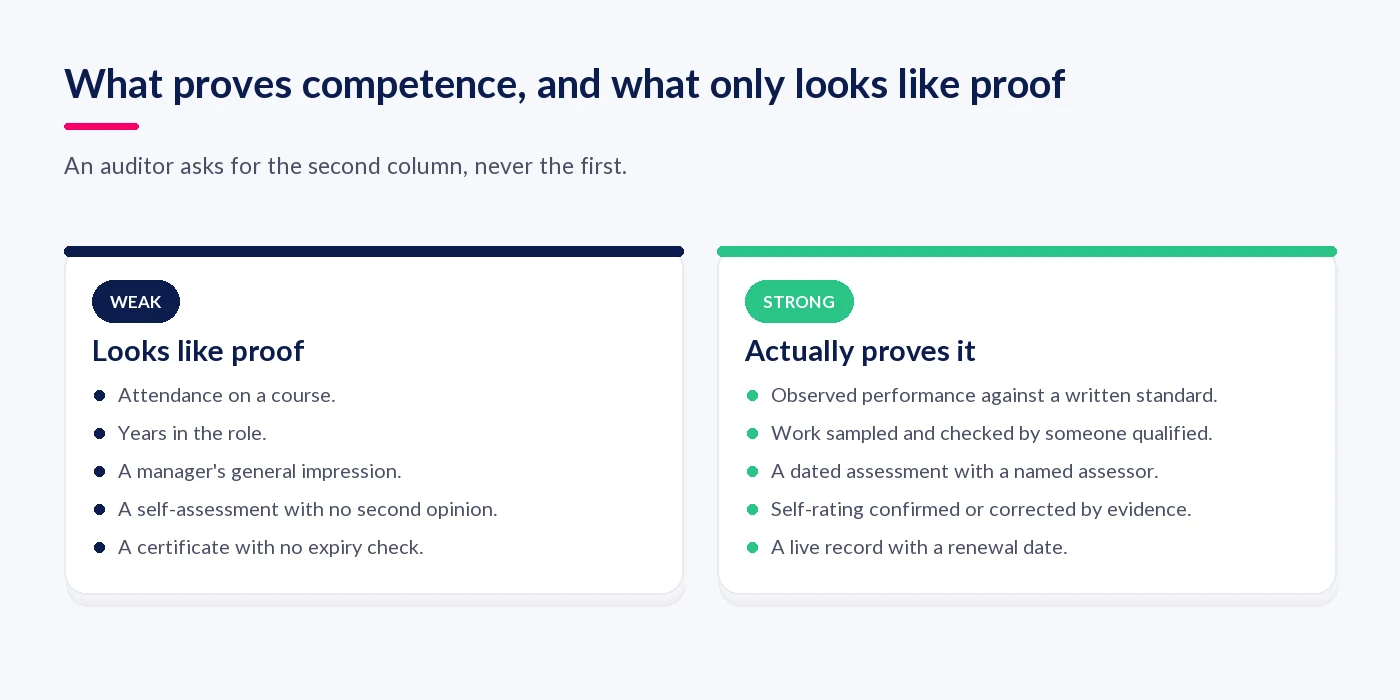
In regulated work this stops being a matter of good practice. Regulation 8 of the Construction (Design and Management) Regulations 2015 requires that a designer or contractor appointed to a project must have the skills, knowledge and experience necessary to fulfil the role, and requires whoever appoints them to take reasonable steps to satisfy themselves of it. The left-hand column of that table is what discharges the duty. The right-hand column is what organisations produce when an inspector asks and are then surprised it is not enough.
How do you assess whether an employee is competent?
Assess against the role standard, not against other people, and gather evidence for each of the four dimensions separately before reaching a single conclusion. The process below takes about an hour per person once the standard exists, and produces a rating you can defend.
- State the required level for the role, in writing, before you look at the person. Rating someone before you have fixed the bar is how bias enters. If two people in the same job have different required levels, say why.
- Collect the person's self-assessment first. It is genuinely useful data, particularly where it is lower than the manager's view, and it makes the conversation a comparison rather than a verdict.
- Gather evidence for each dimension separately. Knowledge from questioning, skill from observation or work sampling, behaviour from multiple observations, currency from the record. Do not let a strong showing in one carry the others.
- Get a second opinion on anything borderline. One assessor is enough for a clear pass or a clear gap. Borderline cases are exactly where a single rater's preference decides the outcome.
- Record the rating with a date, the assessor and a review point. A rating without those three fields becomes unusable within a year, because nobody can tell how old it is or what it was based on.
- Turn every gap into one named action with an owner. An assessment that produces no action is an audit of your own staff, and people notice.
Doing this on spreadsheets is where it fails: the standard lives in one file, the ratings in another, and the renewal dates in nobody's calendar. Holding the role standard, the assessment and the evidence on a single record is what removes up to 90% of the administration involved, and the methodology behind that figure is set out on our customer outcomes page. The competency and assessment records themselves live in StaffCircle's competency framework tools.
If the reason you are assessing competence is to work out who could step up, the Succession Planning Guide with free customisable templates covers turning those ratings into a bench.
What is the difference between a competent employee and a high performer?
Competent means meeting the standard the role requires. High-performing means exceeding it, consistently, usually with an effect on other people's work as well as their own. Most of any workforce is competent and not high-performing, and that is a healthy state rather than a problem to be fixed.
Conflating the two causes real damage in both directions. Treating every competent employee as underperforming produces a permanent improvement culture nobody can win at. Treating every high performer as competent in every dimension is how organisations promote someone into a role they have never demonstrated a single behaviour for. Separating current competence from future potential is the whole purpose of the 9-box grid, and the training half of the gap is covered in competency-based training. Where competence records feed bench strength rather than just this year's appraisal, Success Circles is how that view is built from everyday signals against the same competencies.
At team level, the practical instrument for holding all of this is a skills matrix: required level per role, current level per person, and the gap visible in a single grid. The wider series sits on the competency framework article index.
Frequently asked questions
What is the difference between competence and competency?
Competency is the defined capability a role requires, written into a framework. Competence is whether a specific person currently meets it. In everyday use the words are swapped freely, but keeping them apart is useful: a framework holds competencies, while a person holds competence in a role, at a point in time.
Can an employee be competent but still underperform?
Yes, and it is common. Competence is capability; performance is what actually got delivered. Someone fully capable can underdeliver because of workload, unclear priorities, a poor process, health, or motivation. Treating a performance problem as a capability problem sends people on training that was never the answer.
How often should employee competence be reassessed?
Annually for most roles, and more often where the work, the technology or the regulation changes quickly. In regulated safety and clinical roles the cycle is usually set externally. The trigger matters more than the calendar: reassess whenever the role changes materially, not only when the review date arrives.
Who decides whether an employee is competent?
The line manager usually holds the decision, working to written criteria, with a second opinion on borderline cases. For technical or safety-critical competencies the assessor should be someone who performs the task at or above the required level. HR owns the standard and the consistency, not the individual judgement.
What happens if an employee is found not competent?
Not yet competent is a development finding, not a disciplinary one, and should produce a named action with an owner and a date. Where the gap creates immediate risk, the role is normally supervised or restricted until the assessment is passed. Repeated failure after genuine support becomes a capability process.
If you need one record showing the standard, the assessment and the evidence for every person, that is what StaffCircle's competency framework tools are built to hold.
Related articles

See StaffCircle in action
Book a personalised demo and see how StaffCircle drives performance, engagement and development.