What is competency-based training?
A competency-based training programme is one that measures completion by demonstrated capability rather than hours attended: a learner moves on only once they can perform the task to a written standard, assessed by someone qualified to judge it. The same term covers two things, a workplace training model and an education model called competency-based education.
Key facts
- Competency-based training ends when capability is proven, not when the timetable does.
- Assessment is against a written standard, judged by a qualified assessor.
- English apprenticeship standards define knowledge, skills and behaviours, tested at end-point assessment.
- In schools and colleges the same idea is called competency-based education.
- Time-based training records attendance; competency-based training records evidence.
What does competency-based training mean?
It means the training is designed around a defined standard of performance, and a learner is only signed off when they have demonstrated that standard in practice. Content, pace and duration all flex; the standard does not. That single inversion, from time as the constant to capability as the constant, is the whole of the model.
Four things follow from it, and all four are practical rather than theoretical:
- The standard is written before the course. You cannot assess against a standard you have not defined, which is why competency-based training usually depends on a competency framework existing first.
- Duration varies by person. Two learners on the same programme may finish weeks apart, and neither outcome is a failure.
- Assessment is observational, not just written. A test can confirm knowledge; only observed practice confirms skill.
- Completion produces evidence, not a certificate. The record says who assessed what, against which standard, on what date.
What is competency-based education?
Competency-based education is the same principle applied in schools, colleges and universities: learners progress when they demonstrate mastery of a defined competency rather than when a term or module ends. It is often called mastery learning, and it changes what a qualification certifies, from time enrolled to capability evidenced.
The UK's clearest working example is the apprenticeship system in England. Each apprenticeship standard published by Skills England defines the knowledge, skills and behaviours (KSBs) needed to competently carry out an occupation, and the apprentice is then tested by an independent end-point assessment designed to confirm they can actually perform in that occupation. The training provider delivers; a separate organisation confirms competence. That separation of teaching from judging is a defining feature of the model, and it is what stops a provider certifying its own results.
The reason both meanings matter to an HR reader is that they meet in the middle. An apprentice arrives with a KSB-shaped record of competence; your internal framework then has to keep that record alive rather than filing the certificate and starting again.
How is competency-based training different from traditional training?
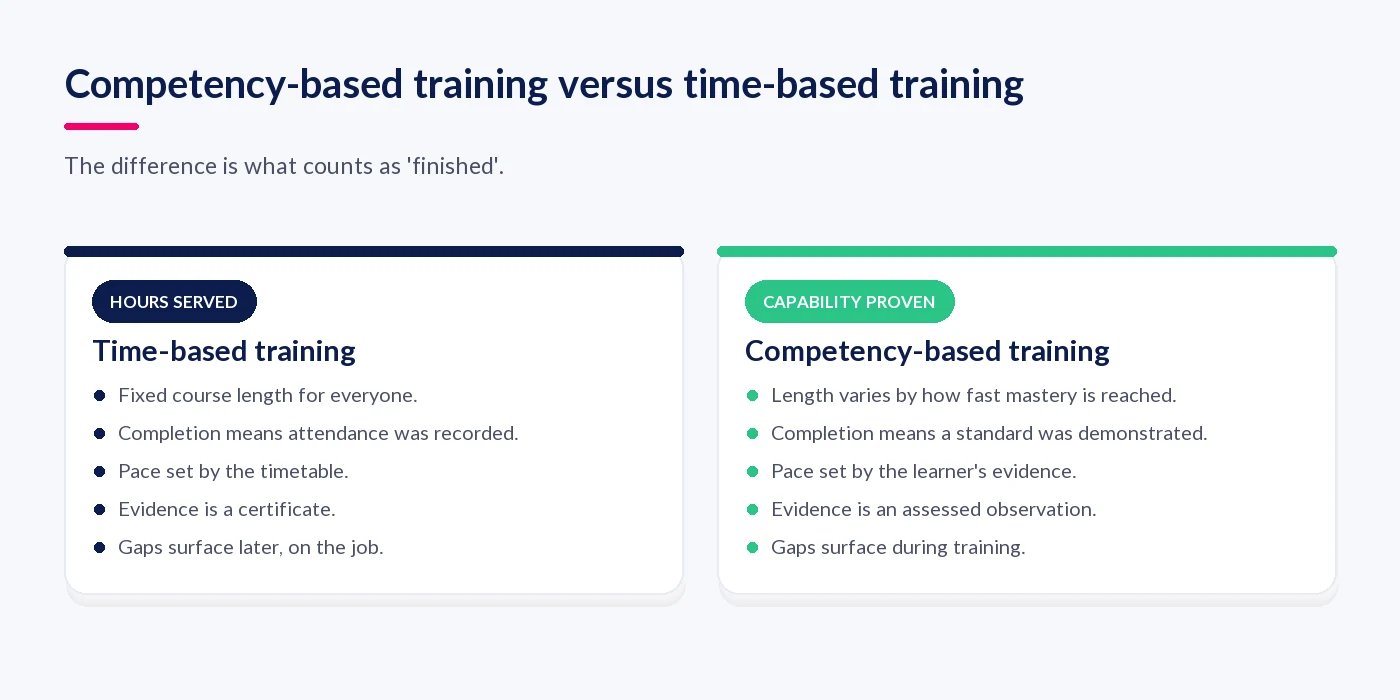
Traditional training fixes the time and lets capability vary; competency-based training fixes the capability and lets time vary. Everything else in the table below follows from that one difference, including where the cost sits and where gaps surface.
| Dimension | Traditional, time-based training | Competency-based training |
|---|---|---|
| What "complete" means | The course ended and attendance was recorded. | A written standard was demonstrated and signed off. |
| What is fixed | Duration and content. | The standard of performance. |
| What varies | How capable people are at the end. | How long each person takes to get there. |
| Pace | Set by the timetable and the group. | Set by the individual's evidence. |
| Assessment | Often a knowledge test, or none at all. | Observed performance plus knowledge, against defined criteria. |
| Who judges | The trainer who delivered the content. | A qualified assessor, ideally independent of delivery. |
| Evidence produced | An attendance record and a certificate. | A dated assessment naming the assessor, the standard and the outcome. |
| Where gaps surface | Later, on the job, usually as an incident or a complaint. | During training, while it is still cheap to fix. |
| Cost profile | Predictable up front, unpredictable afterwards. | Higher design and assessment cost, lower rework cost. |
| Best suited to | Awareness, induction, updates on policy. | Anything where doing it wrong has a real consequence. |
The honest weakness of the competency-based column is assessor time. Observing and signing off individuals costs more than putting thirty people in a room for a day, and organisations that ignore that cost end up with a competency-based design assessed in a time-based way, which is the worst of both. Budget the assessment, or do not claim the model.
Where is competency-based training used?
It concentrates wherever getting the job wrong has a consequence somebody has to answer for: regulated safety work, clinical and care practice, apprenticeships, and any role where a customer or an auditor can ask to see proof of capability. It is also used in ordinary corporate development, though usually less rigorously.
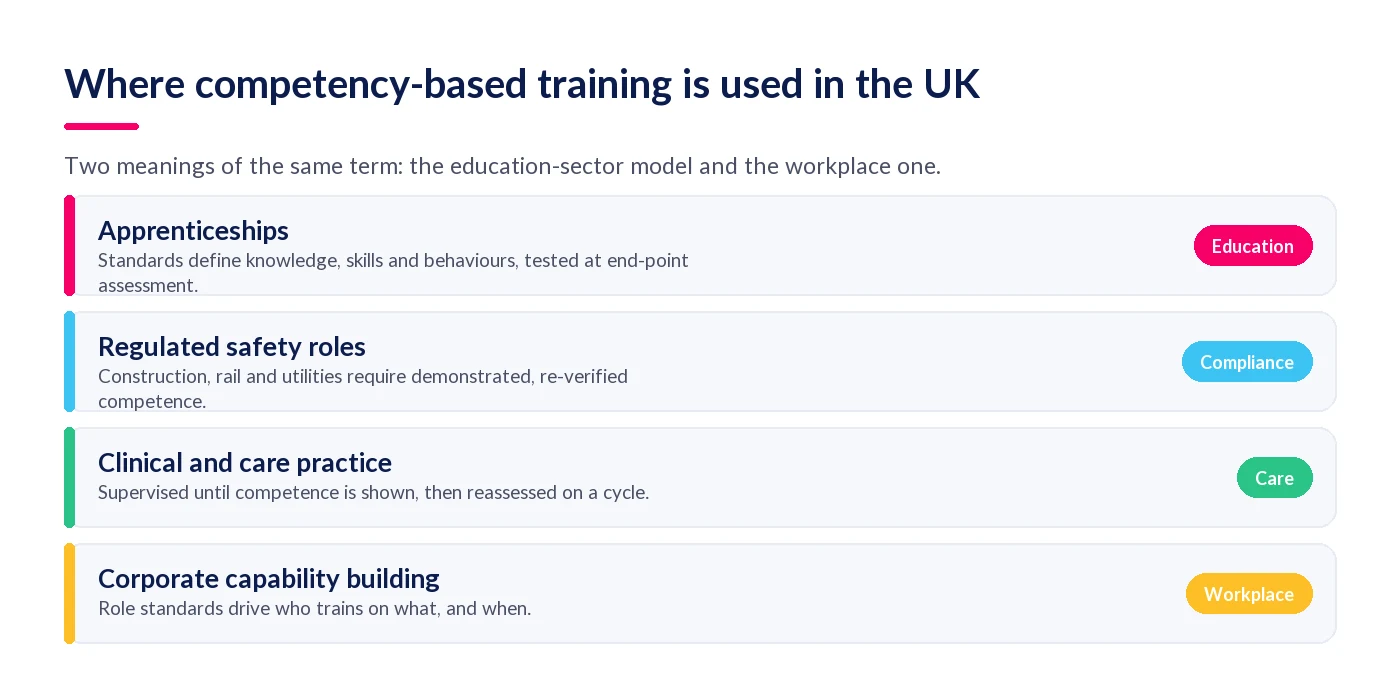
Construction is the clearest regulated case. Regulation 8 of the Construction (Design and Management) Regulations 2015 requires that a designer or contractor appointed to a project must have the skills, knowledge and experience necessary to fulfil that role, and puts a duty on whoever appoints them to take reasonable steps to satisfy themselves of it. A training log showing who attended a course does not discharge that duty. An assessment record showing what each person was judged able to do, by whom and when, does.
In corporate settings the driver is usually different but the mechanics are the same. Once role standards exist, training stops being a catalogue people browse and becomes a response to a specific, evidenced gap. Our guide to skills gap analysis covers how those gaps are identified at organisation level, and a skills matrix is how a single team keeps track of who has reached which level.
If the reason you are reading this is that development is meant to feed promotion decisions, the Succession Planning Guide with free customisable templates covers that half of the problem.
How do you set up competency-based training?
Start from the standard and work outwards to the content, which is the reverse of how most training is commissioned. Define what competent looks like, decide how it will be evidenced, design the training to close the distance, then build the record that proves it. Six steps.
- Write the standard for one role, not the whole organisation. Take a single role family and define the competencies and levels required. Without this, everything downstream is guesswork.
- Decide what counts as evidence for each competency. Observation, work sampling, a knowledge check, a customer outcome. Agree it before anyone trains, or the assessment becomes a negotiation.
- Assess current capability against the standard. You are training the gap, not the whole subject. Most people will need two or three competencies, not the full programme.
- Design the training around those gaps, in modules that can be finished independently. Fixed-length cohort courses quietly reintroduce time as the measure.
- Separate assessment from delivery. The person who signs off competence should not be the person whose teaching is being judged. In apprenticeships this is a legal separation; internally it is good practice.
- Record the outcome with a date and a review point. Competence expires. An assessment with no renewal date will be out of date long before anyone notices.
The administrative weight of steps two, five and six is what usually kills competency-based training in mid-sized organisations. Holding role standards, assessments, evidence and renewal dates in one place rather than across spreadsheets is exactly what StaffCircle's competency framework tools are built for, and the same record-keeping is why customers reach 96% on-time review completion; the methodology behind that figure is set out on our customer outcomes page. For related reading, the competency framework article index collects the series, and what makes an employee competent covers the evidence side in detail.
Frequently asked questions
How long does competency-based training take?
There is no fixed duration, which is the point. Learners who can already demonstrate part of the standard finish sooner; those starting further back take longer. In practice most organisations set an outer limit for planning purposes, but the sign-off still depends on demonstrated capability rather than the date.
Is competency-based training the same as competency-based learning?
The terms are used interchangeably in most workplaces. Where a distinction is drawn, training refers to the designed intervention and learning to the learner's progression through it. Competency-based education is the school, college and university version of the same principle, usually with formal assessment and accreditation attached.
What are the disadvantages of competency-based training?
It costs more to design and far more to assess, because sign-off is individual rather than group-based. Progress is harder to forecast, which complicates resource planning. It also handles judgement and behaviour less neatly than technical tasks, so behavioural competencies need multiple observations over time rather than one assessment.
Who assesses competence in competency-based training?
Someone qualified in the competency being assessed, and ideally not the person who delivered the training. In apprenticeships an independent end-point assessment organisation does it. Internally the assessor is usually a senior practitioner or line manager working to written criteria, with a second opinion on borderline cases.
Does competency-based training work for soft skills?
Yes, but only if the behaviour is written as something observable and assessed more than once. A single observation of a difficult conversation proves very little. Three observations across different situations, against wording specific enough that two managers would agree, does produce a defensible judgement.
If you need role standards and assessment records in one place before you redesign any training, that is what StaffCircle's competency framework tools provide.
Related articles


See StaffCircle in action
Book a personalised demo and see how StaffCircle drives performance, engagement and development.