What is a competency-based interview?
A competency-based interview is a structured interview in which every candidate is asked the same questions about things they have actually done, and each answer is scored against a published set of competencies and rating levels rather than judged on the interviewer's overall impression of the conversation.
Key facts
- Every candidate gets the same questions, in the same order, on the same scale.
- Answers are rated against defined behaviours, not against the previous candidate.
- The UK Civil Service runs this format nationally through its Success Profiles framework.
- Most interviews cover four to six competencies in 45 to 60 minutes.
- Probing follow-ups exist to separate your actions from your team's.
How does a competency-based interview work?
The employer picks four to six competencies from the role's framework, writes one question for each, and asks every candidate the same set in the same order. Each answer is probed until the candidate's own actions are clear, then scored against a published rating scale. Scores are compared across the panel before any hiring decision is made.
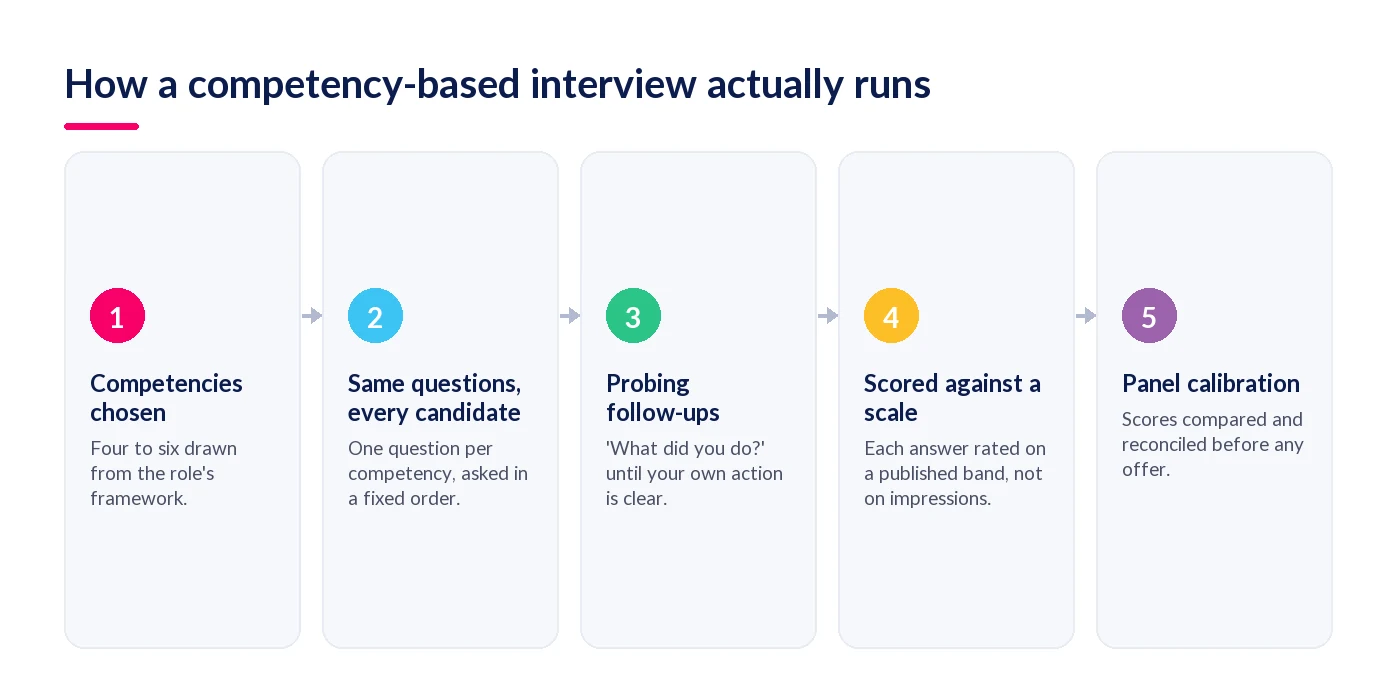
The design is deliberately restrictive, and that is the point. Unstructured interviews drift towards whoever the interviewer found easiest to talk to. Fixing the questions, the order and the scale removes most of that drift, which is why regulated and public-sector employers standardised on it. The UK Civil Service Success Profiles framework is the largest published example: it defines five assessment elements, of which behaviours is the competency-based one, and each behaviour is written out separately for every grade band.
The competencies themselves come from the employer's framework, not from the interviewer's judgement on the day. If you want to see where that list originates, start with what a competency framework is.
What questions are asked in a competency-based interview?
The questions change with the seniority of the role, even when the competency name stays the same. A graduate is asked about their own delivery; a manager about the team's; a senior leader about the function's. Below are 21 examples grouped by level, so you can see the widening scope directly.
| Level | Competency | Example question |
|---|---|---|
| Graduate or first role | Delivering at pace | Tell me about a time you had to organise your own work to hit a deadline. |
| Working together | Describe a group project where someone was not pulling their weight. | |
| Developing self | Tell me about something you taught yourself outside a course. | |
| Communicating | Describe a time you had to explain something to someone who was not interested. | |
| Making decisions | Tell me about a choice you made with less information than you wanted. | |
| Changing and improving | Give an example of doing something in a better way than you were shown. | |
| Resilience | Tell me about a setback and what you did in the week afterwards. | |
| Manager or team lead | Delivering at pace | Describe a time your team was going to miss a commitment. What did you change? |
| Developing others | Tell me about someone whose performance you improved. What did you actually do? | |
| Making decisions | Describe a decision you made that was unpopular with your team. | |
| Communicating and influencing | Tell me about a time you had to get a peer department to change its plan. | |
| Managing a quality service | Describe a recurring failure in your area and how you removed the cause. | |
| Working together | Tell me about a conflict between two people in your team. | |
| Changing and improving | Describe a change you implemented that your team resisted. | |
| Senior leader | Seeing the big picture | Tell me about a time you stopped work that was going well because it no longer fitted the strategy. |
| Making decisions | Describe the hardest trade-off you have made between cost and capability. | |
| Developing others | Tell me how you built a successor for a role you owned. | |
| Communicating and influencing | Describe a time you had to take a board or executive team somewhere they did not want to go. | |
| Leadership | Tell me about a culture problem you inherited and what measurably changed. | |
| Changing and improving | Describe a transformation that underdelivered. What did you learn? | |
| Managing a quality service | Tell me how you decided what to stop doing when resources were cut. |
For a bank organised the other way round, by competency area rather than by seniority, along with what interviewers listen for in each answer, see our guide to competency-based questions.
How are competency-based interviews scored?
Each answer gets a score on a fixed band scale, one score per competency, and the bands describe what an answer had to contain rather than how the candidate came across. Scores are then compared across interviewers and reconciled, so a generous marker and a harsh one do not decide the outcome. Below is a working four-band rubric of the kind most employers use.
| Band | What it means | What the answer contained |
|---|---|---|
| 4 — Strong | Clearly exceeds the standard for the grade. | A recent, specific episode; the candidate's own actions unambiguous; a named obstacle; a quantified result; and a change made afterwards. |
| 3 — Meets | Meets the standard for the grade. | A specific episode with clear personal actions and a stated outcome, but no quantification or no reflection. |
| 2 — Partial | Some evidence, not enough to confirm the standard. | A relevant example, but the actions blur into the team's, or the result is missing. |
| 1 — Limited | Little usable evidence. | General statements about how the candidate normally works, with no single episode described. |
| 0 — No evidence | Nothing to score. | No example offered, or an example that does not relate to the competency asked about. |
Two consequences follow from this. First, a candidate can be interesting, likeable and articulate and still score a 1, because none of those things are on the scale. Second, the scale tells you exactly what to put into an answer: the episode, the personal action, the obstacle, the number, the lesson. Employers building the scale rather than sitting the interview should start from an agreed definition of what makes an employee competent, because a rubric with no underlying standard just relocates the guesswork.
The internal equivalent of this problem is assessing people you already employ against a role standard before promoting them, which is what the Succession Planning Guide with free customisable templates is built for.
What is the difference between a competency-based interview and a strengths-based interview?
A competency-based interview asks what you have already done and scores the evidence against defined behaviours. A strengths-based interview asks what you enjoy, what energises you and what you do instinctively, and reads the answers for authenticity and pace. One predicts whether you can do the job; the other predicts whether you will keep doing it well.
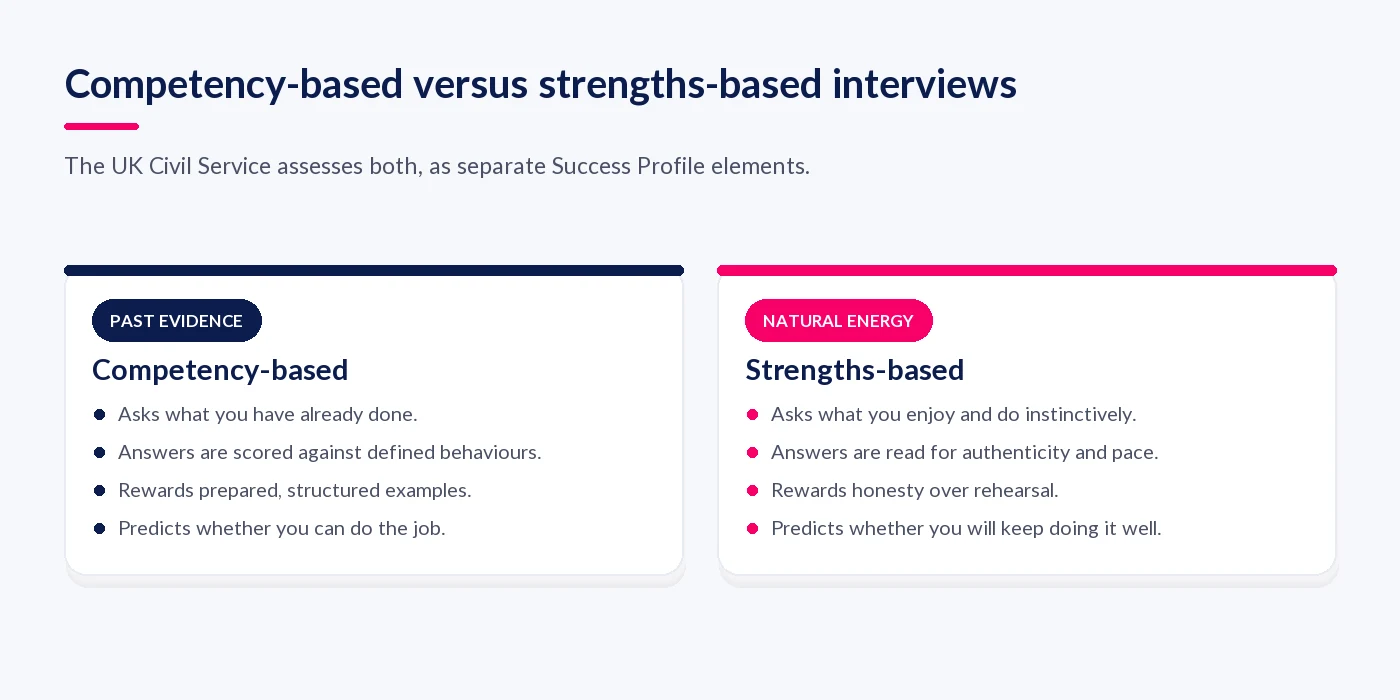
The two are not rivals, and many employers run both. In the Civil Service they are separate elements of the same Success Profile, assessed and scored independently. The practical difference for a candidate is preparation: competency questions reward a prepared bank of structured examples, while strengths questions are asked at a faster tempo precisely so that rehearsed answers stand out as rehearsed.
How do you prepare for a competency-based interview?
Work backwards from the scoring scale rather than forwards from your CV. Find the competencies, build six examples that cover them between them, write each one out with a number in the result, and check that every example makes your own actions unmistakable. Five steps, and the fourth is the one most candidates skip.
- Find the competencies before anything else. They are usually in the person specification. If the employer publishes a framework, read the level wording for the exact grade, not the grade above.
- Build six episodes, not twenty answers. Six varied examples from the last three years will cover four to six competencies with room to redirect if a question arrives in an unfamiliar shape.
- Write each episode out with the result quantified. A number in the result is the single clearest separator between a band 3 and a band 4 answer.
- Strip "we" out of the action section. Go through each written example and replace every collective verb with what you personally did. This is the step that moves most answers up a band.
- Prepare for the probe, not just the question. For each example, know the detail one layer down: the date, the numbers, who objected, what you would do differently. Probing questions are where partial answers come apart.
If you are on the hiring side, the same preparation applies in reverse: the interview is only as consistent as the framework behind it. Our competency framework examples show the level wording that makes a rubric usable, and the rest of the series sits on the competency framework article index.
Frequently asked questions
How long does a competency-based interview last?
Typically 45 to 60 minutes for four to six competencies, allowing roughly eight minutes per competency including probing follow-ups. Senior appointments often run 90 minutes or split across two panels. If the invitation names the competencies and the duration, you can work out how much depth each answer needs.
How many competencies are assessed in a competency-based interview?
Four to six is standard. Fewer than four rarely covers the role adequately; more than six means each one gets too little time to probe properly. Employers assessing more than six usually split them across stages, with one panel taking behaviours and another taking technical competence.
Are competency-based interviews the same as behavioural interviews?
Effectively yes. Behavioural interview is the more common term in the United States, competency-based in the UK and Ireland. Both ask for described past behaviour and score it against defined criteria. Where they differ is emphasis: competency-based interviews are usually tied to a published framework with named levels.
Can you fail a competency-based interview on one answer?
Sometimes, yes. Many employers set a minimum band per competency alongside an overall threshold, so a zero or one on any single competency can rule a candidate out regardless of the total. This is why a weak example is better than no example, and why you should never skip a question.
What should you take into a competency-based interview?
A single page listing your six episodes by competency, with the key numbers, is normally acceptable and often welcomed. Do not take full written answers, because reading them out flattens the delivery and makes probing awkward. Check the invitation, as some assessment centres restrict notes.
If you are designing the interview rather than sitting it, the framework and scoring scale behind it are what StaffCircle's competency framework tools are built to produce.
Related articles


See StaffCircle in action
Book a personalised demo and see how StaffCircle drives performance, engagement and development.