What are competency-based questions?
A competency-based question is an interview question that asks you to describe something you have actually done, so the interviewer can score real evidence of a defined behaviour instead of an opinion about you. They usually open with "Tell me about a time when", and every candidate is asked the same ones.
Key facts
- Competency-based questions ask what you did, never what you would do.
- Every candidate gets the same questions, so answers can be compared fairly.
- STAR, meaning situation, task, action and result, is the standard answer structure.
- Interviewers score your own actions, so answers built on "we" lose marks.
- Four to six competencies is typical for a single interview.
What is a competency?
A competency is a specific, observable capability a role requires, written down clearly enough that two different assessors watching the same person would agree on whether the standard was met. It covers what someone knows, what they can do, and how they behave while doing it. It is not a personality trait, and it is not a task from a job description.
That definition is why competency-based questions exist. If a competency is observable behaviour, the fairest way to assess it before you hire someone is to ask for a described instance of that behaviour and score what they actually did. Our guide to what a competency framework is explains where the list of competencies being tested comes from, and competency framework examples shows the level-by-level wording assessors score against.
What do competency-based questions look like?
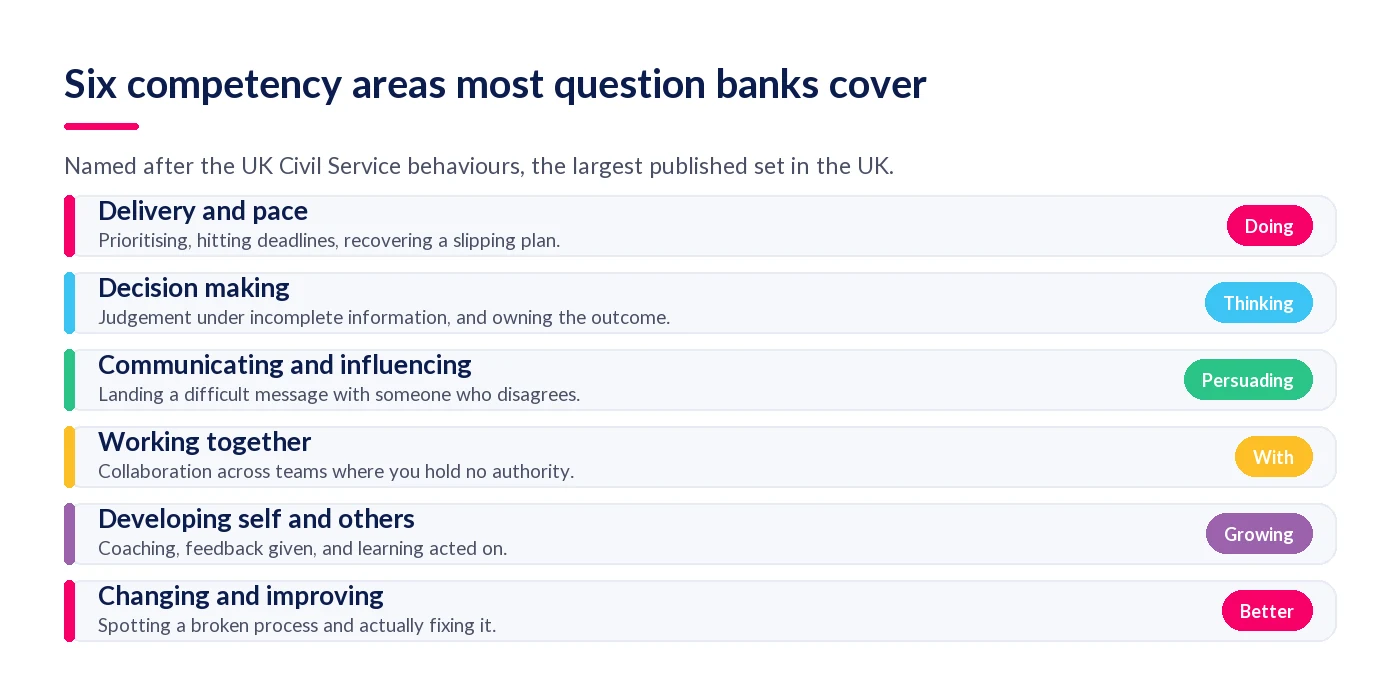
They look like requests for a specific past episode, grouped by the competency being tested. Below are 24 real examples across the six competency areas that appear most often in UK interviews, together with what the interviewer is listening for in each answer. The behaviour names follow the UK Civil Service Success Profiles behaviours, the largest published behaviour set in the country.
| Competency area | Example question | What the interviewer is listening for |
|---|---|---|
| Delivering at pace | Tell me about a time you had to deliver something to a tight deadline. | Whether you re-planned the work or simply worked longer hours. |
| Describe a time you had to reprioritise at short notice. What did you drop? | Whether you can name the trade-off you made, and who you told. | |
| Tell me about a piece of work that slipped. What did you do? | Early escalation rather than hoping it would recover quietly. | |
| Give an example of handling several competing deadlines at once. | A repeatable method, not heroics. | |
| Making effective decisions | Tell me about a difficult decision you made with incomplete information. | How you bounded the risk before committing. |
| Describe a decision you got wrong. What happened next? | Whether you own it without either excusing or over-apologising. | |
| Give an example of a time you had to decide quickly. | Speed paired with one deliberate check. | |
| Tell me about a time you challenged a decision made by someone more senior. | Judgement and tact together, and what you did when overruled. | |
| Communicating and influencing | Tell me about a time you explained something technical to a non-technical audience. | Whether you changed the message or just slowed it down. |
| Describe a time you persuaded someone who initially disagreed with you. | Evidence you understood their objection before answering it. | |
| Give an example of delivering unwelcome news to a client or colleague. | Directness with care, and what you offered alongside the bad news. | |
| Tell me about a time your communication was misunderstood. | Whether you noticed, and what you changed afterwards. | |
| Working together | Tell me about a time you worked with a team you had no authority over. | Influence without a reporting line. |
| Describe a disagreement with a colleague and how it was resolved. | Whether the working relationship survived the disagreement. | |
| Give an example of covering for someone who was under pressure. | Judgement about when helping becomes absorbing their problem. | |
| Tell me about a time you had to work with someone you found difficult. | Professionalism, and no character assassination of the absent colleague. | |
| Developing self and others | Tell me about the most useful piece of feedback you have received. | A specific change you made because of it. |
| Describe a time you coached someone through something they found hard. | Whether you did it for them or taught them to do it. | |
| Give an example of a skill you deliberately set out to learn. | A plan, a timeframe and a point where it became useful. | |
| Tell me about a time you raised a performance concern with someone. | Whether you addressed it early and in person. | |
| Changing and improving | Tell me about a process you improved. | A before and an after you can quantify. |
| Describe a time you had to work in a new way you did not agree with. | Whether you engaged with the change while raising the concern properly. | |
| Give an example of spotting a problem before it became one. | What signal you noticed, and who you took it to. | |
| Tell me about a change you led that met resistance. | How you handled the people who never came round. |
Two patterns are worth noticing. Every question asks for one episode, not a general policy, which is why "I always make sure to" is the fastest way to lose a mark. And several questions deliberately invite a failure. Those are not traps; they test whether you can hold a mistake and a lesson in the same answer.
How do you answer a competency-based question?
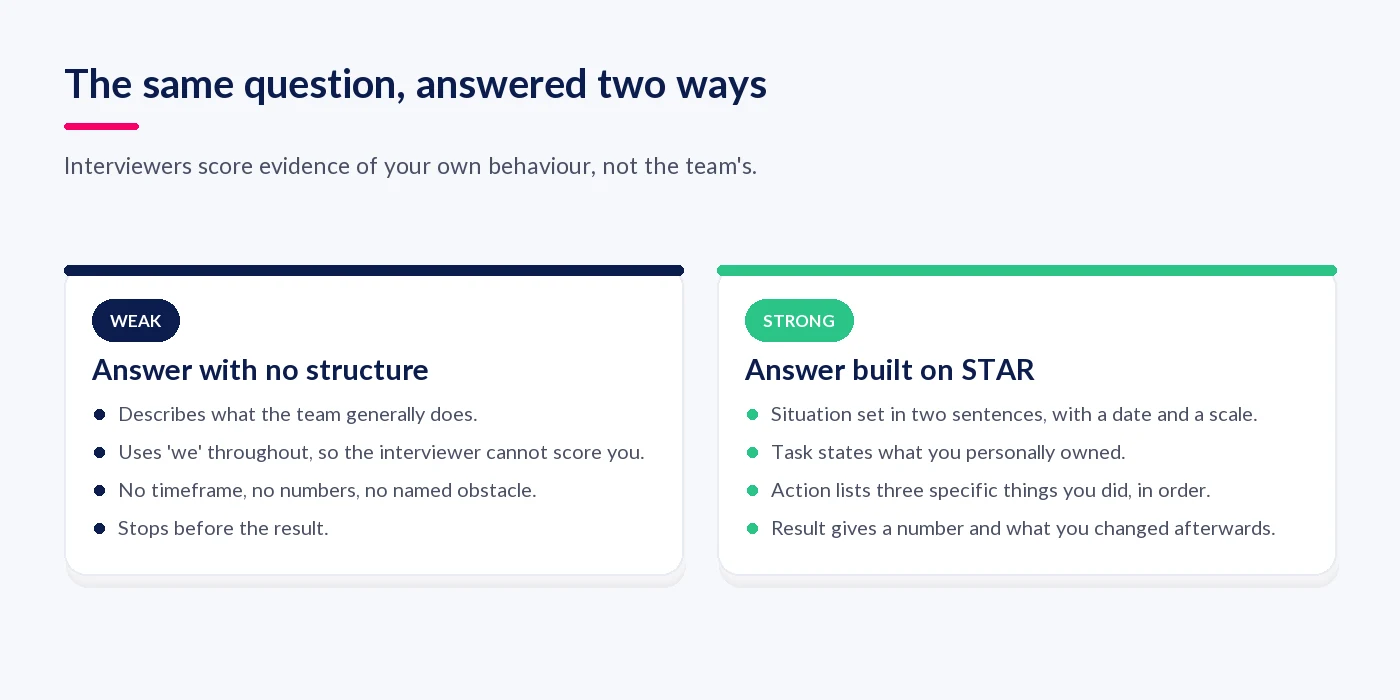
You answer with STAR: set the situation in two sentences, state the task you personally owned, describe three specific actions you took, then give the result with a number in it. Roughly two minutes in total, weighted heavily towards the action. The most common failure is not lack of experience but an answer where the interviewer cannot tell what you did rather than what the team did.
Here is the structure applied to a real question, with the wording written out rather than described. The example is illustrative, but it is the level of specificity a scored answer needs.
| Element | What it has to establish | Model wording |
|---|---|---|
| Situation | When, where, and how big. Two sentences maximum. | "Last September our largest client moved their board meeting forward by three weeks. That meant the annual service review pack, normally six weeks of work across four people, had to be finished in seventeen days." |
| Task | What you personally owned, and the constraint. | "I owned the pack. My job was to deliver it complete and accurate without pulling the team off two other live accounts." |
| Action | Three specific things you did, in order, with the reasoning. | "I did three things. First I asked the client's operations director which three decisions the board actually needed to make, and cut the pack from forty slides to eighteen. Second I moved data collection off a shared spreadsheet to a single named owner per section, with a fifteen-minute stand-up at nine each morning. Third, on day four, I escalated to my manager to get two days of an analyst's time released from a lower-priority internal project." |
| Result | The outcome, quantified, plus what changed afterwards. | "We delivered on day fifteen, two days early, and the client signed the renewal at that board meeting. We kept the eighteen-slide format for every review since, which took roughly a third out of the preparation time." |
Compare that with the same experience answered without structure: "We had a really tight turnaround on a client review last year and everyone pulled together. It was stressful but we got there in the end and the client was happy." Nothing in that sentence is untrue, and nothing in it can be scored. There is no timeframe, no named obstacle, no action attributable to the speaker, and no result.
What are interviewers actually scoring?
Interviewers score four things in each answer, and they score them separately: whether the example is genuinely relevant to the competency, whether your own actions are clear, whether the actions show judgement rather than effort, and whether there is a stated result. An answer can be enjoyable to listen to and still score badly on all four.
This is why probing follow-ups happen. "What did you do?", asked twice, is not the interviewer being slow. It is them trying to separate you from your team so they have something to write in the box. The same logic applies from the employer's side of the table: a scoring scale is only as good as the underlying standard, which is the argument for defining what makes an employee competent before you write the questions.
If you are building the question set rather than answering it, the Succession Planning Guide with free customisable templates is useful for the internal version of the same problem: assessing existing people against a role standard before you promote them.
How do you prepare for competency-based questions?
You prepare by building a small bank of your own examples rather than by memorising answers. Six well-chosen episodes, each usable for two or three different competencies, will cover almost any interview. Preparing question by question produces forty half-remembered stories and no depth in any of them.
- Pull the competencies out of the job advert. Most adverts list them explicitly, or name them in the person specification. If the employer publishes a framework, read the level wording for the grade you are applying to.
- Choose six episodes from the last three years. Aim for variety: a delivery under pressure, a conflict, a failure, a change you led, someone you developed, a decision made on thin information.
- Write each one out in STAR, in full sentences. Writing it out is what forces the numbers and the specifics to the surface. You will not recite it, but you will remember the shape.
- Map episodes to competencies, not the reverse. Note which two or three competencies each episode can serve, so you can redirect an example when a question arrives in an unexpected form.
- Rehearse the action section out loud, once. Time it. If the action takes under thirty seconds it is too thin; if the whole answer runs past three minutes you will be interrupted.
For the wider format these questions sit inside, including how the scoring and panel calibration works, see what a competency-based interview is. The full series sits on the competency framework article index.
Frequently asked questions
How many competency-based questions will I be asked?
Usually four to six in a single interview, one per competency being assessed, plus probing follow-ups on each. A forty-five minute interview rarely covers more than five properly. Panels running two rounds may split the competencies between them, so ask which ones each stage covers.
What is the STAR method?
STAR stands for situation, task, action and result. It is a four-part structure for answering competency questions: set the context briefly, state what you personally had to achieve, describe the specific actions you took, then give the outcome. The action section should take up roughly half the answer.
Can you use the same example for more than one competency-based question?
Yes, provided you emphasise a different aspect each time. Reusing an episode once is normal and shows depth. Reusing it three times sounds like you only have one story, so build a bank of six episodes and rotate. If an interviewer says they have heard it, offer a second example.
What should you do if you have no example for a competency-based question?
Say so, then offer the nearest real thing rather than inventing something. A smaller or older example described honestly scores better than a fabricated one, which probing questions expose quickly. If the experience genuinely does not exist, describe how you would approach it and flag that it is hypothetical.
How long should an answer to a competency-based question be?
Around two minutes, with the action section taking about half of it. Under a minute usually means the interviewer has too little to score and will have to probe. Beyond three minutes you lose the thread and will be interrupted mid-example, which rarely helps.
If you are on the hiring side and want the framework these questions are scored against, that is what StaffCircle's competency framework tools are built to produce.
Related articles
See StaffCircle in action
Book a personalised demo and see how StaffCircle drives performance, engagement and development.