Training Needs Analysis: A Method That Survives the Budget
Here is an unpopular opinion from someone who has read a lot of training needs analyses: most of what they find is not a training need.
A team misses its targets, a manager asks for a course, and the request joins forty others on a spreadsheet. Nobody asks whether the team already knows how to do the job and is being stopped by something else: a target that rewards the wrong behaviour, a broken tool, a process nobody explained. The course runs, the problem stays, and next year's analysis asks for it again.
That matters more when money is tight. In the UK government's Employer Skills Survey 2022, 43% of employers said they would have liked to provide more training than they did. Of those, 45% could not spare staff time and 40% lacked the funds. When budget and time are the constraint, spending either on the wrong fix is the most expensive mistake an L&D plan can make.
A training needs analysis (TNA) is a structured review of the gap between the capability your organisation needs and the capability it has, used to decide which gaps training should close. A useful TNA does three more things: it separates training gaps from problems training cannot fix, ranks the genuine needs by impact and risk, and costs them against a real budget.
Key facts
- A TNA usually works at three levels: organisation, team and individual.
- Not every performance gap is a training need; many are caused by tools, targets or process.
- UK employers spent £53.6 billion on training in 2022, according to the Employer Skills Survey.
- Health and safety training is required on recruitment and when new or increased risks arise.
- The CIPD treats ongoing learning needs analysis as a health check, not a one-off event.
What is a training needs analysis meant to tell you?
A training needs analysis tells you where capability falls short of what the business needs, why, and which shortfalls are worth paying to fix with training. The output is not a list of courses but a ranked, costed set of decisions a finance director could agree with.
Most guides describe three levels of analysis, and the CIPD's learning needs analysis factsheet uses the same split: the whole organisation, a specific department or workstream, and individuals. It also makes a point that guides often skip: the levels "must be viewed holistically", because an individual gap only matters in the context of what the team and the organisation are trying to achieve.
Whatever level you are working at, the analysis should be able to answer these questions:
- Which business outcomes is this year's development spend meant to support?
- What does competent performance look like in each role, written down?
- Where is current performance short of that standard, and what is the evidence?
- For each gap, is the cause a lack of knowledge or skill, or something else?
- Which training is required by law, regardless of preference?
- What is the cheapest intervention that would close each genuine gap?
- How will you know, three months later, whether it worked?
If you have already run a skills gap analysis, you have most of the raw material for questions two and three. The TNA is where you turn those gaps into decisions.
Is it a training problem at all?
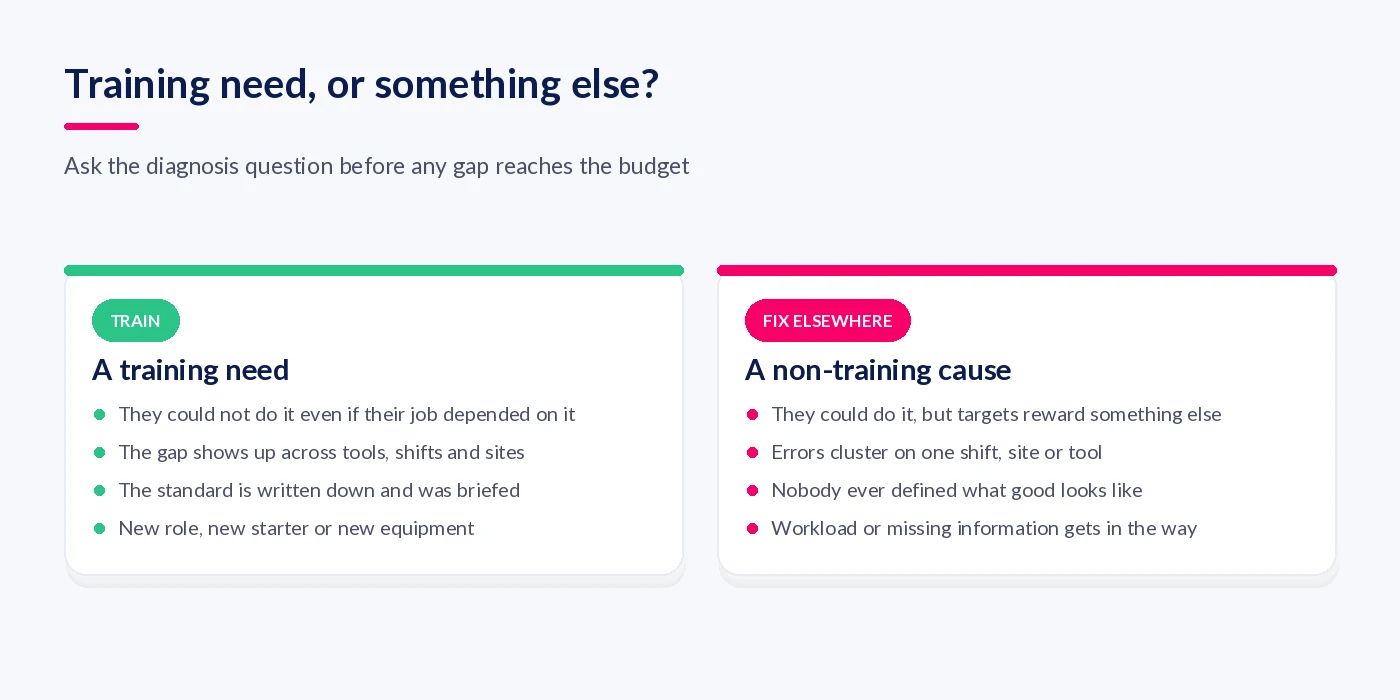
Before any gap goes into the plan, test whether training can fix it. The simplest test is a question that performance consultants have used for decades: could this person do the task correctly if their job depended on it? If the honest answer is yes, they already have the knowledge and skill, and something else is getting in the way. Training will not move it.
A piece on Cathy Moore's training design blog makes the same point at the start of its TNA method, asking "Is training the only answer?" before any analysis begins. Its worked example splits a single request into a training gap and a "management gap": staff were rushing a conversation because a handle-time scorecard rewarded speed. No course fixes a scorecard.
In my experience the non-training causes fall into a short list, and it is worth checking each one explicitly:
| What you see | Likely cause | The fix (not a course) |
|---|---|---|
| People knew the right way last month and have stopped doing it | Targets or incentives reward the wrong behaviour | Change the measure or the target |
| Errors cluster on one shift, site or piece of kit | Tools, equipment or environment | Fix the tool or the conditions |
| Different people do the task differently, all confidently | The standard was never defined or communicated | Write the standard; brief it; add a job aid |
| Good people do the task late or partially | Workload or competing priorities | Re-plan the work, not the people |
| Nobody can find the current version of the process | Information or access | Put the process where the work happens |
These gaps still need fixing. Give each one an owner outside L&D, usually the operational manager, and record it in the analysis so it does not reappear next year as a course request.

How do you carry out a training needs analysis?
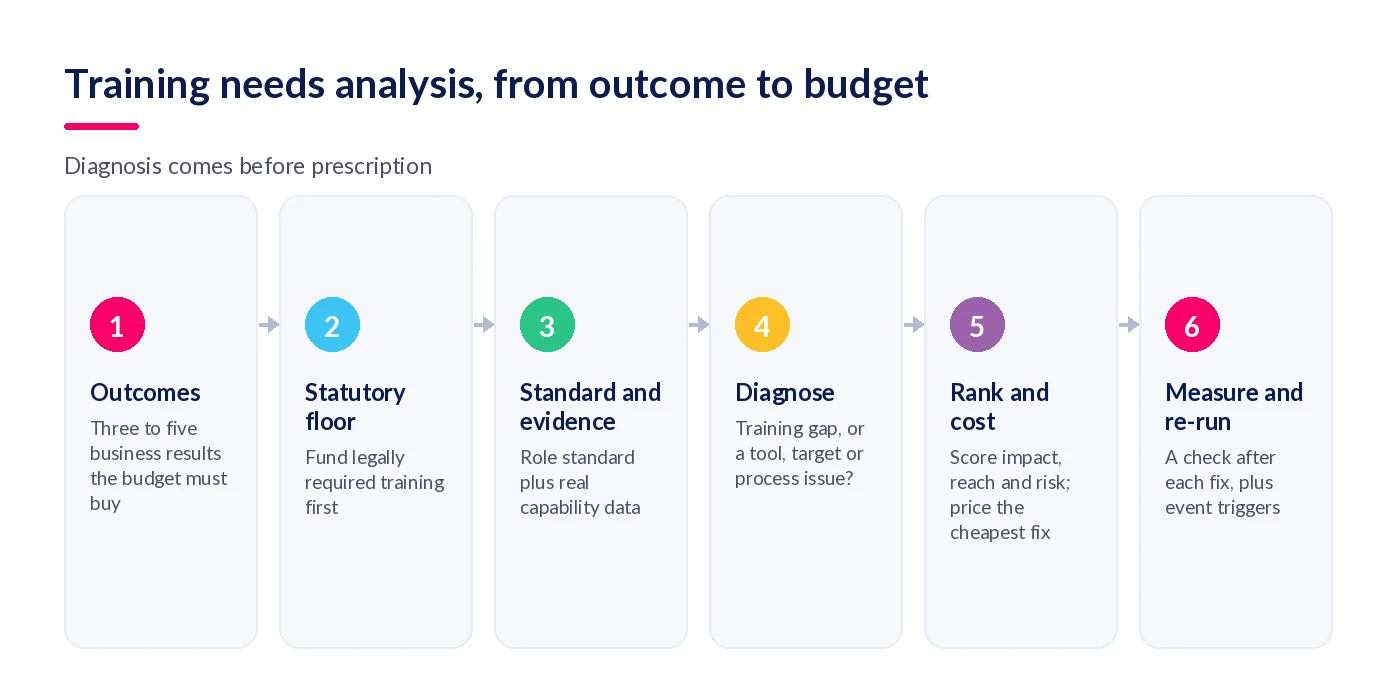
You carry out a training needs analysis by starting from the business outcomes, ring-fencing statutory training, defining the standard for each role, gathering evidence of current capability, diagnosing each gap, then ranking and costing the genuine training needs. The eight steps below are the version I would run in a mid-sized organisation with a fixed budget.
- Name the outcomes the budget has to buy. Pick three to five business outcomes for the year, each with a number attached, before you collect a single training request.
- Ring-fence the statutory floor. List the training the law requires regardless of preference, such as health and safety training on recruitment, transfer, new equipment or new systems of work, and fund it first.
- Define the standard for each role. Write down what good looks like for each role using a competency framework or skills matrix, so every gap is measured against the same standard.
- Gather evidence of current capability. Combine performance data, manager observation, one-to-one notes and short assessments. Use self-rating surveys as one input, never the only one.
- Diagnose every gap before prescribing. For each gap, ask whether the person could do it if their job depended on it. If yes, the cause is not knowledge or skill, and the fix is not training.
- Score and rank the genuine training needs. Score each need on business impact, number of people affected and risk, then rank them. Statutory needs sit above the line automatically.
- Cost the cheapest intervention that works. For each ranked need, price at least two options, such as a job aid, coaching, e-learning or a course, and choose the cheapest that will close the gap.
- Set a measure and a re-run trigger. Attach the measure you will check after the intervention and the events that reopen the analysis: new starters, role changes, new equipment and quarterly reviews.
Why statutory training goes first
Some needs are not up for debate. Regulation 13 of the Management of Health and Safety at Work Regulations 1999 requires employers to give employees adequate health and safety training when they are recruited, and when they are exposed to new or increased risks because of a transfer or change of responsibilities, new or changed work equipment, new technology, or a new or changed system of work. That training must "be repeated periodically where appropriate", be adapted to new or changed risks, and "take place during working hours".
So statutory training is funded before anything discretionary is ranked, and the regulation's triggers double as events that reopen the analysis during the year. A mandatory training matrix is the usual way to structure the statutory list.
Where the standard comes from
Step three is where many analyses quietly fail. Without a written standard, a "gap" is whatever a manager feels is missing that week. A competency framework or a skills matrix gives every role a defined set of skills and proficiency levels, so two managers assessing the same person reach similar conclusions.
Evidence, not opinion
The CIPD lists sources from interviews and observation to surveys, competency frameworks and performance data, and advises that "a mix of these methods at the same time will give better results." Self-assessment surveys are weak evidence on their own: managers tend to request what they have heard of.
A worked example: £30,000 and 23 requests
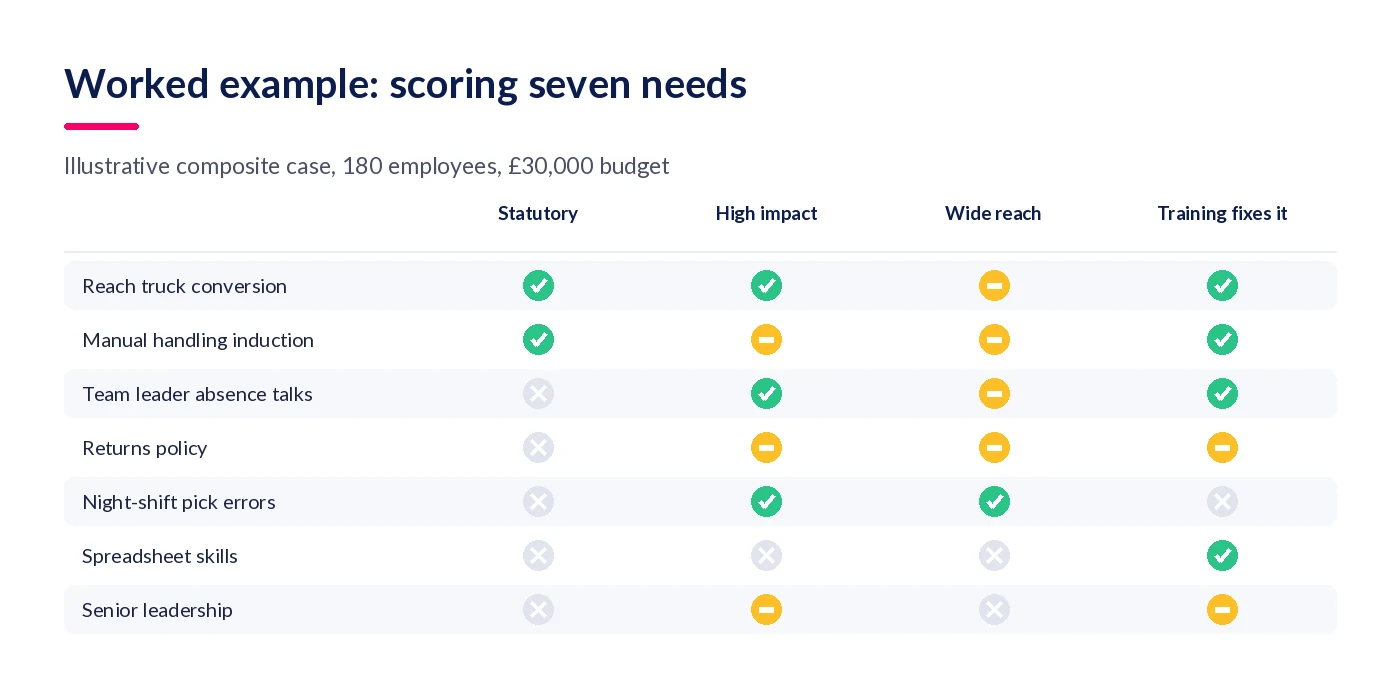
Here is how the method plays out in a composite case, a 180-person distribution business with a £30,000 discretionary development budget. The figures are illustrative, not benchmarks. Managers had submitted 23 training requests. Grouped and diagnosed, they came down to seven needs.
| Need | Training fixes it? | Statutory? | Priority | Decision | Cost |
|---|---|---|---|---|---|
| Operators moving onto new reach trucks | Yes | Yes (new equipment) | 1 | Accredited conversion training | £6,400 |
| New starters' manual handling | Yes | Yes (recruitment) | 1 | In-house induction module | £1,200 |
| Nine new team leaders avoiding absence conversations | Yes | No | 2 | Short programme plus monthly coaching | £7,500 |
| Returns handled inconsistently by customer service | Partly: policy changed and was never briefed | No | 3 | One-page job aid and a team briefing | £300 |
| Pick errors on the night shift | No: errors traced to poor lighting in two aisles | No | n/a | Passed to operations to fix | £0 |
| Advanced spreadsheet skills for two finance staff | Yes | No | 4 | Self-paced e-learning | £200 |
| Leadership programme for senior managers | Unclear: no outcome defined | No | 4 | Pilot with one cohort and a defined measure | £6,000 |
Committed spend comes to £21,600. The remaining £8,400 is held back until the quarterly re-run, because the business knows it will recruit in the spring and is due to introduce a new warehouse management system, both of which trigger fresh training needs under regulation 13.
Notice three things. The £18,000 leadership request was not refused, just shrunk to a pilot until someone could say what it was for. The night-shift problem cost the training budget nothing. And over a quarter of the budget is unspent on purpose; that reserve is what lets the plan survive the year.
If you need to put a financial case to the board alongside the plan, StaffCircle's ROI calculator is a quick way to frame the cost of doing nothing.
Why the annual TNA survey keeps failing
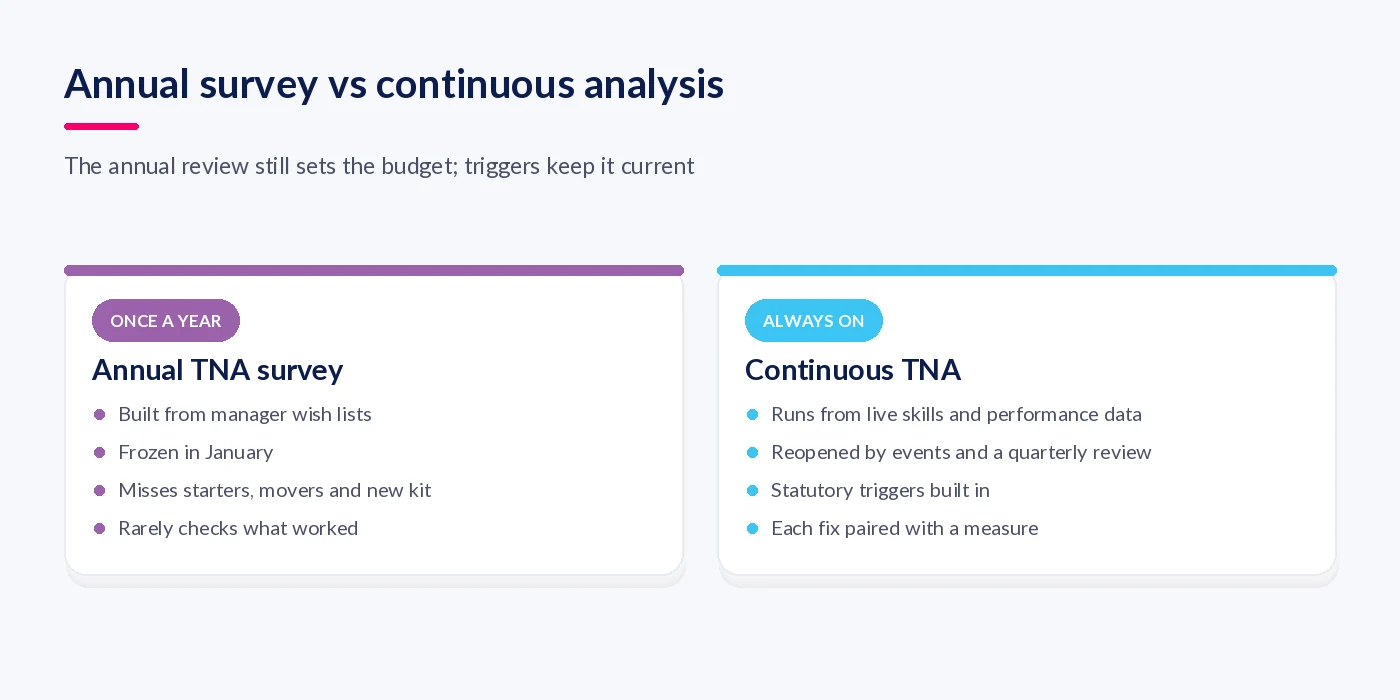
Most training needs analyses fail because they are treated as a once-a-year form-filling exercise rather than a decision process.
The survey becomes a wish list
Asking every manager "what training does your team need?" without a written standard or a diagnosis step simply records preferences.
Nothing is costed until after it is approved
A plan that lists needs without prices invites a finance team to cut it with a percentage. A plan that shows ranked, priced options lets the business choose what to drop, and see what that costs.
It is stale by the second quarter
People join, leave and change roles; equipment and systems change. An analysis frozen in January cannot see any of that, which is why the next section matters.
Nobody checks whether it worked
If step eight is skipped, next year's analysis has no idea which interventions closed gaps. Pair every intervention with a measure, and use a structured approach to training evaluation to check it.
Turning an annual exercise into a continuous one
A continuous training needs analysis runs from live skills and performance data and is reopened by events, rather than rebuilt once a year from a survey. The CIPD draws the same line between a one-off training needs analysis and an ongoing learning needs analysis, which it describes as "a current or future health check" on capability.
In practice that means three changes:
- Keep the evidence in one place. Role standards, skills ratings, one-to-one notes and development plans should sit together, so the gap is visible without a data-gathering exercise.
- Define the triggers. New starters, role changes, new equipment, new systems of work and a quarterly review date each reopen the analysis for the people affected.
- Make it part of the manager's routine. A manager who discusses capability at every one-to-one and records it in an employee development plan is running a TNA continuously without calling it one.

How StaffCircle supports training needs analysis
StaffCircle is built to keep the evidence for a training needs analysis in one place, so the analysis becomes a view of live data rather than a spreadsheet project.
A standard for every role
StaffCircle's AI competency frameworks generate a framework for a role and enrich it with skills, job descriptions and progression paths, giving every gap a consistent standard to be measured against. See how it works on the employee development software page.
Live skills gap data
A real-time skills gap dashboard shows coverage by team, so the organisational and team levels of the analysis are visible at any time, not only after an annual survey.
Development plans tied to the gap
Personalised development plans and objectives let managers turn an individual gap into an agreed action, and the regular check-ins that sit alongside them are where the diagnosis question gets asked.
Final thoughts
A training needs analysis earns its keep when it stops money being spent on the wrong problem. Diagnose before you prescribe, fund the legal floor first, rank and price everything else, and keep part of the budget back for the year you have not seen yet. If you would like to see how StaffCircle keeps skills and development data in one place, book a demo.
FAQ
What is a training needs analysis?
A training needs analysis is a structured review of the gap between the capability your organisation needs and the capability it has, used to decide which gaps training should close. A good one also identifies gaps training cannot fix, prioritises the rest and costs them against a budget.
What are the three levels of training needs analysis?
The three levels are organisational, team and individual. Organisational analysis starts from strategy and asks what capability the business needs. Team analysis compares a function's skills with its objectives. Individual analysis compares each person's current knowledge, skills and behaviour with the standard for their role. The levels should be read together, not separately.
What is the difference between a training needs analysis and a skills gap analysis?
A skills gap analysis measures the distance between the skills a role needs and the skills people have. A training needs analysis takes those gaps and decides which ones training should close, which need a different fix, and in what order to fund them. The gap analysis is the input; the TNA is the decision.
What is the difference between a TNA and a learning needs analysis?
The CIPD describes a training needs analysis as a one-off exercise tied to a specific training activity, and a learning needs analysis as an ongoing health check on capability. In practice the best TNAs behave like learning needs analyses: they run continuously from live skills data rather than once a year.
How often should you carry out a training needs analysis?
Run a full review once a year to set the budget, then re-run it in smaller cycles. Quarterly reviews and event triggers such as new starters, role changes, new equipment or new systems of work keep it current. An analysis that is only refreshed annually is usually out of date by the second quarter.
Who should be involved in a training needs analysis?
HR or L&D usually owns the process, but line managers supply most of the evidence because they see performance every day. Senior leaders set the outcomes the budget must serve, finance confirms the budget, and employees contribute self-assessments. Health and safety leads should confirm the statutory training list.
What methods are used to collect training needs data?
Common methods include performance data, manager observation, one-to-one and appraisal notes, skills assessments, competency framework ratings, interviews, focus groups and surveys. The CIPD advises using a mix of methods at the same time. Surveys alone tend to produce a wish list rather than an evidence-based picture of need.
How do you know if a performance problem is a training need?
Ask whether the person could do the task correctly if their job depended on it. If they could, the cause lies elsewhere, such as unclear expectations, poor tools, missing information, conflicting targets or workload, and training will not fix it. If they genuinely could not, it is a knowledge or skill gap that training can address.
How do you prioritise training needs with a limited budget?
Fund statutory training first. Then score each remaining need on business impact, the number of people affected and the risk of leaving it, and rank the list. Cost the cheapest option that will close each gap, fund down the ranking until the budget runs out, and keep a small reserve for in-year triggers.
Is a training needs analysis a legal requirement in the UK?
No law requires a document called a training needs analysis. However, regulation 13 of the Management of Health and Safety at Work Regulations 1999 requires adequate health and safety training on recruitment and when new or increased risks arise, repeated periodically where appropriate. A TNA is the practical way to show you have identified those needs.
What should a training needs analysis report include?
Include the business outcomes the plan serves, the statutory training list, the gaps found and the evidence behind them, which gaps were judged non-training issues and who owns them, the ranked and costed training plan, the measure for each intervention, and the dates or triggers for the next review.
Related articles



See StaffCircle in action
Book a personalised demo and see how StaffCircle drives performance, engagement and development.