Off-the-Job Training Tracking: What Employers Must Evidence
Priya is three months into a level 3 apprenticeship at a regional distribution business. Her training plan, signed by her, her line manager Dan and the training provider, says she will receive 550 hours of off-the-job training. The standard she is on publishes a minimum of 466. At her first progress review, the provider asks Dan a simple question: how many hours has Priya actually had so far, and which of them took place at work?
Dan knows she has attended every college session, spent two afternoons shadowing the transport planner and a morning on a warehouse safety course. He has no dated, timed record of any of it, and the provider cannot count what nobody wrote down.
Off-the-job training tracking means keeping a dated, timed record of every training activity an apprentice receives during paid hours that teaches new knowledge, skills or behaviours from their apprenticeship standard. For starts from 1 August 2025, each standard has a published minimum number of hours. The training provider must evidence delivery, but the employer has to release the apprentice, record any training it delivers itself and take part in reviews.
The 466 and 550 figures above are not invented. They come from the worked example in the Department for Education's own apprenticeship funding rules for 2026 to 2027, and Priya is a composite built around them. This guide follows her from the signed plan to the final statement.
The rule, and where it actually comes from
Most guidance paraphrases the requirement, but the source settles most arguments. Regulation 3 of the Apprenticeships (Miscellaneous Provisions) Regulations 2017 makes off-the-job training a condition of every approved English apprenticeship, and says each apprenticeship agreement must specify how much of it the apprentice will receive.
The regulation defines it as training that is not on-the-job training, received during the apprentice's normal working hours, for the purpose of achieving the published standard. On-the-job training is the opposite: training received solely to let the apprentice do the work they are employed for.
The funding rules then add the operational detail. Paragraph 82 calls off-the-job training a statutory requirement and is blunt about the consequence: funds are at risk of recovery if the policy is not met. Your tracking record is a funding document. It needs to answer six questions for every apprentice:
- What is the published minimum for this standard, and what did we plan to deliver?
- Has the minimum been reduced for evidenced prior learning, and by how much?
- What activity took place, on what date, from what time to what time?
- Which module, unit or knowledge, skills and behaviours (KSBs) does it relate to in the training plan?
- Did it happen in paid hours, away from productive work?
- Who delivered it: the provider, a subcontractor or the employer?

From 20% to a fixed number of hours per standard
If your apprenticeship knowledge dates from before 2025, the biggest change is that the percentage has gone for new starts. The GOV.UK off-the-job training guidance (updated August 2026 to align with the 2026 to 2027 rules) sets out the history:
- Starts up to 31 July 2025: at least 20% of normal working hours, capped at 30 hours a week for funding purposes. The familiar "6 hours a week" figure is simply 20% of a 30-hour week.
- Starts from 1 August 2025: a minimum volume of hours published for each apprenticeship standard. Under the 2026 to 2027 rules (paragraph 85) that figure now sits on the front of each standard on the Skills England website, and it applies to full-time, part-time and term-time apprentices alike.
Three other numbers matter. The minimum can be reduced only for relevant prior learning identified at initial assessment, and no programme may fall below 187 hours of evidenced delivery (paragraph 86.2). The practical period must last at least 8 months (paragraph 77). And there is no direct link between hours and duration: the rules give the example of a standard needing 278 hours delivered over 8, 12 or 15 months (paragraph 87.1).
If you have apprentices who started on both sides of August 2025, your tracking needs to know which rule applies to whom.
What counts, and what quietly does not
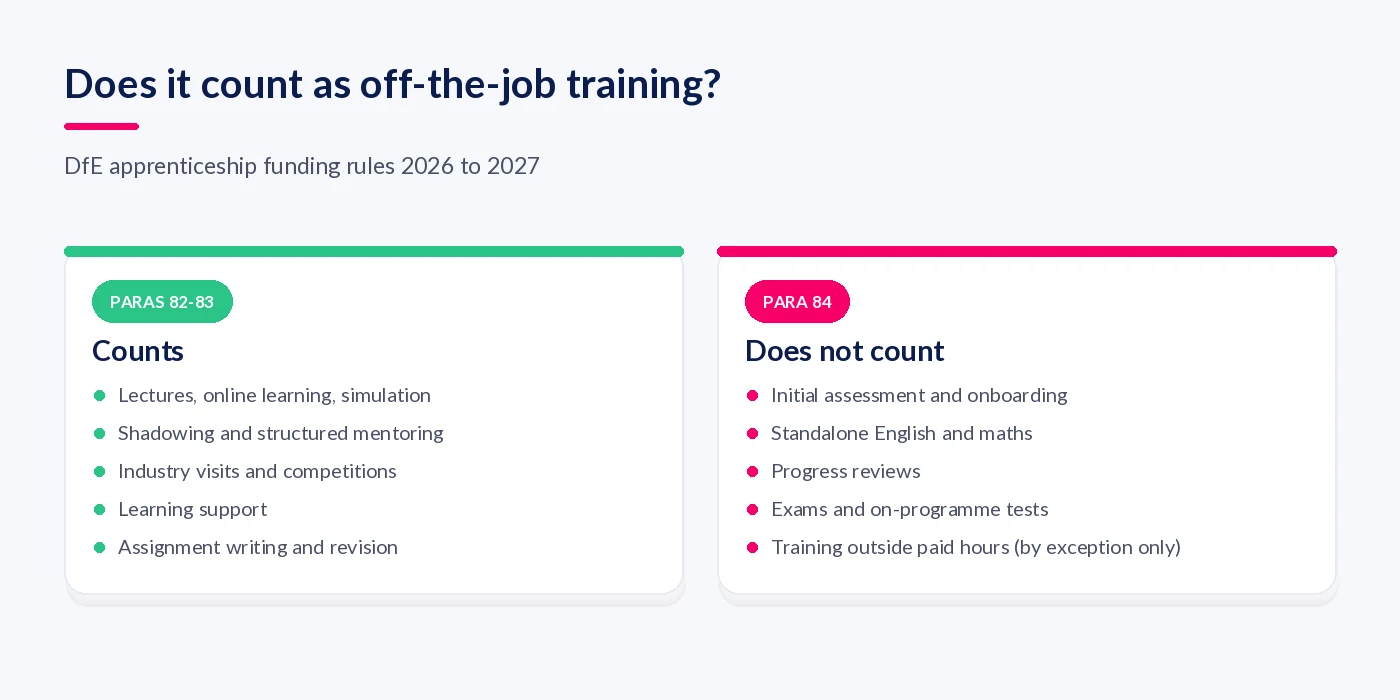
Paragraphs 83 and 84 of the funding rules list eligible and ineligible activities. Several excluded items feel like training, which is where records go wrong.
| Counts towards off-the-job hours | Does not count |
|---|---|
| Teaching of theory: lectures, role play, simulation, online learning, manufacturer training | Initial assessment and onboarding |
| Practical training: shadowing, mentoring, industry visits, competitions | Standalone English and maths qualifications |
| Learning support | Training in skills the standard does not require |
| Writing assignments | Progress reviews |
| Revision | Exams and other on-programme testing |
| Training outside normal working hours (unless the apprentice agrees and is compensated, and only by exception) |
Priya's shadowing afternoons can count, as long as she was learning something the standard requires and was not simply helping out. Her warehouse safety course is less clear. If it was induction training every new starter gets so they can do the job, it is on-the-job training under the regulation and does not count. If it covered safety KSBs written into her standard and her training plan, it can.
The monthly rule most employer guides skip
Most articles stop at "hit the minimum hours by the end". The 2026 to 2027 rules also care about rhythm.
Unless the training plan sets out an agreed front-loaded or block release model, paragraph 94 requires a plan for off-the-job "active learning" in every calendar month of the practical period. If there is no plan for a month, the provider must record a break in learning. If planned training does not happen for two consecutive calendar months, a retrospective break in learning is required and the missed activity has to be re-planned. For front-loaded and block release models the window is every 3 calendar months (paragraph 93).
That turns a busy season into a compliance event. If Dan cancels Priya's study time through the December peak and January stocktake, the provider must record a break and her end date may move.
Two more details are rarely mentioned:
- Employer-delivered training still needs provider evidence. Paragraph 91 says the provider is responsible for evidencing all required off-the-job training "even if another party (e.g. subcontractor, employer) delivers this training." Your in-house sessions are in scope.
- Fewer hours than planned needs a signed statement. If actual hours land below the plan (but above the minimum), the provider must produce a statement of planned hours, delivered hours, the reason and confirmation the minimum was met. The employer and apprentice sign it, and it must be in the evidence pack within 12 weeks of completion (paragraphs 96 to 98).
Who holds which evidence
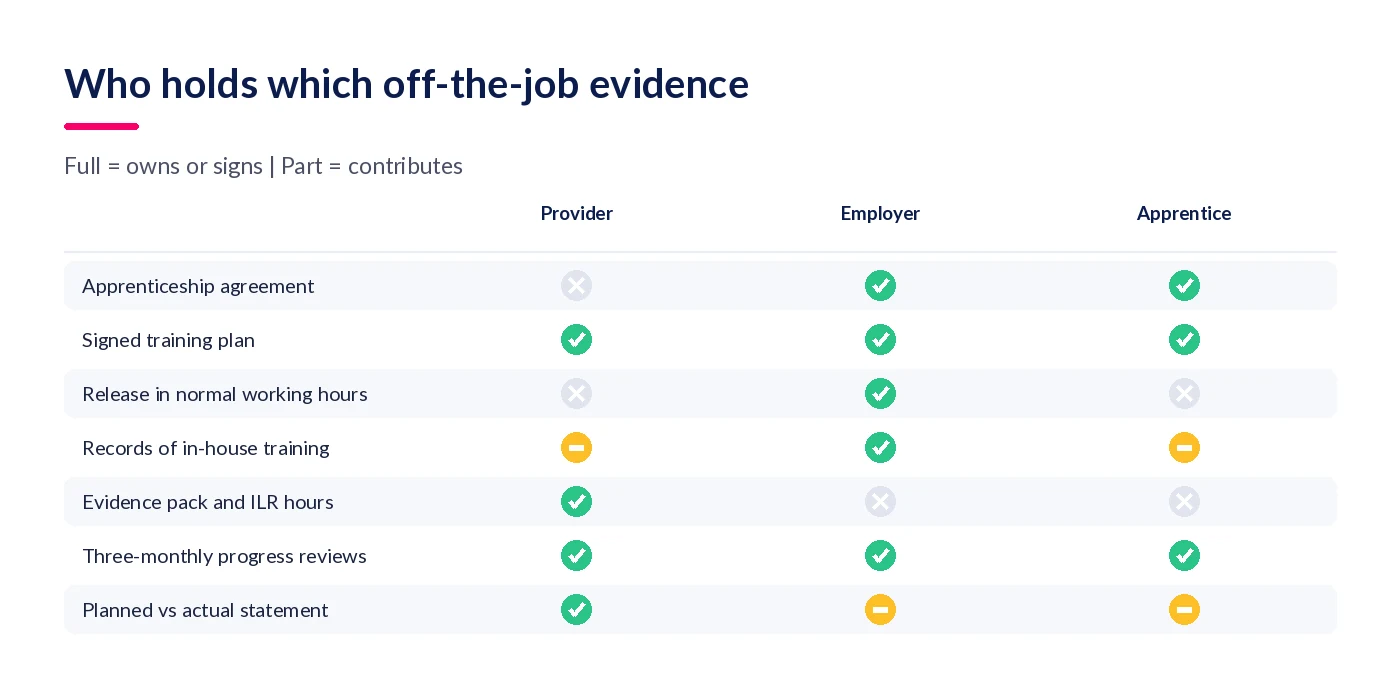
The provider owns the evidence pack. The employer owns the conditions that make the evidence possible. Paragraph 66 says the employer must agree to support and supervise the apprentice, release them for off-the-job training as documented in the training plan, give them the chance to apply what they learn, and take part in or provide input into progress reviews.
That shows up in three documents:
- The apprenticeship agreement, between employer and apprentice, which must state the planned off-the-job hours.
- The training plan, signed by all three parties, which must include the apprentice's normal working hours, the total planned off-the-job hours, the delivery model, who delivers each component and written confirmation from the employer that the apprentice will be allowed to train within normal working hours (paragraph 100).
- Progress review records, at least every 3 calendar months, as a three-way discussion. If the employer cannot attend it must be given the chance to contribute, but the rules say the employer must attend in the majority of reviews for each apprentice (paragraph 102.2.1).
Tracking Priya's 550 hours, step by step
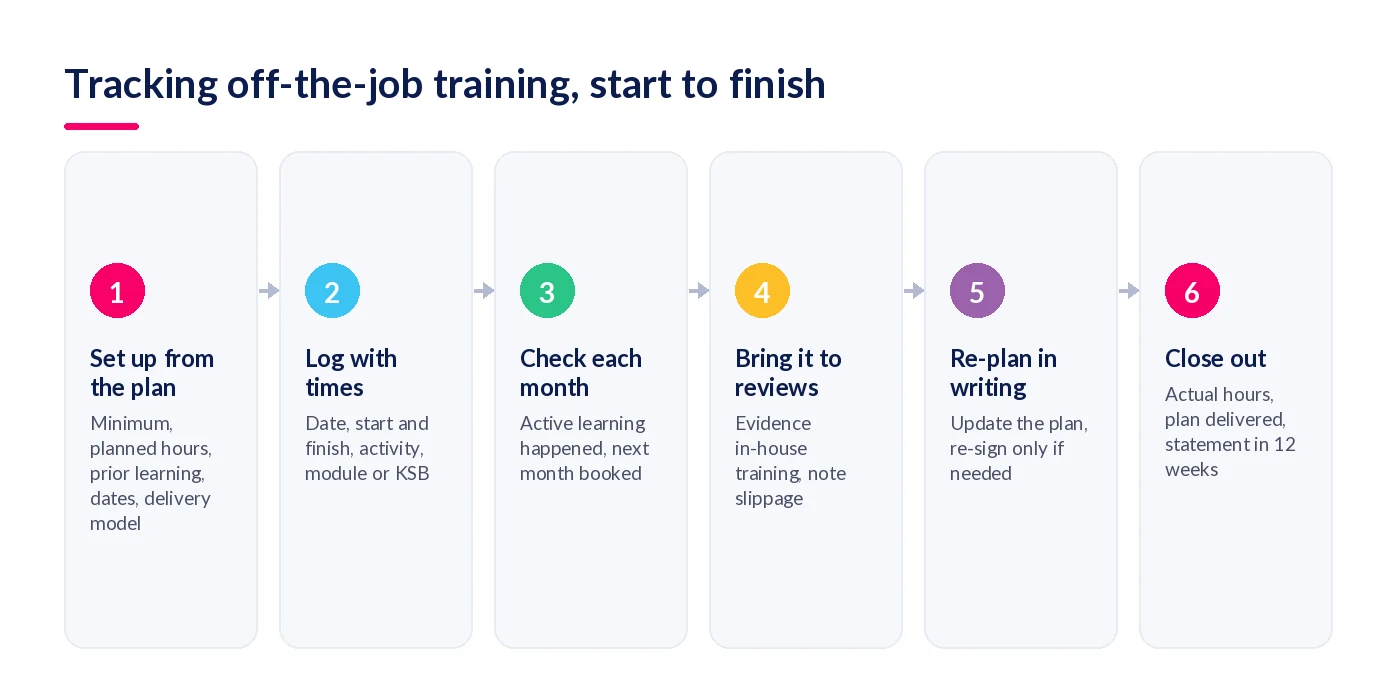
Here is how Dan could have answered the provider's question in thirty seconds. None of it needs a specialist system, just consistency.
1. Build the tracker from the signed training plan
Copy the numbers from the plan into the record before any training starts: published minimum (466), planned hours (550), any prior learning reduction, start and planned end dates, normal weekly hours and delivery model. If the plan and the apprenticeship agreement show different hours, raise it now. The rules require the volumes and dates to align.
2. Log every activity with times and a plan reference
The GOV.UK guidance describes off-the-job training as "a quantitative, rather than a qualitative, policy". Each entry needs a date, start and finish time, a short description and the module or KSB it maps to. Priya's shadowing becomes "Route planning with transport planner, 13:00 to 16:30, KSB: planning and organising". Times let an auditor check the arithmetic.
3. Check the month, not just the running total
At each month end, confirm that some active learning took place and that next month's is booked. A running total of 140 hours looks healthy until you notice none of it happened in the last eight weeks.
4. Take the record into the progress review
Paragraph 103 says each review must check progress against the training plan, document any slippage against planned hours and give a chance to discuss evidence of training outside the provider's control. That last phrase is your in-house training. Bring it.
5. Re-plan slippage in writing
If hours are behind, agree where they will be made up and update the plan. The employer only needs to re-sign when content changes, the planned end date moves or the re-planned hours materially change how much release time you must give (paragraph 103.4.1).
6. Close out properly
At the end of the practical period, the provider records actual hours delivered. Employer, provider and apprentice must agree the training plan content has been delivered (paragraph 101). If actual hours are below planned, sign the provider's statement promptly so it lands in the pack inside 12 weeks.
A simple log for Priya's first fortnight might look like this:
| Date | Time | Activity | Plan reference | Delivered by | Hours |
|---|---|---|---|---|---|
| Week 1, Tue | 09:00 to 16:00 | College day: operational planning theory | Module 2 | Provider | 6.0 |
| Week 1, Thu | 13:00 to 16:30 | Shadowing transport planner on route scheduling | KSB: planning | Employer | 3.5 |
| Week 2, Tue | 09:00 to 16:00 | College day: managing stock and data | Module 3 | Provider | 6.0 |
| Week 2, Wed | 14:00 to 16:00 | Assignment writing (protected study time) | Module 2 | Apprentice | 2.0 |
| Week 2, Fri | 10:00 to 11:00 | Progress review | Not eligible | All three | 0.0 |
The progress review stays on the log at zero hours, so the record is complete without inflating the total.
Where off-the-job tracking breaks down
The provider portal is treated as the whole record
Providers log their own sessions well. The shadowing, mentoring and study time that happens at work is what goes missing, and unrecorded hours do not exist for funding purposes.
Line management gets labelled as mentoring
The funding rules' glossary is specific: mentoring must deliver new learning, be in the training plan, be given by a more senior or experienced colleague and must not be general line management. A weekly catch-up with Dan about rotas is not off-the-job training, however useful it is.
Study time leaks into evenings
An apprentice who writes assignments at home after their shift is not receiving off-the-job training unless they agreed to it and were compensated, and it can only ever be the exception. Booking protected study time inside paid hours is the fix, and it is also fairer to the apprentice.
Part-time apprentices get a full-time plan
Part-time programmes no longer extend automatically, but the duration must be realistic for the hours worked (paragraph 87.3). Squeezing 466 hours into 8 months for someone on 20 hours a week will fail its own monthly checks.

Apprenticeships belong inside your development plans, not beside them
Almost every apprenticeship tracking problem I have seen has the same root: the apprenticeship lives in the provider's system and an HR spreadsheet, while development conversations happen elsewhere. The line manager never sees the hours, so never protects them.
The fix is to treat the training plan as one part of the apprentice's wider employee development plan. The KSBs from the standard become skills on your skills matrix, so progress is visible in the same place as everyone else's. Mandatory training they would get anyway stays on the mandatory training matrix, clearly separated from off-the-job hours. And once they qualify, the evidence habit carries over into CPD tracking for roles that need it.
Shift-based apprentices need this most, because study time competes with the rota; see our guide to development software for frontline teams.
How StaffCircle supports apprentice development
StaffCircle is not an ILR or funding-claims system and does not replace your provider's evidence platform. It keeps the employer's side of the record alongside the rest of an employee's development.
Development plans and learning records in one place
Apprentices and managers can hold the training plan's activities as development actions and log completed learning against them, so in-house shadowing and study time is captured when it happens rather than reconstructed before a review. See how this works in centralised learning.
Skills and competencies mapped to the standard
KSBs from an apprenticeship standard can be set up as skills or competencies in a framework, so the apprentice's progress shows on the same view as the wider team. Our competency framework page explains the approach.
One-to-ones that protect training time
Regular check-ins give line managers a prompt to ask whether this month's off-the-job learning happened and what is booked next, before it becomes a break in learning. That is part of our performance management and development module.
Back to Priya
With a simple log, Dan's answer at the review would have been: 118 hours to date, 31 of them delivered in-house, every month covered, December study days already moved to the first week of January. Priya's hours are protected because her manager can see them.
Off-the-job training tracking is not complicated, just easy to leave to someone else. If you want to see how StaffCircle keeps apprentice development alongside everyone else's, book a demo.
This article summarises the DfE apprenticeship funding rules for 2026 to 2027 (version 3) and GOV.UK off-the-job training guidance for England. It is not legal or funding advice; check the current rules and your provider's requirements for your apprentices.
FAQ
How many off-the-job training hours does an apprentice need?
For apprenticeships starting from 1 August 2025, each standard has its own published minimum volume of off-the-job training hours, shown on the standard's page on the Skills England website. It can only be reduced for evidenced prior learning, and no programme can fall below 187 hours of evidenced delivery.
Is off-the-job training still 20% of working hours?
Not for new starts. The 20% rule, capped at 30 hours a week for funding purposes, applies to apprentices who started up to 31 July 2025. Apprentices starting from 1 August 2025 work to the fixed minimum published for their standard instead.
Does English and maths count as off-the-job training?
No. Standalone English and maths qualifications must be delivered in addition to the minimum off-the-job training requirement. The training plan must make clear they are not included in the planned off-the-job hours.
Do progress reviews count towards off-the-job hours?
No. The funding rules list progress reviews as an activity that must not be included.
Can off-the-job training happen outside working hours?
Only by exception. Training outside normal working hours does not count unless the apprentice agrees and is compensated, for example with time off in lieu or an additional payment, and the majority of training must not be delivered that way.
Can off-the-job training take place at the apprentice's workplace?
Yes. 'Off-the-job' means away from the apprentice's productive job role, not away from the building. Shadowing, mentoring and online learning at work can all count if they meet the definition.
Does mentoring count as off-the-job training?
It can. The mentoring must deliver new learning relevant to the apprenticeship, happen in normal working hours and be documented in the training plan. The mentor must be a more senior or experienced colleague, it cannot be general line management, and the apprentice must not be doing productive work at the time.
Who is responsible for evidencing off-the-job training?
The training provider is ultimately responsible, even when the employer or a subcontractor delivers some of the training. Any training you deliver in-house therefore needs a dated, timed record.
What evidence of off-the-job training is needed?
Evidence must be quantifiable: what the activity was, the date, the time spent and how it links to the training plan, such as a module or KSB reference.
How often must off-the-job training take place?
Under the 2026 to 2027 rules there must be a plan for off-the-job active learning in every calendar month, or at least every three calendar months for front-loaded and block release models. If there is no plan for a period, the provider must record a break in learning.
What happens if an apprentice receives fewer hours than planned?
If actual hours fall below the planned hours but still meet the standard's minimum, the provider produces a statement explaining the difference, which the employer and apprentice sign. It must be in the evidence pack within 12 weeks of completion. Falling below the minimum puts funding at risk of recovery.
How often are apprenticeship progress reviews held?
At least every three calendar months, as a three-way discussion between provider, employer and apprentice. A different agreed frequency must still keep reviews no more than six months apart.
Related articles



See StaffCircle in action
Book a personalised demo and see how StaffCircle drives performance, engagement and development.