Mentoring Programme Software: What to Look For Before You Buy
Four months into the pilot, Hannah's managing director stopped her in the corridor and asked a fair question: is the mentoring working? Hannah runs learning and development for a 600-person logistics business. She had matched 40 pairs from a spreadsheet, sent a welcome pack and a calendar invite, and kept a tab of "meetings logged". The tab said 112 meetings. It did not say which pairs had quietly stopped after the second one, whether any mentee had learned anything, or why three warehouse supervisors had never been matched at all.
So she booked three software demos. All three opened with the matching algorithm.
Mentoring software is a system for running a workplace mentoring programme: it pairs mentors with mentees, records what each pair agrees to work on, keeps meetings happening, ends relationships cleanly and reports on outcomes. When you buy it, judge it less on the matching engine and more on momentum, privacy controls, access for frontline staff and whether it can show results beyond the number of meetings logged.
Key facts
- The CIPD describes mentoring as a more experienced colleague sharing greater knowledge.
- The Government Communication Service guide suggests one to two hours a month for six months.
- Equality Act 2010 s.158 permits proportionate positive action, including targeted mentoring schemes.
- Using diversity data for matching needs an Article 6 basis and an Article 9 condition.
Hannah (a composite of several L&D leads, not one real person) is not unusual. Almost every mentoring problem I have seen sits after the match, not before it.
What does mentoring software actually do?
Mentoring software replaces the spreadsheet, email chain and shared folder with one place where a programme lives. A good platform answers these questions at any moment, for any pair:
- Who is paired with whom, and why were they matched?
- What did they agree to work on, and for how long?
- Are they still meeting, or has the relationship stalled?
- Who can see what was discussed, and who cannot?
- How did it end, and what changed for the mentee?
- Across the whole programme, is it doing what it was set up to do?
If a product cannot answer the third and sixth questions without someone exporting data to Excel, it is a matching tool rather than a programme tool.
Is mentoring the same as coaching?
Not quite, although the words get swapped constantly. The CIPD's coaching and mentoring factsheet describes workplace mentoring as a relationship in which "a more experienced colleague shares their greater knowledge", and notes that mentoring relationships "tend to be longer term than coaching arrangements". It also admits the two terms "are often used interchangeably". The difference matters when buying: coaching is usually tied to a goal the organisation sets, while mentoring goals tend to belong to the mentee, which affects who should see the record.

The matching algorithm is the least important thing you are buying
Every vendor page I read for this article led with matching. It is the most demonstrable feature, so it gets the demo. But matching happens once per pair; everything else happens every month for six months.
The Government Communication Service mentor and mentee guide is a useful reality check on what a programme actually asks of people: "typically one to two hours per month for six months, with learning activities between meetings". It puts the mentee in charge of logistics, asking them to "schedule and rearrange meetings as needed, and set agendas for each session", and it expects pairs to "build in time at specific points during your mentoring partnership to reflect on how things are going".
Read as a software requirement, that means a tool that makes six meetings easy to schedule, prompts the midpoint review, notices when a pair goes quiet and offers a dignified way out. A perfect match that fades after meeting two is worth less than a decent one that runs the course.
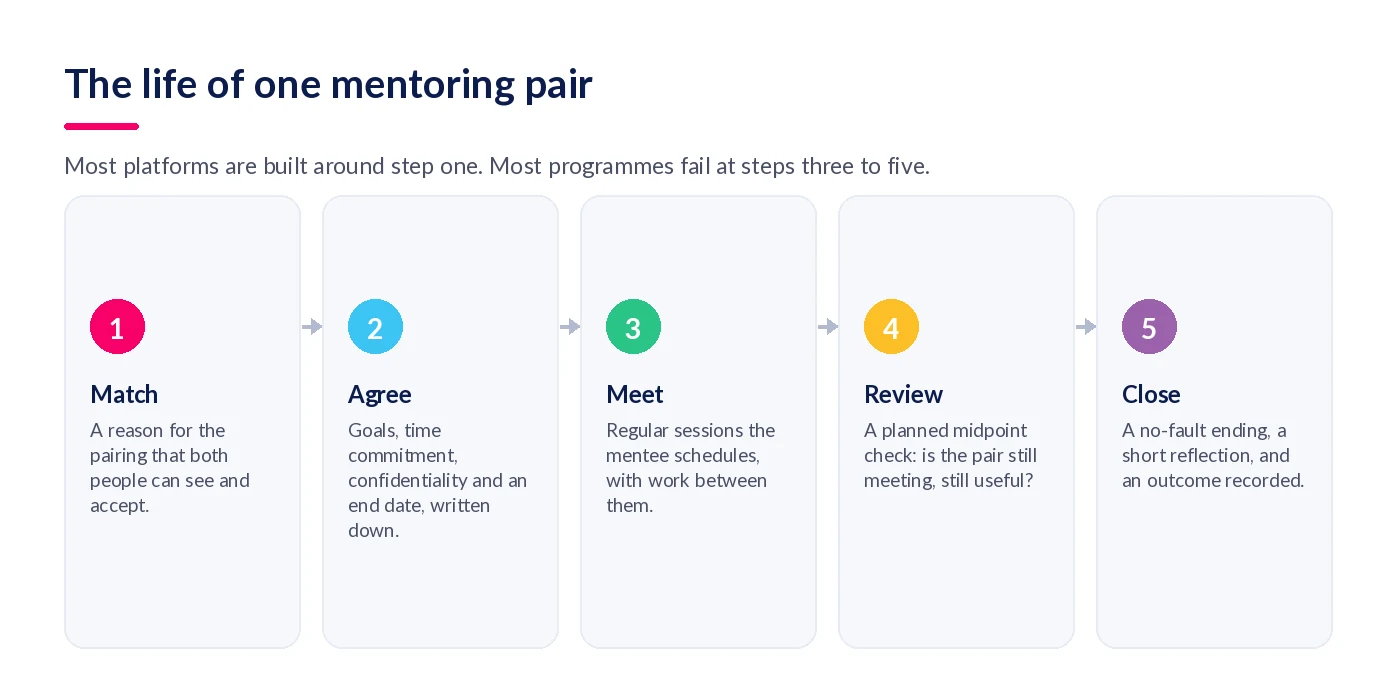
Matching still matters, but ask how the platform explains a match to the two people involved. "The algorithm chose you" is a weak start. "Sam has led the kind of site move you are about to face" is a reason to turn up.
Diversity mentoring: the legal detail most vendor pages skip
Many organisations buy mentoring software to run a programme for an under-represented group, such as women in engineering. That is usually lawful in Great Britain, within limits vendor content rarely mentions.
What the Equality Act 2010 allows
Section 158 of the Equality Act 2010 applies where an employer "reasonably thinks" that people sharing a protected characteristic suffer a disadvantage, have different needs, or have participation that "is disproportionately low". In that case the Act does not prohibit "any action which is a proportionate means" of helping them overcome the disadvantage, meet those needs or participate.
The government's positive action guidance for employers names mentoring directly, giving "providing additional support through mentoring or shadowing schemes" as an example. It is equally direct about the limits: "Positive discrimination is unlawful in Great Britain." It also says "if there is no evidence that any groups are experiencing barriers, you should not use positive action", although that evidence "does not need to be sophisticated statistical data". And it warns that if positive action "continues indefinitely, without any review, it may no longer be proportionate".
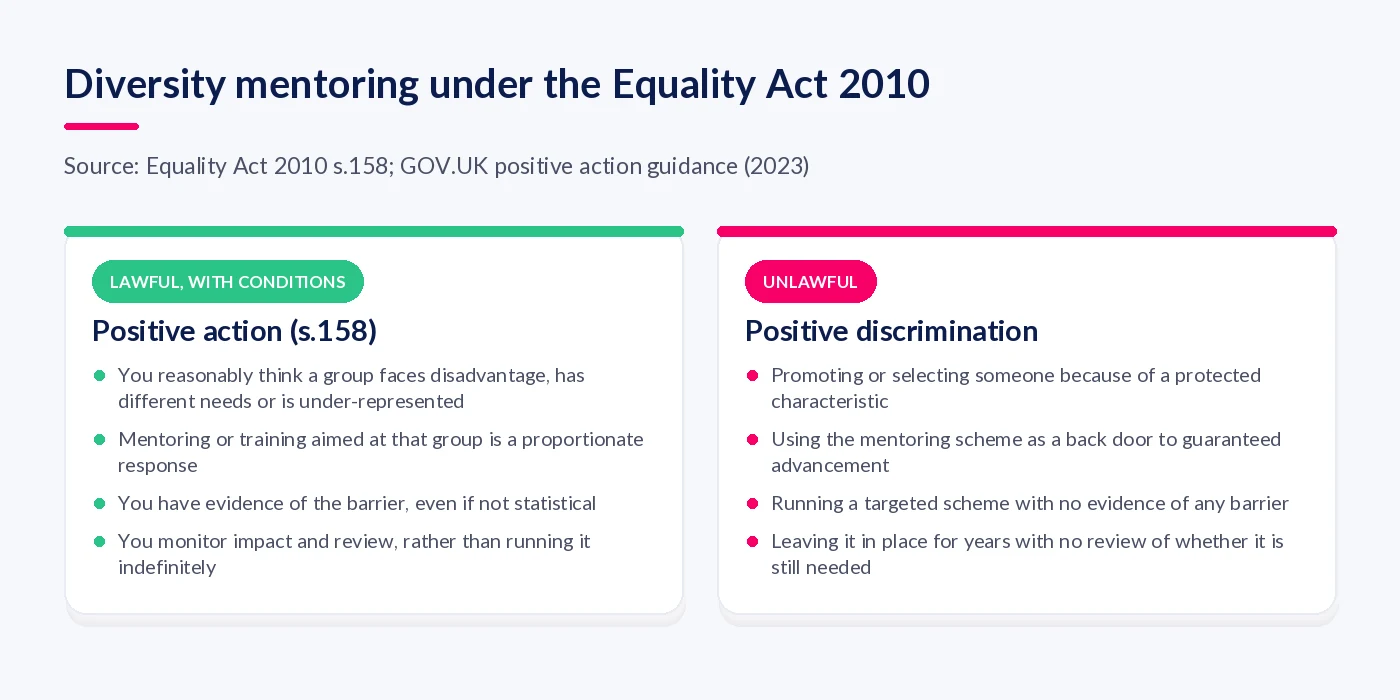
What this means for software: you need a record of why the programme exists (the evidence of the barrier), what it was meant to achieve, and a scheduled review. A platform that reports outcomes by cohort makes that review possible. One that only counts meetings does not.
Matching on diversity data is a data protection decision
If the platform matches people using ethnicity, disability, sexual orientation or other special category data, UK GDPR applies with extra force. The ICO's guidance on special category data says you "must identify both a lawful basis under Article 6 and a condition for processing special category data under Article 9", and that you are "more likely to need to do a DPIA" (a data protection impact assessment) for it.
There is a trap here that catches HR teams who already collect equality monitoring data. The ICO's guidance on using employment records is blunt: "You must make sure you do not use information you collect to monitor equality of opportunity for any other purpose." Pulling monitoring data from your HR system to drive mentor matching is a new purpose. Ask participants for it directly, explain why, and decide that before the vendor sets up the integration, not after.
Who gets to read the notes?
This is the question I would put first in any demo, and the one vendors are least prepared for. Mentoring works because mentees can say things they would not say to their manager. The Royal College of Radiologists' guidance on mentoring puts it plainly: "Mentoring arrangements should be separate from probation, performance management, appraisal, and progression processes." It adds that a mentor who is not a close colleague or line manager "will typically allow mentees to speak more freely". The civil service guide goes further: "the mentor should have no direct contact with the mentee's line manager about mentoring discussions."
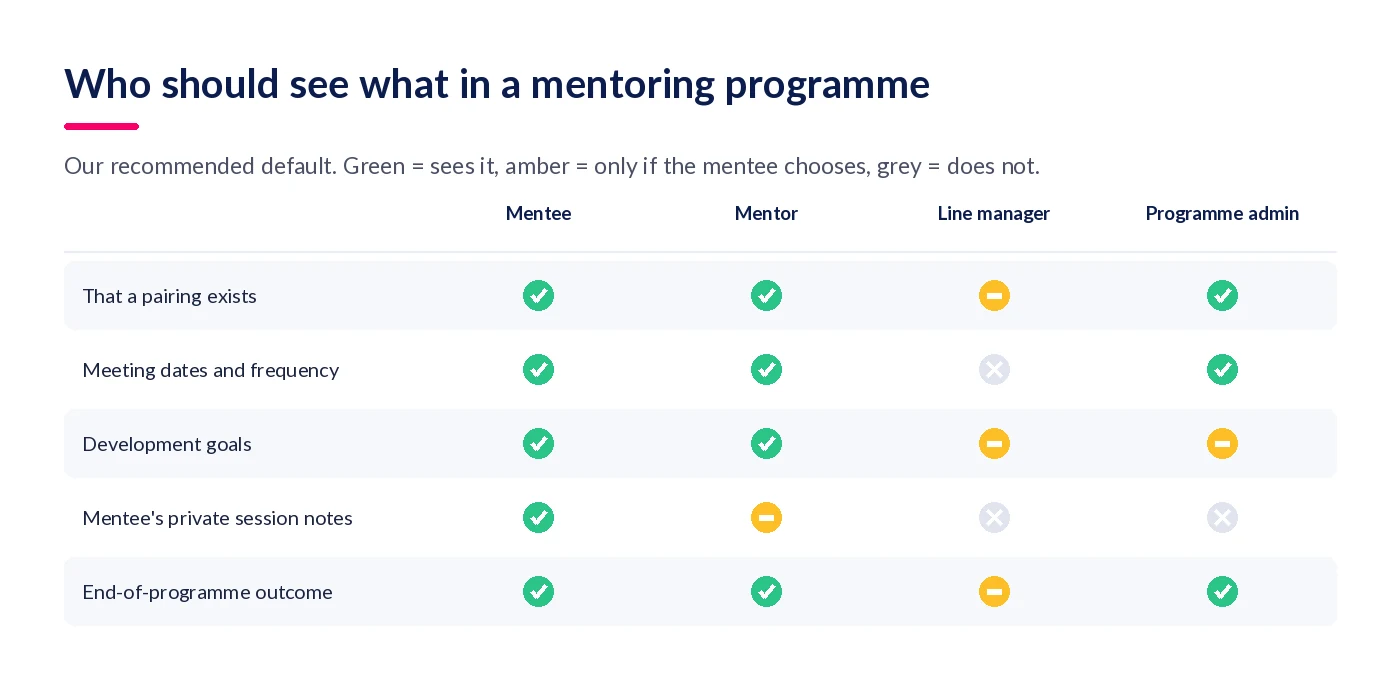
Two consequences follow. First, test the permission model in the platform, not the slide about it: can an administrator or line manager read session notes, and can a mentee share a goal without sharing the notes? Second, remember that anything written down is potentially disclosable. The ICO's subject access request guidance for employers says you "must respond to a SAR from a worker without delay and within one month", and expects employers to search places like Teams chat channels where in-scope information sits. Mentoring notes held on a platform are very likely to be in scope too. Tell mentors to write notes they would be comfortable with the mentee reading, because the mentee may well ask to.
How to evaluate mentoring software: a buyer's scorecard
Use this in demos. The right-hand column is the answer that should make you hesitate.
| What to test | What to ask in the demo | Answer that should worry you |
|---|---|---|
| Momentum | Show me what happens when a pair has not met for six weeks. | "The admin can run a report." |
| Structure | Where do the pair record their goals, time commitment and end date? | "They can use the notes field." |
| Privacy | Log in as an administrator. Can you read a pair's session notes? | "Yes, for safeguarding," with no way to change it. |
| Endings | How does a pair close the relationship, and what is recorded? | "It just expires." |
| Frontline access | Show me the experience for someone with no company email or laptop. | "They'd need an account in our directory first." |
| Outcomes | What does the end-of-programme report contain besides meeting counts? | A dashboard of sessions, hours and satisfaction scores only. |
| Data | Which fields are used for matching, and can we switch any off? | "The model uses everything in your HRIS." |
| Connection | Can a mentee's goal sit in their development plan without exposing the notes? | "You'd export it." |
Measuring outcomes without vanity metrics
Matches, meetings logged and a satisfaction score are easy to report and tell you almost nothing. Hannah's 112 meetings could mean 40 healthy pairs or 15 committed ones and 25 dead ones.
The research is honest about scale. A meta-analysis by Eby, Allen and colleagues (2008) linked mentoring to a range of favourable outcomes but described the effects as generally small. That is not a reason to skip mentoring. It is a reason not to promise your board a transformation, and to measure carefully enough to see a modest effect.
A workable approach has three layers:
- Health, during the programme. The share of pairs that have met in the last six weeks, and the share that completed the midpoint review. These tell you where to intervene while you still can.
- Change, at the end. Did the mentee make progress on the goal they set at the start? Ask the mentee, and where they agree, their manager.
- Results, six to twelve months later. Retention, internal moves and promotions for participants, compared with a similar group who did not take part. Without that comparison group you are only describing what happened to people who were probably keen anyway.
Be careful with the statistics vendors use. The widely repeated claim that mentees were promoted five times more often traces back to an internal Sun Microsystems study I could not find published anywhere checkable. The one Fortune 500 figure with a stated method comes from a vendor: MentorcliQ's 2024 report found that 488 companies, about 98%, "visibly provide mentoring programs", based on a review of public websites and reports between June 2023 and February 2024. That shows mentoring is common, not that it works.
Where mentoring programmes stall
Mentors run out of capacity
Your best mentors are usually your busiest people. The RCR's advice to mentors is to "ensure you have genuine capacity to give the time that mentoring requires". Set a cap per mentor in the platform, and treat mentor recruitment as an ongoing job rather than a launch task.
The fade after meeting two
The first meeting has momentum, the second goodwill. By the third, diaries win. Nudges, an agreed schedule and a planned midpoint review earn their keep here, and a programme lead needs a list of quiet pairs, not a meeting total.
Frontline staff never get matched
Programmes that run on email sign-up and desk calendars quietly exclude shift workers, drivers and care staff, as Hannah's warehouse supervisors found. If much of your workforce is deskless, check mobile access and sign-in without a corporate account first.

Nobody ends anything
Relationships that never formally close leave your data full of pairs that look active. The civil service guide recommends closing the partnership "without fault or blame attached to either party". Build a closing step with a short reflection into the programme, and make it the moment you capture outcomes.
Do you need dedicated mentoring software at all?
Not always. A small pilot can run on a spreadsheet, an agreement template and a programme lead who checks in personally. The case for software grows with scale, sites and the need to report outcomes.
The bigger decision is whether mentoring lives in a standalone tool or inside the platform where development already happens. A standalone tool can match and schedule well but leaves the mentee's goal in one system and their development plan in another. Built-in mentoring connects those threads, but only if the privacy walls described above are real. Pricing for standalone tools is usually per user and often quote-only, so compare total cost including administration time.
If you are still deciding what mentoring is for, start with your employee development plans and career progression routes. Mentoring works best as one channel feeding a plan, alongside regular one-to-ones with the line manager, not as a separate programme with its own goals.
Where StaffCircle fits
StaffCircle is a development and performance platform, not a standalone mentor-matching product. Judge it on the parts of mentoring that connect to development.
Mentoring goals that sit in the development plan
StaffCircle gives every employee a personalised development plan. A mentee's goal for the relationship can be an objective in that plan, so it stays visible after the mentoring ends and links to the skills it is meant to build.
Finding mentors from real skills data
Competency frameworks and skills-gap analysis show who has the experience a mentee needs, which gives a match a reason both people can understand. Success Circles™ help you see emerging successors who would benefit most from a mentor, which ties mentoring to succession planning rather than leaving it as a perk.
Keeping mentoring and line management separate
One-to-ones, reviews and objectives run in the performance management side of the platform. Treat those as the line manager's space and mentoring as the mentee's, and configure visibility so the two do not leak into each other.
Before you sign
Hannah's eventual choice was not the platform with the cleverest matching. It was the one that could tell her which pairs had gone quiet, let her warehouse supervisors join from their phones, and kept session notes away from line managers by default. Run the scorecard, settle the data questions before launch, and decide now how you will know in twelve months whether it worked. If you would like to see how development plans, skills and succession connect in one place, book a StaffCircle demo.
FAQ
What is mentoring software?
Mentoring software runs a workplace mentoring programme in one place. It pairs mentors and mentees, records goals and agreements, schedules and prompts meetings, closes relationships and reports on outcomes, replacing spreadsheets and email chains.
How does mentoring software match mentors and mentees?
Most platforms offer algorithmic matching on profile fields such as skills, goals and location, self-selection where mentees choose from a shortlist, or matching by an administrator. Whichever you use, both people should be able to see why they were paired.
What is the difference between mentoring and coaching?
The CIPD describes mentoring as a more experienced colleague sharing knowledge, and notes mentoring relationships tend to be longer term than coaching. Coaching usually targets a performance goal; mentoring goals usually belong to the mentee.
How long should a mentoring relationship last?
There is no legal or standard length. The Government Communication Service guide suggests one to two hours a month for six months, and says the partnership should last as long as the pair agree at their first meeting.
How often should mentors and mentees meet?
Roughly monthly is a common pattern. The civil service guide suggests one to two hours a month with learning activities between meetings. Agree the rhythm in writing at the start and review it at the midpoint.
Do you need software to run a mentoring programme?
Not for a small pilot, where a spreadsheet and a committed programme lead can work. Software earns its cost with scale, multiple sites, deskless staff and outcome reporting.
How do you measure the success of a mentoring programme?
Track pair health during the programme, progress against the mentee's own goal at the end, and retention, internal moves and promotions six to twelve months later, compared with a similar group who did not take part.
Is a diversity mentoring programme legal in the UK?
Usually, yes. Section 158 of the Equality Act 2010 allows proportionate positive action where you reasonably think a group faces disadvantage or is under-represented. You need evidence of the barrier and should review the scheme regularly.
Can mentoring software use diversity data for matching?
Only with care. Ethnicity, disability and similar data are special category data, needing an Article 6 lawful basis and an Article 9 condition. The ICO says equality monitoring data must not be reused for other purposes.
Should a line manager be an employee's mentor?
Generally not. The Royal College of Radiologists says mentoring should be separate from performance management and appraisal, and that a mentor who is not a line manager typically lets mentees speak more freely.
Can an employee request their mentoring notes?
Very likely. Notes about an employee held on a platform are personal data, and the ICO says employers must answer a subject access request within one month. Mentors should write notes the mentee would be comfortable reading.
What is reverse mentoring?
Reverse mentoring pairs a junior employee, as mentor, with a senior colleague, often on technology or the experience of under-represented groups. The same agreements and privacy rules apply.
Related articles

See StaffCircle in action
Book a personalised demo and see how StaffCircle drives performance, engagement and development.