Competency Framework Software: A Buyer's Guide
Most competency framework software buyer's guides read the same way: a definition, a feature checklist, a table of logos, a "request a demo" button. Follow that order and you will buy a tool that scores well on the checklist and still sits half-used a year later, because the checklist was never the hard part. The hard part is what happens between signing the contract and having a framework that a manager actually opens during a review.
Competency framework software is a platform for defining the behaviours, knowledge and skills expected in each role, assessing people against that standard, and tracking the gap over time. The buying decision that actually matters is not which vendor has the most features — it is whether the tool forces you to define competencies role by role before it lets you assess anyone, whether it can tell a skill from a competency instead of treating "Excel" and "strategic thinking" as the same kind of row, and whether the resulting record would survive an audit, a regulator visit or a tribunal. Get those three right and the rest of the evaluation is comparatively easy.
Why “Competency Management Software” Means Three Different Things
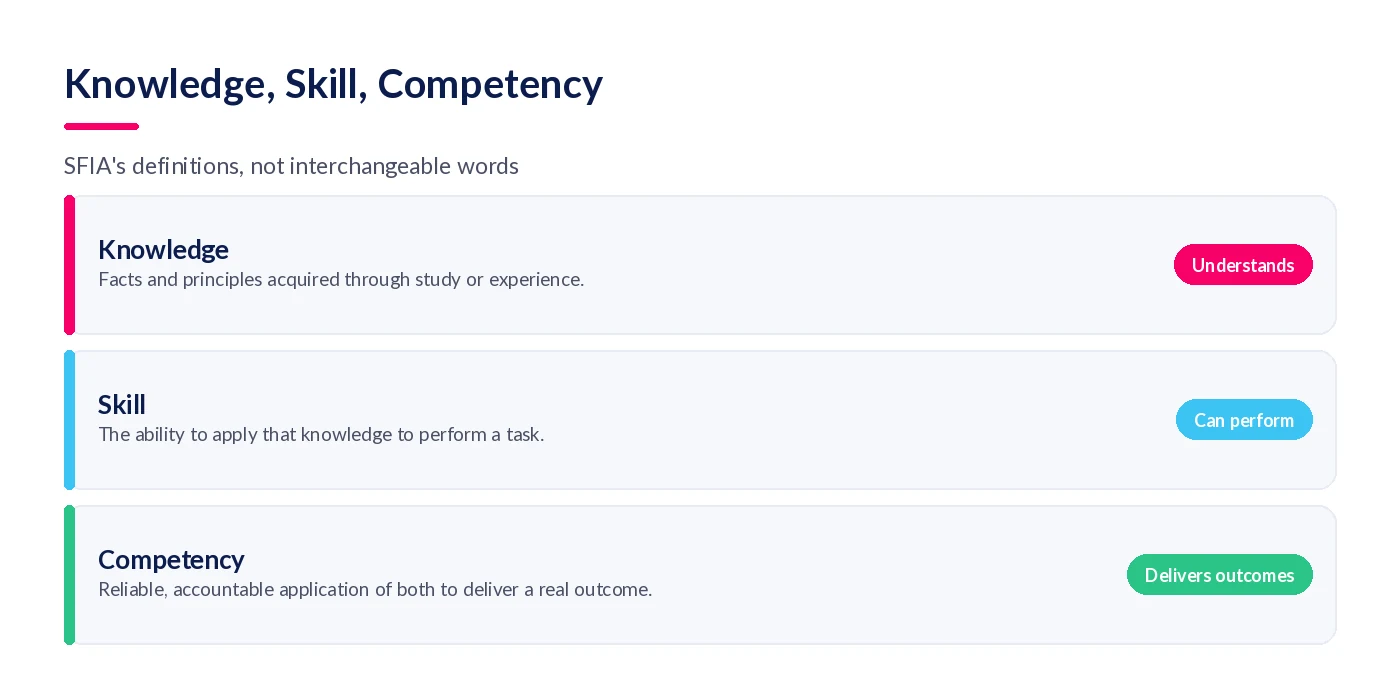
Ask five vendors what their platform manages and you will get five different answers, because the category conflates three distinct concepts that most buyer's guides use interchangeably. SFIA, the Skills Framework for the Information Age, draws the distinction precisely: knowledge is “facts, concepts, principles and information that an individual has acquired through education, study or experience”; skill is “the ability to apply knowledge to perform tasks or activities effectively”; competency is “the effective and reliable application of knowledge and skills in a professional context with responsibility and accountability for outcomes.”
That chain matters commercially, not just semantically. A tool built to track discrete, testable skills — can this person run this machine, pass this certification, configure this system — is solving a different problem from a tool built to assess whether someone reliably demonstrates “influences without authority” across a review cycle. Some platforms do both well. Several of the vendors that rank for “competency framework software” today — among them Compono, AG5 and Skills Base — are explicit that they started on one side of that line (skills tracking, usually) and built competency assessment on top, or vice versa. Neither approach is wrong, but if your organisation needs both a certification register for compliance and a behavioural framework for promotion decisions, ask which side of that history the product you're evaluating actually came from, because it usually shows in where the gaps are.
Role-to-Competency Mapping Is the Step Every Demo Skips Over
Every vendor demo covers the assessment screen: pick a person, pick a competency, choose a rating, save. Almost none dwell on the step before that, which is deciding which competencies apply to which roles in the first place — and that step is where most home-grown and several bought frameworks quietly fail.
Role-to-competency mapping is the exercise of attaching a specific, weighted set of competencies to each role or role family, rather than assessing everyone against one generic company-wide list. Done badly, a warehouse supervisor and a finance director end up rated against the same “strategic thinking” competency, phrased identically, which tells you nothing useful about either of them. Done properly, the mapping starts from a small number of core, company-wide competencies (the behaviours everyone needs, regardless of role) and adds a handful of role-specific ones layered on top — and the two are visibly different in the interface, not buried in one long undifferentiated list.
When you evaluate software on this point, ask three concrete questions rather than accepting “yes, we support role mapping” at face value: can a role inherit from a role family so you are not rebuilding the same core competencies for every job title; can the same competency carry a different expected level per role (a “Level 3” expectation for a team lead versus “Level 5” for a director, using the same competency name); and can HR see, at a glance, which roles have no competencies mapped yet. That last one sounds trivial until you are six months into a rollout and discover a third of your roles were never actually assigned a framework.

Build the First Framework Before You Buy the Software
The operational gap in most buying guides sits between “choose a vendor” and “the framework is live and managers trust it.” That gap is filled by work the software cannot do for you, however much the sales deck implies otherwise.
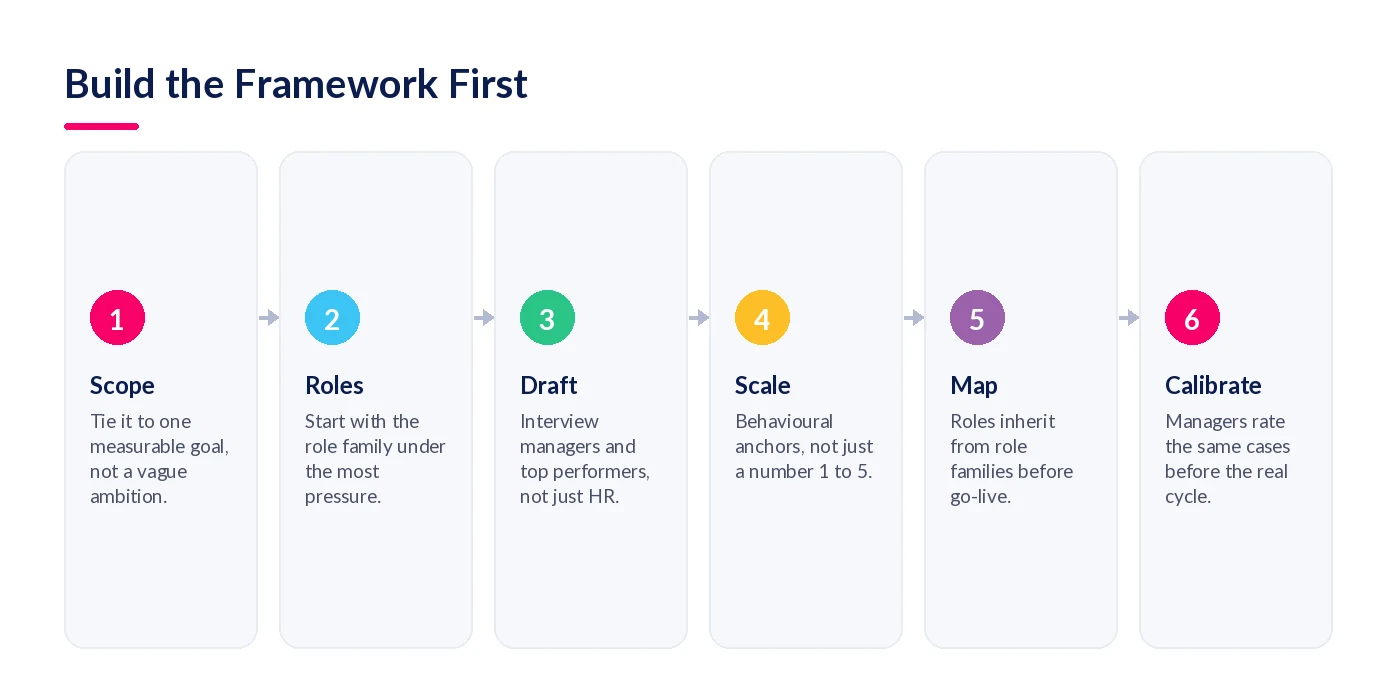
Six steps, roughly in order:
- Tie the scope to one measurable goal. “Improve leadership capability” is not a scope; “reduce time-to-productivity for new team leads” is. A vague brief produces a framework nobody can tell you succeeded or failed.
- Start with the roles under the most pressure. Do not attempt every role in the organisation in one pass. Pick the role family where a gap is already costing you — usually first-line management or a technical role with high turnover — and prove the model there first.
- Draft competencies with the people who will be rated on them, not just HR. Structured interviews with department heads and current top performers in the target roles surface the behaviours that actually separate strong from average performance, which a policy document written in isolation rarely does.
- Design the scale with behavioural anchors, not just numbers. A rating of “3 out of 5” means nothing on its own. “Level 3: independently handles routine situations, escalates the unusual ones appropriately” means something a manager can actually apply consistently.
- Map roles to competencies before the software goes live, using the inheritance approach above, so the platform launches with a working structure rather than an empty shell managers are expected to configure themselves.
- Run a calibration session before the first review cycle. Get every manager rating the same three or four sample cases and compare notes before ratings go live for real. Skip this and you will discover, a quarter in, that one manager's “meets expectations” is another's “exceeds.”

On competency count: resist the temptation to comprehensively document everything at once. A framework with four to six core, company-wide competencies plus three to five role-specific ones per role family stays usable. Frameworks running to forty or more competencies are the most commonly cited reason a rollout gets abandoned — not because the software failed, but because nobody, manager or employee, can hold that many distinctions in their head during a real conversation.
Where the Buying Decision Breaks Down
Five situations that most vendor content glosses over, because none of them make for a clean feature-list bullet point.
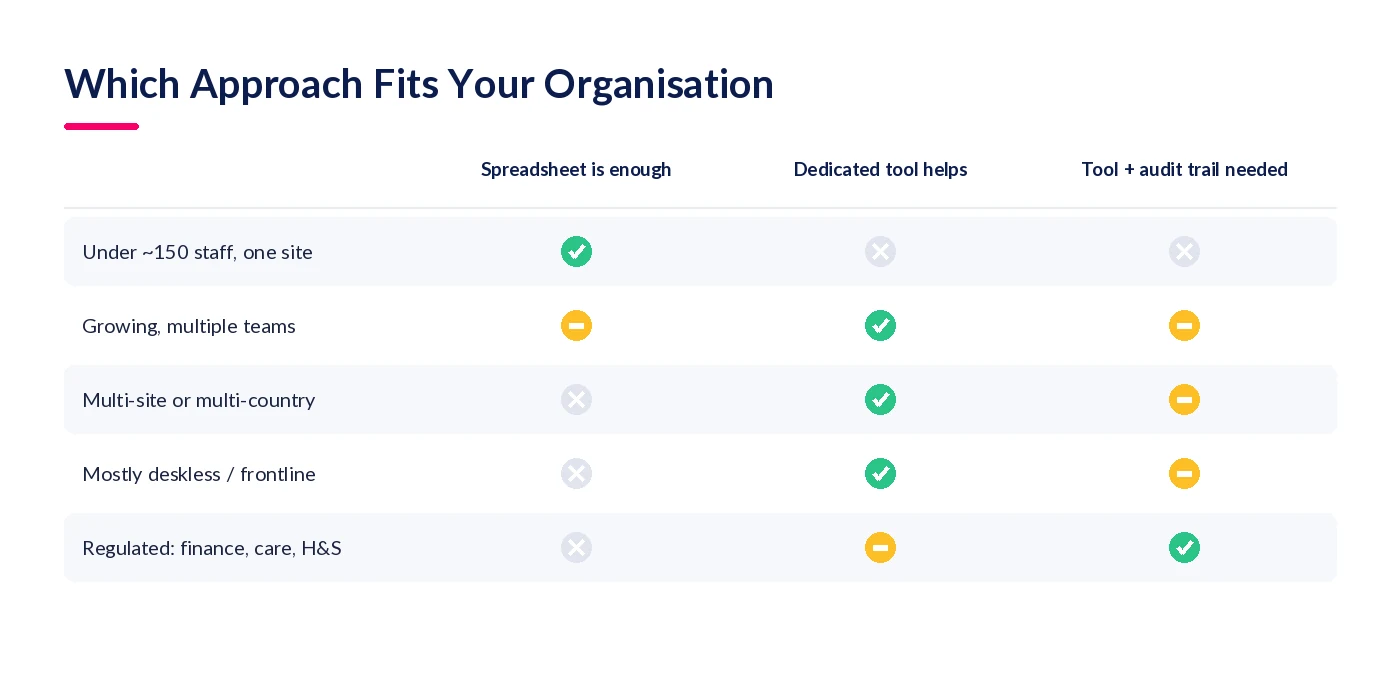
Multi-country organisations. There is no single global competency template that transfers cleanly across markets — what counts as strong “communication” or appropriate assertiveness varies by culture and by local employment law. The software question is not whether it supports multiple languages; it is whether the framework itself can flex core competency wording by region while keeping the underlying rating scale comparable for global talent decisions.
Deskless and frontline workforces. Emergence Capital estimates that roughly 80% of the global workforce is deskless, and that enterprise software spending has historically gone almost entirely to desk-based applications. A competency tool built around a manager logging into a desktop dashboard, with no equivalent mobile or kiosk path for the person actually being assessed, quietly excludes most of the workforce it claims to serve.
Organisations under roughly 150 people. Below that size, a well-structured spreadsheet with clear behavioural anchors often outperforms a dedicated platform, because the administrative overhead of configuring a new system exceeds the coordination problem it is meant to solve. Dedicated software starts earning its cost once you have enough roles and enough managers that consistency, not just record-keeping, becomes the actual problem.
Regulated sectors. In health and safety, competence is not a one-off framework exercise — the Management of Health and Safety at Work Regulations 1999 require every employer to appoint one or more competent persons to assist with statutory compliance, and the HSE defines competence as the combination of training, skills, experience and knowledge, and the ability to apply them to perform a task safely — an ongoing standard, not a certificate issued once. Health and social care carries the same logic: Regulation 18 of the Health and Social Care Act 2008 (Regulated Activities) Regulations 2014 requires sufficient numbers of suitably qualified, competent, skilled and experienced staff to be deployed, continuously, not at hiring alone. Financial services has its own version: the FCA's Senior Managers and Certification Regime expects firms to make “regular, thorough and consistent assessments” of staff fitness and propriety, which includes competence. If you operate in any of these sectors, the software question shifts from “can it store a rating” to “can it produce, on demand, an audit trail showing when competence was last verified and by whom.”
Unionised environments. Competency ratings that feed into pay or promotion decisions are exactly the kind of process a recognised union will want sight of before rollout, not after the first contested review. Build in a consultation step; it is cheaper than retrofitting one.
Reading Vendor Claims With a Straight Face
Competency and skills-management vendor pages are full of precise-sounding statistics — a named percentage improvement in time-to-competency, a named reduction in turnover, a specific productivity gain attributed to “organisations that use a structured framework.” Trace enough of these back to their source and a pattern emerges: the number often originates on an unrelated vendor's own marketing page, for a different product category entirely, with no underlying study behind it — a form of citation laundering where a confident-sounding figure passes from one vendor blog to the next until nobody remembers where it actually came from. Some pages also assert regulatory enforcement history — inspectors penalising firms specifically for competency record failures — without citing a single case.
None of this means the underlying claim is false. It means you should ask for the primary source before you let a number influence a business case, in the same way you would for any other procurement decision. A vendor that can point to a named, dated, third-party study is telling you something useful. A vendor whose figure traces back to another vendor's blog post is not.
Where StaffCircle Fits
StaffCircle's competency framework module is built around the distinction this guide opens with: skills and competencies live in the same platform but are not forced into the same data shape. Roles inherit from role families so a core competency set does not need rebuilding for every job title, and AI-assisted framework generation drafts role-specific competencies and proficiency levels from a starting role description, which is aimed squarely at the “months of manual work before the software even launches” problem this guide describes — a claim from our own product pages that, like any vendor claim, is worth verifying against your own rollout before you rely on it.
Competency and skills data sit alongside performance management — Smart Objectives, OKRs, 1:1s and reviews — rather than in a separate silo that needs a manual export to inform a review conversation, which addresses the integration gap most buyer's guides mention as a criterion without explaining what “integrated” should actually look like in practice. For regulated and compliance-heavy sectors, StaffCircle's construction and skills-compliance tooling is built around the audit-trail requirement this guide describes: a record of when competence was last verified, by whom, and against what standard, rather than a single static score.
None of that replaces the work in the “build the first framework” section above. Software that generates a starting framework still needs your managers to validate it against real roles and calibrate ratings before it goes live — the tool shortens the drafting phase, not the adoption phase.
Final Thoughts
Buy on the checklist and you will end up choosing between platforms that all tick the same boxes. Buy on the questions in this guide — can it actually separate a skill from a competency, does role mapping work the way your organisation is shaped, can it produce an audit trail if a regulator or a tribunal ever asks for one — and the shortlist gets short fast, because most vendors can only answer some of them convincingly.
If you want to see how StaffCircle handles competency and skills data alongside performance management in practice, book a demo, or use the ROI calculator to model what a structured rollout would be worth against your own headcount and turnover figures. Full pricing is also available if a business case needs real numbers rather than “contact sales.”
FAQ
What is competency framework software?
Competency framework software is a platform for defining the behaviours, knowledge and skills expected in each role, assessing people against that standard, and tracking gaps over time. Most platforms also handle role-to-competency mapping, proficiency scales and reporting, and many now sit alongside performance management rather than as a standalone tool.
What's the difference between competency framework software and skills management software?
Skills management software tracks discrete, testable abilities — can this person run this machine, pass this certification. Competency framework software assesses broader behaviours, knowledge and attitudes that predict good performance in a role, usually rated qualitatively. Many vendors do both, but check which side of that line the product started on, because it usually shows in where the gaps are.
How is a competency different from a skill?
SFIA defines a skill as the ability to apply knowledge to perform a task or activity, and a competency as the effective and reliable application of knowledge and skills in a professional context with responsibility and accountability for outcomes. A skill is something you can demonstrate once; a competency is something you demonstrate reliably, under real conditions, over time.
How do you map roles to competencies?
Start with a small set of core, company-wide competencies everyone needs, then layer three to five role-specific competencies on top for each role family. Roles should inherit from their family rather than being configured individually, and the same competency can carry a different expected level per role — a team lead and a director can both be rated on "strategic thinking" at different levels.
How much does competency framework software cost?
Most vendors do not publish pricing and quote per-user or per-employee rates on request, often with a separate implementation fee. Get a quote scoped to your actual headcount and role count before comparing vendors, since list prices for similar-looking platforms can vary by several multiples once implementation and support are included.
Is competency framework software worth it for a small business?
Below roughly 150 employees, a well-structured spreadsheet with clear behavioural anchors often outperforms dedicated software, because the coordination problem it solves — consistency across many managers — has not yet appeared. Dedicated software tends to earn its cost once you have enough roles and managers that inconsistent ratings become a real business risk.
How long does it take to implement competency framework software?
The software itself can be configured in weeks. The framework behind it — defining competencies, drafting behavioural anchors, mapping roles and calibrating managers — is the part that takes longer and cannot be skipped, whatever the sales process implies. Piloting on one role family first, rather than the whole organisation at once, shortens the realistic timeline.
Does competency framework software integrate with performance management?
It should. Competency and skills data are most useful when they inform review conversations, development plans and succession decisions directly, rather than sitting in a separate system that needs a manual export. When evaluating a platform, ask to see a review workflow that pulls competency ratings in live, not just a slide claiming the two modules are "integrated."
How many competencies should a role have?
Keep it small. Practitioner consensus favours four to six core, company-wide competencies plus three to five role-specific ones per role family. Frameworks running to forty or more competencies are a commonly cited reason rollouts get abandoned, because no manager can hold that many distinctions in mind during a real conversation.
What features should you look for in competency management software?
Beyond the basics — assessment workflows, proficiency scales, reporting — look specifically for role inheritance (so competencies don't need rebuilding per job title), the ability to see which roles have no framework mapped yet, an audit trail showing when a rating was last verified and by whom, and genuine integration with performance management rather than a parallel system.
Can competency framework software work for frontline or deskless employees?
Only if it is built to. Emergence Capital estimates roughly 80% of the global workforce is deskless, yet most enterprise software, including a lot of competency tooling, assumes a manager and employee both have regular access to a desktop dashboard. Check for a genuine mobile or kiosk path for the person being assessed, not just the manager doing the assessing.
Is competency management a legal requirement in any industries?
Yes, in several. UK health and safety law requires employers to appoint competent persons under the Management of Health and Safety at Work Regulations 1999. Health and social care providers must deploy sufficiently competent, skilled and experienced staff under Regulation 18 of the 2014 Regulated Activities Regulations. Financial services firms must make regular, ongoing fitness and propriety assessments under the FCA's Senior Managers and Certification Regime.
How do you calibrate competency ratings across different managers?
Before the first live review cycle, get every manager to rate the same three or four sample cases independently, then compare and discuss the differences as a group. Without this step, ratings drift: one manager's "meets expectations" can be materially different from another's, which undermines any pay, promotion or succession decision built on the data.
What questions should you ask a vendor before buying?
Ask whether the product distinguishes skills from competencies structurally, not just in marketing language; whether roles can inherit from role families; whether it produces an audit trail for regulated use cases; how it handles frontline or deskless staff; and for the primary source behind any statistic in the sales deck, since many circulating figures trace back to an unrelated vendor's own marketing page rather than an independent study.
Related articles
See StaffCircle in action
Book a personalised demo and see how StaffCircle drives performance, engagement and development.