Designing a Leadership Development Programme That Changes Behaviour
A leadership development programme is a structured, time-bound plan that moves a defined group of people from the leadership behaviours they show today to the behaviours the organisation needs from them, and then proves the shift happened. The design work is in the second half of that sentence. A good programme starts from a short list of observable behaviours, selects people openly, mixes formal learning with real assignments, makes the line manager part of the plan, and judges success by what the participant's team notices months later, not by attendance or end-of-course scores.
Most of the pages that rank for this subject list course formats: workshops, coaching, action learning, e-learning, away days. Formats are the last decision, not the first. This guide works in the order the decisions should be made, and spends most of its time on the part almost everyone skips: getting the behaviour to show up back at work, and being able to say so with evidence.
The stakes are not abstract. The Chartered Management Institute says that 82% of managers are promoted into their roles without any formal training. If your organisation is typical, the people running your teams learnt leadership by watching whoever managed them. A programme is the chance to change that on purpose.
What the programme has to answer before anyone books a venue
Before you design a single session, the programme should be able to answer these questions in writing. If it cannot, the content will drift towards whatever the provider already sells.
- Who is it for? First-line managers, middle managers, senior leaders and high-potential individual contributors need different things. One programme for everyone usually serves nobody well.
- Which behaviours should change? Named, observable behaviours, not themes like "resilience" or "strategic thinking".
- Why these behaviours, now? The business problem they address: turnover in a particular team, poor-quality one-to-ones, a succession gap, a merger.
- How will people be chosen? Nominated, self-selected, assessed, or all three, and who decides.
- What does the line manager do? Before, during and after.
- What will count as success? The measure, the source of the evidence and the date you will look at it.
The answers belong in a one-page brief that the sponsor, HR and every participant's manager can read. You will use it again when you evaluate.
The gap between the training room and Monday morning
A leadership programme can be well designed, well delivered and well liked, and still change very little.
The Civil Service guide to evaluating management and leadership training, published under Government Skills and trialled on four Cabinet Office programmes, is blunt about this. It notes that end-of-course reaction surveys measure satisfaction, "but not actual learning or effectiveness", that satisfaction with training "often does not correlate with actual learning", and that self-assessments of competencies "often do not correlate with actual competencies". It also quotes research finding that "limited cognitive capacity and task overload in the aftermath of leadership training programs can reduce the transfer of learning into action", and names line manager support and organisational culture among the factors that decide whether learning turns into changed behaviour.
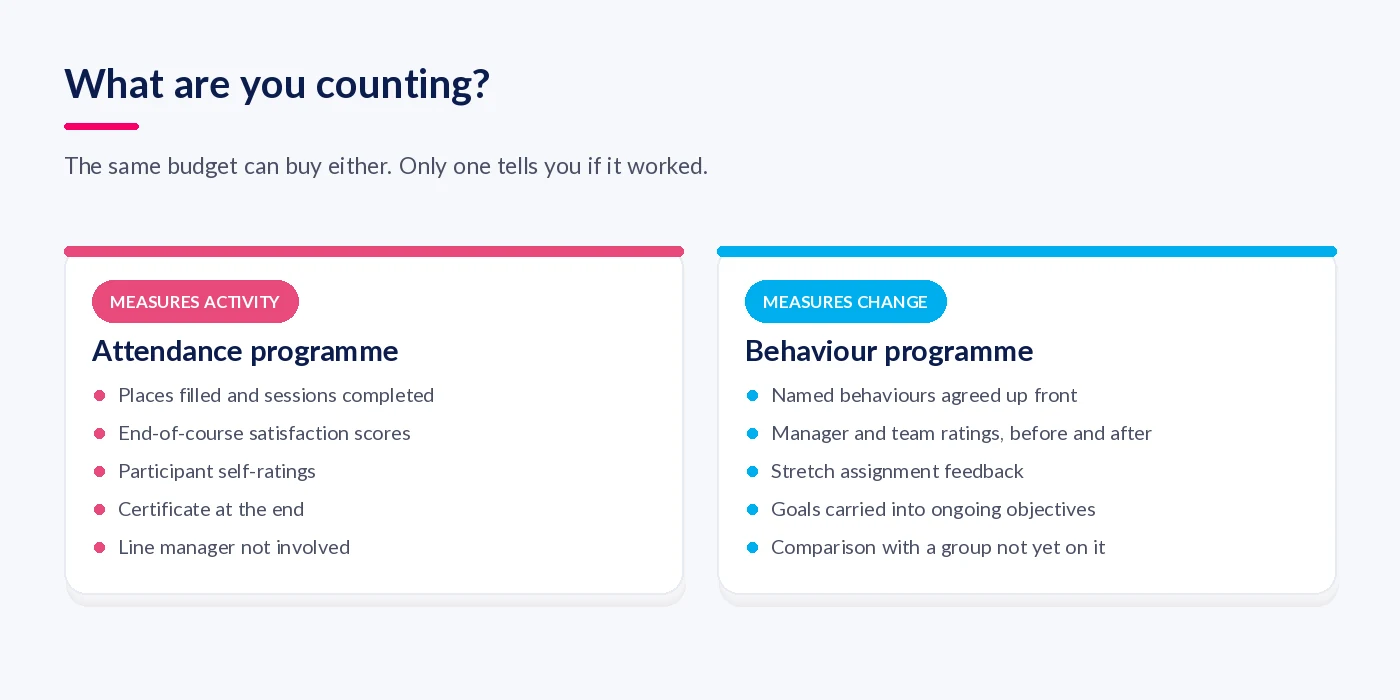
Put simply: the happy sheet tells you the room was warm, and the participant's own view of their progress is not reliable evidence. What tells you the programme worked is whether people who work with the participant see them doing something different.
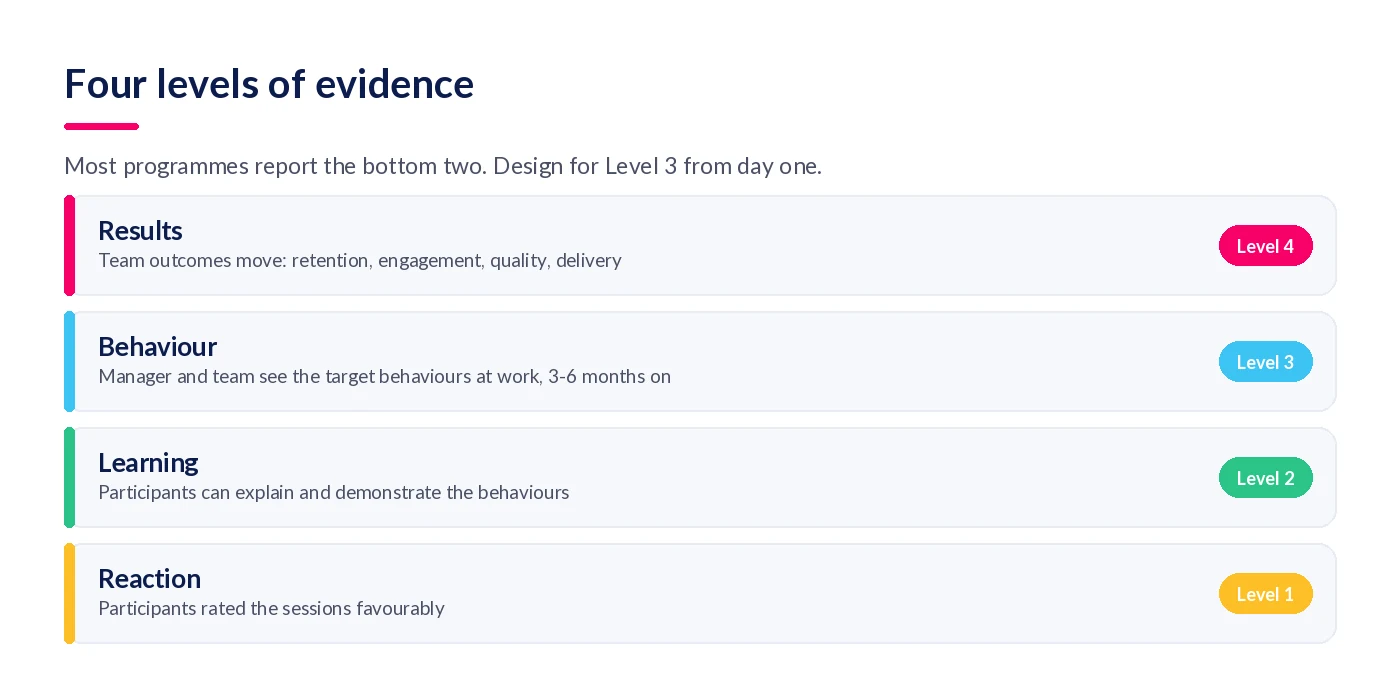
The Kirkpatrick Model gives you the vocabulary. Level 1, Reaction, measures whether people found the experience favourable. Level 2, Learning, measures whether they acquired the knowledge and skills. Level 3, Behaviour, measures "the degree to which the target audience performs the critical behaviors" back in its own environment. Level 4, Results, measures whether the organisational outcomes followed. Most leadership programmes report Levels 1 and 2 and stop. Designing for Level 3 from day one is the single biggest difference between a programme that changes behaviour and one that changes nothing.
Seven design decisions, in the order to make them
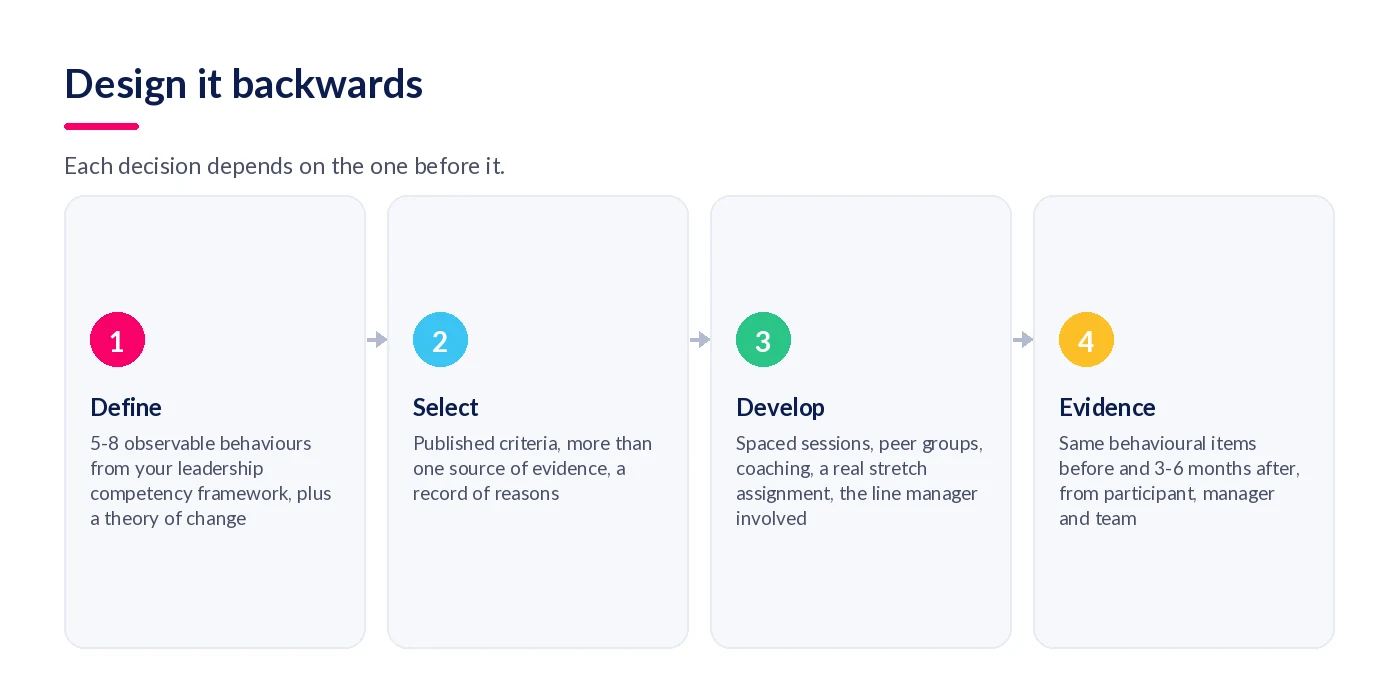
These steps run in sequence because each one depends on the one before. You cannot select fairly until you know the behaviours, and you cannot measure until you have written down what should change.
1. Start from the behaviours, not the course catalogue
If you have a leadership competency framework, this is where it earns its keep. Pick the five to eight behaviours that matter most for the population you are developing. Fewer is better: a programme that tries to shift twenty behaviours shifts none.
Rewrite each one as something a team member could see or hear. "Gives clear direction" is a theme. "Sets the week's priorities with the team on Monday and checks progress on Thursday" is a behaviour. Our guide to behavioural indicators covers how to write them so they can be assessed. If you do not have a framework, a training needs analysis of your current managers will give you a starting list.
2. Write a theory of change you can measure
A theory of change is a plain statement of cause and effect: the programme does X, so the participant does Y at work, so the team experiences Z. The Civil Service guide recommends that it be "specific enough to serve as a foundation for measurement", for instance by naming the specific management practices the training aims to improve.
Write one line per behaviour. For example: "Sessions on structured one-to-ones, plus practice in peer groups, so the participant holds a fortnightly one-to-one with every direct report using an agreed agenda, so team members say they know what is expected of them and get regular feedback." Every part of that sentence can be checked later.
3. Select participants openly and fairly
Selection is where programmes quietly lose credibility. If places go to whoever the director likes, everybody notices, and the programme becomes a reward rather than a development tool.
There is also a legal dimension most guides leave out. Under section 39(2)(b) of the Equality Act 2010, an employer must not discriminate against an employee "in the way A affords B access, or by not affording B access, to opportunities for promotion, transfer or training". A leadership programme is an opportunity for training and, often, a route to promotion. Separately, section 158 permits proportionate positive action where you reasonably think people who share a protected characteristic have participation in an activity that is "disproportionately low", for example by encouraging them to apply. It does not permit lowering the bar at the point of selection.
In practice: publish the criteria, use more than one source of evidence (a manager nomination alone is a single point of bias), look at who applied and who was chosen against your workforce profile, and keep a short record of the reasons. If you use a high-potential assessment, be clear which criteria measure potential and which simply measure visibility.
4. Blend formal, social and on-the-job learning
You will see the 70-20-10 model quoted on almost every page about leadership development: 70% of learning from experience, 20% from other people, 10% from formal courses. It is worth knowing where it comes from. The Center for Creative Leadership traces it to its own research in the late 1980s, built on asking successful executives what had shaped them. CCL still defends it as a good model for learning, while describing it as "incomplete". Treat the numbers as a reminder of proportion, not a budget formula. No one should be auditing your programme to check that formal learning is exactly 10%.
The useful point underneath it holds: most leadership behaviour is learnt by doing it, badly at first, with someone helping you notice. So build the programme around three strands:
- Formal: short sessions, each introducing one or two behaviours, spaced weeks apart so there is time to practise in between.
- Social: small peer groups that meet between sessions to compare what they tried, plus coaching or mentoring from a more experienced leader.
- On the job: deliberate practice in the participant's real role and a stretch assignment (step 6).

5. Make each participant's line manager part of the programme
If there is one step to keep when budgets are cut, keep this one. The participant's line manager decides whether they get the time to practise, whether the stretch assignment is real, and whether new behaviour is noticed and reinforced or quietly discouraged.
Brief managers before the programme starts. Hold a short three-way conversation (participant, manager, programme lead) to agree the one or two behaviours that matter most for this person. Then put the programme on the agenda of every one-to-one for its duration: what did you try, what happened, what will you try next. Ten minutes a month from the manager does more for transfer than another day in a workshop.

6. Give every participant a stretch assignment with an evidence trail
A stretch assignment is real work that demands the target behaviours at a level the participant has not yet reached: leading a cross-team project, running a change in their own area, taking on a difficult stakeholder. It is the "experience" part of the programme and it should not be invented busywork.
Agree up front what good looks like, in behavioural terms, and who will see it. At the end, collect short written feedback from two or three of those people. That feedback, not a presentation to the board, is the evidence that the behaviour transferred.
7. Measure behaviour through other people's eyes
Use the same short set of behavioural items, drawn from step 1, before the programme and again three to six months after it finishes. Ask the participant, their manager and their direct reports. The Civil Service guide treats pre-post surveys as essential and suggests surveys of team members as a way to see effects on the people the trained manager leads. A well-designed 360 review does this job if its items match the programme's behaviours.
Without a comparison group you cannot prove the programme caused the change: a new team, a quieter quarter or a better manager could all play a part. The guide recommends considering a randomised design where it is feasible; for most mid-sized employers, comparing participants with a similar group starting the following year is a reasonable and fair alternative.
Four ways a programme stalls
It is designed around a provider's catalogue
The content arrives first and the behaviours are retro-fitted. Fix it by handing providers your behaviour list and theory of change and asking them to design to it.
Participants come back to the same workload
A manager who spends two days away returns to two days of backlog, and the new habits never get a chance. Space sessions out, keep them short, and agree with the line manager what will come off the participant's plate during the programme.
Success is measured by the participants
Self-ratings go up after almost any programme. Taken alone they tell you about confidence, which matters, but not about behaviour. Always pair them with the manager's and the team's view.
It ends with a certificate and nothing after
Behaviour that is not reinforced fades. Build the follow-up into normal management: the development goals move into the participant's ongoing objectives, the line manager keeps them on the one-to-one agenda, and the six-month re-survey is in the diary before the first session starts.
A 12-month programme for first-line managers, sketched
Here is what the steps above look like for a cohort of twelve newly promoted team leaders in a mid-sized organisation. It is an illustration, not a prescription; adjust the timings to your own operating rhythm.
| When | What happens | Who is involved | Evidence collected |
|---|---|---|---|
| Month 0 | Behaviours chosen from the framework; criteria published; nominations and applications reviewed | HR, sponsor, senior managers | Selection record; applicant and participant profile |
| Month 1 | Baseline survey; three-way goal conversations; launch session on the first two behaviours | Participant, line manager, team | Pre-programme ratings from all three |
| Months 2–5 | Four half-day sessions, one every month; fortnightly peer groups; monthly one-to-one check on progress | Participant, peers, line manager | One-to-one notes; practice logs |
| Months 4–8 | Stretch assignment, with success agreed in behavioural terms up front | Participant, assignment sponsor | Short written feedback from people affected |
| Month 9 | Closing session; development goals moved into ongoing objectives | Participant, line manager | Updated development plan |
| Month 12 | Re-survey with the same items; compare with a similar group not yet on the programme | Participant, line manager, team | Post-programme ratings; comparison |
Where StaffCircle fits
A programme designed this way needs a place where behaviours, goals, conversations and feedback sit together, so that evidence builds up as part of normal management rather than in a separate spreadsheet. That is what StaffCircle's skills and development tools are for.
The behaviours live in your competency framework
You can hold your leadership behaviours in StaffCircle as a competency framework with proficiency expectations attached to roles, so the programme's target behaviours are the same ones people are assessed against in their day job.
Development goals stay on the one-to-one agenda
Programme goals can be set as development objectives and reviewed in regular one-to-ones and check-ins, so the line manager's part in step 5 happens in the tool they already use rather than as an extra task.
Feedback from the people who see the behaviour
Continuous feedback and 360 reviews let you gather the manager's and the team's view of the same behaviours before and after the programme, giving you the Level 3 evidence most programmes never collect.
Programmes that earn their budget
A leadership development programme is easy to buy and hard to prove. The ones that earn their budget are designed backwards: from the behaviours the organisation needs, to the evidence that those behaviours now show up, to the learning that gets people there. The line manager is part of the design, the stretch assignment is real work, and success is judged by the people who work with the participant, not by the participant alone.
If you would like to see how StaffCircle connects competency frameworks, development goals, one-to-ones and feedback in one place, book a demo and we will walk you through it.
FAQ
What is a leadership development programme?
A leadership development programme is a structured, time-bound plan to move a defined group of people from the leadership behaviours they show today to the behaviours the organisation needs, combining formal learning, peer and coaching support, real assignments and line manager involvement, and measuring whether the behaviours change at work.
How long should a leadership development programme last?
There is no fixed rule. Programmes aimed at behaviour change usually run over several months so participants can practise between sessions; the illustration in this guide runs for nine months of activity with a re-survey at twelve. What matters more than length is spacing sessions out and following up afterwards.
Who should go on a leadership development programme?
Anyone whose role needs leadership behaviours they do not yet show consistently: newly promoted managers, experienced managers stepping up, and high-potential individual contributors. Run separate cohorts for different levels, and select openly using published criteria and more than one source of evidence.
What should a leadership development programme include?
A short list of target behaviours taken from your leadership competency framework, a theory of change, an open selection process, spaced formal sessions, peer groups or coaching, a stretch assignment, structured line manager involvement, and a before-and-after measure of behaviour from the participant, their manager and their team.
Is the 70-20-10 model evidence-based?
The Center for Creative Leadership traces the model to its research in the late 1980s, based on what successful executives said had shaped them, and still describes it as a good but incomplete model. Use it as a reminder that most leadership is learnt on the job, not as a precise budget split.
How do you measure the impact of a leadership development programme?
Survey the participant, their line manager and their direct reports on the same behavioural items before the programme and three to six months after it. Add evidence from stretch assignments and, where possible, compare with a similar group who have not yet taken part. Reaction surveys alone do not measure effectiveness.
Why do leadership programmes fail to change behaviour?
Common reasons are content chosen before the behaviours, participants returning to the same workload with no time to practise, line managers who are not involved, success measured only by self-ratings or attendance, and no follow-up once the formal sessions end.
What is the role of the line manager in leadership development?
The line manager agrees the participant's development goals, gives them room to practise, sponsors or supports the stretch assignment, keeps progress on the one-to-one agenda and provides one of the independent views of whether behaviour has changed.
Does the Equality Act apply to selecting people for leadership programmes?
Yes. Section 39(2)(b) of the Equality Act 2010 prohibits discrimination in the way an employer gives or withholds access to opportunities for promotion, transfer or training. Section 158 allows proportionate positive action, such as encouraging applications from under-represented groups, but not lowering the selection standard.
What is a stretch assignment in leadership development?
A stretch assignment is a real piece of work that requires leadership behaviours above the participant's current level, such as leading a cross-team project or running a change. Success should be agreed in behavioural terms beforehand and evidenced through feedback from the people affected.
What is the difference between leadership training and leadership development?
Leadership training usually means a course or workshop that teaches knowledge and skills. Leadership development is broader: it includes training but also coaching, peer learning, real assignments and manager support over time, and is judged on whether behaviour changes at work.
How does a leadership competency framework support a development programme?
It gives the programme its target behaviours, so the programme develops the same behaviours people are assessed against in their roles. It also provides the behavioural indicators you can turn into survey items to measure change before and after the programme.
Related articles


See StaffCircle in action
Book a personalised demo and see how StaffCircle drives performance, engagement and development.