How to Write Behavioural Indicators for a Competency Framework
Sarah runs HR for a 600-person distribution business, and she is in a calibration meeting that has stalled. Two shift managers have rated the same team leader against the competency "Communicates effectively". One gave a 4. The other gave a 2. Both are certain they are right, and both can point at the framework to prove it.
They are both right, which is the problem. "Communicates effectively" does not describe anything either manager could have watched happen. It describes a conclusion, and each of them reached it from different evidence. The fix is not a better rating scale or a longer meeting. It is better behavioural indicators.
Behavioural indicators are short, observable descriptions of what a person does when they are demonstrating a competency. Good ones start with an action verb, describe one behaviour in a real work situation, avoid trait words and adjectives of degree, and change in scope from level to level. The test is simple: two managers watching the same work should agree whether the indicator was met.
This guide covers the drafting job itself: raw material, wording, negatives, levelling and testing with managers. If you need the wider build first, start with our guide to building a competency framework and come back here when you reach the indicators.
What a behavioural indicator is, and what it is not
A competency is a capability you want. A behavioural indicator is the evidence that someone has it. The UK Civil Service's Success Profiles behaviours describe nine behaviours across six grade levels, and introduce the lists as examples of behaviours that give "an overview of what we expect". Police Scotland's Competency and Values Framework describes each competency with "a list of behaviours which indicate" that a person is displaying it.
Both make the same quiet point: indicators are evidence, not a checklist. The older Civil Service Competency Framework 2012 to 2017 said it directly. Its indicators were "not designed to be comprehensive". Nobody is expected to tick every line. A manager is expected to recognise the competency when they see it, and the indicators tell them what to look for.
So each indicator has to help a manager answer a handful of practical questions:
- What would I actually see or hear if this person had this competency?
- In what situation would I see it?
- What does it look like when it is missing or going wrong?
- How is it different at this person's level compared with the level above?
- What evidence could I point to in a review if someone asked why I gave this rating?
An indicator that cannot answer the first question is not an indicator. It is a value statement or a personality description, and both belong somewhere else in the framework.
The two-manager test most indicators fail
Most frameworks get the competency list roughly right and fall down on the wording underneath. The failures are predictable enough to check line by line.

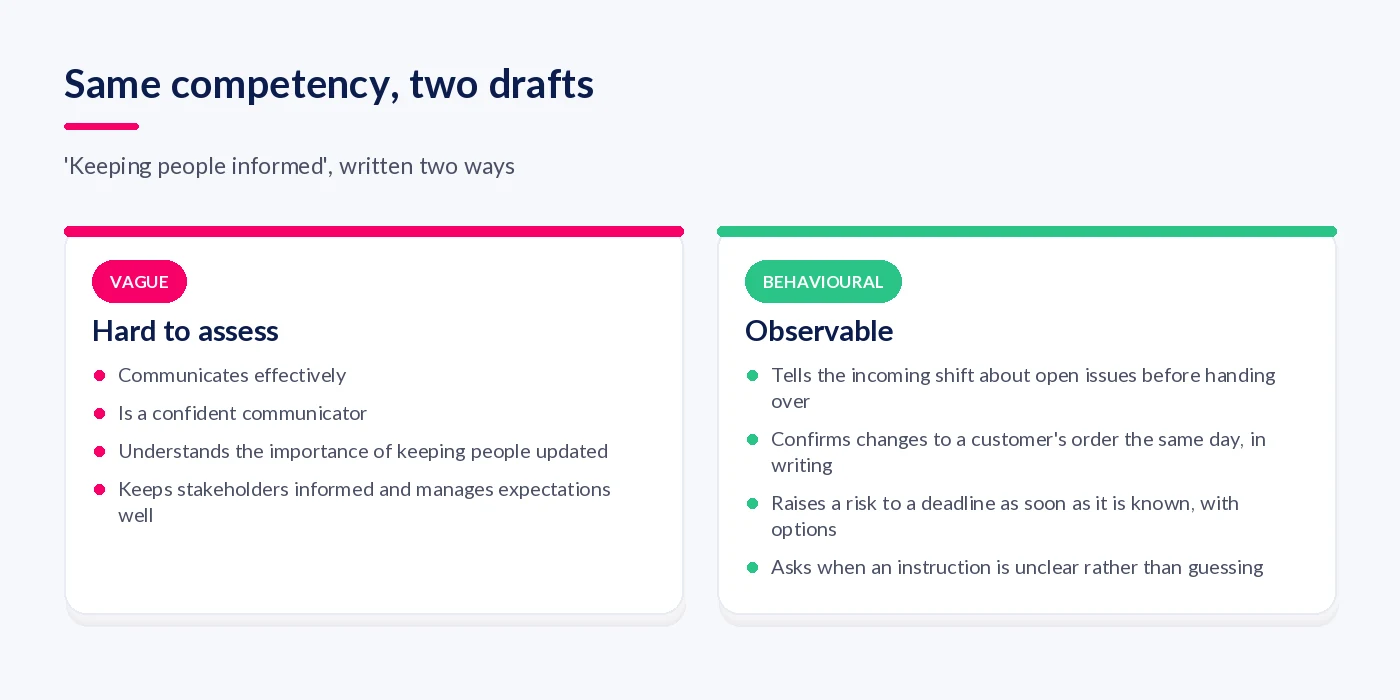
Take the running example from Sarah's meeting, a competency called Keeping people informed. Here are four lines that appear, in some form, in a great many frameworks, and what is wrong with each:
| Draft indicator | The problem | Rewritten |
|---|---|---|
| Communicates effectively | "Effectively" is a judgement, not a behaviour | Tells the incoming shift about open issues before handing over |
| Is a confident communicator | Describes a trait, and confidence is easy to misread across cultures and personalities | Explains a change to the team in their own words and answers questions on the spot |
| Understands the importance of keeping people updated | Understanding is invisible; only action can be observed | Confirms changes to a customer's order the same day, in writing |
| Keeps stakeholders informed and manages expectations well | Two behaviours in one line, plus "well" | Raises a risk to a deadline as soon as it is known, with options |
Four rules come out of that table:
- Start with an action verb a person could be seen doing: tells, confirms, raises, asks, checks, explains, escalates, records.
- One behaviour per line. If a line contains "and", it is probably two indicators, and a person can meet one half without the other.
- No trait words such as confident, proactive, resilient or passionate. They describe the person, not the behaviour.
- No adjectives of degree such as effectively, well or appropriately, unless the line also says what effective looks like.
Even good published frameworks drift on these rules. The current Civil Service behaviours include lines like displaying "confidence when making difficult decisions", sitting alongside sharper ones like inviting challenge and involving others in decision making. The second kind is the one two managers will agree on.
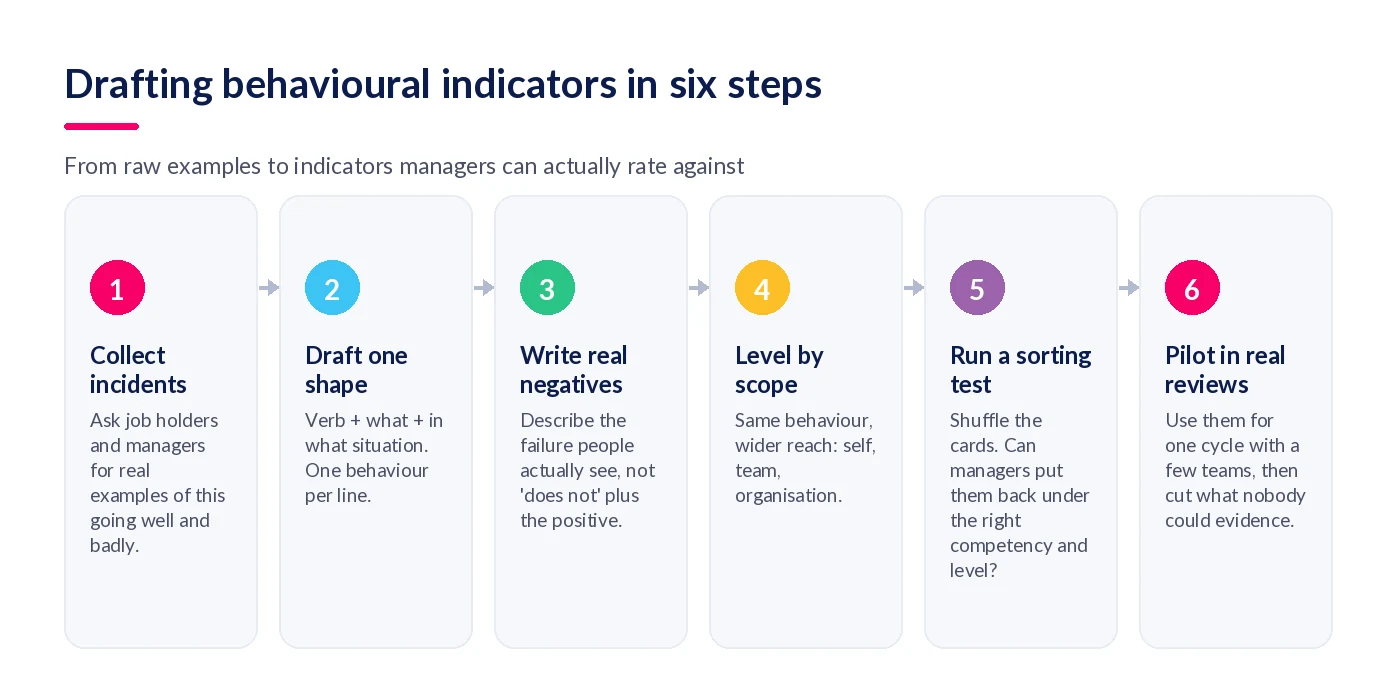
Writing them, step by step
Indicators drafted at a desk tend to be abstract. This process starts from the job instead.
Step 1: Collect real incidents first
Before writing a single line, ask people who know the role for specific examples: a time someone handled this really well, and a time it went badly. What happened, what did the person do, and what was the result? This is a light version of the critical incident technique that John Flanagan described in Psychological Bulletin in 1954, a method for collecting direct observations of effective and ineffective behaviour. Ten or fifteen incidents per competency is usually enough to see the patterns.
Step 2: Draft in one consistent shape
Turn each pattern into a line using the same structure every time: verb + what + in what situation. "Escalates (verb) a risk to the delivery date (what) as soon as it is known (situation)." A fixed shape makes vague lines stand out, because they will not fit it.
Pick a grammatical person and stick to it. Police Scotland's framework writes in the first person ("I take responsibility for my own actions"), which reads well in a self-assessment. A verb-led third person style ("Takes responsibility for…") is quicker to scan on a review form. Mixing them in one framework looks careless and confuses readers.
Step 3: Write negative indicators as real behaviour
The weakest negative indicator is the positive with "does not" in front of it. "Does not keep people informed" tells a manager nothing new. A useful negative describes the failure people actually see: "Leaves the next shift to discover open issues for themselves" or "Reports a missed deadline after it has passed". The incidents from Step 1 are the best source, because the bad examples are usually vivid.
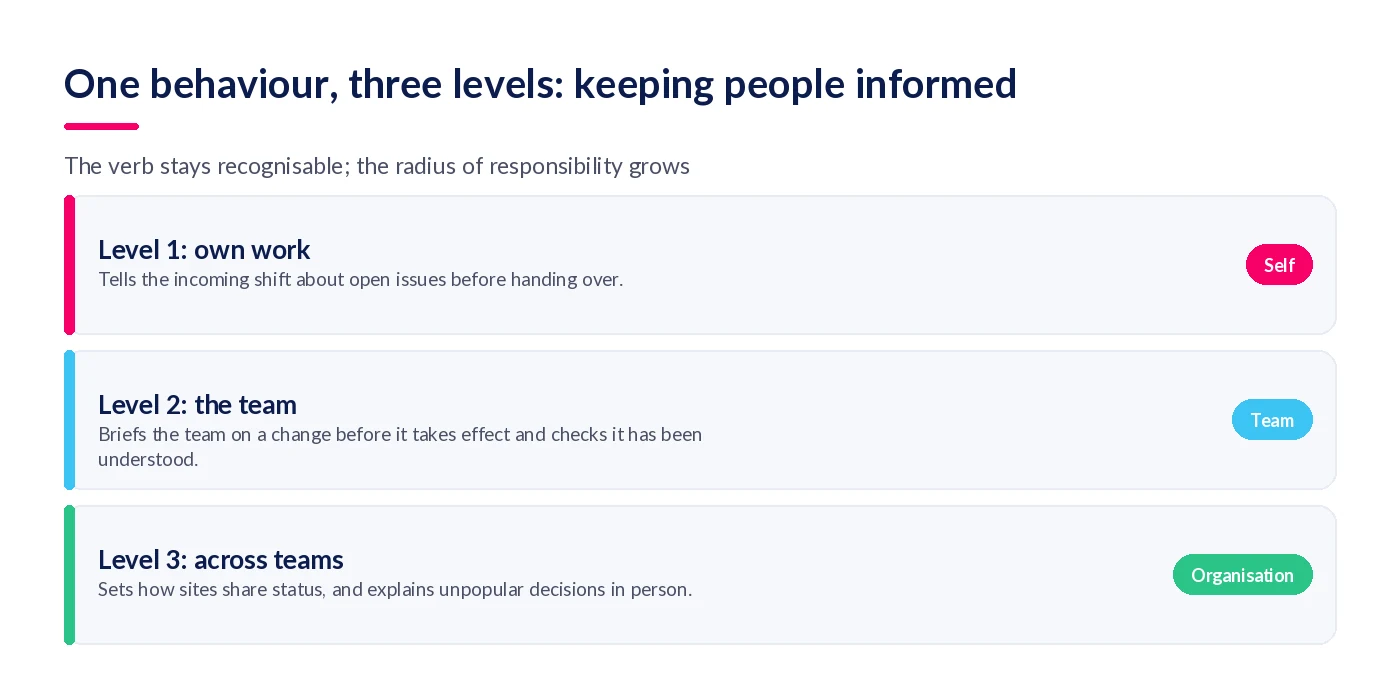
Step 4: Level by scope, not by adjective
The commonest levelling mistake is three columns that read "good", "very good" and "excellent". Instead, keep the behaviour recognisable and widen its reach: own work, then the team, then across teams or the organisation. Both the 2012 to 2017 Civil Service framework and the policing framework describe their levels as cumulative, so someone at a higher level should also show the behaviours below. That means higher levels do not need to repeat lower ones. Our guide to proficiency levels covers how many levels to use; this step is about the words inside them.
Step 5: Run a sorting test with managers
Print every indicator on its own card, remove the headings and shuffle them. Ask five or six managers to put each card back under the competency and level they think it belongs to. Where most of the group disagrees with you, the wording is ambiguous, so rewrite or drop the line.
This borrows the idea of "retranslation" from rating-scale research. Smith and Kendall's 1963 paper used it as a way to build unambiguous anchors for rating scales, and behaviourally anchored rating scales are commonly built by discarding behaviours that experts cannot agree how to place. You do not need the full statistical method. You need the habit of checking that other people read your indicators the way you meant them.

Step 6: Pilot in a real review cycle
Use the draft indicators with two or three teams for one cycle, then ask managers which lines they could evidence and which they rated on gut feel. Cut or rewrite the gut-feel lines before the full rollout.
Positive and negative indicators: why you want both
The 2012 to 2017 Civil Service Competency Framework is still one of the clearest public examples of paired indicators. Every competency set "effective" and "ineffective" behaviours side by side at each level. Under Making Effective Decisions at the most junior level, for instance, undertaking "appropriate analysis to support decisions" sits opposite making decisions "without the evidence to back them up".
Pairs like that do three jobs a positive list alone cannot:
- They give managers words for a problem they have noticed but struggled to name.
- They show where the line sits, since behaviour that is fine at one level can be a warning sign at the next.
- They make ratings easier to explain: "I saw this twice this quarter" beats "I didn't see enough of the positives".
Keep the negative list shorter than the positive one. Two or three sharp negatives per level are more useful than a mirror image of every positive line.
Where indicator sets go wrong
Too many lines to assess
Ten competencies with eight indicators at each of four levels is 320 lines. No manager reads that during a review. Published frameworks keep it to a handful per level: the policing framework's We take ownership competency has between five and nine. If your draft runs longer, the sorting test and pilot will usually show which lines to cut.
Values dressed up as behaviours
"Shows pride in their work" and "Approaches tasks with enthusiasm" are worthy, but hard to observe consistently. If a line describes an attitude, either find the behaviour that shows it or move it to your values statement. Our piece on leadership competency frameworks covers the same trap at senior level.
Wording that disadvantages some groups
Indicators are criteria you apply to people, so they carry legal risk. Under section 19 of the Equality Act 2010, applying a criterion that puts people who share a protected characteristic at a particular disadvantage is indirect discrimination, unless you can show it is a proportionate means of achieving a legitimate aim. An indicator such as "contributes energetically in meetings" or "is visible in the office every day" may disadvantage disabled staff, part-time workers or people with caring responsibilities, without being needed for the job. Ask of every line: does the role actually require this behaviour, or is it just one way of showing the competency?
Indicators that only fit desk jobs
Head-office drafts often assume email, meetings and documents. A warehouse team leader or care worker keeps people informed through handovers, huddles and radios. Collecting incidents from frontline staff in Step 1 is the simplest fix. For more examples across job families, see our competency framework examples.
A worked indicator set you can adapt
Here is the Keeping people informed competency from Sarah's meeting, rewritten using the six steps. It is an example to adapt, not a standard: your incidents should change the wording.
| Level | Positive indicators | Negative indicators |
|---|---|---|
| 1: Own work | Tells the incoming shift about open issues before handing over. Confirms changes to a customer's order the same day, in writing. Asks when an instruction is unclear rather than guessing. | Leaves the next shift to discover open issues. Passes on a change by word of mouth only, with no record. |
| 2: The team | Briefs the team on a change before it takes effect and checks it has been understood. Raises a risk to a deadline as soon as it is known, with options. Shares the reason behind a decision, not just the decision. | Reports a missed deadline after it has passed. Briefs some shifts and not others. |
| 3: Across teams | Sets how sites and teams share status, and checks it is being used. Explains unpopular decisions in person to the people affected. Closes the loop with people who raised a concern. | Announces major changes by email only. Lets different sites hear different versions of the same decision. |
Back in Sarah's calibration meeting, the question changes from "is she an effective communicator?" to "did she brief all three shifts before the rota changed, and did anyone check it landed?" Both managers can answer that, and if they still disagree, they are now arguing about evidence rather than opinion. That is what calibration is supposed to be.
Where StaffCircle fits
Good indicators are a writing job. Keeping them in use, consistently, across every manager and site is a systems job, and that is where StaffCircle helps.
One framework, held in one place
StaffCircle's competency framework tools let you define competencies, levels and the indicators under each, and assign them to roles, so every manager is assessing against the same wording rather than a copy of a spreadsheet that has drifted.
Evidence alongside the rating
Managers can record what they observed against a competency during the year through check-ins and feedback, so when review time comes the rating has examples behind it. That makes the two-manager test something you can actually check.
Seeing where ratings disagree
Reporting across teams shows where one manager's ratings on a competency sit well apart from their peers'. That is often a sign an indicator is being read differently, and a prompt to revisit the wording rather than just the score.
Final thoughts
Behavioural indicators are the least glamorous part of a competency framework and the part that decides whether it works. A competency list tells people what matters. The indicators tell managers what to look for, and that is what makes ratings fair, comparable and explainable.
Start from real incidents, write one observable behaviour per line, level by scope, and test the wording with the managers who will use it. If you would like to see how StaffCircle holds a competency framework and the evidence behind each rating in one place, book a demo.
FAQ
What are behavioural indicators in a competency framework?
Behavioural indicators are short descriptions of observable actions that show whether someone is demonstrating a competency. They turn a broad label such as communication or ownership into things a manager can actually see or hear at work, so different managers can assess the same person in the same way.
What is the difference between a competency and a behavioural indicator?
A competency is the capability you want, such as making effective decisions. Behavioural indicators are the evidence of it: the specific things a person does when they have it. A competency usually has a short definition and then several indicators, often written separately for each level of seniority.
How many behavioural indicators should each competency have?
There is no fixed rule. Published frameworks typically give a handful per level. Police Scotland's version of the policing framework, for example, lists between five and nine per level for one competency. Fewer, sharper indicators are easier to assess than long lists, so cut any that managers cannot evidence.
What are positive and negative behavioural indicators?
Positive indicators describe what effective behaviour looks like. Negative indicators describe what ineffective behaviour looks like. The 2012 to 2017 Civil Service Competency Framework set them side by side as effective and ineffective behaviours, which helps managers recognise a problem as well as a strength.
Should behavioural indicators be written in the first or third person?
Either works if you are consistent. The Police Scotland framework writes indicators in the first person, such as I take responsibility for my own actions. Many corporate frameworks use a verb-led third person style. First person suits self-assessment; verb-led statements are quicker to scan in a review form.
How do you make behavioural indicators observable?
Start each indicator with an action verb, name what the person does it to and add the situation. Remove trait words like confident or proactive, and adjectives of degree like effectively or well. Then test it: if two managers watched the same week of work, would they agree whether it happened?
How do you write behavioural indicators for different levels?
Keep the behaviour recognisable and widen its scope at each level, from the person's own work to their team to the wider organisation. Avoid levels that differ only by adjectives such as good, very good and excellent. Make levels cumulative, so a higher level assumes the behaviours below it.
What is the critical incident technique?
The critical incident technique is a method for collecting specific examples of effective and ineffective behaviour from people who know the job. John Flanagan described it in Psychological Bulletin in 1954. It is a practical way to gather raw material for behavioural indicators instead of drafting them from a blank page.
What is a behaviourally anchored rating scale?
A behaviourally anchored rating scale, or BARS, attaches specific examples of behaviour to each point on a rating scale. It grew out of work such as Smith and Kendall's 1963 paper on retranslation, which aimed to make rating scale anchors unambiguous. Well-written behavioural indicators work in a similar way.
How do you test behavioural indicators before rolling them out?
Run a sorting test: shuffle the indicators and ask a group of managers to place each one under the right competency and level. Rewrite any that land in the wrong place. Then pilot the framework in one review cycle and remove indicators that nobody could find evidence for.
Can behavioural indicators be discriminatory?
They can if the wording favours one group without a good reason. Under section 19 of the Equality Act 2010, a criterion that puts people sharing a protected characteristic at a particular disadvantage is indirect discrimination unless it is a proportionate means of achieving a legitimate aim. Review indicators for that risk.
Related articles

See StaffCircle in action
Book a personalised demo and see how StaffCircle drives performance, engagement and development.