Evidence-Led 360 Reviews: Templates and Bias Controls
An evidence-led 360 review is a multi-rater appraisal in which the rater groups, the questions and the evidence required are all standardised before the cycle opens. Locked groups, a fixed competency model and anonymity thresholds replace ad-hoc surveys, so results stay comparable between periods and remain defensible when they inform development or progression.
Key facts
- Four standardised components: rater groups, competency model, structured questions, and reporting.
- Five raters minimum across groups before release, with an anonymity threshold per group.
- Raters need at least eight weeks of collaboration inside the review period.
- Any rating below 3 or above 4 must carry a written example.
- Run once or twice a year, paired with monthly one-to-ones.
Ad-hoc 360s create noise, not insight. Inconsistent rater groups, variable question quality and missed reminders dilute the signal and introduce risk. Leaders then struggle to defend outcomes or link them to objectives and development plans.
An evidence-led 360 solves this by standardising inputs, automating workflow, and tying results to clear next steps. What follows is a practical blueprint for running repeatable, compliant 360 cycles with rater rules, question banks, timelines and bias controls built in.
The four components of a 360-degree appraisal
A robust cycle rests on four standardised components: rater groups locked by role, a competency model mapped to the role family and level, a fixed question bank with evidence prompts, and reporting that protects individual identities. Change any one of them mid-programme and the data stops being comparable period to period.
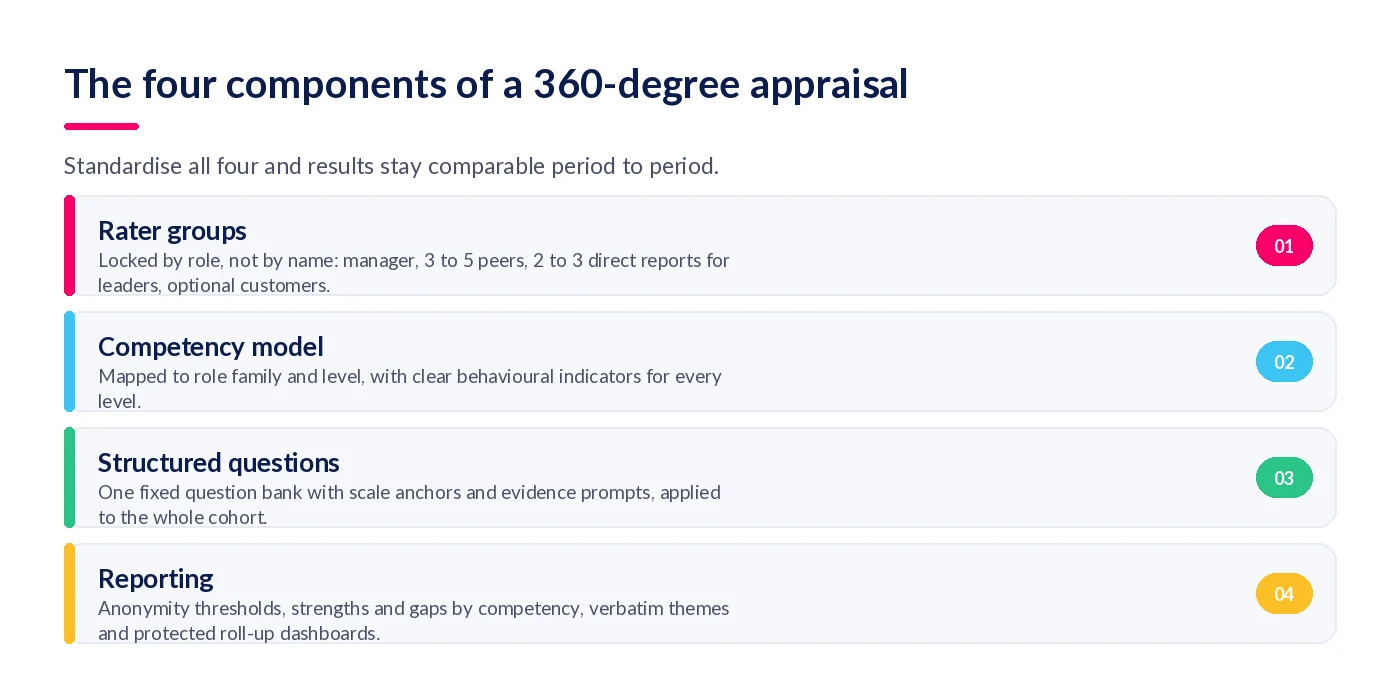
- Rater groups. Define and lock groups by role, not by name. Typical groups include the manager, 3 to 5 peers, 2 to 3 direct reports for leaders, and optional customers. Use eligibility rules such as minimum collaboration time and recency of interaction.
- Competency model. Map competencies to the role family and level. Example domains: results delivery, collaboration, customer impact, communication, problem solving and values alignment. Maintain clear behavioural indicators per level.
- Structured questions. Use a fixed question bank with scale anchors and evidence prompts. Apply the same set to everyone in a cohort so results can be compared.
- Reporting. Aggregate with anonymity thresholds, highlight strengths and gaps by competency, and surface verbatim themes. Provide summaries for the employee and manager, plus roll-up dashboards for HR and leadership that protect individual identities.
Locking the groups by role is what makes the cycle repeatable. This is the rater matrix to copy:
| Rater group | Typical count | Eligibility rule | Anonymity |
|---|---|---|---|
| Manager | 1 | Held the reporting line for the full period | Named by default |
| Peers | 3 to 5 | 8 weeks collaboration, interaction in the last quarter | Aggregated, threshold applies |
| Direct reports | 2 to 3 (leaders only) | Reported to the employee for 8 weeks or more | Aggregated, threshold applies |
| Customers | Optional, 1 to 3 | Live account contact during the period | Aggregated, threshold applies |
Standardised question bank and evidence prompts
Balanced questionnaires reduce halo effects and increase reliability. Pair every rating scale with a targeted evidence prompt, so a score always arrives with the behaviour that produced it. The same six domains cover most role families without rewriting the bank for each team.
- Results delivery: on a 1 to 5 scale, how consistently does this person meet agreed objectives? Add an example from the last quarter.
- Collaboration: rates cross-team cooperation. Evidence prompt: describe a time they unblocked another team.
- Customer impact: assesses ownership and responsiveness. Evidence prompt: provide a recent customer outcome they influenced.
- Communication: measures clarity and audience awareness. Evidence prompt: note a meeting or update they led that improved understanding.
- Problem solving: looks at analysis and trade-offs. Evidence prompt: cite a decision where they balanced speed and risk.
- Values alignment: checks behaviour linked to company values. Evidence prompt: describe a moment that reflected a stated value.
For written feedback, use dual prompts to force balance:
- What is the most valuable behaviour this person should keep doing?
- What is the one behaviour that, if improved, would unlock greater impact in the next 90 days?
Sample feedback statements to set tone and reduce bias
Raters copy the examples you show them, so publish model statements alongside the form. Evidence-led comments name the behaviour, the context and the outcome. Constructive comments name the behaviour, the cost, and the specific change requested next.
Positive, evidence-led
- Kept the Q2 OKR on track by re-baselining milestones when supplier lead times slipped, resulting in 96 percent of target delivered.
- Translated complex data into a one-page brief that enabled faster decisions in the regional standup.
- Mentored a new analyst for four weeks, which improved data quality and reduced rework.
Constructive, action-oriented
- Stakeholder updates sometimes arrive after key decisions. Agree a weekly checkpoint and share decisions within 24 hours to increase alignment.
- Delegation is limited to familiar tasks. Identify two recurring activities to hand over this month with clear success criteria and review points.
- Customer issues occasionally sit without ownership. Adopt an explicit owner in the first response and confirm next step timelines.
Bias controls and rater selection rules
Bias reduction is designed in, not inspected in later. Express each control as a threshold the system enforces rather than guidance a manager might remember, and the same cycle produces comparable data whoever runs it. Six controls do most of the work.
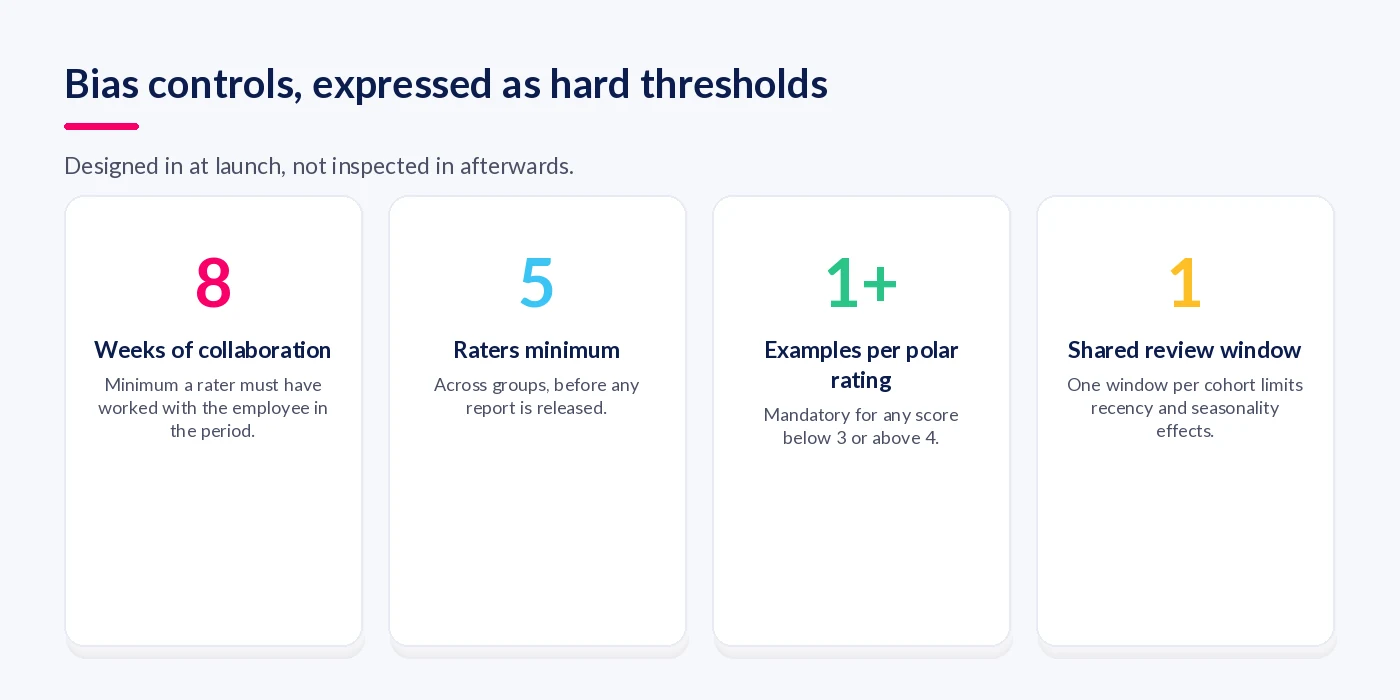
- Eligibility rules: raters must have collaborated for at least 8 weeks in the review period.
- Minimum counts: enforce 5 raters across groups before releasing reports, with anonymity thresholds for each group.
- Standardised scales: behavioural anchors per score prevent rater drift.
- Evidence prompts: mandate at least one concrete example for any rating below 3 or above 4.
- Timing controls: align reviews to the same window to limit recency and seasonality effects.
- Manager moderation: managers review theme summaries, not raw comments per rater, which reduces retaliation risk.
Workflow automation with StaffCircle
StaffCircle standardises the cycle and removes the manual chasing that quietly decides whether a 360 finishes on time. Routing, anonymisation, approvals and audit trails run as configuration rather than as somebody’s spreadsheet, and the outcomes land in objectives instead of a PDF.
- Routing and scheduling: launch mid-quarter runs with automated invitations, reminders and deadline nudges across web and mobile for high participation.
- Anonymisation and approvals: apply anonymity rules and manager approvals before release. HR keeps audit visibility without exposing identities.
- Evidence capture: attach timeline entries, objectives and recognition as linked evidence to contextualise ratings.
- Outcomes to OKRs and PDPs: convert themes into measurable next steps inside objectives and personal development plans, then track progress on dashboards.
- Success Circles: Success Circles aggregate 360 insight with objectives and recognition to give a fair, real-time view of performance and potential that supports progression decisions.
Automating the routing and reminders is where the admin goes: StaffCircle customers report up to 90% less performance admin. For the wider picture, see how a modern performance management system connects reviews, goals and development in one place, and use SMART objective and OKR templates to standardise how the resulting objectives are written.
Deployment checklist and mid-quarter timeline
A mid-quarter launch avoids the year-end crush and gives the growth priority a full quarter to move. The sequence below runs over six weeks, from locking the templates to booking the 30-day check-in, and repeats unchanged every cycle.
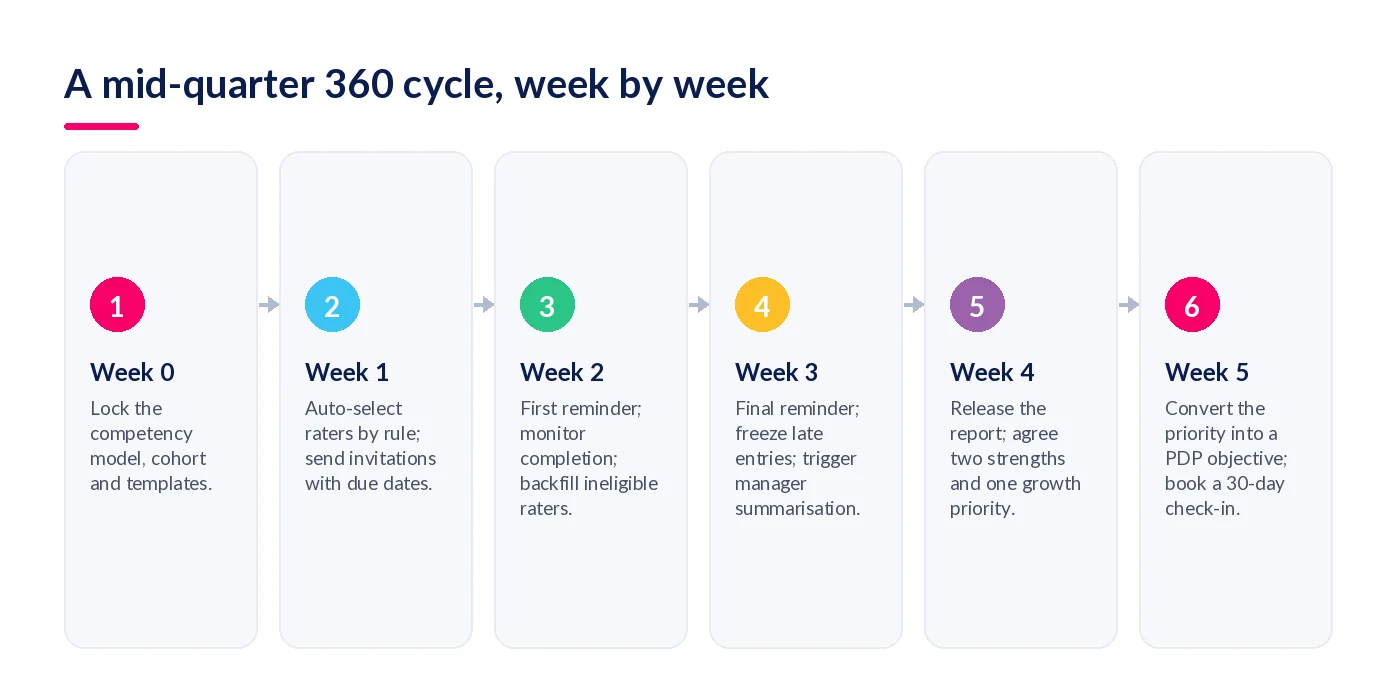
- Week 0. Lock the competency model, cohort and templates.
- Week 1. Auto-select raters using the eligibility rules, and send invitations with due dates and role-based guidance.
- Week 2. Send the first reminder, monitor completion dashboards and backfill raters who fail eligibility.
- Week 3. Send the final reminder, freeze late entries and trigger manager summarisation.
- Week 4. Release the employee report, schedule the discussion and agree the top two strengths and top one growth priority.
- Week 5. Convert the growth priority into a development plan objective with milestones, schedule a 30-day check-in and log it in the central timeline.
Quality gates before release: the minimum rater count is met, evidence is present for every polar rating, and the manager has cross-checked verbatims for tone and specificity. If you are standing a process up from scratch, this step-by-step 360 feedback rollout covers the groundwork before week 0.
Interpreting a 360 review and linking to action
Prioritise signals that repeat across more than one rater group and tie to competencies linked to role impact. A single sharp comment is data, not a theme. Translate each surviving theme into one measurable action with an owner, a cadence and a review date.
- If communication clarity is flagged, set a goal to provide a weekly stakeholder digest with defined recipients, sent every Friday, tracked for 8 weeks.
- If delegation is a constraint, create a development objective to transition two processes with documented procedures, success measures and a review cadence.
Track progress using development plan milestones and objective dashboards rather than a follow-up meeting nobody books. For the planning side, see how to build a development plan for employees and how a personal development review keeps the momentum between cycles.
Are 360 appraisals effective?
Yes, when they are standardised, evidence-led and linked to objectives and development. Effectiveness drops sharply in two situations: when inputs are inconsistent between raters or cycles, and when the report arrives without next steps. The design decides the outcome, not the format.
How often should 360 appraisals be done?
Typically once or twice per year, depending on role criticality and how fast the role is changing. Pair them with monthly one-to-ones and lightweight continuous feedback so the 360 is a periodic calibration rather than the only moment anyone gives feedback, and respondents are not overloaded.
What software is used for 360 appraisals?
Integrated performance management software that automates scheduling, anonymity, reminders and reporting, and links outcomes to goals and development. StaffCircle delivers this as one mobile-accessible workflow with audit trails and leadership dashboards.
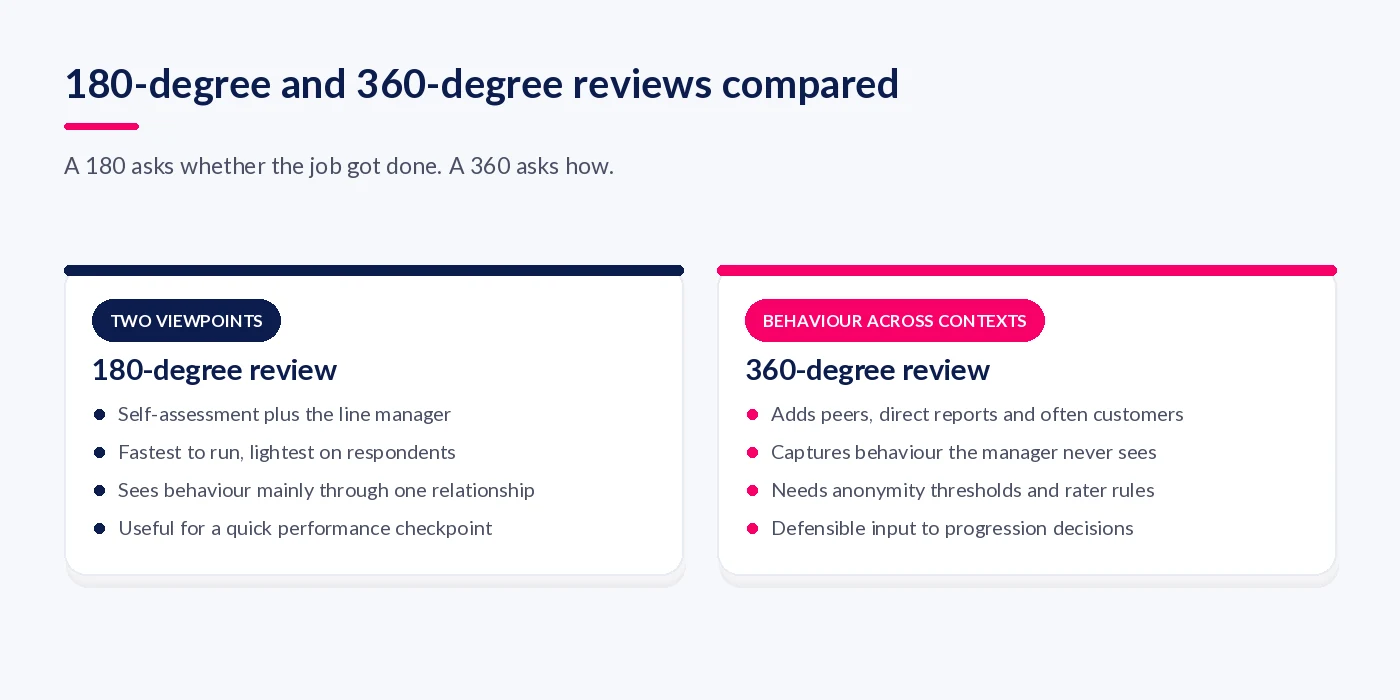
What is the difference between a 180 and a 360 review?
A 180 includes self and manager inputs. A 360 adds peers, direct reports and often customers, to capture behaviour across contexts the manager never sees.
Frequently asked questions
What to write in a 360 appraisal?
Focus on recent, observable behaviour rather than personality, and anchor every point to a specific example from the review period. Balance one strength worth repeating with one behaviour that would unlock more impact, then propose a concrete next step with a timeframe the employee can genuinely act on.
How to do a 360-degree performance appraisal?
Define rater groups and eligibility rules, then apply one standard competency model and question set across the cohort. Automate invitations, reminders and cut-offs, enforce anonymity thresholds before release, and convert the agreed themes into objectives and development plan actions with scheduled check-ins so the feedback changes something.
What questions are common in 360 feedback?
Scaled items with behavioural anchors covering results delivery, collaboration, communication, customer impact, problem solving and values alignment, each paired with an evidence prompt asking for a concrete example. Most banks close with two written questions: one behaviour to keep doing, and one that would unlock greater impact.
What are the four components of a 360-degree appraisal?
Rater groups locked by role, a competency model mapped to role family and level, a structured question bank with scale anchors and evidence prompts, and reporting that applies anonymity thresholds while staying auditable. Standardise all four and results stay comparable between cycles and defensible under challenge.
How to interpret a 360 review?
Look for patterns that repeat across more than one rater group rather than reacting to single comments. Prioritise the themes tied most closely to role impact, then convert each into a measurable objective with a named owner, a milestone and a review date so that progress stays visible.
Summary and next step
Evidence-led 360s work when inputs are standardised, bias controls are enforced as thresholds, and outcomes flow directly into OKRs and development plans. StaffCircle automates the full cycle, from rater selection and anonymisation through approvals and reporting to Success Circles for fair progression. Start by locking the four components, then run one mid-quarter cohort end to end.
Related articles
See StaffCircle in action
Book a personalised demo and see how StaffCircle drives performance, engagement and development.