Competency Framework Examples: Real Structures You Can Copy
Competency framework examples show how a role's expected behaviours and skills are written out at each proficiency level, so people can see exactly what "good" looks like at their grade and the next one up. The strongest examples come from real, published frameworks — the UK Civil Service's Success Profiles behaviours, or the Skills Framework for the Information Age (SFIA) for technical roles — because they show genuine level-by-level wording, not just a list of competency names. Below are four worked examples you can copy the structure from, plus the process for adapting them to your own roles.
What Is a Competency Framework, Really?
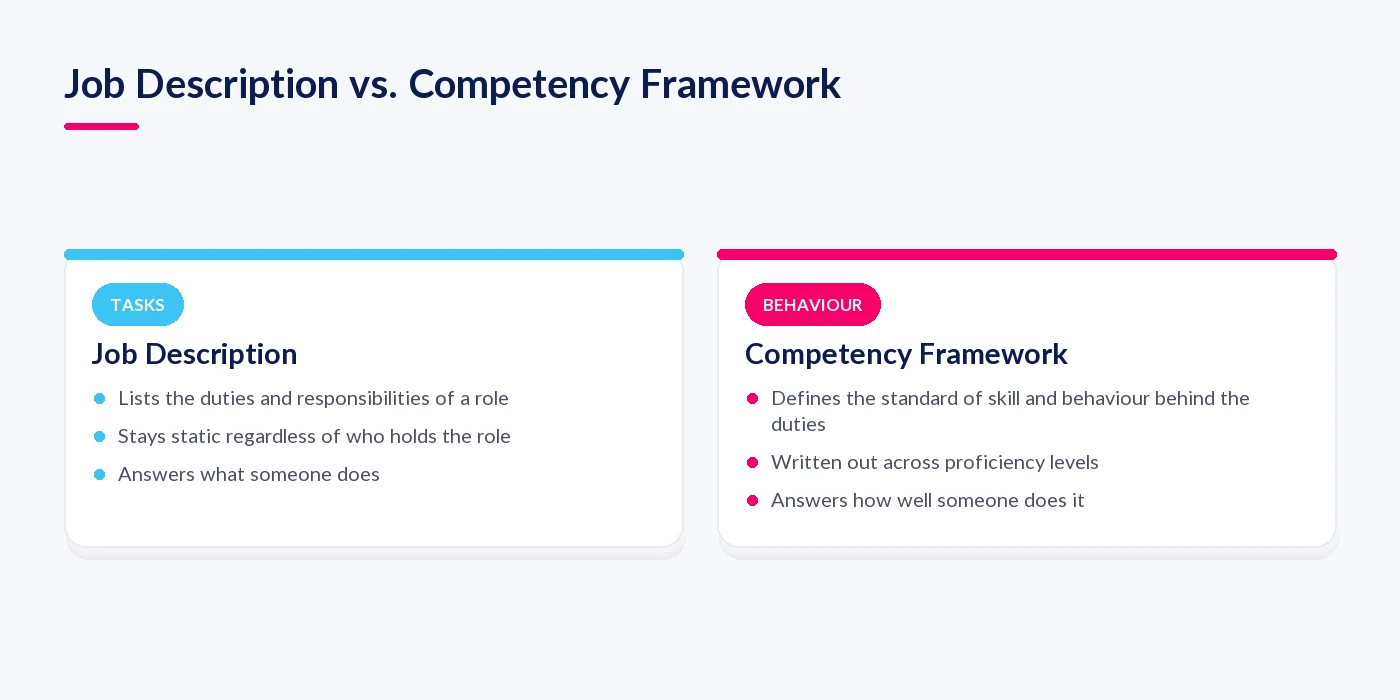
A competency framework is a structured description of the skills, knowledge and observable behaviours a person needs to perform a role well, written out across two or more levels of proficiency. It is different from a job description, which lists duties and tasks. A competency framework describes how those duties get done — the standard of behaviour and capability behind them — and it applies the same structure consistently across every role it covers. If you're starting from a blank page rather than adapting an existing one, our step-by-step guide to building a competency framework covers that groundwork in more depth.
A usable framework has to answer a specific set of questions for every competency it contains, and this is where most home-grown attempts fall down:
- What is this competency actually called, and how is it defined in one sentence?
- How many proficiency levels does it have, and what distinguishes one level from the next?
- What observable behaviour — not a vague trait — proves someone is operating at each level?
- Is this a core competency (expected of everyone) or a functional one (specific to a role family)?
- Where does the evidence for "this person is at Level 3" actually come from?
- How does the framework connect to hiring, appraisal, pay progression and succession decisions?
Most frameworks fail on the third and last of these, which is exactly the gap the examples below are chosen to close.
Why Most "Competency Framework Examples" Online Are Useless
Search for the phrase and you get two kinds of page. The first is a listicle — ten or fourteen well-known frameworks named in a row (SHRM, SHL's Universal Competency Framework, Lominger, SFIA, the EU's e-Competence Framework) with no proficiency wording attached to any of them. You learn the frameworks exist, not what a level 2 versus a level 4 behaviour looks like written down.
The second kind goes deeper into one role family and writes out three to five levels with real behavioural sentences. Far more useful, but almost always invented and illustrative, with no source behind it — so you can't check the wording, or see how a real, publicly governed framework actually phrases a level boundary.
This post uses both. Two examples are quoted directly from real, published frameworks — Civil Service Success Profiles and SFIA — showing exactly how a credible, externally governed body writes a level descriptor. The other two are original worked examples (customer service, sales) built in the same structural style, for roles with no single public standard.
Four Competency Framework Examples You Can Copy
1. Public Sector Leadership Behaviour — UK Civil Service Success Profiles
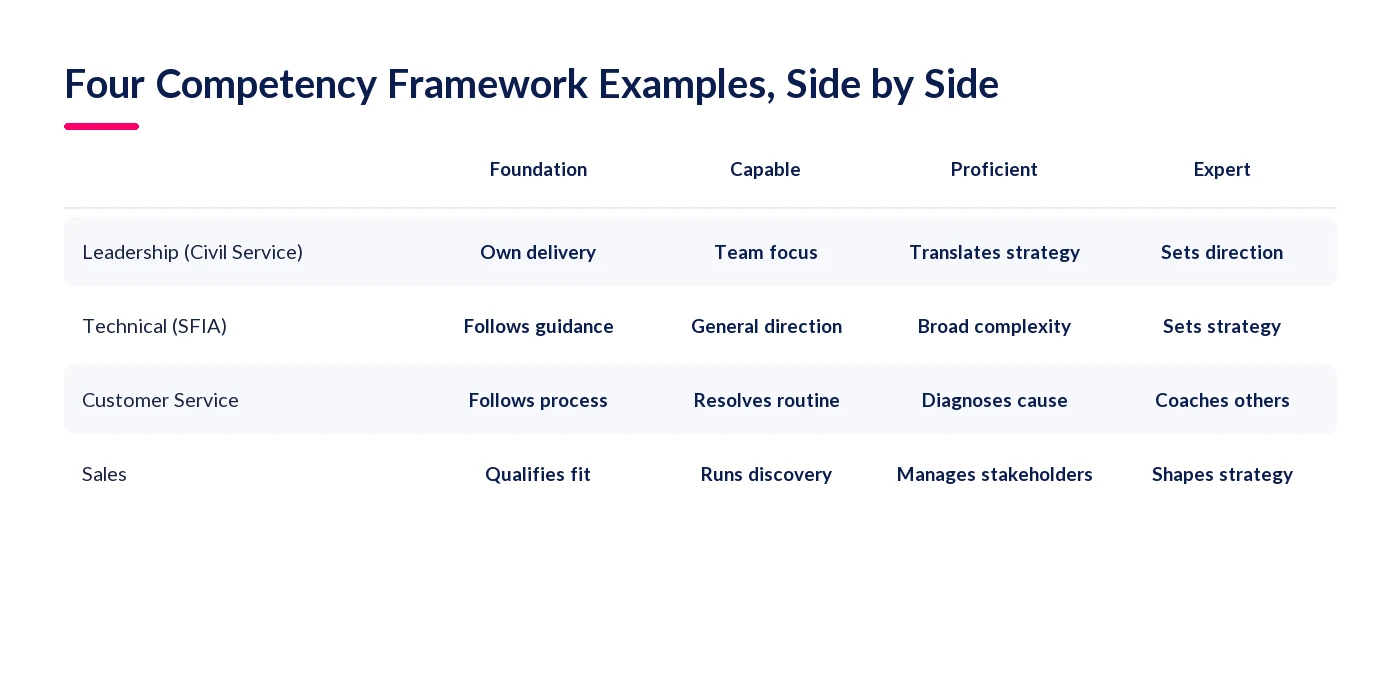
The Civil Service's Success Profiles framework is one of the largest, most publicly documented behavioural competency frameworks in the UK, covering nine behaviours across every grade from Administrative Assistant to Director General. Each behaviour is written out separately for each grade band, so the same behaviour reads as a materially different standard depending on seniority. Take "Delivering at Pace":
- AA/AO grade: "always work with focus and pace to get the job done on time and to a high standard"
- HEO/SEO grade: "show a positive approach to keeping the whole team's efforts focused on the top priorities"
- Deputy Director grade: "translate strategic priorities into clear outcome-focused objectives for managers and teams"
Notice what changes between levels: it isn't the topic (pace and delivery stays constant), it's the scope of what you're accountable for delivering — your own output, your team's focus, or the department's translated strategy. That's the single most useful thing to copy from this example: write each level as the same behaviour applied at a wider radius of responsibility, not as an unrelated new skill.
2. Technical/IT Competency — SFIA
The Skills Framework for the Information Age (SFIA) is the standard reference for technical and digital roles, and it separates two things most home-grown technical frameworks conflate: the skill itself (e.g. database administration, software development) and seven generic responsibility levels that apply across every skill. Level 4, "Enable", is defined across three dimensions:
- Autonomy: "Works under general direction within a clear framework of accountability. Exercises considerable personal responsibility and autonomy."
- Influence: "Influences projects and team objectives. Has a tactical level of contact with people outside their team, including internal colleagues and external contacts."
- Complexity: "Work includes a broad range of complex technical or professional activities in varied contexts."
The structural lesson here is separating the generic level (how much autonomy, influence and complexity someone operates with) from the specific skill it's applied to. Write your responsibility levels once, then apply the same ladder to every technical skill in your framework — it stops you writing five separate, inconsistent proficiency scales for five different technologies.
3. Customer Service Competency
There's no single public standard for customer service competency, so this is an original worked example in the same style. Call the competency "Customer Problem Resolution":
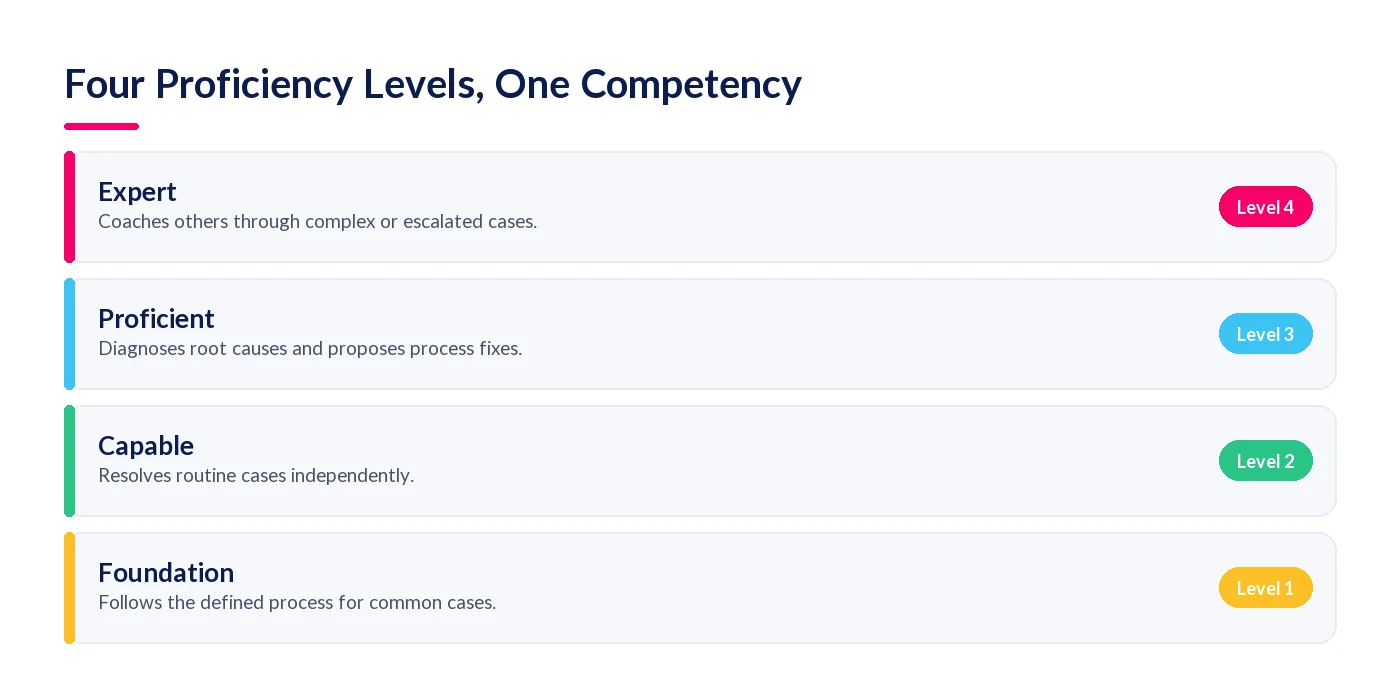
- Foundation: Follows the defined process for common issues, escalating anything outside the standard script without attempting a workaround.
- Capable: Resolves routine issues independently and recognises which non-standard cases genuinely need escalation, reducing unnecessary handoffs.
- Proficient: Diagnoses the root cause behind a recurring complaint pattern, not just the individual ticket, and proposes a process fix to a team lead.
- Expert: Coaches others handling complex or escalated cases, and is the point of reference the team turns to before something goes to a manager.
The pattern to copy: each level names a genuinely different observable action (follows / resolves / diagnoses / coaches), not a vaguer or more enthusiastic version of the same action. "Excellent problem solving skills" is not a level descriptor; "coaches others handling complex cases" is.
4. Sales Competency
Same approach applied to "Consultative Selling":
- Threshold: Follows the qualification framework to identify whether a prospect fits the ideal customer profile before booking a demo.
- Fully Functional: Runs discovery calls that surface the prospect's actual business problem, not just their stated feature request, and tailors the demo accordingly.
- Advanced: Manages multi-stakeholder deals, identifying and influencing the economic buyer separately from the technical evaluator.
- Expert: Shapes account strategy for the most complex, highest-value deals and is brought in by peers to help unblock stalled negotiations.
Both original examples deliberately use four levels rather than five or six. More levels sound more precise, but every extra level is another boundary you have to be able to defend in an appraisal conversation — and most roles don't actually have five meaningfully distinct performance bands.
How to Write Your Own Competency Framework Examples
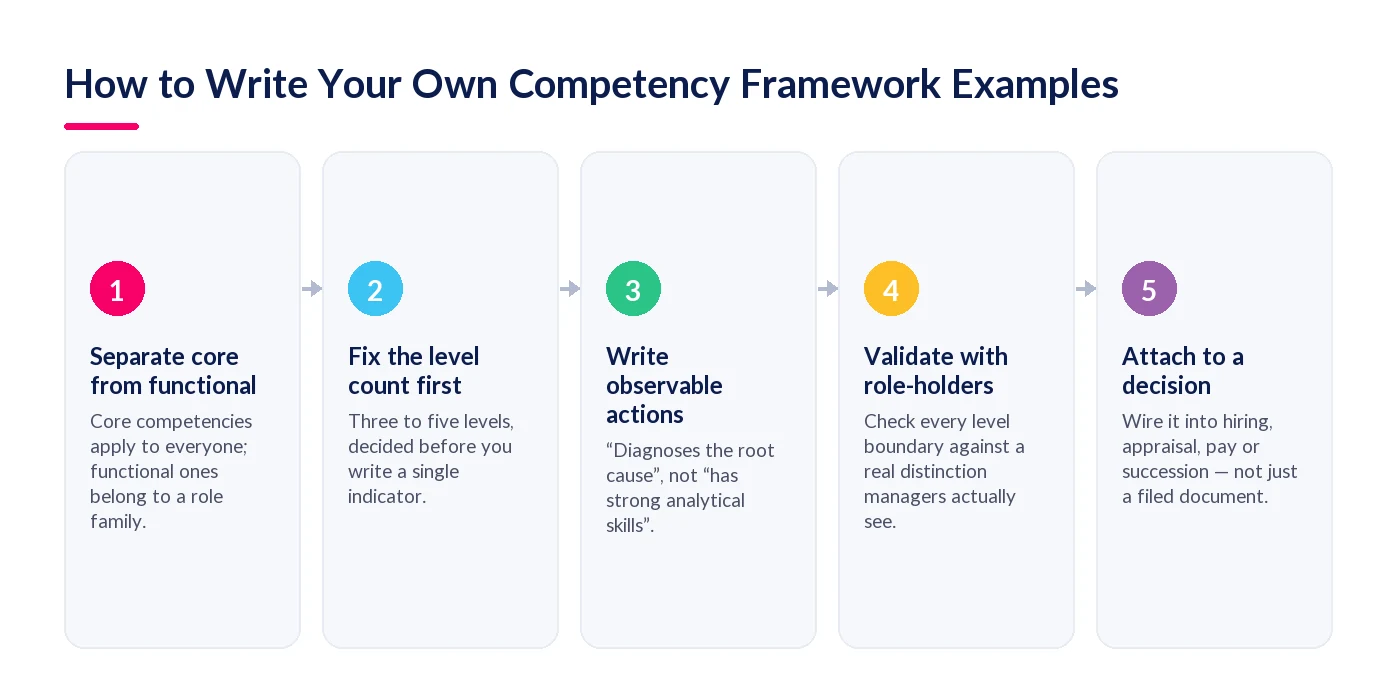
- Separate core from functional competencies. Core competencies (communication, collaboration, accountability) apply to everyone; functional ones (consultative selling, database administration) belong to a specific role family. Most individual-contributor roles need 8–12 competencies in total; loading a role with 20+ makes the framework unusable in practice.
- Fix the number of proficiency levels before you write a single indicator. Three to five levels is the working range across every example above. Decide the count first, then write to it — adding a level halfway through drafting means rewriting every competency you've already finished.
- Write each level as an observable action, not an adjective. "Diagnoses the root cause" is checkable. "Has strong analytical skills" is not. If two people could read a level descriptor and reasonably disagree on whether a colleague meets it, rewrite it.
- Validate with the people who'll be assessed against it. Draft the framework, then sit down with a handful of actual role-holders and their managers and ask: does Level 2 vs Level 3 match a real distinction you've seen between two people in this job? If they can't think of an example, the boundary is wrong.
- Attach the framework to a decision, not just a document. A competency framework that isn't wired into hiring criteria, appraisal ratings, pay progression or succession planning is a PDF nobody opens after month one.
Where Competency Framework Examples Break Down
Copied Verbatim, Never Adapted
The Civil Service and SFIA examples above are genuinely useful templates for structure and wording style — they are not a framework you can paste into your own organisation unchanged. A "Delivering at Pace" behaviour written for a 500,000-person department needs different scope language for a 200-person manufacturing business. Copy the pattern (same behaviour, widening scope by level), not the literal sentence.
Left to Go Stale
Writing consultants Sally Whiddett and Sarah Hollyforde, whose critique of competency frameworks is widely cited in HR practice literature, note that frameworks commonly "focus on the past and therefore cannot keep up to date with rapidly-changing environments" and can end up "unwieldy and not user-friendly" when organisations don't maintain them — with staff seeing "no clear links to what the business is aiming to achieve." A framework written once in 2023 and never revisited is describing a role that has since moved on.
Never Linked to Pay or Promotion
If your competency framework underpins job grading and pay bands, it isn't just an L&D document — it's the mechanism you'd have to defend under equal pay law. ACAS guidance is explicit that employers with 50 or more staff should run an equal pay audit, and smaller employers a lighter-touch equal pay review, to check that people doing "the same, similar, equivalent or of equal value" work are paid equally. A grading structure built on vague, inconsistently-applied competency levels is exactly the kind of thing that audit would need to unpick.
No Evidence Trail in Regulated Sectors
In health and social care, CQC's Regulation 18 requires that staff be "supervised until they can demonstrate required/acceptable levels of competence to carry out their role unsupervised" and receive "regular appraisal of their performance." In construction, CDM 2015 Regulation 8 requires that a designer or contractor "must have the skills, knowledge and experience... necessary to fulfil the role." In both cases, naming a competency isn't enough — an inspector or auditor wants to see the assessment and the evidence behind the rating, not just the framework document that describes what "competent" should look like.
A Practical 30-Day Plan
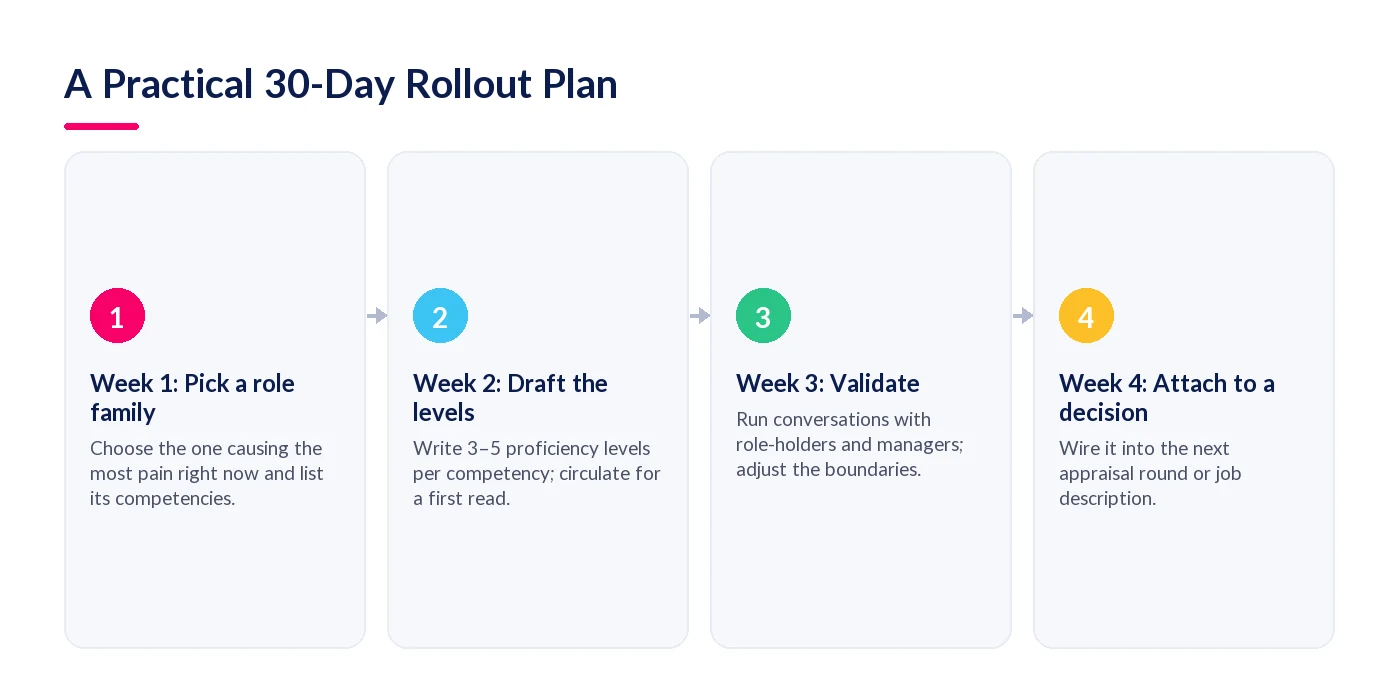
Writing a framework for the whole organisation at once is how most attempts stall. A tighter rollout for one role family works better:
- Week 1: Pick one role family causing the most pain right now — usually the one with the highest turnover, the most inconsistent appraisal ratings, or a live compliance requirement. List its core and functional competencies.
- Week 2: Draft three to five proficiency levels per competency, using the observable-action test from the section above. Circulate to two or three managers for a first read.
- Week 3: Run validation conversations with role-holders and managers. Adjust boundaries where real people don't map cleanly onto a level.
- Week 4: Wire the finished framework into one live decision — the next round of appraisals, or the job description for the next open req in that role family — so it's tested against something real within a month, not filed away.
How StaffCircle Turns Competency Framework Examples Into Working Frameworks
StaffCircle's AI competency framework tool is built to remove the slowest part of everything above — the first draft — while keeping the structure sound enough to actually adapt and validate.
A Starting Framework in Minutes, Not Months
Instead of starting from a blank page, StaffCircle's AI identifies your base roles and enriches them with responsibilities, skills and company- and industry-specific context, generating proficiency levels and career pathways as a first draft you refine rather than build from zero.
One Record Per Person, Not a Filed PDF
Once a framework exists, it needs to attach to real people, not sit in a shared drive. Role-based competency requirements defined through the skills and development framework apply automatically to everyone holding that role, so an individual's proficiency level against each competency lives on their record alongside the evidence behind it.
Gaps Surfaced Automatically
Skills gaps and missing role coverage are highlighted directly, rather than requiring a separate audit exercise — so you can see where a team is under-levelled on a competency before it becomes a delivery or compliance problem. Our guide to running skills audits covers how to turn that gap analysis into a remediation plan.
A Framework That Moves With the Role
As roles and required skills evolve, the framework adapts rather than sitting frozen at its first-draft version — directly addressing the "written once, never revisited" failure mode above. And because Success Circles builds bench-strength and succession views from everyday signals against these same competencies, the framework stays connected to the decisions — promotion, succession, pay progression — it's supposed to inform. See our guide on connecting competency frameworks to succession planning for more on that link.
Final Thoughts
The best competency framework examples aren't the ones with the most polished PDF design — they're the ones where a level boundary is written specifically enough that two different managers would rate the same person the same way. Borrow the structural pattern from Success Profiles and SFIA (same behaviour, widening scope or responsibility per level), write your own levels as observable actions rather than adjectives, and connect the finished framework to at least one real decision within the first month.
If you'd rather not start from a blank page, book a demo to see how StaffCircle generates a company-specific competency framework in minutes and keeps it attached to real evidence as roles change.
FAQ
What is a competency framework example?
A competency framework example is a worked illustration of one competency written out across its proficiency levels — for instance, "Communication" defined at four levels from following a set script to coaching others through complex conversations. A good example shows the actual behavioural wording at each level, not just the competency's name.
What are examples of behavioural competencies?
Common behavioural (core) competencies include communication, collaboration, adaptability, accountability, initiative and problem-solving. These apply across most roles in an organisation, unlike functional competencies, which are specific to a role family such as consultative selling or database administration.
What are examples of technical competencies?
Technical competencies are role-specific hard skills such as software development, data analysis, database administration or technical writing. Frameworks like SFIA separate the technical skill itself from a set of generic responsibility levels (autonomy, influence, complexity) that apply across every technical skill in the framework.
What are proficiency levels in a competency framework?
Proficiency levels describe how deeply someone demonstrates a competency, typically across three to five stages — for example Foundation, Capable, Proficient and Expert. Each level should describe a genuinely different observable behaviour, not a more enthusiastic version of the same one.
How do you write competency framework examples?
Write each level as a specific, observable action using a clear verb — "diagnoses the root cause" rather than "has strong analytical skills." Fix the number of levels before drafting, and make sure each level widens the scope of responsibility rather than introducing an unrelated new skill.
How many competencies should be in a framework?
Most individual-contributor roles work well with 8–12 competencies in total: a handful of core competencies shared across the organisation, plus three to five functional ones specific to the role. Frameworks with 20 or more competencies per role are rarely used consistently in practice.
How do you write competency level descriptors?
A good level descriptor names a specific action a person can be observed doing, not a trait they possess. If two managers could reasonably disagree on whether a colleague meets a descriptor, it needs rewriting to be more concrete.
What is the difference between a competency framework and a job description?
A job description lists the duties and tasks a role covers. A competency framework describes the standard of behaviour and skill behind how those duties get done, applied consistently across every role it covers — and, unlike a job description, it's written across multiple proficiency levels.
What is the difference between a competency framework and a skills framework?
A skills framework typically tracks discrete, measurable abilities — can this person use this tool or technique. A competency framework is broader, combining skills, knowledge and observable behaviour into a rounded performance standard, often including softer behavioural competencies alongside technical ones.
Is a competency framework the same as a job profile?
No. The competency framework is the organisation-wide structure of competencies and levels. A job profile (or competency profile) applies the relevant subset of that framework to one specific role, selecting which competencies matter and at what level.
What does a competency framework example for managers look like?
Manager-level frameworks typically add leadership-specific competencies on top of core ones: strategic thinking, delegation, change management and coaching direct reports through performance conversations. The Civil Service Success Profiles framework shows this well — the same behaviour, such as "Delivering at Pace," is written with a materially wider scope of accountability at manager and director grades than at entry grades.
What is a competency framework example for customer service?
A typical customer service competency framework centres on a competency like "Customer Problem Resolution," moving from following a defined process for common issues at the foundation level, through independent resolution, to diagnosing root causes behind recurring complaints and eventually coaching others through complex or escalated cases.
How do I know if my competency framework is actually being used?
Check whether it's wired into a real decision — hiring criteria, appraisal ratings, pay progression or succession planning — rather than sitting as a standalone document. A framework nobody consults when making these decisions has, in practice, stopped being used regardless of how recently it was written.
Related articles
See StaffCircle in action
Book a personalised demo and see how StaffCircle drives performance, engagement and development.