Signs Poor One-to-Ones Are Hurting Engagement
Your engagement survey will not tell you that one-to-ones are failing. It will tell you nine months later, after the damage has turned into a resignation, when the number for one department drops and everybody in the room starts guessing why.
That is not a criticism of surveys. It is what a lagging indicator does. The conversations between managers and their people are the leading indicator, and the frustrating thing for HR is that they happen behind closed doors, forty managers at a time, with no natural way to see them. Except that poor one-to-ones leave marks. They show up in calendars, in notes that were never written, in actions that were never carried forward, and in a particular kind of silence. This post is about reading those marks early.

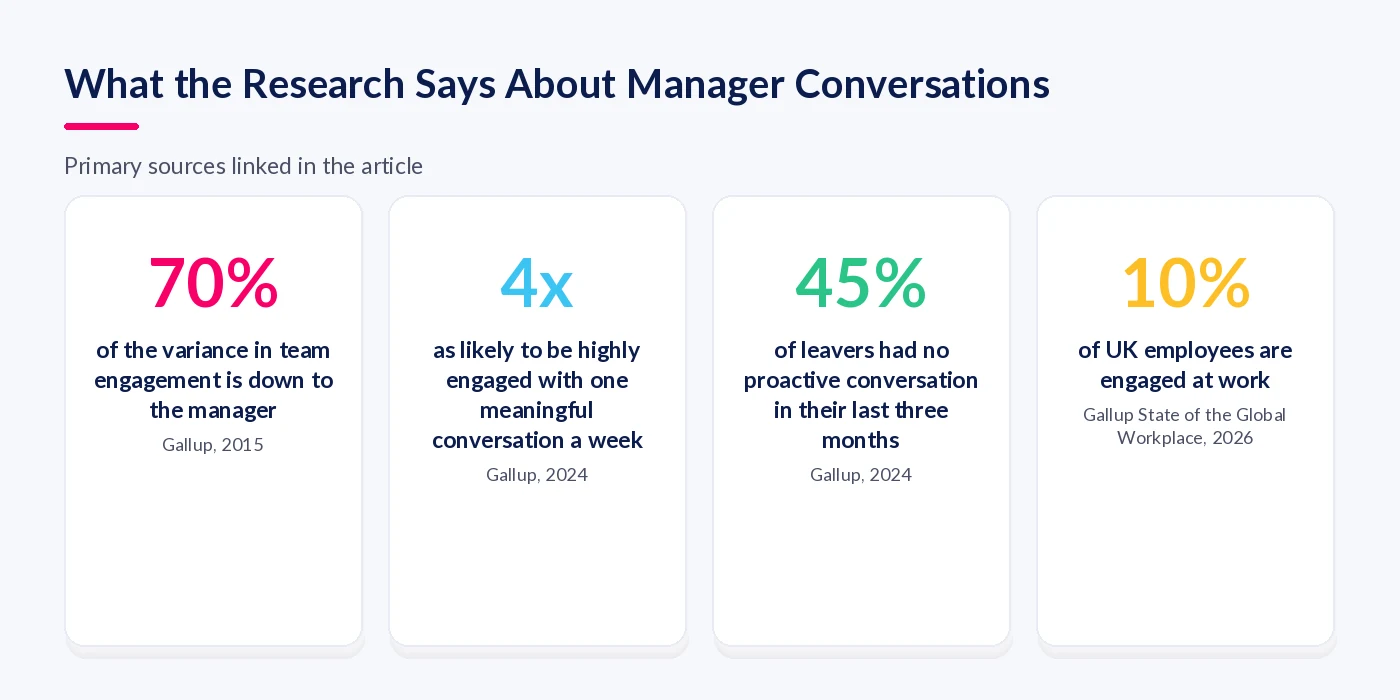
Poor one-to-ones hurt employee engagement because the manager is the single largest influence on how engaged a team is, and the one-to-one is where most of that influence is exercised or wasted. Gallup's research puts at least 70% of the variance in team engagement down to the manager, and finds that employees whose managers hold regular meetings with them are almost three times as likely to be engaged. When the meetings are cancelled, turned into status reports, or held without any record or follow-through, the effect runs the other way, and it runs quietly.
Why the Survey Is the Last Place It Shows Up
The UK starts from a low base. Gallup's 2026 country data puts UK employee engagement at 10%, half the global figure of 20% and below the European average of 12%. Against that backdrop, a poor one-to-one is not a neutral event. It is one of the few regular contacts with the organisation that a disengaged employee has, and it is confirming their view.
Managers cannot be relied on to notice. Steven Rogelberg, who has studied one-to-ones more closely than anyone, finds that nearly half are rated suboptimal by employees while managers overestimate how well they go. The CIPD's Good Work Index 2026 adds the consequence: people with worse managers or poorer workplace relationships are much more likely to say they want to quit, and its earlier analysis of UK Working Lives data found 45% of those with a very poor relationship with their line manager expected to leave within a year, against 14% of those with a very good one.
There is a further reason to look at the one-to-one specifically. The CIPD's Good Work Index 2025 found that one-to-one meetings with the line manager are the most widely used employee voice channel in the UK, reported by 66% of employees, ahead of team meetings and surveys. It also estimated that around 10 million UK employees do not believe they receive useful feedback from their manager or that their manager helps them improve. For most people the one-to-one is not one channel among many. It is the channel, and when it is poor there is often nothing behind it.
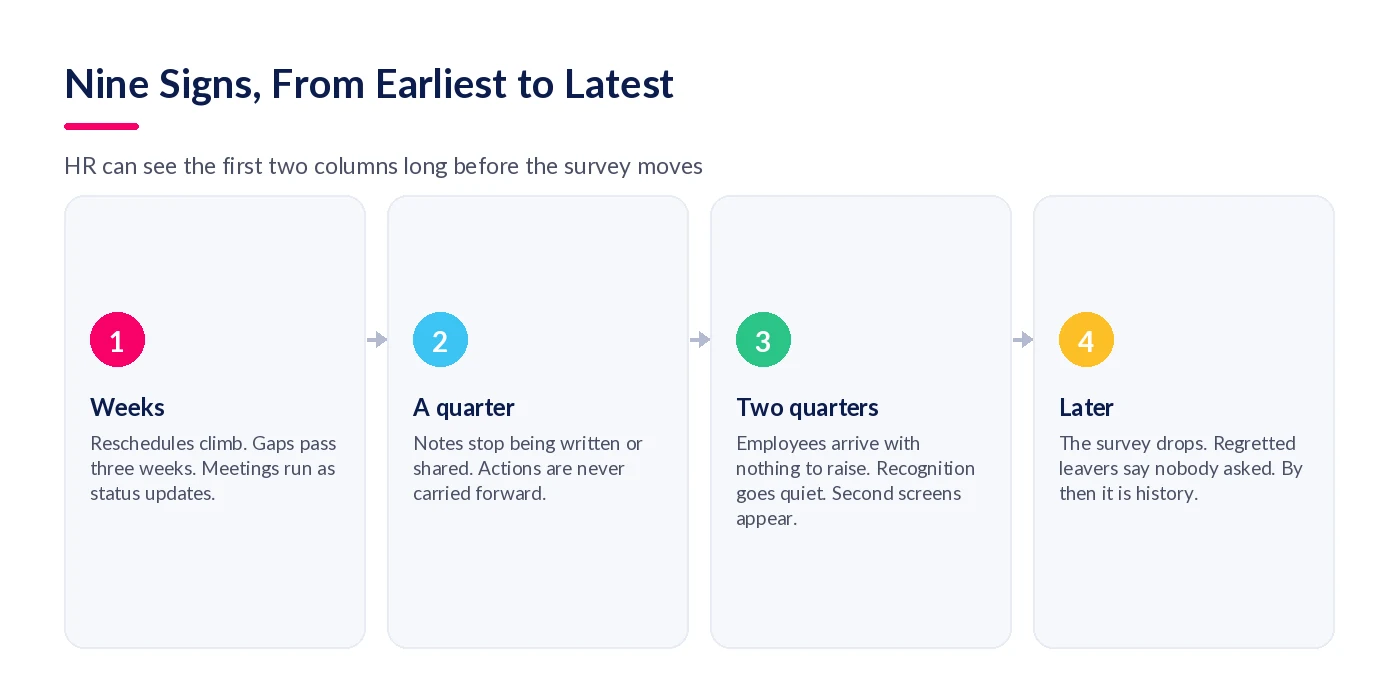
So HR needs signals that arrive before the survey and do not depend on the manager's self-assessment. Here are nine, in roughly the order they become visible.
Nine Signs, Ranked by How Early You Can See Them
1. The reschedule rate is climbing
The earliest and most measurable sign. A one-to-one moved once is life. A one-to-one that moves most weeks, or is cancelled more often than it is held, tells the employee exactly where they rank. Lighthouse's long-running writing on bad managers puts cancelling ahead of every other failure, and the reason is simple: the meeting is the only visible evidence that the manager's attention exists. Pull the data from calendars or from your performance platform and rank managers by the proportion of scheduled one-to-ones that actually happened.
2. Gaps are passing three weeks
When Microsoft's workplace analytics team matched calendar data to engagement surveys across two Fortune 100 companies, the average manager spent 30 minutes every three weeks with each report. Employees who had little or no one-to-one time were more likely to be disengaged; those who had twice the one-to-one time of their peers were 67% less likely to be; and employees whose manager never met them one-to-one at all were four times as likely to be disengaged. Three weeks is the average, not the target. Treat it as the point at which a gap becomes a pattern.
3. Every one-to-one is a status update
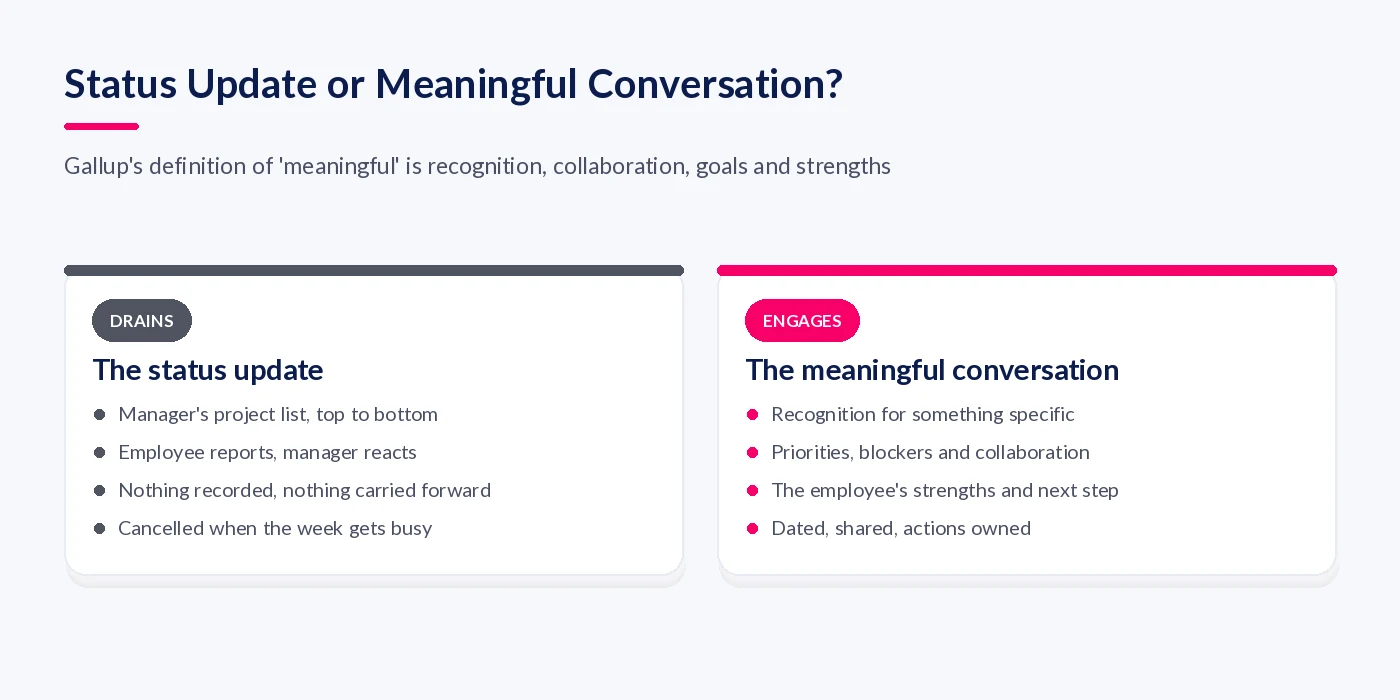
Ask managers what they covered and listen for project names. Gallup's definition of a meaningful conversation is recognition, collaboration, goals and priorities, and the employee's strengths. In its survey of around 15,000 employees, only 16% said their last conversation with their manager was extremely meaningful. A status update is the manager's agenda run against the employee's time, and it is the commonest way a regular meeting produces no engagement at all.
4. Notes are not written, or not shared
Acas expects a written record of what is discussed, shared with the employee afterwards. Beyond the compliance point, a one-to-one with no shared note is a one-to-one the employee cannot hold the manager to. If your platform shows a meeting as held but the record is blank, that is the sign. If notes live in a manager's private notebook, HR will not see this one until a subject access request arrives.
5. Nothing is carried forward
The action from last time is the test of whether the conversation mattered. When actions are not recorded, or are recorded and never revisited, employees learn that raising something changes nothing. Look for meetings with actions set and no actions closed, over two or three cycles.
6. The employee arrives with nothing to raise
Jen Dary's five signs in Harvard Business Review include not being able to fill the time. Managers often read this as a good sign: no problems. It is usually the opposite. It means the employee has stopped bringing things, either because they were not acted on or because the meeting has become the manager's. A one-to-one should be the employee's meeting, and an empty agenda from their side is a withdrawal.
7. Recognition has gone quiet
Gallup's Q12 asks whether the employee received recognition or praise in the last seven days, and only 23% of employees strongly agree they get the right amount. Recognition is one of the four elements of a meaningful conversation, and it is the first thing to disappear when one-to-ones become status reports. If your platform records recognition, look for managers whose teams have had none in a month.
8. The second screen
Also from Dary: one or both people on another screen. It is hard to measure and easy to see. Where you run one-to-ones over Teams, the signal is cameras off and answers that lag. Where they happen in person, ask employees directly in a pulse: "My manager gives me their full attention in our one-to-ones." The answer will surprise some managers.
9. Leavers say nobody asked
The last sign, and the one that arrives too late to help the person giving it. Gallup found that 45% of people who left their job voluntarily had no proactive conversation with a manager or leader about their satisfaction, performance or future in the three months before they went, and that 42% said their organisation could have done something to keep them. Add one question to every exit interview: when did you last have a one-to-one that was about you? The answers, aggregated by manager, are the clearest evidence you will get.
The Manager Who Is Disengaged Too
Before blaming forty managers, look at their own numbers. Gallup's 2026 global report found manager engagement fell from 27% to 22% in a single year, nine points below its 2022 level, while in organisations that follow its best practices 79% of managers were engaged, nearly four times the global average. Microsoft's 2022 Work Trend Index found 74% of managers saying they did not have the influence or resources to make change for their teams. A manager who is stretched, unsupported and quietly disengaged does not stop caring about their people. They stop having the capacity to show it, and the one-to-one is the first thing to go.
That reframes several of the signs. A rising reschedule rate is often a workload signal about the manager as much as a neglect signal about the employee. A status-update meeting is frequently a manager who has never been shown what else the meeting is for; the CIPD's performance management guidance is explicit that managers "need to be suitably skilled to do this and in turn need to be supported by HR practices and processes that are fit for purpose". The response to the nine signs, in other words, is usually support and structure rather than a difficult conversation with the manager.
What the Patterns Cost
We have kept the maths out of this post deliberately; the complete guide to one-to-one check-in ROI walks through turnover, absence and productivity with UK sources, and the ROI calculator will do it for your headcount. The short version is that the cost is mostly turnover you did not need to have. The CIPD's 2024 resourcing survey puts the median cost of recruiting a replacement at £1,500, or £2,000 for a senior manager, and that is before the lost output Gallup estimates at 40% to 200% of salary depending on the role. The people most likely to go are the ones the CIPD describes: those with worse managers and poorer relationships. Regretted attrition, broken down by manager, is the number that makes a board listen.
Reading the Signs Across Forty Managers
None of the nine signs is hard to see for one manager. The HR problem is seeing them across forty, and doing it without turning into a surveillance function. Four sources do most of the work.
Cadence data from your performance platform or calendars gives you signs one, two, four and five directly: scheduled versus held, days since last one-to-one, meetings with no note, actions set and not closed. A short quarterly pulse with three items covering attention, recognition and "my manager talks to me about my progress" gives you signs three, seven and eight from the employee's side, which is the side that matters. Exit interviews with the one added question give you sign nine. And the engagement index by team confirms, late, what the other three told you early. Our guide to one-to-one meeting software for HR teams explains which platforms surface this and which keep it locked in a manager's private notes.

Turning It Around Without a Manager Training Programme
The instinct is to send every manager on a course. The evidence points to something smaller. Gallup's recommendation, repeated in its 2026 manager development work, is one meaningful conversation a week with each person, 15 to 30 minutes, and it notes that employees who get daily feedback are three times more likely to be engaged than those who get it annually. Four moves make that habit stick.
First, put the employee's agenda first in the template, so the meeting cannot become a status update by default. Second, make the note and the actions shared and visible, so that carrying things forward is the path of least resistance. Third, give managers the cadence data about themselves before HR sees it; most will fix a three-week gap the moment they notice it. Fourth, ask the exit-interview question and feed the answers back by team. Managers who need more than that will show up in the data, and the feedback skills work can go to them rather than to everyone.
A fifth move is about the manager's own diary. If a manager has twelve reports and a fortnightly cadence, that is six half-hour conversations a week, three hours, before any preparation. Where the reschedule rate is high, the honest question is whether the manager has the span of control to hold the cadence at all. Reducing the number of reports, or moving some to a monthly rhythm with a weekly ten-minute check-in in between, is often a better fix than another reminder. The point is to make the habit possible before asking for it.
Here is a composite of how this tends to play out, drawn from the pattern rather than any one client. Picture a 300-person professional services firm whose engagement survey has dropped four points in one division. The cadence data showed two managers in that division averaging one recorded one-to-one every seven weeks, against a company norm of every two. Neither manager was aware of the gap; both had absorbed extra reports after a restructure. Rebalancing the teams and switching the template so actions and the employee's items came first took a month. The next pulse recovered before the annual survey ran. Nobody went on a course.
Where StaffCircle Fits
StaffCircle was built for HR teams who need to see the cadence across the organisation and for managers who need a one-to-one they can run from a phone. Three things address the signs above directly.
The cadence is visible
One-to-ones are scheduled and recorded on the employee's record alongside objectives, feedback and recognition, and reporting shows which check-ins are complete and which are overdue by manager and team, so signs one, two, four and five are on a dashboard rather than in a manager's memory.
The template does the work
Best-practice templates put actions carried forward and the employee's items ahead of the manager's, and feedback and recognition are dated entries, so a status update is harder to run than a meaningful conversation.
The record exists even when nobody types
Notetaker records a spoken one-to-one, summarises key points, decisions, actions and sentiment, aligns it to the right record and shares the summary with attendees. That closes sign four for managers who never sit at a keyboard, and gives HR a consistent, searchable record across the organisation. Pulse surveys, eNPS and sentiment in the Engagement module supply the employee's side.
Final Thoughts
The one-to-one is where engagement is made or lost, one manager and one employee at a time, and it is the part of the organisation HR sees least. The nine signs above are visible weeks or months before the survey moves, and most of them can be read from data you already hold. Start with reschedules and gaps, add three pulse items and one exit question, and give managers their own numbers first. Book a demo to see how StaffCircle makes the cadence, the record and the recognition visible across every team.
FAQ
What are the signs your one-to-ones aren't working?
The earliest are a rising reschedule rate and gaps of more than three weeks between meetings. Then meetings that run as status updates, notes that are never written or shared, actions never carried forward, employees who arrive with nothing to raise, no recognition, and people on a second screen. The last sign is leavers saying nobody talked to them about their future before they went.
What makes a bad one-to-one meeting?
A bad one-to-one is the manager's agenda run against the employee's time: a project status update with no recognition, no discussion of priorities or strengths, no record and no follow-through. Gallup found only 16% of employees rated their last conversation with their manager as extremely meaningful.
What should a manager not do in a one-to-one?
Cancel it repeatedly, turn it into a status report, do most of the talking, look at another screen, skip the actions from last time, or leave without a shared note. Each of those signals to the employee that the meeting, and by extension they, are not a priority.
Why do employees dread one-to-ones?
Usually because past meetings changed nothing: things they raised were not acted on, the conversation was about the manager's project list, or the meeting felt like an inspection. Steven Rogelberg's research finds nearly half of one-to-ones are rated suboptimal by employees while managers think they went well.
Is it OK to cancel a one-to-one?
Occasionally, if it is rescheduled rather than dropped. The problem is the pattern. When a one-to-one is cancelled more often than it is held, the employee reads it as evidence of where they rank, and HR should treat the reschedule rate by manager as an early engagement signal.
Why are one-to-ones important for employee engagement?
Because the manager accounts for at least 70% of the variance in team engagement, according to Gallup, and the one-to-one is where most of that influence is exercised. Employees whose managers hold regular meetings with them are almost three times as likely to be engaged, and one meaningful conversation a week makes them four times as likely to be highly engaged.
What happens if a manager never has one-to-ones?
Microsoft's analysis of calendar and survey data at two Fortune 100 companies found employees whose manager never met them one-to-one were four times as likely to be disengaged as individual contributors overall, and twice as likely to view leadership unfavourably.
Should a one-to-one be a status update?
No. Status can be handled asynchronously in a check-in or an objective update. The one-to-one should cover recognition, priorities, blockers, collaboration and the employee's development, which is what Gallup's research identifies as making a conversation meaningful.
How do you know if a one-to-one is working?
From the employee's side, not the manager's. Ask in a short pulse whether the manager gives full attention, whether they received recognition recently and whether someone has talked to them about their progress. From the data side, check that meetings are held on schedule, notes are shared and actions from last time are closed.
How do managers know how their one-to-ones are landing?
Mostly they do not, which is the blind spot Rogelberg documents. Giving managers their own cadence data, plus anonymised pulse feedback from their team on attention and recognition, is the fastest way to close it.
What is a meaningful conversation according to Gallup?
One that covers recognition, collaboration, goals and priorities, and the employee's strengths, held once a week for 15 to 30 minutes. Gallup finds this single habit develops high-performance relationships more than any other leadership activity.
How much of team engagement comes down to the manager?
Gallup's estimate is at least 70% of the variance in team engagement. The CIPD's UK analysis points the same way: 45% of employees with a very poor relationship with their line manager expected to quit within a year, against 14% of those with a very good one.
Related articles
See StaffCircle in action
Book a personalised demo and see how StaffCircle drives performance, engagement and development.