Best One-to-One Meeting Software for HR Teams
Ask a line manager what one-to-one meeting software is for and you will hear about agendas, talking points and not forgetting what was said last time. Ask an HR director the same question and you get a different answer entirely: are the one-to-ones actually happening, what was discussed when a capability case lands on my desk, and can I produce the notes inside a month if the employee asks for them?
Almost every "best one-to-one software" list on the internet answers the manager's question. We read the eight that rank for the term in September 2026. Between them they recommend Fellow, Lattice, Leapsome, Spinach, Teamflect and a handful of others, mostly on the strength of their AI agenda builders. Not one of them mentions UK GDPR, a subject access request, a tribunal, a frontline worker without a laptop, or a single UK vendor. This post answers the HR director's question instead.

One-to-one meeting software, for an HR team, is a platform that schedules and structures regular manager and employee check-ins, records what was discussed on the employee's central record alongside their objectives and reviews, shows HR which conversations are happening and which are not, and does all of that within UK data protection rules. A tool that only helps one manager run a better meeting is a productivity app. Useful, but not the thing you are buying when the engagement survey drops and the tribunal claim arrives in the same quarter.
Two Buyers, Two Different Products
The confusion in this market comes from two products sharing one name. Manager meeting tools such as Fellow, Spinach and the meeting features in Notion or Teams are bought by individuals or teams, hold notes privately between two people, and stop at the end of the meeting. They are excellent at what they do. HR one-to-one platforms treat the conversation as one event on a person's record: the objectives it referenced, the feedback it produced, the actions it set, the review it will feed and, if it comes to it, the capability process it evidences.
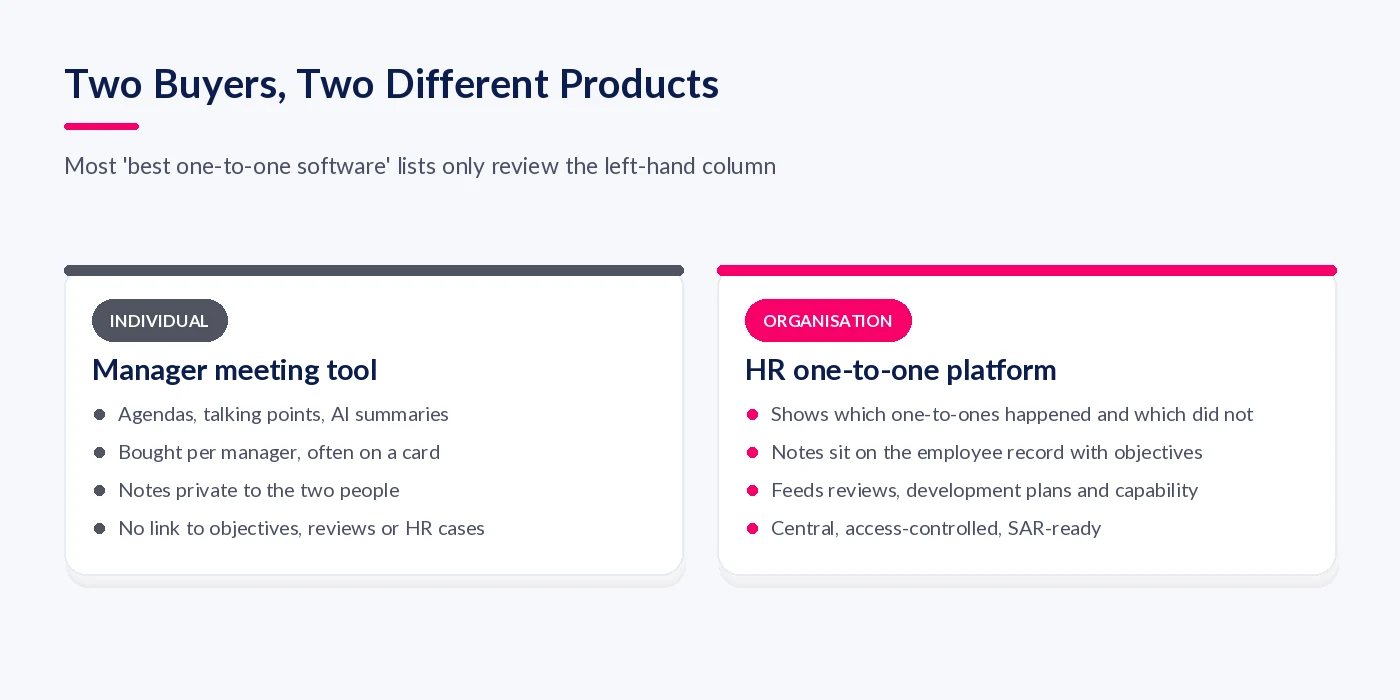
Why does the distinction matter so much? Because the value of a one-to-one to the organisation is mostly in its regularity and its record, and neither is visible from inside a private notes app. Gallup's finding, repeated across a decade of its research, is that one meaningful conversation a week with each direct report makes employees four times as likely to be highly engaged, "regardless of whether they are a frontline, hybrid or fully remote worker". The same research found that 42% of people who left their job in the previous year said their manager or organisation could have done something to prevent it, and 45% had no proactive conversation about their satisfaction or future in their last three months. HR cannot act on any of that unless it can see the cadence.
What HR Needs a One-to-One Tool to Prove
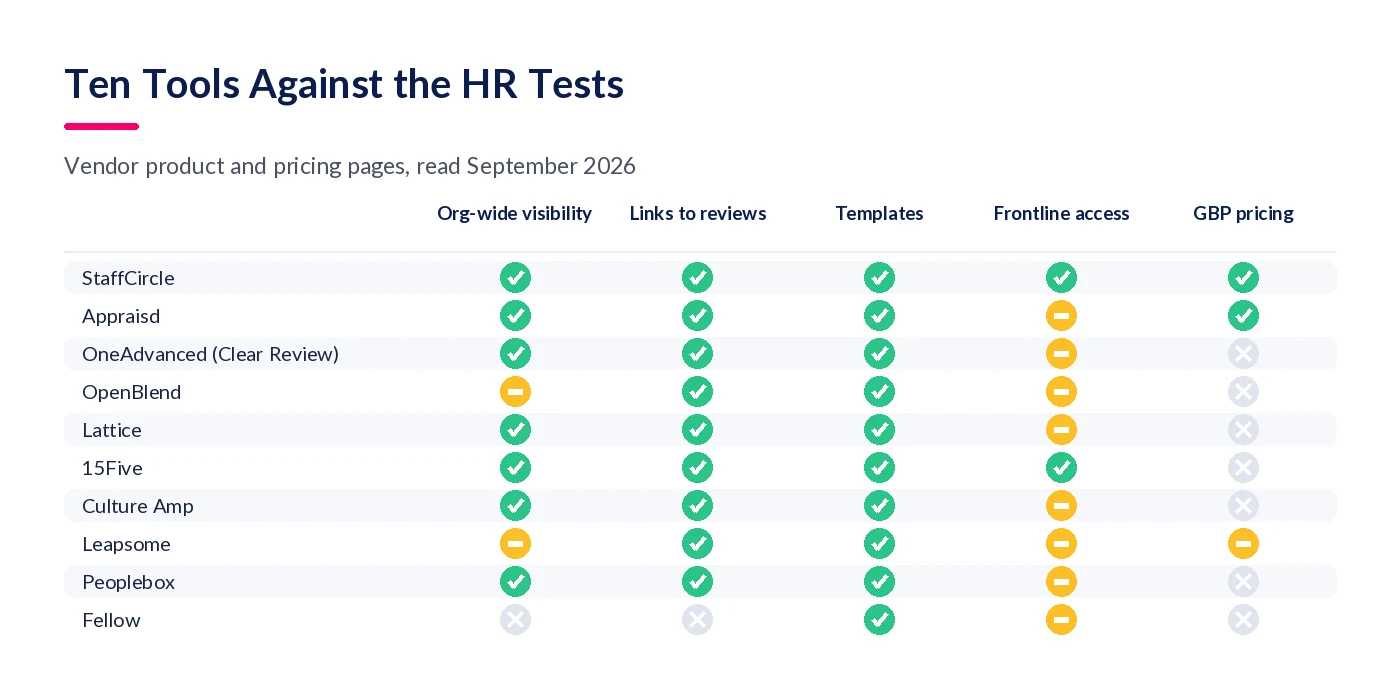
We scored the shortlist below against five things, each of which comes from a real HR problem rather than a feature list.
1. That the conversations are happening
Organisation-wide visibility of check-in frequency by manager and department, with gaps flagged. This is the criterion almost every listicle skips and the one that separates the two product types. Culture Amp publishes a one-to-one usage report; 15Five gives a "global viewer" sight of every agenda; Frankli, Peoplebox and Small Improvements all say HR can see which managers are meeting their people. Fellow, by design, does not.
2. That notes sit on the same record as objectives and reviews
A one-to-one that references an objective should update the objective. A development point raised in March should be in the review in June without anyone retyping it. This is what turns twelve small conversations into a fair, evidenced review, as we describe in the guide to the continuous performance management cycle.
3. That the record would stand up in a capability case
Acas is unambiguous: "It's important to keep a written record of what is discussed. This should be shared with the employee afterwards." Its guidance on performance problems adds that employers should keep a record of any conversation about performance and try to help someone improve before any formal step. A tribunal in January 2025, Briggs v The Trustees of the National Museums of Scotland, is instructive in the other direction. The employer had held weekly one-to-ones and three improvement plans and could evidence them, and still lost, with £22,210 awarded, because the formal warning step in its own policy was skipped. Documented one-to-ones are necessary. A tool that also connects them to the formal process is what makes them sufficient.
4. That it is built for UK GDPR, not retrofitted
The ICO lists appraisal and performance review records among employment records, warns that consent is a weak lawful basis because of the power imbalance between employer and worker, and says records should be stored centrally rather than locally "so you are not dependent on the availability of individual managers for access". Its guidance on subject access requests gives "Can I have a copy of the notes from my last appraisal?" as an example of a valid request, with one month to respond. Notes in a manager's personal OneNote fail every one of those tests.
5. That every employee can take part, including the ones without a laptop
Lattice's mobile app handles one-to-ones but relationships are set up on desktop; Leapsome has no native app and suggests a browser shortcut; Teamflect and Zensai live inside Microsoft 365, so every participant needs a licence. For a warehouse, a ward or a site, that is the first filter, and we cover it in depth in our review of continuous feedback software for frontline teams.
The Shortlist: Ten Tools Scored
Facts and prices below are from each vendor's own pages as read in September 2026. Third-party listicles routinely quote out-of-date prices, so we have linked the source each time.
StaffCircle (UK)
One-to-ones sit in the same performance management module as objectives, reviews, feedback and development plans, with best-practice templates and check-in scheduling, so every conversation lands on the employee's record and the next one is already in the diary. Reporting shows which check-ins are complete and which are overdue across the organisation. The optional Notetaker records and summarises a one-to-one, maps it to the right record and shares the summary with attendees. Installs as a home-screen web app with SSO and no Office 365 licence, and runs inside Teams. Priced in pounds, from £3.85 per employee per month billed annually, with no per-user AI licensing. Certified to ISO/IEC 27001:2022 and ISO/IEC 42001:2023. Disclosure: it is our product; judge it against the customer stories rather than this paragraph.
Appraisd (UK)
Manager check-ins and coaching conversations alongside objectives, reviews and 360s, an AI notetaker that produces editable structured notes from check-ins, and reports on trends in ratings and completion. Pricing is published: a £3,600 annual minimum for the first 50 employees, then £6, £4 and £3 per employee per month by band, with UK hosting as standard. Web-based; mobile is not described on the pages we read.
OneAdvanced Performance & Talent, formerly Clear Review (UK)
Built around "adult-to-adult" conversations and monthly check-ins, with organisation-wide insight into goal setting, feedback and conversations, and a UK-based support team. Works in any modern browser on any device. Pricing is quote-only.
OpenBlend (UK)
A coaching-led framework for one-to-ones that puts wellbeing and motivation alongside performance, and promises "data to spot disengagement early". Customers include Gymshark and Network Rail. Based in Maidenhead; pricing on request.
Lattice (US)
Collaborative agendas, cadence controls, action tracking and a full history of past meetings, plus an AI agent for notes, summaries and coaching. One-to-ones are bundled with the Performance, Goals and Engagement products at $10, $8 and $4 per seat per month, billed annually in US dollars only, with a $4,000 minimum agreement. Admin analytics show meeting frequency and participation rate.
15Five (US)
A shared one-to-one workspace where both parties add talking points, with a private notes section, a talking-point bank and weekly check-in items that flow into the agenda. HR can see one-to-one agendas company-wide. Perform is $11 per user per month billed annually; the Kona meeting assistant adds $2 per employee and Kona Coach $19 per manager per month. Native iOS and Android apps. Our 15Five comparison goes further.
Culture Amp (AU/US)
Shared agendas, check-in questions that push past status updates, and the usage report mentioned above showing the percentage of active conversations by department and manager. One-to-ones link to goals and 360 feedback. Pricing is quote-only, billed annually; mobile support for one-to-ones is not confirmed on the vendor's pages.
Leapsome (DE)
Ready-made or custom templates, objectives displayed alongside the agenda, instant feedback turned into talking points, and an AI assistant that transcribes with built-in consent. Meetings are included with every Leapsome contract, priced in EUR, GBP or USD on a one-year minimum. No native app.
Peoplebox (US)
Both sides add talking points, OKR progress loads automatically, each party has private notes, and HR sees one-to-one activity across the organisation. Native Slack and Teams. $8 per employee per month billed annually for the performance module that includes one-to-ones.
Fellow (CA)
The best pure meeting tool on most lists, with 500-plus templates, AI talking points and notes that stay private between manager and report. That privacy is the point and also the limitation: there is no link to reviews or objectives and no organisation-level view. Free tier, then $7 to $25 per user per month. A good choice for a manager, not for HR.
| Tool | HR sees cadence? | Notes on employee record | Access | Published pricing |
|---|---|---|---|---|
| StaffCircle | Yes, completion and overdue reporting | Yes, with objectives, reviews, development | Web app, SSO, no Office 365 licence; Teams | From £3.85 per employee per month, annual |
| Appraisd | Yes, trend and completion reports | Yes | Web-based | £3,600 a year minimum; £3 to £6 per employee per month |
| OneAdvanced Performance & Talent | Yes, organisation-wide insight | Yes | Any browser, any device | Quote only |
| OpenBlend | Partial (disengagement signals) | Yes | Not stated | Quote only |
| Lattice | Yes, 1:1 analytics | Yes | Native app; set-up on desktop | USD $10 per seat per month, $4,000 minimum |
| 15Five | Yes, global viewer | Yes | Native iOS and Android | USD $11 per user per month plus AI add-ons |
| Culture Amp | Yes, usage report | Yes | Mobile not confirmed | Quote only |
| Leapsome | Partial | Yes | Browser shortcut | EUR/GBP/USD, one-year minimum |
| Peoplebox | Yes | Yes | Slack and Teams native | USD $8 per employee per month |
| Fellow | No | No | Web and mobile | Free to USD $25 per user per month |
The Template Question, Answered Once
Every tool above ships one-on-one meeting templates, and every list ranks them by how many. The number is irrelevant. What matters is whether the template enforces five things in the right order, because the order is what stops a one-to-one collapsing into a status update.
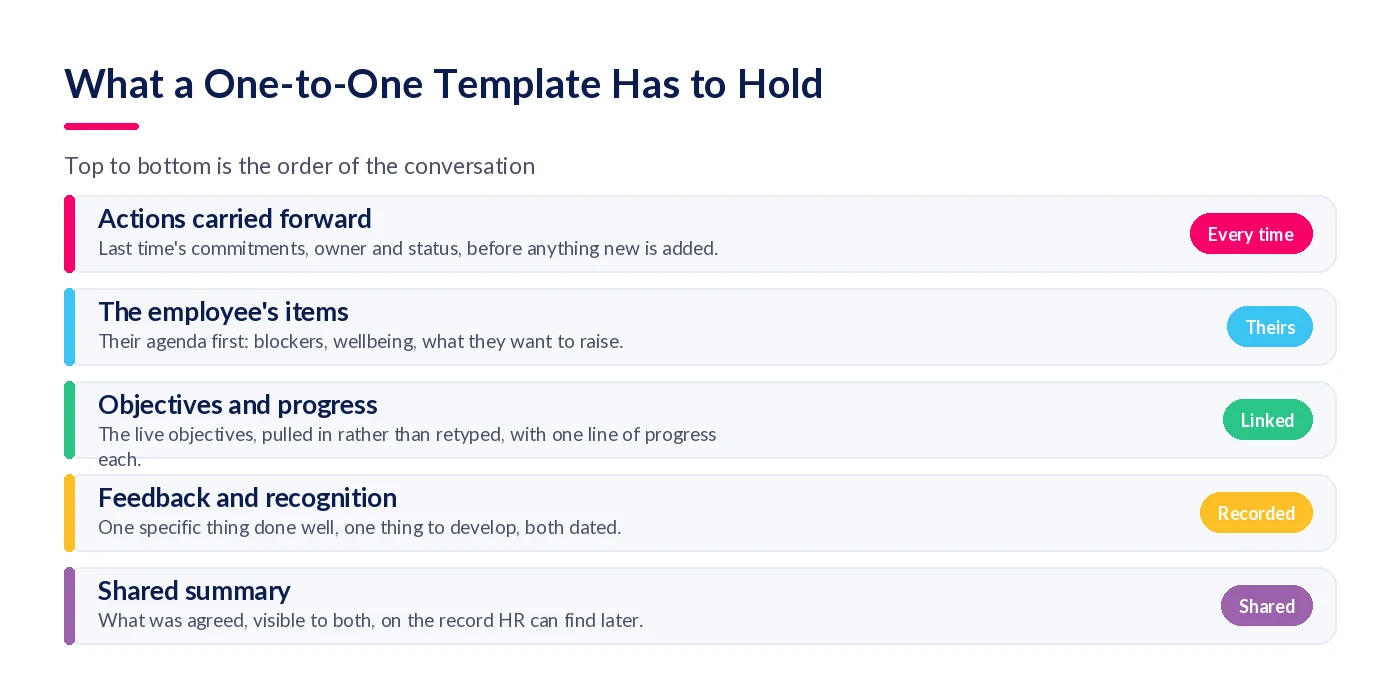
Actions from last time come first, so nothing agreed is quietly dropped. The employee's items come before the manager's, because the research on what makes a conversation meaningful points to recognition, collaboration, priorities and strengths rather than the manager's project list. Objectives are pulled in live, not retyped. Feedback and recognition are dated, because a dated entry is evidence and an undated one is a memory. And the summary is shared with both parties, which is the Acas standard and the thing that makes the record defensible. If you want a starting set of prompts, our check-in questions and the complete guide to one-to-ones cover the conversation itself; this post is about the system around it.
Notes, Notetakers and the ICO
AI notetaking is the feature every vendor now leads with, and it deserves an HR-grade look rather than a demo. Lattice's agent summarises and coaches; 15Five's Kona is priced per employee and per manager; Leapsome and Appraisd both stress consent and editable output; Fellow keeps recordings private to the pair; Spinach promises never to train on your data. StaffCircle's Notetaker aligns each recording to the right one-to-one or review and shares a summary with attendees, under an ISO/IEC 42001 certified AI management system.
Three points from the regulator frame the decision. The ICO says consent "is not usually appropriate in the employment context, due to the imbalance of power", so the lawful basis for recording one-to-ones will usually be legitimate interests, documented in an impact assessment, with a visible notice at the start of the meeting. It says monitoring "conducted without transparency is unfair", and lists hidden audio recording among monitoring technologies, so silent recording is out. And it expects employers to keep records accurate and to consider challenges to accuracy, which means a human reads the transcript before it becomes the record. There is no ICO guidance specific to AI notetakers yet; the general rules already answer most questions. Choose a tool whose summary the employee can see and correct, and whose AI is not billed per head, and you have most of the governance built in.

Where StaffCircle Fits
We built StaffCircle for organisations of roughly 50 to 1,000 people where HR needs the organisation-level view and managers need something they will actually open. Four things follow from that.
The one-to-one is an event on the record, not a document
Objectives, feedback, recognition, development actions and review ratings all live on the same person's timeline, so a one-to-one reads from and writes to the rest of the cycle without re-keying.
HR can see the cadence
Scheduling and completion reporting show which check-ins have happened and which are overdue, by manager and team, so the pattern behind a falling engagement score is visible before the survey confirms it. Our post on the signs poor one-to-ones are hurting engagement lists what to look for.
Everyone can join, on any device
The home-screen web app needs no app store and no Office 365 licence, and the platform also runs inside Teams, so a mixed desk and frontline workforce is on one system at one price.
The record protects both parties
Summaries are shared with the employee, Notetaker turns spoken conversations into consistent, searchable records, and everything is held centrally under ISO/IEC 27001 controls, which is what the ICO's guidance on employment records asks for. To see what regular, recorded one-to-ones are worth in your numbers, the ROI calculator models engagement, turnover and manager time for your headcount.
Final Thoughts
The best one-to-one meeting software for an HR team is the one that answers the HR director's questions: are the conversations happening, are they on the record with the objectives and the review, would the record survive a capability hearing or a subject access request, and can every employee take part. Manager meeting tools answer none of those and were never meant to. Score the shortlist against the five tests, insist on GBP pricing and UK hosting where it matters to you, and treat the AI notetaker as a data protection decision rather than a demo feature. Book a demo to see how StaffCircle runs one-to-ones, objectives and reviews on one record.
FAQ
What is one-to-one meeting software?
Software that schedules and structures regular manager and employee check-ins, records what was discussed, tracks actions between meetings and, in HR-grade platforms, links each conversation to the employee's objectives, reviews and development plan while giving HR visibility of which one-to-ones are happening.
What is the best one-to-one meeting tool for HR teams rather than individual managers?
For HR the best tools are performance platforms where one-to-ones sit on the employee record and cadence is visible organisation-wide: StaffCircle, Appraisd and OneAdvanced Performance & Talent in the UK, and Lattice, 15Five, Culture Amp and Peoplebox internationally. Manager tools such as Fellow are excellent for the meeting itself but give HR no view and no link to reviews.
How often should one-to-ones be held?
Gallup's research finds that one meaningful conversation a week with each direct report makes employees four times as likely to be highly engaged, and that when conversations are that frequent they can be as short as 15 to 30 minutes. Weekly or fortnightly suits most teams, weekly for new starters or people who are struggling, and monthly is the outer limit before engagement suffers.
How long should a one-to-one meeting last?
Around 30 minutes for a weekly or fortnightly one-to-one, and 45 to 60 minutes if you only meet monthly. Gallup found that frequent 15 to 30 minute conversations do more for engagement than less frequent hour-long ones.
Is a one-to-one a performance review?
No. A one-to-one is a regular, informal conversation about progress, blockers, wellbeing and development; a performance review is a formal, periodic assessment against objectives. The two should connect, so that the review draws on what the one-to-ones recorded, but Acas advises informal regular conversations alongside formal reviews, not instead of them.
What is the difference between a check-in and a one-to-one?
In most platforms a check-in is a short, often asynchronous update on work and objectives, sometimes answered in the app before the meeting, while a one-to-one is the live conversation between manager and employee. Good tools feed the check-in answers into the one-to-one agenda so the meeting starts from what the employee has already said.
What should a one-to-one meeting template include?
Five things in order: actions carried forward from last time, the employee's own items, the live objectives with a line of progress each, dated feedback and recognition, and a shared summary of what was agreed. The order matters because putting the employee's items before the manager's stops the meeting becoming a status report.
Should one-to-ones be documented, and who should see the notes?
Yes. Acas says it is important to keep a written record of what is discussed and to share it with the employee afterwards. The shared summary should be visible to both parties and held centrally; private manager notes should be kept separate, minimal and accurate, because they are still personal data the employee can request.
Can employees request their one-to-one notes?
Yes. The ICO gives 'Can I have a copy of the notes from my last appraisal?' as an example of a valid subject access request. Employers must respond within one month, extendable by two months for complex requests, and may redact information about other people.
Do one-to-one notes count as personal data under UK GDPR?
Yes. The ICO lists appraisal and performance review records among employment records, and one-to-one notes about an identifiable employee are personal data. They need a lawful basis, usually legitimate interests rather than consent, must be accurate and secure, and should be stored centrally with access limited to those who need it.
Can we use an AI notetaker in one-to-ones, and do we need consent?
You can, but the ICO says consent is not usually appropriate in employment because of the power imbalance, so rely on legitimate interests supported by a data protection impact assessment, tell people clearly at the start of each meeting that it is being recorded, never record covertly, and have a human check the transcript before it becomes the record.
How do you track that managers are actually holding one-to-ones?
Use a platform that reports check-in completion and frequency by manager and team, and treat gaps of more than three or four weeks as a signal. Culture Amp, Lattice, 15Five, Peoplebox, Appraisd and StaffCircle all offer some form of organisation-wide visibility; pure meeting tools such as Fellow do not.
What one-to-one software works for frontline or deskless staff without a laptop or Office 365 licence?
Look for a tool that runs on a personal or shared phone without a corporate identity. StaffCircle installs as a home-screen web app with SSO and no Office 365 licence; 15Five and Lattice have native apps but each employee needs a login; Teamflect and Zensai require Microsoft 365; Leapsome and PerformYard run in a browser only.
Related articles
See StaffCircle in action
Book a personalised demo and see how StaffCircle drives performance, engagement and development.